
R410A vs R454B Refrigerant: A–Z Guide
August 17, 2026
If you want to know r410a vs r454b refrigerant what you need to know before buying or servicing an AC system in South Florida, here is the short version:
• Global Warming Potential (GWP) — R-410A: 2,088 — R-454B: 466 (78% lower)
• Safety Classification — R-410A: A1 (non-flammable) — R-454B: A2L (mildly flammable)
• EPA Status (June 2026) — R-410A: Banned in new equipment since Jan 1, 2025 — R-454B: Required in all new residential systems
• Drop-in Replacement? — R-410A: - — R-454B: No — requires purpose-built equipment
• Energy Efficiency — R-410A: Baseline — R-454B: ~3–5% higher COP
• Operating Pressure — R-410A: Baseline (~274 psig at 90°F) — R-454B: ~5% higher (~288 psig at 90°F)
• Existing Systems — R-410A: Can still be serviced with reclaimed R-410A — R-454B: New installations only
The HVAC industry just went through one of its biggest shifts in decades. Starting January 1, 2025, manufacturers could no longer produce new residential AC equipment using R-410A — the refrigerant that has powered most home cooling systems for over 20 years. If you are shopping for a new AC system in Kendall, Pinecrest, Coral Gables, or anywhere else in South Florida right now, you are almost certainly looking at R-454B equipment whether you realize it or not.
This guide breaks down exactly what changed, what it means for your existing system, and what to look for when choosing a new one — so you can make a confident, informed decision without getting lost in the technical jargon.
The transition away from R-410A is not a sudden whim of AC manufacturers. It is part of a structured, global environmental initiative designed to reduce greenhouse gas emissions. The primary driver behind this shift is the Environmental Protection Agency (EPA) AIM (American Innovation and Manufacturing) Act of 2020.
Under the AIM Act, the EPA is phasing down the production and import of hydrofluorocarbons (HFCs) — high-GWP chemicals commonly used in refrigeration and air conditioning. In our industry, we have seen similar phase-outs before. For instance, R-410A was originally introduced to replace R-22 (Freon) because R-22 contained chlorine, which actively depleted the earth's protective ozone layer.
While R-410A successfully solved the ozone depletion problem (having an Ozone Depletion Potential of zero), it still carried a massive environmental drawback: an exceptionally high Global Warming Potential. To understand how these changes impact your home comfort decisions, check out our guide on 3 Things You Should Know About Refrigerant.
To put this in perspective, the transition to R-454B is a crucial step in modern HVAC decarbonization. For a deeper look into the history of these transitions, read our A Brief Guide on Air Conditioner Refrigerant and its environmental impacts.
The primary environmental benefit of R-454B is its incredibly low Global Warming Potential. R-454B has a GWP of 466, which is approximately 78% lower than R-410A’s GWP of 2,088. This means that if any refrigerant does happen to escape from a system, its potential impact on global warming is less than a quarter of what R-410A's would be.
Additionally, R-454B boasts a much shorter atmospheric lifetime. While R-410A can persist in the atmosphere for nearly 17 years, R-454B breaks down in about 3 to 5.5 years. Like its predecessor, R-454B has a zero ozone depletion potential (ODP), making it a highly sustainable solution for the long-term future of residential cooling in South Florida.
The EPA mandate established a strict timeline for this transition. As of January 1, 2025, the manufacturing and import of new residential air conditioning systems utilizing R-410A was officially prohibited.
Now that we are in June 2026, the transition is fully in place. If you are replacing an old cooling unit in your Cutler Bay or Palmetto Bay home today, the new equipment installed will utilize a low-GWP refrigerant like R-454B.
However, this does not mean your existing R-410A system is obsolete or illegal. You are perfectly permitted to continue running and servicing your current R-410A system. Reclaimed and recycled R-410A will remain available for repairs and recharges for many years to come, though the supply of virgin R-410A will continue to decrease as the EPA phasedown progresses.
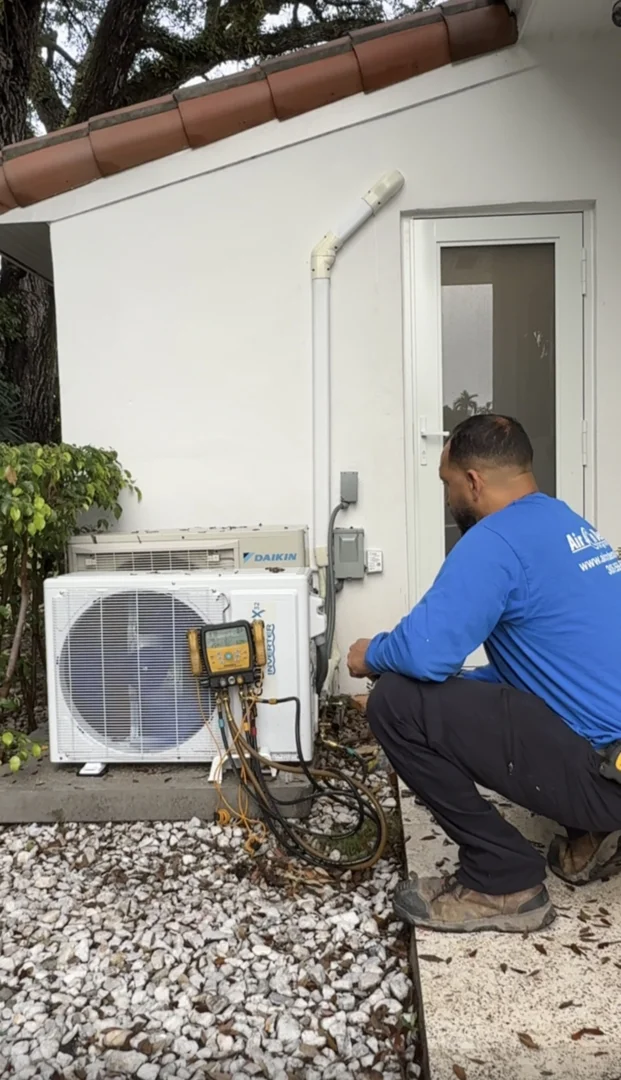
Understanding the physical and chemical differences between these two refrigerants helps explain why they cannot simply be swapped. R-410A is a near-azeotropic blend composed of 50% R-32 and 50% R-125. Because it is near-azeotropic, it behaves almost like a single-component fluid, evaporating and condensing at a constant temperature with minimal "glide."
R-454B, on the other hand, is a zeotropic blend consisting of 68.9% R-32 and 31.1% R-1234yf (a hydrofluoroolefin, or HFO). Because it is a zeotropic blend, it has a temperature glide of approximately 1.5°F. This glide means that as the refrigerant evaporates or condenses, the different components change state at slightly different temperatures.
This behavior is critical to understand during system service, as R-454B must always be charged into the system as a liquid to prevent "fractionation" (where one component of the blend escapes faster than the other during a leak). To see how these fluids move heat through your home, read more about How the Refrigeration Cycle Cools Your Home.
• Chemical Type — R-410A: HFC Blend — R-454B: HFC/HFO Blend
• Composition — R-410A: 50% R-32 / 50% R-125 — R-454B: 68.9% R-32 / 31.1% R-1234yf
• Temperature Glide — R-410A: Minimal (~0.2°F) — R-454B: Approx. 1.5°F
• Critical Temperature — R-410A: 160.3°F (71.3°C) — R-454B: 170.8°F (77.1°C)
• Latent Heat Capacity — R-410A: 256 kJ/kg — R-454B: 273 kJ/kg (7% higher)
A major concern for homeowners in hot areas like Homestead and Country Walk is whether the new refrigerant can handle the brutal South Florida heat. Fortunately, R-454B is an exceptional performer.
In terms of operating pressures, R-454B runs slightly higher than R-410A — roughly 5% higher pressure at the same saturation temperature. For example, at a 90°F saturation temperature, R-410A operates at about 274 psig, while R-454B operates at approximately 288 psig. This minor difference means manufacturers did not have to completely reinvent AC system designs, but they did have to optimize compressors and coils to handle the unique flow characteristics.
When it comes to efficiency, R-454B actually outperforms R-410A:
• Higher COP: R-454B offers a 3% to 5% higher Coefficient of Performance (COP) under standard operating conditions.
• Better High-Ambient Efficiency: At extreme outdoor temperatures above 95°F, R-454B systems can achieve a 5% to 7% better Energy Efficiency Ratio (EER) than equivalent R-410A designs.
• Superior Latent Heat: With a 7% higher latent heat capacity, R-454B carries heat more efficiently per pound, allowing the compressor to work less to achieve the same amount of cooling.
You can learn more about how these components work together in our detailed article on How the Compressor Evaporator and Condenser Function.
The most talked-about change in the transition to R-454B is its safety classification. ASHRAE rates refrigerants based on toxicity and flammability:
• R-410A is classified as A1: "A" stands for low toxicity, and "1" means no flame propagation under test conditions (non-flammable).
• R-454B is classified as A2L: "A" stands for low toxicity, and "2L" indicates mild flammability with a slow burning velocity.
While "mildly flammable" might sound intimidating at first, R-454B is incredibly difficult to ignite. It has a high Lower Flammability Limit (LFL) of about 11.3% to 12.4% by volume, meaning a massive amount of refrigerant would have to leak into a very confined space to even reach a flammable concentration.
Furthermore, its minimum ignition energy is extremely high (greater than 1,000 mJ). It cannot be ignited by a static spark or a hot surface; it requires a persistent, high-energy open flame to burn, and even then, it burns at a incredibly slow velocity (only 5.2 cm/s). To manage this safely, modern R-454B air conditioners are built with active safety sensors and mitigation systems that automatically run the indoor blower fan to safely disperse the refrigerant if a leak is ever detected.
If you currently have an older R-410A system in your Lakes By the Bay or Kendale Lakes home, you might wonder if you can simply drain the old refrigerant and refill it with the new, eco-friendly R-454B.
The short answer is: No, absolutely not. R-454B is not a direct drop-in replacement for R-410A systems.
Because R-454B has a different pressure-temperature curve, a 1.5°F temperature glide, and different lubricant requirements (it uses specialized synthetic Polyolester, or POE, oil formulations), putting it into an older system will cause immediate compressor damage and system failure. Furthermore, because R-454B is an A2L refrigerant, it legally requires systems that are factory-certified with specific electrical shielding, spark-proof contactors, and leak-mitigation controls. For more context on refrigerant management, read why Your AC System Should Not Run Out of Refrigerant.
Mixing different types of refrigerants in the same system is strictly prohibited by federal law and is incredibly destructive to your air conditioner. If R-410A and R-454B are mixed, they will form an unpredictable chemical blend with highly erratic operating pressures.
This chemical contamination will:
1. Cause the compressor to overheat and fail prematurely.
2. Completely void any manufacturer warranties on your equipment.
3. Prevent technicians from being able to properly read system pressures, making future troubleshooting impossible.
4. Create potential safety hazards due to altered flammability limits.
If your system is losing charge, mixing gases is never the answer. Discover why a Leaky Refrigerant is a Bigger Problem Than You Might Think.
If you are dealing with a refrigerant leak on an older R-410A system, you are faced with a classic homeowner dilemma: do you patch it up or replace the whole unit?
Because the production of R-410A is phasing down, acquiring this refrigerant for repairs will naturally become more difficult over time. If your system is over 10 to 12 years old and has a leak in the evaporator coil, opting for a complex repair and a full R-410A recharge may not be the most sensible long-term choice.
If you suspect your system is low on charge, look out for the Signs of Low Refrigerant Levels in Your Air Conditioner. If you indeed have a leak, you can read our guide on Resolving Low Refrigerant Issues to help weigh your options.
Installing a new air conditioning system in South Florida requires careful attention to detail, especially with the introduction of R-454B. Because R-454B has slightly different thermodynamic properties, systems designed for it require approximately 10% to 20% additional heat transfer surface area (larger or more dense coils) to achieve the exact same cooling capacity as older R-410A models.
This means the physical outdoor condenser unit or the indoor air handler cabinet might be slightly larger than the one you are replacing. Proper load calculations and expert sizing are more critical than ever to ensure your new system can handle the high humidity of Coral Gables and Coconut Grove.
To understand why professional design matters so much, check out Air Conditioning Installation in Miami FL Why Si and learn about The Importance of Proper AC Installation.
When you buy a new R-454B system, you are future-proofing your home. You are choosing a system that complies with all modern environmental regulations, ensuring that replacement parts, manufacturer support, and refrigerant will be readily available for the next 15 to 20 years.
Furthermore, the increased energy efficiency of R-454B means reduced energy consumption during our long, hot South Florida summers. For a complete strategy on choosing the right system for our local climate, read our Miami AC Guide Optimal Air Conditioning Installa.
Yes, R-454B is extremely safe for residential use. While it carries an A2L "mildly flammable" rating, it is incredibly difficult to ignite under real-world conditions. Additionally, new air conditioners designed for R-454B are factory-equipped with advanced sensors that actively monitor for leaks. If a leak is detected, the system automatically shuts down the compressor and engages the indoor fan to safely disperse the refrigerant long before it can reach a flammable concentration.
Absolutely. The EPA mandate only restricts the manufacture and import of new R-410A equipment. It does not prevent you from maintaining, repairing, or recharging your existing system. Reclaimed and recycled R-410A will remain available for service work for many years. However, if you suspect your system has a leak, you should address it promptly. Read more to find out Are You Leaking Refrigerant and understand The Problem with a Refrigerant Leak.
R-454B has superior thermodynamic properties compared to R-410A, including a 7% higher latent heat capacity. This allows it to absorb and reject heat more efficiently as it cycles through your system. In practical terms, this leads to a 3% to 5% increase in energy efficiency under normal conditions, and up to a 7% improvement during extreme high-temperature days. Keeping your refrigerant lines sealed and leak-free is key to maintaining this efficiency; learn How Leaky Refrigerant Affects Your Air Condition to see why.
The transition from R-410A to R-454B is a major win for both South Florida homeowners and the environment. By choosing a modern, low-GWP system, you enjoy superior cooling performance, higher energy efficiency, and the peace of mind that comes with future-proof technology.
At Air On Demand, we specialize in high-quality Daikin cooling systems designed to deliver maximum comfort in our intense South Florida climate. Whether you live in Pinecrest, Palmetto Bay, Kendall, or Coral Gables, we make the transition seamless with our convenient online booking, fast local service, and real-time updates. Plus, you can rest easy knowing our installations are backed by Daikin's outstanding warranties, including a 12-year parts warranty and their trusted Comfort Promise.
Ready to upgrade your home comfort or need expert advice on your existing system? Schedule professional AC installation in Miami with our friendly, local team today!