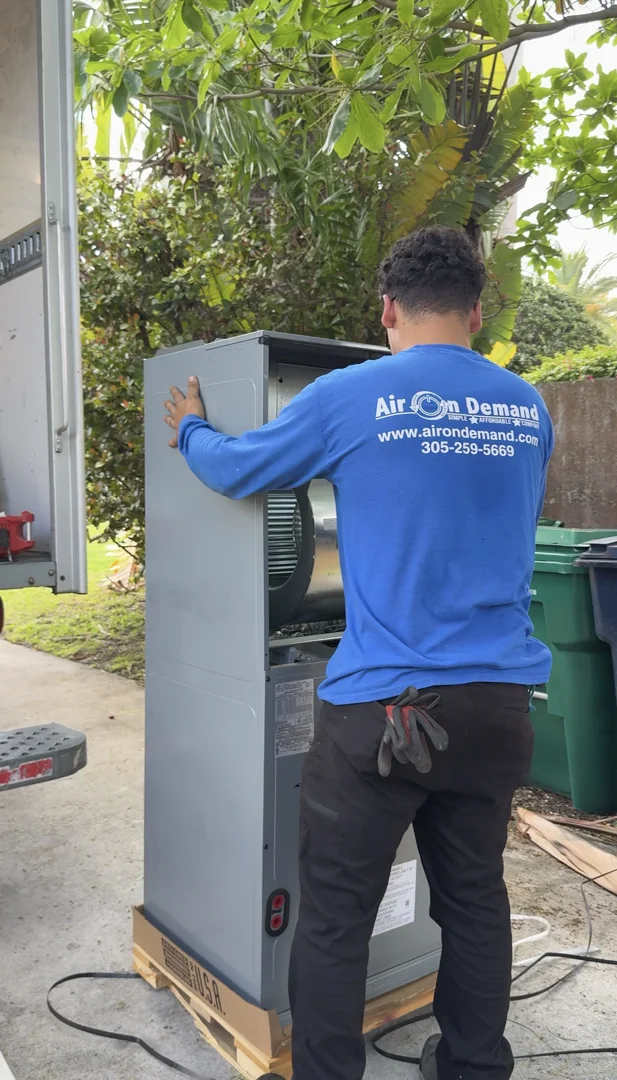
How Oversized AC Units Make Humidity Problems Worse
August 17, 2026
How oversized AC units make humidity problems worse is one of the most misunderstood issues in South Florida homes — and it catches a lot of homeowners completely off guard.
Here's the quick answer:
• An oversized AC cools your home too fast, causing it to shut off before it can remove enough moisture from the air
• This on-and-off pattern is called short cycling
• Short cycles leave indoor humidity at 55–65% even when your thermostat reads 72°F
• The result is air that feels cold and clammy — sometimes called the "cold jungle" effect
• Over time, this excess moisture raises mold risk, increases energy consumption, and wears out your equipment faster
In Miami's climate, where outdoor humidity is relentless, your AC has to work as a dehumidifier just as much as a cooling system. A unit that's too large for your home never runs long enough to do that job properly. You end up with a space that feels sticky and uncomfortable no matter how low you set the thermostat — and most homeowners have no idea their AC size is the culprit.
The sections below break down exactly what's happening inside your system, how to spot the signs, and what you can do about it.
To understand why a bigger air conditioner isn't always better, we have to look at how your system actually manages moisture. Many people believe that air conditioners only cool the air temperature. In reality, modern residential air conditioning systems are designed to perform two distinct functions: lowering the air temperature (sensible cooling) and removing airborne moisture (latent cooling).
Dehumidification occurs as a natural byproduct of the refrigeration cycle. When your system is running, the indoor blower fan draws warm, humid air from your living spaces and pushes it across the freezing-cold evaporator coil. As this warm, moist air makes contact with the cold metal surface of the coil, it rapidly cools down to its dew point.
Just like water droplets forming on the outside of a cold glass of sweet tea on a sweltering July afternoon in Coral Gables, the water vapor in your home's air condenses onto the evaporator coil. This collected water then drips down into a condensate drain pan and flows safely out of your home.
This process is explained in detail in our guide on How Your Air Conditioner Helps to Control the Humidity. However, for this moisture-removal process to work effectively, the evaporator coil must remain cold, and the air must pass over it repeatedly. This requires sustained, steady runtime.
When your air conditioner has too much cooling capacity for the square footage of your home, it experiences a phenomenon known as short cycling.
Think of your AC like a car. If you are driving in heavy stop-and-go traffic, slamming on the gas pedal only to immediately hit the brakes, you waste fuel and put massive stress on the vehicle. An oversized AC behaves the same way. When the thermostat detects that the indoor temperature has risen slightly, it signals the system to turn on.
Because the compressor is massive and has an abundance of cooling power, it blasts an overwhelming volume of icy air into your home. The thermostat, usually located in a central hallway, registers a rapid temperature drop within just 5 to 8 minutes and immediately shuts the system down.
This rapid on-and-off behavior is the classic definition of short cycling. Instead of running healthy, steady cycles of 20 to 30 minutes, the oversized system turns on and off 4 to 6 times an hour. To dive deeper into why this pattern is so destructive, check out our article on the Miami AC Guide: Why Short Cycling on an AC Unit Can Be a Problem.
Now, let's connect the dots between short cycling and high indoor humidity.
An evaporator coil does not instantly drop to 40°F the second your AC turns on. It takes roughly 5 to 10 minutes of continuous operation for the coil to reach its optimal cooling temperature and start condensing water vapor.
When an oversized system short cycles and shuts down after only 5 to 8 minutes, the evaporator coil barely has enough time to get cold and begin the condensation process. The system satisfies the thermostat's temperature setting (the sensible load) almost instantly, but it fails to address the moisture in the air (the latent load).
To make matters worse, whatever moisture did manage to condense on the coil during that brief run cycle doesn't have time to drain away. When the system abruptly shuts off, the blower fan often continues to run briefly, or the stagnant air in the ductwork warms up. This causes the standing water on the wet coil to re-evaporate directly back into your home's air supply.
This dynamic is why how oversized ac units make humidity problems worse is such a frustrating issue for homeowners. You can read more about how this cycle impacts your overall indoor environment in our post on How Humidity Can Affect the Quality of Air Conditioning.

Living in South Florida communities like Pinecrest, Palmetto Bay, or Cutler Bay means dealing with high outdoor humidity year-round. When your air conditioner fails to keep indoor relative humidity (RH) levels in check, your home quickly becomes uncomfortable and potentially hazardous to your health.
Because an oversized air conditioner runs in short, explosive bursts, it never has the chance to establish proper, balanced airflow throughout your home.
The rooms closest to your indoor air handler will get blasted with freezing air, while rooms further away — such as back bedrooms or rooms with large, west-facing windows — remain warm and stuffy. This rapid cooling prevents the air from circulating thoroughly, creating distinct hot and cold spots.
Furthermore, oversized systems push air at incredibly high airflow rates. If your home's ductwork was originally sized for a 2.5-ton system and a contractor installs a 4-ton unit without modifying the ducts, the static pressure inside your ventilation system will skyrocket. This leads to noisy registers, whistling grilles, and stagnant air pockets where humidity pools undisturbed.
It is a common myth that a larger AC is more efficient because it cools your home faster. In reality, an oversized system consumes significantly more energy.
The outdoor compressor draws the most electrical power during its initial startup phase. Because a short-cycling system is constantly starting up and shutting down, it consumes significantly more electricity than a properly sized system running a single, continuous, low-draw cycle.
Additionally, this constant starting and stopping places immense mechanical strain on the compressor and the blower motor. Essential lubricants don't have time to circulate properly, leading to premature friction and heat damage.
This accelerated wear and tear can slash the expected lifespan of your system by 20% to 30%, turning a system that should last 15 years into one that fails in under 10. For a closer look at how these operational stresses lead to mechanical failure, read about the Air Conditioning Issues That Lead to Compressor Damage.
To understand how these factors affect your home overall, our Miami Air Conditioning Guide: What You Need to Know covers the essential elements of maintaining a healthy, efficient system in our unique coastal environment.
To visualize the direct differences between these two scenarios, consider this comparison:
• Average Cycle Length — Correctly Sized AC (e.g., 2.5 Tons): 20 to 30 minutes — Oversized AC (e.g., 4 Tons): 5 to 8 minutes
• Cycles Per Hour — Correctly Sized AC (e.g., 2.5 Tons): 2 to 3 steady cycles — Oversized AC (e.g., 4 Tons): 5 to 6 rapid cycles
• Indoor Relative Humidity — Correctly Sized AC (e.g., 2.5 Tons): Healthy 40% to 50% — Oversized AC (e.g., 4 Tons): Clammy 55% to 65%+
• Indoor Air Feel — Correctly Sized AC (e.g., 2.5 Tons): Crisp, light, and comfortable — Oversized AC (e.g., 4 Tons): Cold, sticky, and damp ("cold jungle")
• Energy Consumption — Correctly Sized AC (e.g., 2.5 Tons): Highly efficient steady-state operation — Oversized AC (e.g., 4 Tons): Frequent startup power spikes
• Equipment Lifespan — Correctly Sized AC (e.g., 2.5 Tons): Full expected lifespan (12–15 years) — Oversized AC (e.g., 4 Tons): Reduced by 20% to 30% due to wear
• Air Distribution — Correctly Sized AC (e.g., 2.5 Tons): Even temperatures across all rooms — Oversized AC (e.g., 4 Tons): Major hot/cold spots and stagnant air
When indoor relative humidity remains consistently above 55%, you experience the "cold jungle" effect. This is when your skin feels cold and clammy because the high humidity prevents your body’s natural sweat from evaporating. To compensate, many homeowners lower their thermostat settings even further, which only wastes more energy and worsens the short cycling cycle.
If you suspect your air conditioner is too large for your home, the first step is understanding how proper sizing is determined.
In the past, many contractors relied on outdated "rules of thumb," such as allocating one ton of cooling capacity for every 500 square feet. In South Florida, this lazy practice is a recipe for disaster. It completely ignores critical variables like insulation quality, window types, ceiling heights, home orientation to the sun, and local climate realities.
To size a system correctly, a professional technician must perform a Manual J load calculation. This industry-standard calculation evaluates your home’s exact thermal characteristics to determine the precise amount of sensible and latent heat your system needs to remove.
When it comes to selecting a new system, details like SEER2 ratings and proper capacity matching are essential. You can learn more about how to navigate this process in our guide on How to Choose the Right Air Conditioning Installation.
You don't necessarily need to be an HVAC engineer to spot an oversized system. If you notice any of the following warning signs in your home, there is a very high probability your system is too large:
1. The 10-Minute Cool Down: Your home goes from warm to icy cold in less than 10 minutes from the moment the system turns on.
2. High Indoor Humidity: Your thermostat reads a cool 71°F, but your skin feels damp, sticky, and clammy.
3. Frequent On/Off Cycles: You constantly hear your outdoor unit turning on, running for a few minutes, turning off, and then repeating the process 10 minutes later.
4. Musty Odors: Stagnant, humid air inside your ductwork and living spaces creates a persistent musty smell.
5. Divergent Room Temperatures: Your living room is freezing, but your bedrooms feel like a humid greenhouse.
It is worth noting that while an oversized system cycles on and off rapidly, there are other issues that can cause a system to do the opposite. If you've ever wondered about the other end of the spectrum, you can read about Why Your AC Runs Constantly in South Florida.
A properly sized air conditioner will run long, gentle, and highly efficient cycles. This allows the evaporator coil to stay cold enough to pull gallons of water out of your air every single day.
Because the system operates primarily in its highly efficient steady-state phase, it uses significantly less power and keeps your monthly energy usage manageable. Additionally, proper sizing ensures that your system achieves its rated SEER2 (Seasonal Energy Efficiency Ratio) efficiency.
To understand how system efficiency and capacity work hand-in-hand to protect your comfort and maximize efficiency, check out our explanation on Miami Air Conditioning Guide: Why SEER Matters.
If you already have an oversized air conditioner installed in your home, replacing a relatively new system immediately may not be practical. Fortunately, there are several professional adjustments and workarounds that can help mitigate high humidity levels:
• Lower the Blower Fan Speed: Most indoor air handlers allow technicians to adjust the fan speed (measured in CFM, or cubic feet per minute). By reducing the airflow across the evaporator coil, the air stays in contact with the cold metal longer. This lowers the dew point and coaxes the system into removing more moisture.
• Install a Whole-Home Dehumidifier: This is the most effective workaround. A dedicated whole-home dehumidifier works alongside your existing AC system, pulling moisture out of the air independently of your cooling cycles.
• Upgrade to a Variable-Speed or Two-Stage Compressor: If you choose to upgrade, systems featuring variable-speed inverter technology (such as Daikin FIT systems) can modulate their capacity anywhere from 10% to 100%. This allows them to run almost continuously at ultra-low, highly efficient speeds, providing unmatched dehumidification.
• Adjust Thermostat Fan Settings: Always ensure your thermostat fan setting is set to "Auto" rather than "On." If the fan runs continuously ("On"), it will blow air over the wet evaporator coil during the off-cycle, pushing all the condensed moisture right back into your home.
When an oversized AC short cycles, it fails to handle the latent moisture load of your home. A whole-home dehumidifier acts as a dedicated partner to your AC.
While the oversized AC focuses on lowering the temperature quickly, the dehumidifier monitors the relative humidity. It pulls damp air out of your living spaces, removes the moisture, and returns dry air back into your ductwork. This allows you to maintain a healthy relative humidity target of 45% to 50%, eliminating the clammy "cold jungle" feel and protecting your home from mold growth.
For optimal comfort, health, and structural safety, indoor relative humidity in South Florida should be kept strictly between 45% and 50%. Keeping your humidity below 50% is crucial because dust mites, mold spores, and musty odors thrive once relative humidity climbs above 55%.
No, you should never close vents to try and balance an oversized system. Closing supply registers restricts airflow and increases static pressure inside your ductwork. This can cause the evaporator coil to freeze over completely, leading to liquid refrigerant floodback and catastrophic compressor damage.
A smaller, properly sized AC runs longer, continuous cycles that steadily pull moisture out of the air. Because dry air allows your skin’s natural moisture to evaporate easily, a room at 75°F with 45% humidity feels significantly cooler, crisper, and more comfortable than a room at 71°F with 65% humidity.
At Air On Demand, we have spent years helping homeowners across Coconut Grove, Coral Gables, Country Walk, Cutler Bay, Homestead, Kendale Lakes, Kendall, Lakes By the Bay, Palmetto Bay, and Pinecrest achieve perfect indoor comfort.
If you suspect your air conditioner is oversized, short cycling, or leaving your home feeling cold and clammy, don't keep turning down the thermostat. Let our experienced local team perform a comprehensive system diagnostic and help you find the right solution for your home.
Schedule professional AC services with Air On Demand today to restore comfort, optimize energy usage, and protect your indoor air quality.