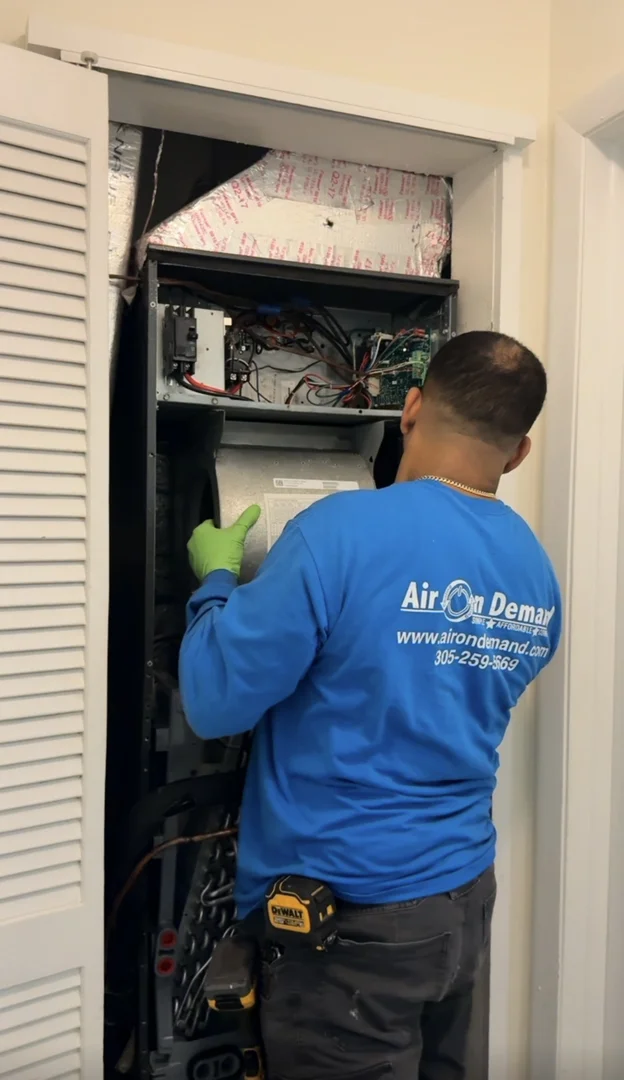
How to Optimize AC Airflow Efficiency for Peak Performance
August 17, 2026
Understanding how airflow affects your air conditioners performance is the fastest way to figure out why your home feels stuffy, humid, or unevenly cooled — even when your system is running constantly.
Here's a quick summary:
How airflow affects AC performance:
• Cooling efficiency — Proper airflow allows the evaporator coil to absorb heat effectively. Restrict it, and your system loses its ability to cool.
• Energy consumption — Poor airflow forces your AC to run longer and work harder, driving up electricity bills. Replacing a dirty filter alone can cut energy use by 5–15%.
• Humidity control — Correct airflow is what removes moisture from the air. Without it, rooms feel clammy even at the right temperature.
• Equipment lifespan — Restricted airflow strains the blower motor and compressor, leading to premature wear and unexpected breakdowns.
• Even temperature distribution — Balanced airflow prevents hot and cold spots from forming in different rooms.
For South Florida homeowners in Kendall, Coral Gables, Pinecrest, and surrounding communities, this issue hits especially hard. The heat and humidity here are relentless, and your AC system is working at full capacity for most of the year. When airflow is compromised — whether from a clogged filter, a leaky duct, or a blocked return vent — your system doesn't just underperform. It struggles to keep up with conditions that demand its absolute best.
The good news? Most airflow problems are fixable, and many can be prevented with simple, consistent maintenance.
Simple guide to how airflow affects your air conditioners performance terms:
• how the compressor evaporator and condenser function
• how the refrigeration cycle cools your home
• how your air conditioner works
When we think about air conditioning, we usually focus on the temperature setting on our thermostat. But temperature is only half of the story. The true medium of comfort in your home is the air itself. Without proper air circulation, even the most advanced cooling system becomes completely ineffective.
To truly understand why your system struggles when circulation drops, we have to look at Why Is Low Air Flow a Problem With Air Condition. Air conditioning is not actually the process of "creating cold air." Instead, it is the process of removing heat and moisture from your indoor air and relocating it outside. If the air in your home cannot reach the cooling components of your AC, that heat transfer simply cannot happen.
At the heart of this thermal exchange is the indoor evaporator coil. Cold, liquid refrigerant flows through this copper or aluminum tubing. As the blower motor pushes warm, humid indoor air across the cold outer surface of the coil, the refrigerant inside absorbs the heat from the air. This process provides "sensible cooling" (dropping the temperature) and "latent cooling" (condensing moisture out of the air, much like water droplets forming on a cold glass of sweet tea on a hot Homestead afternoon).
If the airflow across this coil is restricted, there isn't enough heat passing over it to keep the refrigerant warm. The temperature of the coil drops below freezing, turning any condensed moisture into ice. Once ice forms, it acts as an insulating barrier, further blocking heat absorption and completely stalling the refrigeration cycle.
Your air conditioning system is a closed-loop breathing system. It must inhale just as much air as it exhales. The air it "inhales" comes through the return grilles, while the air it "exhales" is pushed out through the supply vents.
This balance is measured in Cubic Feet per Minute (CFM). In our hot and humid South Florida climate, achieving the right CFM is critical. While dry, high-altitude climates might target a higher airflow of 450 to 550 CFM per ton of cooling capacity to maximize sensible cooling, our humid coastal environment typically requires a nominal target of 400 CFM per ton, or sometimes slightly lower (around 350 CFM per ton) during high-humidity periods to allow for maximum moisture removal.
When this balance is disrupted, you run into the 3 Causes of Low Air Flow. If the return side is restricted, the blower motor has to work against high "static pressure" — essentially, it is trying to pull air out of a vacuum. This strains the motor, increases your energy bills, and starves the supply vents, leaving your family sweating in Coral Gables.
If you are noticing weak air currents coming out of your registers, you are likely asking yourself, "Why Am I Getting Low Air Flow From My AC?" In South Florida, our systems run almost continuously, making them highly susceptible to mechanical and environmental blockages. Let's look at the 3 Reasons for Low Airflow From Your Vents and how they manifest in local homes.
The single most common cause of poor airflow is a neglected air filter. Your filter's job is to catch dust, pet dander, and airborne debris before they can settle on your delicate indoor coil. However, as the filter does its job, it naturally becomes loaded with particles.
A heavily clogged filter acts like a solid wall in your ductwork. It increases the static pressure dramatically, forcing the blower motor to consume significantly more electricity. According to the Department of Energy, replacing a dirty, clogged filter with a clean one can reduce your air conditioner's energy consumption by 5% to 15%.
To understand the full scope of this issue, read about How Dirty Air Filters Impact AC Performance and learn exactly How a Dirty Air Filter Affects Your Air Conditio. While it might be tempting to buy the highest-efficiency MERV 13+ pleated filter on the market to improve indoor air quality, these dense filters can actually restrict airflow as much as a dirty filter if your system's blower motor was not designed to handle that level of resistance.
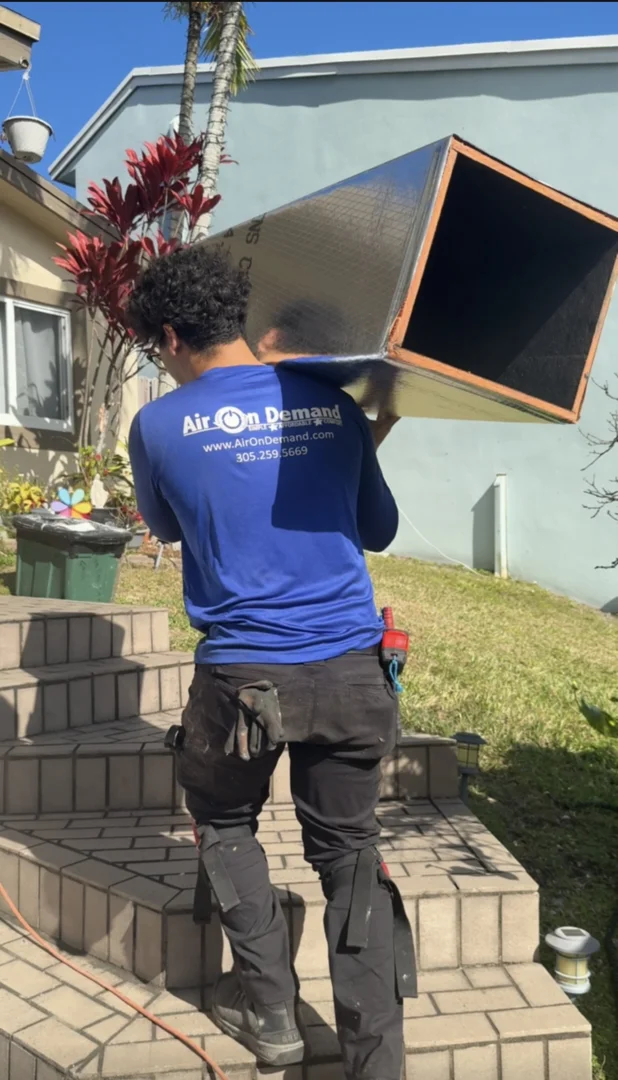
Your ductwork is the highway system for your conditioned air. Unfortunately, many homes in Cutler Bay and Palmetto Bay suffer from duct systems that are deteriorating, poorly sealed, or improperly sized.
Are your ducts messing with your comfort? Absolutely. If you want to know more, explore Are Your Ducts Messing With Your Comfort. When ducts have holes or disconnected joints, a massive portion of your cooled air escapes into your hot, dusty attic instead of reaching your living spaces. This creates a pressure imbalance, often pulling hot, humid attic air or garage fumes back into your home through negative pressure leaks.
Proper sealing and maintenance of ductwork can improve cooling efficiency by as much as 20%. To understand why this is a safety and efficiency priority, check out Why You Should Be Concerned About Leaky Ducts.
Even if your air filter is clean, microscopic dust particles can bypass it over time and settle on the wet surface of your evaporator coil. This forms a grimy layer that restricts the air trying to pass between the delicate aluminum fins.
Similarly, your outdoor condenser unit relies on unrestricted airflow to dump the heat it gathered from inside your home. If the outdoor coil is caked with grass clippings, dirt, or salt spray from the ocean, or if the thin aluminum coil fins are bent and crushed, the heat cannot escape. The compressor has to work much harder and run much hotter to achieve the same amount of cooling. You can read more about this in our guide on How Dirty Coils Affect Your Air Conditioner.
Ignoring airflow issues doesn't just result in a slightly warmer living room; it triggers a cascade of mechanical and operational problems. The physical strain placed on your system when it cannot "breathe" has direct consequences on your comfort and your peace of mind. To see how these issues compound, read about The Impact of AC Problems on Energy Efficiency S.
When airflow is severely restricted, the temperature of the indoor evaporator coil quickly drops below 32°F. The moisture condensing on the coil freezes instantly. As the ice builds up, it completely blocks what little airflow was left, causing the system's cooling capacity to drop to zero.
This lack of heat transfer causes the refrigerant returning to the outdoor compressor to remain in a liquid state rather than gas. Compressors are designed to compress gas, not liquid; trying to compress liquid refrigerant can destroy the compressor's internal valves, leading to a catastrophic system failure.
Additionally, the system may begin "short cycling" — turning on and off rapidly. Because the thermostat is never satisfied, but internal safety sensors are shutting the system down to prevent freezing, the constant starting and stopping places immense wear on the electrical contacts, capacitor, and fan motors, drastically shortening the lifespan of your system.
In South Florida, comfort is defined by humidity control. High relative humidity makes the air feel much hotter than it actually is because it prevents our sweat from evaporating.
Your air conditioner is your home's primary dehumidifier. However, dehumidification requires a balanced, steady flow of air across the evaporator coil. If the air is moving too fast because of an oversized blower motor or incorrect settings, it doesn't spend enough time on the cold coil to drop its moisture. If the air is moving too slowly or is restricted, the coil freezes, halting dehumidification entirely.
The result? A "clammy" home where the thermostat reads 72°F, but you still feel sticky, uncomfortable, and prone to mold growth in hidden areas like closets and behind furniture.
Optimizing your system's airflow is a joint effort between simple homeowner habits and professional diagnostic tools. The table below outlines the key differences between what you can do yourself and what requires our specialized training.
• Replace Air Filter — DIY Friendly?: Yes — Frequency: Every 1–3 months — Impact on Performance: Reduces energy use by 5–15%; prevents coil freezing
• Clear Vent Obstructions — DIY Friendly?: Yes — Frequency: Monthly — Impact on Performance: Eliminates hot spots; balances room pressure
• Trim Outdoor Foliage — DIY Friendly?: Yes — Frequency: Every 3 months — Impact on Performance: Maintains outdoor heat rejection; protects compressor
• Gently Wash Outdoor Coil — DIY Friendly?: Yes — Frequency: Annually — Impact on Performance: Improves outdoor heat transfer; lowers head pressure
• Straighten Bent Coil Fins — DIY Friendly?: No (Requires specialized tools) — Frequency: As needed — Impact on Performance: Restores blocked airflow paths across coils
• Static Pressure Testing — DIY Friendly?: No (Requires manometer) — Frequency: During annual service — Impact on Performance: Diagnoses hidden duct restrictions and blower health
• Duct Sealing & Balancing — DIY Friendly?: No (Requires specialized equipment) — Frequency: Every 3–5 years — Impact on Performance: Boosts cooling efficiency by up to 20%; balances comfort
To keep your system running smoothly between professional tune-ups, establish these simple habits:
1. Check your filter monthly: Especially if you have pets or live near dusty construction areas in Homestead or Cutler Bay. Replace it as soon as you see a gray layer of dust.
2. Clear the area around vents: Ensure that curtains, couches, rugs, or large furniture pieces are not blocking your return or supply grilles. Your system needs at least 6 to 12 inches of clear space around every vent.
3. Maintain outdoor clearances: Keep plants, shrubs, and weeds trimmed back at least 2 feet from your outdoor condenser unit, and ensure there is at least 5 feet of clear space above it to allow hot air to escape freely.
4. Keep all vents open: Avoid the temptation to close vents in unused guest rooms. Your residential AC system was designed with a specific duct volume in mind; closing vents increases static pressure, which can damage your blower motor and cause your coils to freeze.
While DIY steps are crucial, some airflow problems are baked into the design of your home's ductwork. This is where professional balancing comes in.
When our technicians perform a diagnostic visit, we don't just guess. We use calibrated manometers to measure the Total External Static Pressure (TESP) of your system. This tells us exactly how hard your blower motor is working to move air. We also utilize flow hoods to measure the exact CFM coming out of each individual register.
If we find imbalances — such as a master bedroom that is always too hot while the kitchen is freezing — we can adjust the internal duct dampers to redistribute the airflow proportionally. We also specialize in sealing leaky ductwork using advanced mastic sealants, ensuring that every drop of cold air you pay for actually reaches your living space.
Weak airflow is usually caused by a severe restriction on either the return or supply side of your system. The most common culprit is a heavily clogged air filter, followed closely by a frozen evaporator coil that has turned into a solid block of ice. Other potential causes include leaky or disconnected ductwork in your attic, a failing blower motor capacitor, or a build-up of dirt on the blower wheel itself.
Yes, it can. High-efficiency filters (typically MERV 13 or higher) are designed with very dense pleats to capture microscopic allergens. If your system's blower motor (especially older permanent split capacitor, or PSC, motors) is not rated to handle the high static pressure these filters create, it will restrict your airflow significantly. This can lead to frozen coils, an overheated blower motor, and a drop in overall cooling capacity. We recommend consulting with us to find the optimal filter balance for your specific system.
For most South Florida homes, we recommend having your air ducts professionally inspected every 3 to 5 years. However, if you have multiple pets, suffer from severe allergies, or notice visible dust build-up on your register grilles shortly after cleaning them, you may benefit from more frequent duct cleanings. Regular duct cleanings remove the dust, mold spores, and debris that restrict airflow and degrade your indoor air quality.
At Air On Demand, we have spent years helping our neighbors in Coral Gables, Pinecrest, Palmetto Bay, and Kendall stay comfortable through the hottest summers. As local Daikin specialists, we understand that a high-efficiency cooling system is only as good as the airflow supporting it.
Whether you need a comprehensive duct cleaning, professional airflow balancing, or a precision repair to get your system breathing easy again, we are here to help. We offer convenient online booking, fast response times, real-time updates on your technician's arrival, and industry-leading warranties to give you ultimate peace of mind.
Don't let poor airflow drive up your utility bills and compromise your family's comfort. Schedule your professional AC service with Air On Demand today and feel the difference that balanced, optimized airflow can make!