Ultimate Guide to How Your Indoor and Outdoor AC Units Work Together
August 17, 2026
How your indoor and outdoor AC units work together is one of the most important things to understand about your home's cooling system. In short, the two units form a single closed-loop system that moves heat from inside your home to the outside air using refrigerant.
Here's a quick overview of how the coordination works:
• Indoor unit (air handler or evaporator coil): absorbs heat and humidity from your indoor air
• Outdoor unit (condenser): releases that heat outside and sends cooled refrigerant back indoors
• Refrigerant lines: carry refrigerant continuously between the two units
• Result: a repeating cycle that keeps your home cool and comfortable
Most South Florida homeowners have this type of system — called a split system — running around the clock through long, humid summers. When both units are properly matched and maintained, the system runs efficiently and reliably. When they're not, you'll feel it in your comfort and your system's overall efficiency.
This guide breaks down every part of that relationship, from how each component works to why matching your indoor and outdoor units correctly is non-negotiable for long-term performance.
Relevant articles related to how your indoor and outdoor ac units work together:
• how the refrigeration cycle cools your home
• how your air conditioner works
When we talk about central air conditioning in South Florida communities like Coral Gables, Pinecrest, or Palmetto Bay, we are almost always talking about a split system.
A split system gets its name because the components are divided (or "split") into two physical locations: one inside your home and one outside. It is the most common residential HVAC setup in the United States, and for good reason. By keeping the loud, heat-releasing components outdoors and the quiet, air-distributing components indoors, split systems provide incredibly quiet and efficient whole-home comfort.
In our hot, humid climate, a split system is uniquely suited to handle the heavy cooling loads we experience. Instead of trying to force all the mechanical parts into a single window unit or a packaged system on the roof, a split system allows for larger coils and more powerful compressors. This design maximizes the system's ability to pull heat and moisture out of your indoor air, leaving you with cool, crisp, and dehumidified spaces.
To learn more about the fundamentals of these setups, take a look at our article on Air Conditioning Basics: What You Should Know.
To understand how your indoor and outdoor ac units work together, we first need to look at the individual players. Your air conditioner does not actually "create" cold air. Instead, it acts as a heat transfer vehicle. It takes the heat inside your home and dumps it outside.
This process relies on four primary components divided between your two units: the compressor, the condenser coil, the evaporator coil, and the blower motor.
For a deeper dive into how these coils function, you can read Our Quick Guide to the Coils in Your Air Conditioner.
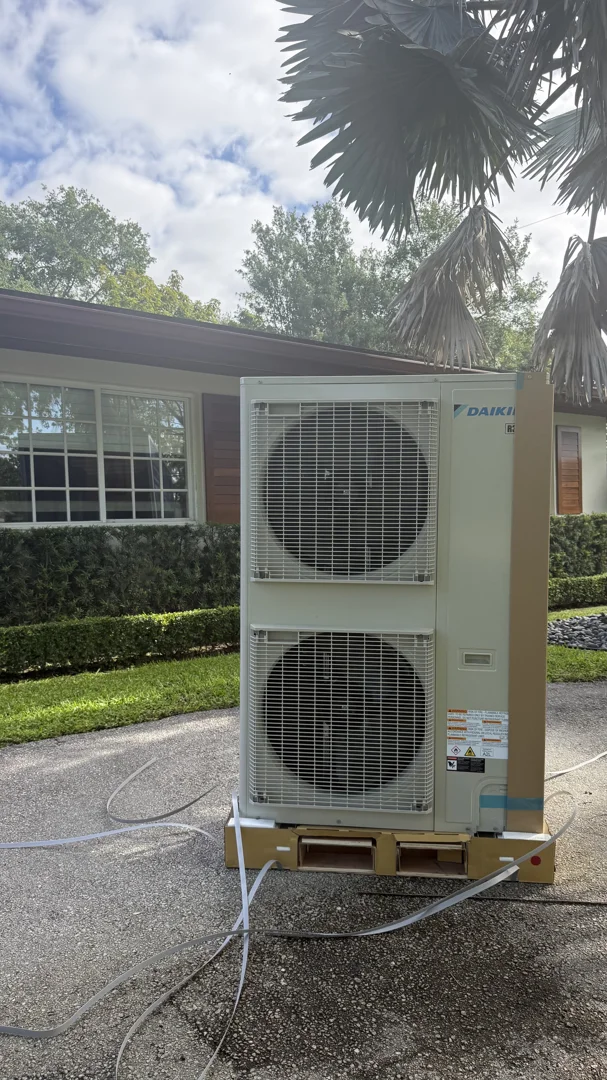
Commonly referred to as the "condenser" or the "AC compressor box," the outdoor unit is the workhorse responsible for heat rejection. It is typically anchored to a concrete pad on the side of your home in Homestead or Cutler Bay.
Its key components include:
• The Compressor: Often called the "heart" of the AC system, the compressor pumps refrigerant through the system and pressurizes it, raising its temperature so it can release heat.
• The Condenser Coil: A large network of copper or aluminum tubing surrounded by thin metal fins. As the hot refrigerant passes through this coil, it releases its heat to the outdoor air.
• The Condenser Fan: Located at the top of the outdoor unit, this fan pulls outdoor air through the condenser coils, carrying the rejected heat away into the atmosphere.
• Electrical Contactors & Controls: These components receive signals from your indoor thermostat, telling the outdoor unit when to turn on and off.
The indoor unit is usually tucked away in a closet, garage, or attic. In South Florida, where natural gas is less common, this unit is typically an air handler equipped with an electric heating strip for our brief winter cold snaps.
Its key components include:
• The Evaporator Coil: The "cold side" of the system. Extremely cold refrigerant flows through this coil. As warm indoor air is blown across it, the refrigerant absorbs the heat and moisture from the air.
• The Blower Fan: A powerful motor that pulls warm air from your home through the return vents, pushes it across the cold evaporator coil, and distributes the newly cooled air back through your ductwork.
• The Air Filter: Located at the return air inlet, the filter catches dust, pet dander, and pollen before the air enters the system, protecting both your indoor air quality and the delicate evaporator coil.
To explore the inner workings of the indoor cabinet, read our detailed guide on the Components of an Air Handler.
Now that we know who the players are, let's look at how they collaborate. Your indoor and outdoor units must operate in perfect synchronization. If one unit stops working, is turned off, or loses power, the entire cooling cycle grinds to a halt.
• Primary Role — Indoor Unit (Air Handler): Absorbs indoor heat & dehumidifies air — Outdoor Unit (Condenser): Releases absorbed heat to the outdoors
• Key Component — Indoor Unit (Air Handler): Evaporator Coil & Blower Fan — Outdoor Unit (Condenser): Compressor & Condenser Coil
• Refrigerant State — Indoor Unit (Air Handler): Cold, low-pressure liquid/vapor — Outdoor Unit (Condenser): Hot, high-pressure liquid/vapor
• Air Movement — Indoor Unit (Air Handler): Circulates cooled air into the home — Outdoor Unit (Condenser): Blows hot exhaust air away from the home
This continuous exchange of heat is governed by the laws of thermodynamics. To understand the exact physics behind this process, you can read about How the Refrigeration Cycle Cools Your Home.
Here is exactly how the magic happens when your thermostat in Kendall or Pinecrest calls for cooling:
1. The Thermostat Signals the System: Your thermostat detects that the indoor temperature has risen above your set point. It sends a low-voltage electrical signal to both the indoor air handler and the outdoor condenser to start up.
2. Heat Absorption (Indoors): The indoor blower fan pulls warm, humid air from your living spaces through your return ducts. This air passes over the freezing-cold evaporator coil. The refrigerant inside the coil absorbs the heat from the air. As the air cools, it also loses moisture, which condenses on the coil and drains away.
3. The Journey Outdoors: The refrigerant, which has now warmed up and turned into a low-pressure vapor, travels out of your home through insulated copper pipes called the suction line.
4. Compression (Outdoors): The refrigerant enters the outdoor compressor. The compressor squeezes the refrigerant vapor, packing its molecules tightly together. This raises both the pressure and the temperature of the refrigerant, turning it into a super-heated, high-pressure gas.
5. Heat Release (Outdoors): The hot gas flows into the outdoor condenser coil. The outdoor fan blows ambient air across the coil. Because heat naturally moves from hot areas to cooler areas, the heat from the refrigerant escapes into the outdoor air. As it cools, the refrigerant condenses back into a high-pressure liquid.
6. The Return Journey: The cooled, high-pressure liquid refrigerant travels back toward your home through the narrower, uninsulated copper pipe called the liquid line.
7. Expansion and Decompression: Before entering the indoor evaporator coil, the refrigerant passes through an expansion valve. This valve acts like a nozzle, dropping the pressure of the refrigerant rapidly. This sudden drop in pressure causes the refrigerant's temperature to plummet, preparing it to absorb indoor heat all over again.
For more details on how central air systems coordinate this cycle, refer to our article: Let Us Teach You a Bit About Your Central AC.
One of the most common mistakes homeowners make when faced with an AC breakdown is attempting to replace only one half of the system. We cannot stress this enough: your indoor and outdoor units must be a certified, factory-matched system.
The Air-Conditioning, Heating, and Refrigeration Institute (AHRI) tests and certifies specific combinations of indoor and outdoor components. When a manufacturer designs an outdoor condenser, they calibrate it to work with a specific indoor evaporator coil that has a matching capacity, airflow rate, and refrigerant volume.
If you are debating whether to upgrade your entire system or fix a single component, check out our guide on AC Repair vs AC Replace.
Trying to pair a brand-new outdoor condenser with an aging indoor air handler is like putting a high-performance sports car engine into a golf cart. It leads to serious performance and operational consequences:
• Severe Efficiency Loss: Modern air conditioners are designed to meet strict SEER2 (Seasonal Energy Efficiency Ratio) standards. An older indoor unit will restrict a new, highly efficient outdoor unit, dropping your actual operating efficiency far below the rated level.
• Excessive Compressor Strain: If the indoor coil is too small or uses a different airflow rate, the refrigerant will not evaporate properly. This can cause liquid refrigerant to flood back into the outdoor compressor, leading to catastrophic mechanical failure.
• Refrigerant Incompatibility: As of May 2026, older systems using R-410A are being phased out in favor of newer, environmentally friendly refrigerants like R-454B. Older indoor coils are physically incompatible with these new refrigerants and their operating pressures.
• Voided Warranties: HVAC manufacturers will not honor their parts warranties if their outdoor units are paired with unapproved, mismatched indoor components.
While traditional ducted split systems are the standard in many Country Walk and Lakes By the Bay homes, ductless mini-split systems have exploded in popularity.
In a traditional ducted system, the indoor unit is connected to a network of metal or flexible ducts that distribute air throughout the entire house. However, traditional ductwork can leak between 20% and 40% of its conditioned air into unconditioned spaces like attics or crawlspaces, significantly reducing efficiency.
Ductless systems eliminate this energy loss entirely by delivering conditioned air directly into individual rooms. A ductless system still uses an outdoor unit paired with an indoor unit, but the physical delivery is different:
• Single-Split Ductless: One outdoor condenser is connected directly to one wall-mounted or ceiling-recessed indoor blower unit.
• Multi-Split Ductless: One outdoor condenser can connect to up to 8 independent indoor units. This allows you to set different temperatures in different rooms, providing localized comfort and allowing you to turn off cooling in unused spaces.
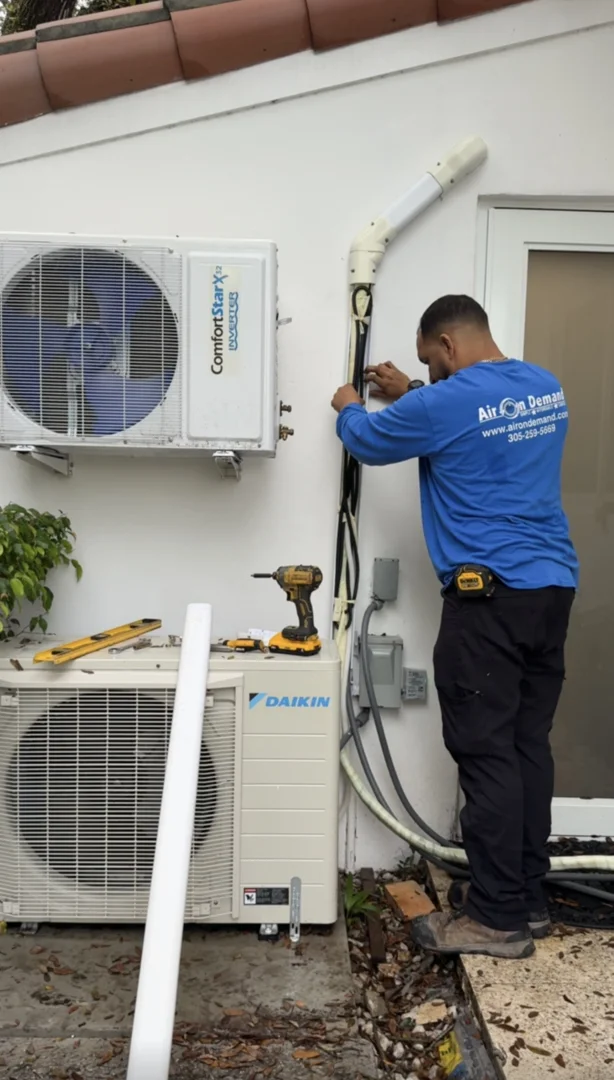
In a ductless system, the connection between the indoor and outdoor units is incredibly streamlined. Instead of massive ductwork, the units are linked by a compact "conduit" that passes through a small, three-inch hole in your exterior wall.
Inside this protective conduit, three critical lines work together:
1. Refrigerant Line Sets: Small copper tubes that carry the refrigerant back and forth to facilitate the heat transfer cycle.
2. Communication Cable: A shielded electrical wire that allows the indoor unit's thermostat to send real-time temperature and fan speed data to the outdoor condenser's inverter compressor.
3. Condensate Drain Line: A small PVC tube that carries the moisture squeezed out of your indoor air safely to the outdoors.
Technically, some contractors might agree to do this, but we strongly advise against it. Installing a mismatched system violates modern building codes, voids your manufacturer's warranty, and will likely cause your new outdoor compressor to fail prematurely.
To ensure your system operates safely, efficiently, and legally, read about The Importance of Proper AC Installation.
Your indoor and outdoor units are physically connected by three elements: copper refrigerant line sets (suction and liquid lines), a low-voltage electrical communication wire, and a condensate drain line. These lines are bundled together and run through your walls, crawlspaces, or attic.
Because the two units operate as a single loop, neglect on one side will quickly destroy the other. To keep them working in harmony, you should:
• Replace your indoor air filter every 30 to 90 days to maintain strong airflow across the indoor coil.
• Keep the outdoor unit clear of grass clippings, leaves, shrubs, and debris to allow proper heat rejection.
• Schedule professional maintenance twice a year to have both the indoor and outdoor coils chemically cleaned, electrical connections tightened, and refrigerant levels verified.
To keep your system running at peak performance year-round, read our Air Conditioner Complete Guide.
Your indoor and outdoor AC units are two halves of a single, highly coordinated system. When they are perfectly matched, properly installed, and regularly maintained, they work together seamlessly to keep your South Florida home cool, dry, and comfortable even in the dead of summer.
At Air On Demand, we specialize in delivering matched, high-efficiency cooling solutions tailored specifically to the unique climate demands of Coconut Grove, Coral Gables, Homestead, and the surrounding areas. As a premier provider of Daikin products, we offer industry-leading warranties, including 12-year parts protection and the Daikin Comfort Promise, ensuring your peace of mind for years to come.
Don't let a mismatched or struggling system compromise your home's comfort. Schedule professional AC service with Air On Demand today to ensure your indoor and outdoor units are working in perfect harmony!