Managing Condensation Overflows in Miami High-Rise Condos
August 17, 2026
A central air conditioner working through a typical South Florida summer day can produce anywhere from 5 to 20 gallons of condensation, making managing condensation overflows in Miami high-rise condos a critical priority for property owners. At Air On Demand, our technicians see the aftermath of these issues every summer, and we know firsthand that this is a massive volume of water moving through your system on a daily basis. When you live in a multi-story building, handling this relentless moisture extraction becomes a complex mechanical challenge. If the primary drain line clogs, those 20 gallons have nowhere to go but out of the drain pan and directly into your living space, threatening drywall, flooring, and electrical systems.
The core problem lies in the interconnected nature of high-rise infrastructure. A standard wet-vac extraction might clear a blockage in a single-family home, but applying that same DIY approach to a multi-story building often fails—or worse, pushes the problem into a neighbor's unit. Knowing exactly why these standard fixes fall short and recognizing when professional intervention is required is the only way to prevent severe structural water damage in shared living spaces.
If you are dealing with a backed-up system right now, reach out for professional Miami AC repair services to resolve the issue safely.
Miami's intense, year-round humidity forces air conditioners to extract massive amounts of moisture daily, creating unique strain on condensate lines. During the hottest months, your cooling system acts as a heavy-duty dehumidifier, pulling water vapor out of the indoor air before circulating the cooled breeze back into your rooms.
Modern high-efficiency HVAC systems are incredibly effective at removing moisture, but that efficiency comes with a byproduct: a constant stream of water. In our years of providing cooling solutions across South Florida, our team has found that as families transition back to school during the thick of the late-summer August peak cooling season, relative humidity frequently exceeds 70%. This extreme moisture level maximizes daily condensation output. Because the system runs continuously to combat the heat, the drain lines never have a chance to dry out.
The impact of humidity on condensation:
• Low (Below 40%) — System Runtime: Intermittent — Estimated Daily Condensation Volume: 2 to 5 gallons
• Moderate (40% - 60%) — System Runtime: Frequent — Estimated Daily Condensation Volume: 5 to 10 gallons
• High (Above 70% - Miami Peak) — System Runtime: Continuous — Estimated Daily Condensation Volume: 15 to 20+ gallons
This sheer volume turns what might be a slow, minor drain issue in a drier climate into a rapid, severe flooding hazard in South Florida. Furthermore, the constantly damp, dark environment inside these condensate lines creates the perfect breeding ground for biological growth. Algae and mold thrive in these conditions, quickly building up into thick, gelatinous blockages that choke the pipe.
Across the Miami area, our Air On Demand installation crews frequently encounter older multi-story buildings that feature aging infrastructure with narrow or partially scaled pipes. Over decades of use, mineral deposits and hardened debris reduce the internal diameter of the plumbing. These older pipes simply struggle to handle the massive condensation volumes produced by today's powerful, high-efficiency air conditioners, making clogs far more frequent and severe.
To understand why condo drainage is so difficult to manage, you have to look at the architecture of the building. Multi-family drainage networks operate on completely different mechanical principles than standalone residential homes.
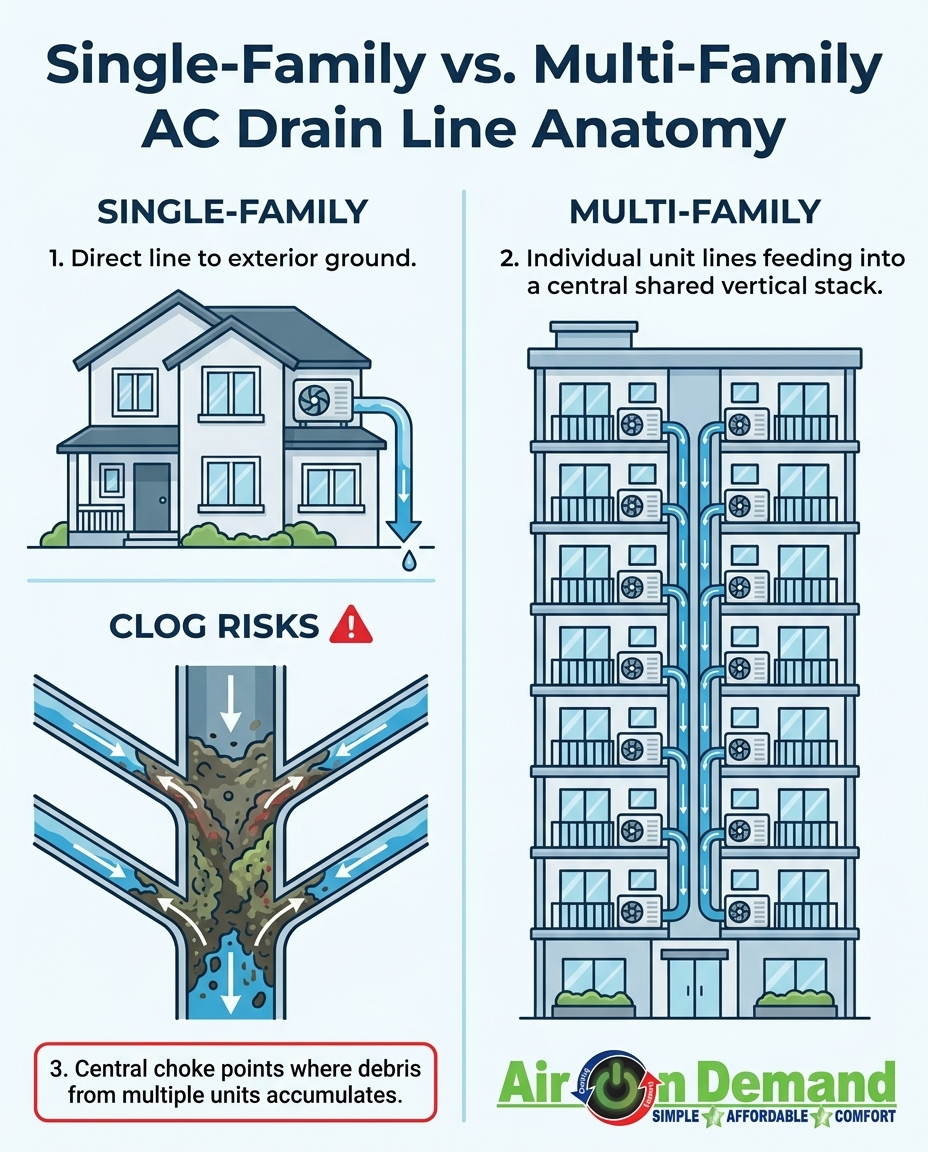
In a typical single-family home, the AC condensate line follows a short, direct path. The PVC pipe runs from the indoor air handler, through an exterior wall, and drips harmlessly onto the ground or into a garden bed. If it clogs, the blockage is isolated to that specific pipe.
In contrast, condo buildings utilize shared plumbing drain stacks. Your individual unit has a lateral branch line that runs horizontally before tying into a massive central vertical pipe—the stack. This vertical stack collects condensation from every unit positioned above and below you in that specific column of the building.
• Branch lines: The horizontal pipes connecting your specific AC unit to the main building drain.
• The vertical stack: The central gravity-fed pipe shared by multiple apartments in a vertical line.
• Tie-in points: The junctions where individual branch lines meet the main stack, which frequently become choke points for debris.
Because these systems are interconnected, treating a single unit's clog without accounting for the entire system is a fundamentally flawed approach. Sediment, algae, and debris from multiple units wash down the stack and accumulate at central choke points—often where the pipe bends or narrows. A blockage that forms on the fourth floor can easily cause water to back up and overflow into units on the fifth and sixth floors.
We often receive emergency calls from condo owners who followed common internet advice to attach a standard wet-vac to the outside cleanout pipe and suck the blockage out. While this works well for a single-family home with a direct line, applying standard suction to shared plumbing drain stacks is often impossible and highly ineffective.
The physics of suction loss make standard shop vacuums useless in a high-rise environment. When you attach a vacuum to your local access port, you are not just pulling against the clog in your branch line; you are pulling against the ambient air pressure of the entire vertical stack and every other unit connected to it. The suction simply dissipates across hundreds of feet of shared piping. Standard shop vacuums lack the specialized high-static attachments and heavy-duty power required to isolate and clear high-rise plumbing.
When suction fails, some people attempt to use pressurized air or chemical gases to force the clog down the pipe. This is incredibly dangerous in a condo setting. Because the water and debris will always take the path of least resistance, forcing pressurized air down your branch line can easily blow the clog—and gallons of stagnant water—backward up the stack and directly into an adjacent apartment.
Early warning signs of a struggling drain line:
• Gurgling sounds: Hearing a bubbling noise near your indoor unit indicates air struggling to pass through standing water.
• Musty odors: A damp, mildew smell coming from your vents often points to stagnant water in the drain pan.
• System hissing: If you are diagnosing unusual sounds from your AC unit, a hiss can sometimes indicate pressure imbalances related to drainage or refrigerant issues.
• Frequent cycling: The system turning on and off rapidly as water sloshes against safety sensors.
When an AC system overflows in a multi-story building, the consequences extend far beyond a wet carpet in a single room. The legal and financial stakes of improper AC maintenance in these environments are exceptionally high.
Water damage is consistently one of the most frequent and costly insurance claims in multi-family buildings. A single overflow from a clogged AC pan can seep through the floorboards, destroying the drywall, custom flooring, and electrical wiring of the unit below yours. If your DIY clearing attempt pushes a clog into a neighbor's line and causes their system to overflow, you could be held liable for the resulting secondary flooding.
Homeowner Association (HOA) regulations generally draw a strict line regarding plumbing responsibility. In most Miami high-rise condos, the unit owner is responsible for maintaining the lateral branch line that serves their specific AC unit, while the HOA is responsible for the main vertical stack. However, general Miami-Dade County building codes mandate specific drainage infrastructure and require that modifications or heavy clearings be performed by licensed professionals.
Working with a local team like ours at Air On Demand—bringing specialized experience navigating Miami high-rise condo infrastructure, shared plumbing stacks, and strict HOA compliance protocols—ensures that any maintenance performed adheres to building rules and protects you from liability disputes.
Because emergency extraction is so difficult in a condo setting, preventing the clog from forming in the first place is the only reliable strategy. Modern HVAC systems include built-in safeguards, but they require proper care to function correctly.
One of the most important components of your AC drainage system is the float switch. Located inside or attached to the primary drain pan, this small device features a sensor or a buoyant cork. If the drain line clogs and water begins to fill the pan, the float rises. Once it reaches a certain level, it triggers a safety mechanism that cuts the low-voltage power to your thermostat, shutting down the entire AC system.
Why the float switch matters:
1. It acts as the final line of defense against overflowing water.
2. It prevents the system from generating more condensation when the exit path is blocked.
3. A triggered switch is a safety feature doing its job, not a mechanical malfunction.
If your AC suddenly turns off and the thermostat goes blank during a hot afternoon, a tripped float switch is the most likely culprit. Never attempt to bypass this switch to force the system back on.
Based on our extensive track record with Miami condos, we always recommend routine AC maintenance as the only proven way to keep shared plumbing drain stacks flowing freely. This involves inspecting and servicing the indoor air handlers where the primary drain pan is located. Professional technicians use specialized solutions to safely dissolve biological growth and flush the branch lines before the peak cooling season begins, ensuring that your system never reaches the point of an emergency shutoff.
Before you schedule your next round of routine AC maintenance, review these common questions regarding high-rise drainage issues to better understand how your condo's system operates.
Your AC is leaking inside because the primary condensate drain line is blocked, forcing the water to back up and overflow the interior drain pan. In Miami high-rise condos, this blockage is usually caused by a buildup of algae, mold, and dust that thrives in the humid, dark environment of the PVC piping. If the safety float switch fails to activate, the water spills over the edges of the pan and into your living space.
Responsibility typically depends on where the blockage originated and your specific HOA bylaws. Generally, unit owners are responsible for damage caused by a failure in their individual AC unit or lateral branch drain line. If the blockage occurred in the main vertical shared stack, the HOA might bear responsibility, but determining the exact origin point requires a professional inspection to satisfy insurance requirements.
Unclogging a line in a high-rise requires professional tools that can isolate the specific branch line without affecting the rest of the building. Technicians use specialized nitrogen clearing tools or high-static industrial vacuums with precise attachments to safely break up the algae and mineral deposits. It requires carefully managing the pressure so that debris is removed entirely rather than pushed further into the shared stack.
If the main shared vertical stack becomes clogged, water will back up and seek the lowest possible exit point above the blockage. This often results in the AC drain pans of multiple lower-level units overflowing simultaneously, even if those specific units have clean branch lines. A shared stack clog is a building-wide emergency that requires immediate coordination with property management.
Using a standard wet-vac on a condo drain line is highly discouraged and rarely effective. Because the plumbing is interconnected with other units, a standard shop vacuum cannot generate enough isolated suction to pull a clog out of a long branch line. Furthermore, DIY attempts risk pushing air and water backward into adjacent apartments, creating secondary water damage and severe liability issues.
High-rise drain lines are uniquely complex ecosystems. The combination of gravity-fed shared stacks, lateral branch lines, and the extreme moisture generated during the August peak cooling season creates a drainage environment that single-family home solutions simply cannot handle. Attempting to clear a blockage with standard DIY methods often wastes time and risks pushing stagnant water into your neighbor's property.
Our team at Air On Demand provides the professional high-rise HVAC expertise necessary to safely isolate your branch line, clear the biological buildup, and ensure the water flows freely into the main stack without endangering adjacent units. If you are experiencing persistent drainage issues, gurgling sounds, or unexplained system shutoffs, do not wait for an overflow to occur. Schedule professional AC repair to safely evaluate your system, clear the lines, and protect your condo from catastrophic water damage.