Diagnosing High-Pressure Hissing Sounds in Peak Summer AC Operation
August 17, 2026
When your house is rapidly heating up in July, Diagnosing High-Pressure Hissing Sounds in Peak Summer AC Operation becomes an urgent priority, especially since that loud ac hissing sound coming from your outdoor unit is impossible to ignore. A strange noise from your cooling equipment is always stressful, but when the afternoon temperature climbs past 95 degrees, the stakes feel significantly higher. You are immediately faced with a critical decision point: do you shut the system down at the thermostat to prevent further mechanical damage, or do you let it continue running in hopes that the noise is just a minor operational quirk? While not every hiss means your system is doomed, the immense strain of extreme July heat drastically elevates the risk of high-pressure refrigerant blowouts.
For professional air conditioning services and reliable AC repair in Miami, our dedicated local team is ready to restore your comfort.
During the peak of summer, your air conditioner is working harder than at any other time of the year. In our years of keeping Miami homes cool, our team at Air On Demand has seen firsthand how extreme heat pushes physical components to their absolute engineering limits. The compressor runs for longer cycles, internal temperatures soar, and the system bears immense strain. Under these grueling conditions, a hissing noise is often the very first auditory warning sign that something within the pressurized refrigerant cycle has been compromised. Ignoring this symptom while the system continues to battle extreme ambient heat can quickly turn a repairable leak into a catastrophic total system failure.
Properly diagnosing the root cause of the sound requires a deep understanding of thermodynamics and high-pressure mechanics. Homeowners need to know how to identify the immediate danger signs so they can safely power down their equipment before the compressor burns out completely. Understanding the difference between normal pressure equalization and an active, dangerous leak is the first step in protecting your investment.
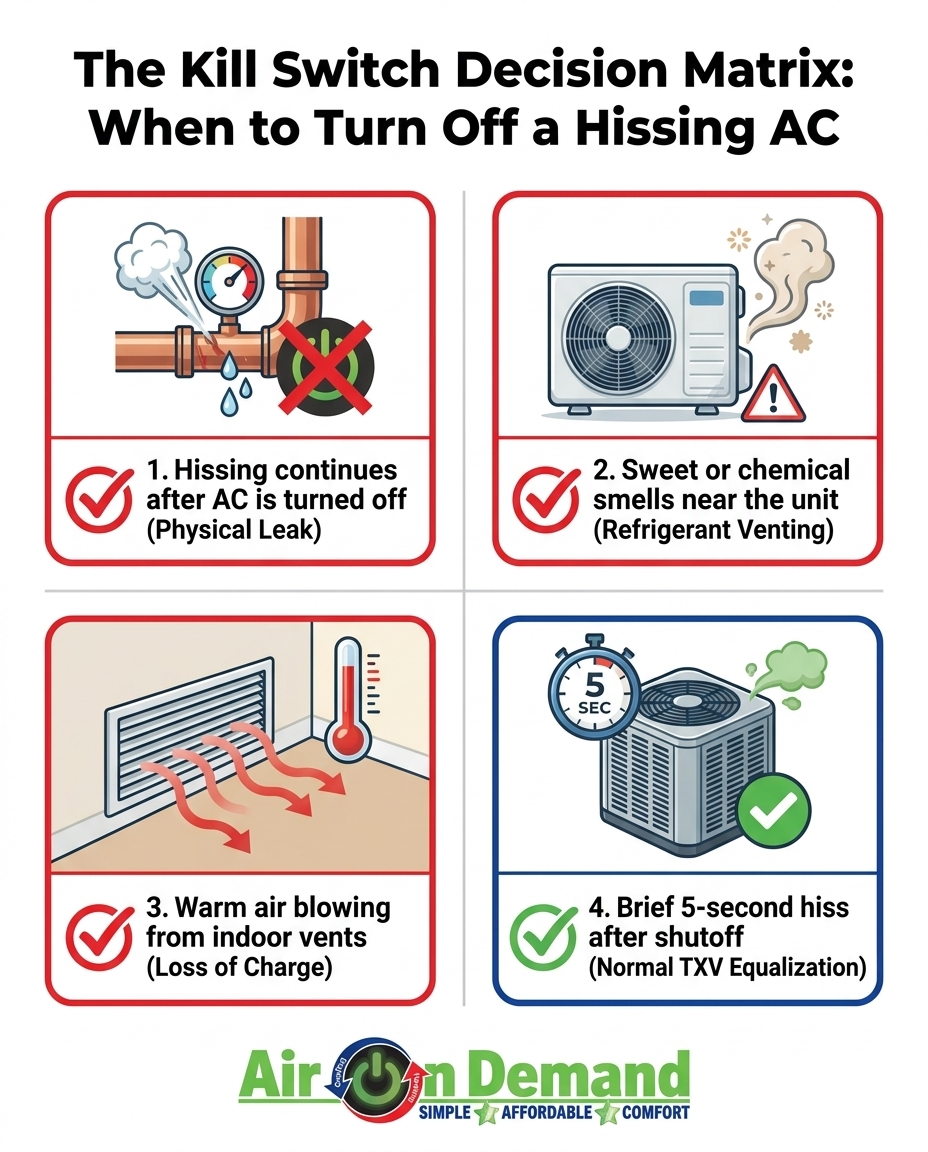
When you hear a loud hissing noise coming from your air conditioner, your first priority is determining if the system is actively venting refrigerant. Operating an air conditioner without the proper refrigerant charge will cause the compressor to overheat, seize, and permanently fail. To help you make an informed decision quickly, we use a specific diagnostic checklist. If you notice any of the following symptoms, treat the situation as an emergency, turn off your thermostat immediately, and contact a professional for emergency AC repair.
• The Post-Cycle Hiss Test: Pay close attention to what happens when the cooling cycle ends. If the hissing sound continues loudly for more than a few minutes after the outdoor unit completely shuts off, you are likely dealing with an active physical leak. The pressure is escaping through a crack or hole in the copper lines.
• Chemical or Sweet Odors: Refrigerant gas is mostly odorless, but the compressor oil that travels alongside it is not. If you detect a strangely sweet, chloroform-like, or harsh chemical smell near the outdoor condenser or blowing through your indoor vents, the system is actively venting its lifeblood into the air.
• Warm Air Blowing from Vents: Place your hand over a supply register while the system is running and hissing. If the air feels room temperature or distinctly warm, the system has already lost a significant portion of its high-pressure charge and can no longer absorb heat from your home.
• Visible Bubbling or Hissing at the Coil: If you safely look at the outdoor condenser coil and see bubbling, oily residue, or a localized spot where the hiss is originating, a brazed joint or copper tube has ruptured under the immense summer pressure.
• Ice Formation on the Refrigerant Lines: Counterintuitively, a lack of refrigerant causes the indoor evaporator coil to drop below freezing. If you see ice building up on the insulated copper line running outside, combined with a hissing sound, the system is starved for refrigerant.
The quick fix: If your system exhibits any of these critical warning signs, do not wait. Switch your thermostat to the "OFF" position immediately. Continuing to run the system will force the compressor to pull a vacuum, drawing in moisture and non-condensable gases that will destroy the internal valves.
Not every hiss coming from your HVAC system is a cause for panic. In fact, certain types of hissing sounds are a perfectly normal part of the refrigeration cycle. The key is understanding the difference between the intentional movement of gas and an unintentional rupture. This distinction often centers around a critical component called the Thermostatic Expansion Valve, or TXV.
The TXV is responsible for regulating the exact amount of liquid refrigerant that flows into your indoor evaporator coil. It acts as a strict gatekeeper, taking high-pressure, warm liquid from the outdoor unit and forcing it through a tiny microscopic orifice. As the liquid squeezes through this valve, it experiences a massive pressure drop, turning into a low-pressure, cold mist. This process is what allows the refrigerant to absorb heat from your indoor air.
When your air conditioner finishes a cooling cycle and shuts off, the high-pressure side of the system and the low-pressure side are temporarily unbalanced. The system naturally wants to equalize. As the remaining high-pressure refrigerant slowly bleeds through the TXV to balance the system, it creates a distinct, brief hissing or gurgling sound. This is known as pressure equalization.
Normal equalization hissing is brief, predictable, and harmless. However, when a copper line or internal valve fails, the sound changes dramatically. Active refrigerant venting is forceful, continuous, and highly destructive. Knowing how to tell the difference is a crucial part of diagnosing unusual AC noise complaints.
• Duration of Sound — Normal TXV Equalization: Lasts 10 to 60 seconds after shutoff, then fades to silence. — Dangerous Refrigerant Leak: Continuous, lasting minutes or hours until the system is entirely empty.
• Volume Level — Normal TXV Equalization: Faint, subtle hiss or light gurgling sound near the indoor unit. — Dangerous Refrigerant Leak: Loud, aggressive hiss resembling a punctured car tire.
• Cooling Performance — Normal TXV Equalization: System cools the house perfectly to the thermostat set point. — Dangerous Refrigerant Leak: System struggles to cool, runs constantly, and blows warm air.
• Accompanying Odors — Normal TXV Equalization: Completely odorless operation. — Dangerous Refrigerant Leak: Noticeable sweet, oily, or chemical smell near the equipment.
If your system's sound aligns with the right column of the table above, the time for observation has passed. The system is actively losing its vital charge, and immediate professional intervention is required to locate and seal the breach.
To fully grasp why high-pressure blowouts happen, it is helpful to understand the basic physics of modern air conditioning systems under heavy load. The refrigerant flowing through your copper lines is highly reactive to temperature changes. In fact, temperature and pressure are directly linked in a closed refrigeration loop. When the temperature outside rises, the internal pressure of your system rises right along with it.
Modern residential air conditioners primarily use a refrigerant called R-410A (often recognized by the brand name Puron). While this refrigerant is vastly superior for the environment compared to older, phased-out chemicals like R-22, it operates at significantly higher baseline pressures. On a mild spring day, the high-pressure side of an R-410A system might sit comfortably around 250 to 300 pounds per square inch (psi).
However, during extreme July heat, the dynamic changes completely. When ambient temperatures reach 95 degrees or higher, the outdoor condenser coil struggles to reject the heat it absorbed from inside your house. Because the outside air is already so hot, the heat transfer process becomes highly inefficient. To compensate, the compressor must work harder, compressing the gas even tighter to raise its temperature above the outdoor ambient air.
Under these grueling summer conditions, compressors run at 100% duty cycles, and internal high-side pressures can easily exceed 400 psi. At these extreme operational limits, the physical stress on the copper tubing, the brazed joints, and the internal valves is immense. A microscopic weakness in a copper elbow that held perfectly fine in April can suddenly rupture under the 400+ psi strain in July. When that pressurized gas violently escapes through the new rupture, it creates the loud hissing sound that catches your attention.
Running a compromised system under these conditions is incredibly dangerous for the equipment. As the refrigerant leaks out, the compressor loses its primary source of cooling. It will continue to pump frantically, overheating rapidly until the internal windings short out or the mechanical pistons seize entirely, turning a repairable leak into a total system replacement.
While extreme heat provides the pressure necessary to cause a blowout, the underlying weakness in the copper lines is often caused by environmental factors specific to the local geography. In coastal regions like Miami FL, outdoor HVAC equipment faces an invisible, relentless enemy: salt air. The unique combination of high humidity, extreme summer heat, and continuous exposure to airborne salt creates the perfect storm for accelerated metal degradation.
When the ocean breeze carries microscopic salt particles inland, they inevitably settle on the aluminum fins and copper tubing of your outdoor condenser coil. In our decades of serving Miami FL, our team at Air On Demand has found that because salt is highly hygroscopic, it attracts and holds moisture from the humid air. When salt and water mix on the surface of dissimilar metals (like copper and aluminum), it triggers a rapid electrochemical reaction known as galvanic corrosion.
Over time, this corrosion literally eats away at the molecular structure of the copper tubing. It does not usually create large, obvious holes. Instead, it creates microscopic, labyrinth-like tunnels through the metal, commonly referred to as pinhole leaks. The copper wall becomes paper-thin in these specific spots. To the naked eye, the coil might just look a little dull or lightly oxidized, but structurally, it has been severely compromised.
When the extreme heat of summer arrives and internal pressures spike past 400 psi, those paper-thin, corroded spots simply cannot hold the force. They burst open, resulting in a sudden, loud hissing sound and a rapid loss of cooling capacity. Because coastal environments are so punishing on outdoor equipment, waiting for a breakdown is a costly strategy.
Consistent, professional routine AC maintenance is the only effective way to combat this hidden threat. During a proper maintenance visit, technicians apply specialized, non-acidic coil cleaners that neutralize salt deposits and wash away corrosive buildup. They also inspect the integrity of the copper lines, catching early signs of pitting and oxidation before the stress of summer heat turns a microscopic weak point into a catastrophic high-pressure blowout.
When a homeowner hears a hissing noise and suspects a leak, the temptation to search for a quick DIY fix is strong. Hardware stores sell cheap cans of "refrigerant recharge" with attached gauges, promising an easy solution. However, attempting to diagnose or repair a high-pressure HVAC system without professional training and specialized tools is not just ineffective—it is highly dangerous and often illegal.
Checking refrigerant levels and pinpointing high-pressure leaks requires the use of specialized manifold gauges. These precision instruments connect directly to the service valves on your outdoor unit. Connecting and disconnecting these hoses to a system operating at 400+ psi requires specific techniques to prevent a sudden release of liquid refrigerant. If high-pressure liquid R-410A contacts human skin, it instantly boils, drawing massive amounts of heat away from the tissue and causing severe, instantaneous frostbite.
Furthermore, simply dumping more refrigerant into a hissing system is a guaranteed recipe for disaster. If you overcharge the system, the liquid refrigerant can flow backward into the compressor (a condition known as liquid slugging), destroying the internal valves instantly. A hissing sound means there is a physical hole; adding more gas without finding and brazing the hole shut simply wastes money and vents more chemicals into the atmosphere.
Because refrigerants have a significant impact on the environment, the federal government strictly regulates their use. Under EPA Section 608 guidelines, it is a violation of federal law for anyone other than a certified, licensed technician to handle, recover, or recharge regulated refrigerants. Professionals use electronic sniffer tools, ultrasonic leak detectors, and ultraviolet dye to safely isolate the exact location of the hiss without risking further damage to the compressor.
Relying on trusted local experts in Miami FL ensures that your system is diagnosed safely and legally. A certified technician will safely recover any remaining refrigerant, braze the leak shut with silver solder under a nitrogen purge, pressure-test the repair, and pull a deep vacuum to remove all moisture before carefully weighing in the exact factory-specified charge.
When extreme heat pushes systems to their limits, homeowners frequently search for answers to understand what their equipment is doing. Below are the most common questions we receive regarding hissing noises, with direct answers to help you determine your next steps.
It is usually either normal pressure equalization in the expansion valve or a physical leak in the refrigerant lines. If the sound is brief and happens right after the system turns off, it is likely just the internal pressures balancing out. However, if the hiss is loud, continuous, and accompanied by a loss of cooling power, you are almost certainly dealing with a ruptured copper line or failing valve.
Yes, if the hiss is loud, continuous, or accompanied by warm air from your vents, turn it off immediately to protect the compressor. Continuing to run the system while it lacks refrigerant will cause the compressor motor to overheat and eventually seize. Shutting off the power at the thermostat is the safest way to prevent a relatively minor leak repair from turning into a total system replacement.
A refrigerant leak will typically hiss continuously even after the system cycles off and may produce a sweet, chemical odor. You will also notice a rapid decline in cooling performance, with the air coming out of your vents feeling lukewarm rather than crisp and cold. In severe cases, you may even see bubbling oil or frost accumulating on the larger copper line outside.
While rare, extreme high pressure combined with a failing compressor can cause dangerous ruptures; professional diagnosis is mandatory. Modern systems have internal pressure relief valves designed to prevent catastrophic explosions, but if those safety mechanisms fail during extreme summer heat, the compressor casing can violently vent. Never approach a violently hissing, shaking outdoor unit—cut the power at the breaker panel instead.
This is normal pressure equalization as the refrigerant balances between the high and low sides of the system. The thermostatic expansion valve (TXV) slowly allows the high-pressure liquid to bleed into the low-pressure evaporator coil until the system is at a state of rest. As long as the sound fades away within a minute and your home remains cool, this is a sign of normal, healthy operation.
Dealing with a loud ac hissing sound during the peak of summer is undeniably stressful, but you now have the knowledge to assess the situation safely. By applying the kill switch decision matrix, you can confidently distinguish between the harmless sound of normal pressure equalization and the urgent warning signs of a dangerous refrigerant leak. Remember that ignoring a continuous hiss during severe heat will inevitably lead to an overheated, permanently damaged compressor.
When the temperature spikes and your system is pushed to its absolute limits, do not take chances with DIY fixes or wishful thinking. Protect your home's comfort and your equipment's lifespan by trusting licensed professionals to properly locate, isolate, and repair high-pressure leaks. If your system is struggling to keep up and making unusual noises, reach out to our team for expert AC repair in Miami today, and let us restore your peace of mind safely and efficiently.