Phasing Out R-410A: What the Refrigerant Transition Means for August Replacements
August 17, 2026
Your air conditioner is running nonstop, but the vents are only blowing lukewarm air, and a slow drip is forming near the indoor air handler. Dealing with a sudden breakdown brings up a critical question regarding phasing out R-410A: what the refrigerant transition means for August replacements in your home. Here at Air On Demand, our technicians see this exact scenario play out every late summer. When your system loses its cooling capacity right as the back-to-school season heat peaks, you are faced with a time-sensitive choice. Do you patch the leak and recharge an aging system, or is it time to upgrade your equipment entirely?
If you are weighing your options, exploring new AC units can help clarify the AC repair vs replace decision.
The HVAC industry is currently undergoing a massive shift that fundamentally changes the traditional calculus for repairing older air conditioners. For decades, R-410A was the gold standard for residential cooling. Today, that standard is being retired to make way for more environmentally friendly alternatives. Acknowledging the immediate discomfort of an AC breakdown in Miami FL is only the first step. You also need to understand how this regulatory shift impacts the long-term reliability of your home comfort system. Making an informed decision now prevents repeated service calls and ensures your home remains consistently cool for the next decade.
The Problem: We frequently speak with homeowners who are suddenly discovering that the refrigerant powering their current air conditioner is being targeted for a nationwide phase-down. This creates uncertainty about the future viability and maintenance of systems installed over the past ten to fifteen years.
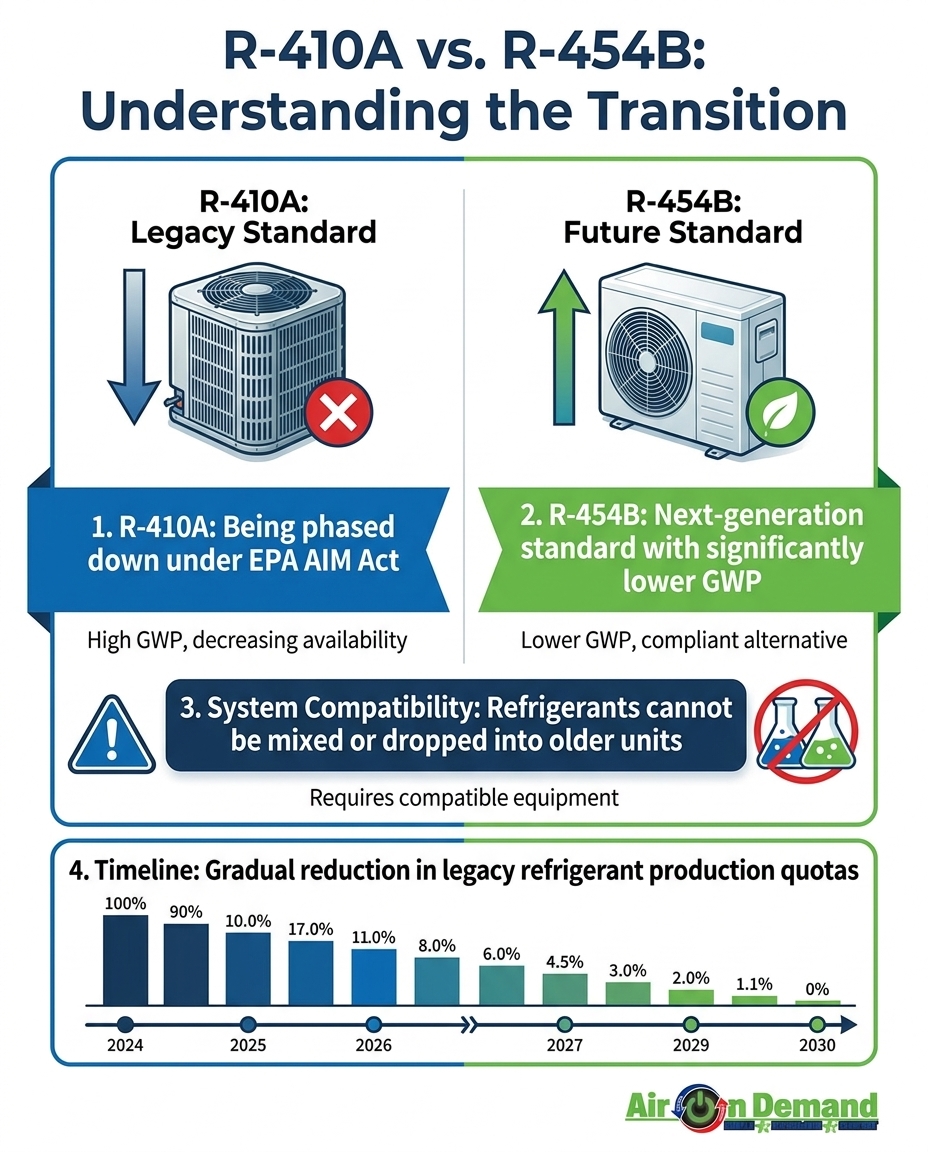
The Cause: The shift is driven by the Environmental Protection Agency's American Innovation and Manufacturing (AIM) Act. This legislation mandates a strict, phased reduction in the production and consumption of hydrofluorocarbons (HFCs) that possess a high Global Warming Potential (GWP). R-410A falls directly into this category. While the refrigerant is not instantly banned from being used in existing systems, the chemical manufacturing quotas are being drastically reduced year over year. Historically, when the supply of a legacy refrigerant is choked off, the availability for future maintenance becomes highly constrained.
The Solution: The HVAC industry has developed next-generation alternatives, leading to the R-410A to R-454B equipment transition. R-454B is the newly adopted industry standard for residential cooling, offering a vastly lower environmental impact while maintaining exceptional cooling performance.
The AIM Act outlines a gradual reduction rather than an abrupt cutoff. The production of high-GWP refrigerants faces steep quota drops over the next decade. By 2036, the production of these chemicals is scheduled to be reduced by 85 percent compared to historical baselines. For existing systems, this means that while you can legally continue operating an R-410A air conditioner, sourcing the necessary refrigerant to fix future leaks will become increasingly difficult as the available supply dwindles.
To meet the new federal mandates, manufacturers have transitioned to a class of refrigerants known as A2Ls. R-454B is the prominent A2L chosen to replace R-410A. These new refrigerants are classified as mildly flammable but are heavily engineered with integrated safety sensors and mitigation protocols, making them exceptionally safe for residential use. Beyond meeting environmental regulations, R-454B offers excellent thermodynamic properties, which translates to efficient, reliable cooling for your home.
Understanding the broad industry transition is important, but applying it to your local environment is critical. In our decades of keeping Miami FL cool, the Air On Demand team has seen firsthand how operating an air conditioner here presents unique challenges you simply will not find in milder, inland climates. Here, systems run nearly year-round, putting immense, continuous strain on aging compressors and mechanical components. This relentless workload means that an air conditioner reaches the end of its operational lifespan much faster.
Furthermore, coastal humidity and salt air act as aggressive catalysts for systemic wear. The salt-laden air constantly interacts with the copper and aluminum components of your outdoor condenser coil. Over time, this exposure leads to galvanic corrosion. The metal literally pits and weakens, creating microscopic vulnerabilities across the entire surface of the coil. When a refrigerant leak occurs in this environment, our technicians rarely find it to be an isolated incident. Instead, it is typically a glaring symptom of broader systemic deterioration.
Because the environment accelerates this breakdown, older systems become highly susceptible to catastrophic refrigerant leaks. A coil that has begun to rot from salt air exposure cannot simply be welded back to factory condition. The structural integrity of the metal is compromised. When you factor in the intense workload required to combat the humidity, these weakened coils are under constant high pressure, making subsequent leaks almost inevitable.
When faced with a leaking unit during the August late-summer peak heat, deciding your next step requires careful evaluation. Finding and patching a leak on a corroded coil is a labor-intensive process. A technician must locate the microscopic hole, attempt to braze the weakened metal, pressure-test the repair, and then recharge the system with R-410A. Because the underlying issue is often widespread corrosion, fixing one weak spot frequently causes the pressurized refrigerant to simply find the next weakest point on the coil. Our repair crews see this frustrating pattern constantly.
This creates a cycle of diminishing returns. You are continually investing in recharging a system with a legacy refrigerant that is actively being phased out. The short-term relief of a patch job is often overshadowed by the likelihood that the system will fail again when pushed to its limits during the hottest weeks of the year. We consistently recommend that for many homeowners, a complete AC replacement offers a more definitive, reliable solution.
Patching a significantly aged coil is a temporary measure. As the metal degrades, the entire surface area becomes a liability. In harsh coastal climates, relying on a patched R-410A system means risking another total loss of cooling right when you need it most. Evaluating the age, repair history, and overall condition of your unit is essential before committing to a costly repair on obsolete equipment.
• Reliability — Patching R-410A System: Temporary fix; high risk of subsequent leaks on corroded coils. — Upgrading to R-454B System: Long-term stability with brand-new, factory-sealed components.
• Refrigerant Supply — Patching R-410A System: Subject to strict EPA phasedown quotas and availability constraints. — Upgrading to R-454B System: The new industry standard, ensuring abundant supply for decades.
• Performance — Patching R-410A System: Struggles to maintain efficiency due to wear and tear. — Upgrading to R-454B System: Optimized thermodynamics for superior cooling and humidity control.
The R-410A to R-454B equipment transition is not just a regulatory hurdle; it represents a significant leap forward in cooling technology. The new refrigerant benefits the homeowner directly through improved performance, better efficiency, and a substantially lower environmental footprint.
1. Massive Reduction in Global Warming Potential (GWP): The primary driver behind the AIM Act is lowering greenhouse gas emissions. R-454B has a GWP that is nearly 78 percent lower than R-410A. This means that in the unlikely event of a leak, the environmental impact is drastically minimized.
2. Enhanced Thermodynamic Properties: R-454B is incredibly efficient at absorbing and releasing heat. This optimized heat transfer allows the compressor to operate with less effort, reducing the overall electrical draw required to cool your home.
3. Superior Cooling Performance: Because the refrigerant absorbs heat more effectively, systems utilizing R-454B can provide faster, more consistent cooling. This translates to better comfort during the hottest parts of the year, quickly pulling down indoor temperatures and managing heavy humidity loads.
4. Potential for Energy Rebates: Upgrading to high-efficiency equipment often qualifies homeowners for various incentives. Generally applicable energy rebates, federal tax credits, or local utility incentive programs may apply to qualifying installations. It is always recommended to verify current programs with your utility provider or a tax professional to see how high-efficiency upgrades can benefit you.
Positioning a system upgrade as a strategic investment rather than a forced expense changes how you approach your home comfort. Future-proofing your home means installing equipment that is fully aligned with the EPA AIM Act and the R-410A to R-454B equipment transition. By adopting the new standard now, you bypass the uncertainty of legacy refrigerant shortages and secure reliable cooling for the next ten to fifteen years.
New equipment is engineered specifically from the ground up to maximize the benefits of R-454B. These are not just older units with a different chemical inside; they feature redesigned compressors, optimized coil surfaces, and advanced sensors. When paired with modern variable-speed technology, these next-generation systems offer unprecedented control over indoor humidity—a crucial factor for coastal living. As a premier installer of advanced Daikin equipment, our team at Air On Demand ensures your home is equipped with reliable, cutting-edge technology that meets all upcoming environmental standards while delivering premium comfort.
It is critical to understand that R-454B cannot simply be dropped into an older R-410A system. The two refrigerants operate at different pressures and require entirely different internal lubrication oils. Furthermore, A2L systems require specific safety mitigation sensors built directly into the air handler. Attempting to retrofit an old system is both unsafe and mechanically impossible. A complete system match—replacing both the indoor and outdoor units—is absolutely necessary to ensure safety, efficiency, and warranty compliance.
Waiting for an aging system to completely fail during the August late-summer peak heat severely limits your options. When your AC dies on the hottest day of the year, the urgency to restore cooling often forces rushed decisions. By taking a proactive approach, you maintain control over the process, ensuring you select the right equipment for your home rather than settling for whatever is immediately available in the warehouse.
Scheduling an upgrade proactively allows you to navigate the current inventory transitions smoothly. As manufacturers ramp down R-410A production and ramp up R-454B units, working with our professional team early ensures you get the exact specifications your home requires. Plus, upgrading before the season ends means you get to enjoy immediate efficiency gains and reliable, uninterrupted cooling for the remainder of the hot season.
Before consulting a professional for tips for replacing a central air conditioner, gather a few key details to streamline the process:
• System Age: Locate the manufacturing date on your outdoor condenser's data plate. If the unit is over 10 years old, replacement is highly recommended.
• Repair History: Note any recent service calls, especially previous refrigerant recharges or motor replacements.
• Energy Bills: Check your summer utility bills for unexplained spikes, which indicate your system is losing efficiency.
• Warranty Status: Verify if your current equipment still has an active parts warranty, though labor and refrigerant are rarely covered on older units.
Navigating the phase-out of legacy refrigerants does not have to be overwhelming. The reality of operating an air conditioner in Miami FL means that your equipment works incredibly hard, and patching a leaky, corroded R-410A unit often leads to repeated frustrations. The R-410A phase-out makes upgrading to a modern, high-efficiency R-454B system a smarter, long-term choice than pouring resources into obsolete technology.
Understanding the toll that harsh coastal climates take on aging equipment helps clarify why a proactive replacement is the most reliable path forward. We encourage you to consult with our local professionals to evaluate the specific condition of your current unit. By exploring phasing out R-410A: what the refrigerant transition means for August replacements, you can confidently secure your home's comfort, efficiency, and peace of mind for the decade ahead.
Will R-410A be completely banned?
No, the EPA is not banning the use of R-410A in existing systems. You can legally continue to operate your current air conditioner. However, the AIM Act mandates a severe phase-down in the production of the refrigerant, which will significantly restrict future supply and make maintenance more difficult over time.
Can I still buy a new R-410A air conditioner today?
Yes, while inventory lasts, you can still purchase a new R-410A system during the transition period. Manufacturers are allowed to sell through their existing stock of legacy equipment. However, investing in an older standard means you may face challenges sourcing refrigerant for future repairs.
What is replacing R-410A in residential systems?
R-454B is the primary refrigerant replacing R-410A in residential air conditioning systems. It belongs to a class of mildly flammable A2L refrigerants that offer a vastly lower Global Warming Potential (GWP). This new standard provides excellent energy efficiency and cooling performance.
Should I wait to buy a new AC with the new refrigerant?
If your current system is failing or requires a major repair like a leak patch, waiting is not advisable. Upgrading to a new R-454B system now prevents you from sinking resources into obsolete equipment. Proactive replacement ensures reliable cooling and immediate efficiency gains.
Can I put R-454B refrigerant into my old R-410A system?
No, R-454B cannot be used in a system designed for R-410A. The two refrigerants operate at different pressures, use different lubrication oils, and require specific internal components. Upgrading to R-454B requires a complete replacement of both the indoor and outdoor units.
How does the AIM Act affect my current air conditioner's warranty?
The AIM Act does not void your existing manufacturer warranty. If a covered part fails, the manufacturer will still honor the parts warranty based on their terms. However, warranties typically do not cover the cost of the replacement refrigerant itself, which may become harder to source as production decreases.