Upgrading Undersized Ductwork in Older Kendall Ranch Homes
August 17, 2026
Your air conditioner is finally giving out, and you are ready to invest in a modern, high-efficiency replacement. However, upgrading undersized ductwork in older Kendall Ranch homes is often the unexpected hurdle standing between you and reliable indoor comfort. A typical pattern we see is a homeowner purchasing a premium AC unit, only to discover that the home's original 1970s ductwork is fundamentally incompatible with modern technology.
Slapping a modern high-efficiency variable-speed unit onto old, restrictive ducts degrades performance rather than improving it. The new system attempts to push a specific volume of air through narrow channels, creating severe resistance. This leaves you at a critical decision point: risking immense system strain and poor cooling with your current setup, or investing in a proper ductwork modification to match your new equipment.
For comprehensive solutions that address the entire system, trust our Miami air conditioning services to evaluate your home's complete cooling infrastructure before installation day.
Homes built decades ago were designed around the building standards and equipment sizes of their era. In Kendall Ranch Homes, specific architectural features make modern HVAC retrofits particularly challenging. The defining characteristic of these properties is their low-slope rooflines, which create extremely tight attic spaces. When the original cooling systems were installed, the standard practice was to use smaller, rigid metal ducts or undersized flexible ducting that easily fit into these cramped overhead areas.
Today's high-efficiency air conditioners require significantly more breathing room. The physical dimensions of modern, larger-diameter ductwork simply do not slide easily into spaces designed for older, smaller materials. Air On Demand brings extensive local experience diagnosing and retrofitting the specific architectural quirks of these low-pitch roof homes, ensuring that new ducting is routed efficiently without compromising the structural integrity of your attic.
A standard low-pitch roof—often featuring a 3:12 or 4:12 slope—leaves very little vertical clearance near the eaves. This physical space limitation restricts where new, wider ducts can be safely routed. Standard duct replacement techniques often fail here because a straight swap is physically impossible.
Instead, retrofitting requires careful adaptation. Professionals must calculate the exact pathways available, sometimes transitioning between different shapes of ductwork (such as moving from round to rectangular profiles) to maintain the necessary interior volume while squeezing through tight clearances. This careful planning ensures the new system receives the airflow it needs without crushing the ducts against roof trusses or burying them improperly in insulation.
To understand why old ducts ruin new air conditioners, you have to look at the physics of airflow. Static pressure is the resistance to airflow within your HVAC system. Think of it like blood pressure for your house: if the arteries (ducts) are too narrow, the heart (the blower motor) has to work dangerously hard to pump air through the home.
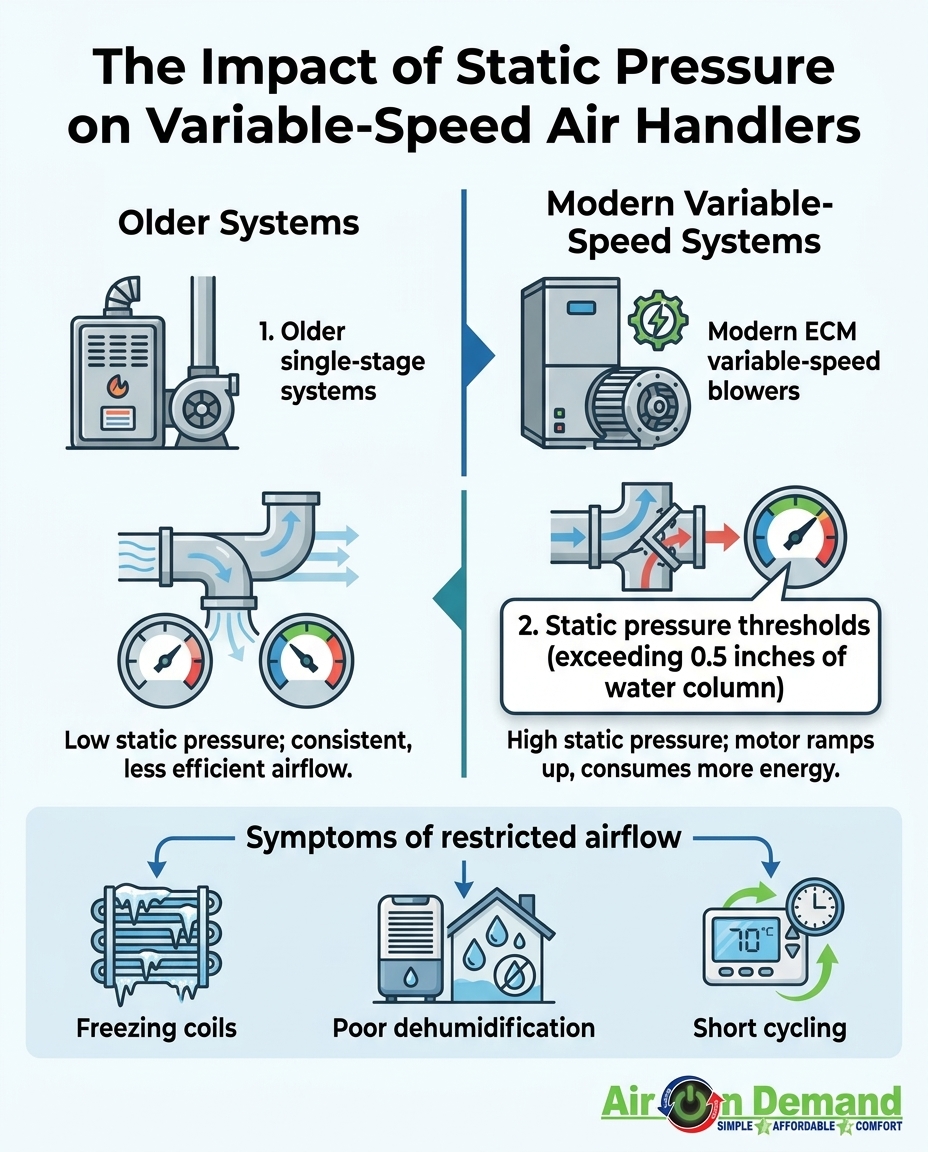
Older 1970s systems featured single-stage blowers that simply turned on at full blast and turned off when the thermostat clicked. Modern units use ECM (Electronically Commutated Motor) variable-speed blowers. These advanced motors are designed to ramp up and down, providing precise climate control. However, they are highly sensitive to resistance. If the static pressure exceeds 0.5 inches of water column—a common occurrence when forcing air through original, undersized ducts—the ECM motor will overwork itself, leading to overheating and premature failure.
This is why upgrading to variable-speed air handlers requires a complete assessment of your delivery system, not just an equipment swap.
• Blower Operation — 1970s Single-Stage HVAC: On (100% capacity) or Off — Modern Variable-Speed (ECM) HVAC: Ramps up and down based on cooling demand
• Airflow Tolerance — 1970s Single-Stage HVAC: Pushes through restrictive ducts (with reduced output) — Modern Variable-Speed (ECM) HVAC: Requires precise, unrestricted airflow to function correctly
• Static Pressure Limit — 1970s Single-Stage HVAC: Often pushed past limits without immediate failure — Modern Variable-Speed (ECM) HVAC: Motors fail prematurely if resistance exceeds 0.5 inches WC
• Duct Size Requirement — 1970s Single-Stage HVAC: Smaller diameters were standard practice — Modern Variable-Speed (ECM) HVAC: Requires larger diameters to handle specific CFM profiles
Modern high-efficiency systems require a specific CFM (Cubic Feet per Minute) airflow profile to operate correctly. Variable-speed systems adjust this airflow constantly. When undersized ducts choke this process, the system cannot move enough air over the indoor coil. This mismatch directly impacts performance, making it completely impossible to achieve the SEER2 efficiency rating printed on the side of your new unit.
Airflow restrictions do more than just strain your equipment; they severely degrade your indoor comfort, particularly when it comes to moisture control. The intense late-summer heat and high year-round humidity of South Florida require robust airflow to properly dehumidify a living space. During late summer (August) in Miami, removing moisture from the air is just as important as lowering the temperature.
Unrestricted airflow is critical to a variable-speed system's ability to remove this moisture. Your air conditioner dehumidifies by passing warm, moist indoor air over the freezing cold evaporator coil. Condensation forms on the coil and drains away outside. However, if choked airflow prevents enough air from crossing that coil, the moisture extraction process stalls. The system may run endlessly without actually pulling the humidity out of the air.
The result is a home that feels cold but incredibly clammy. You might lower the thermostat to 70 degrees, but because the humidity remains high, the air feels heavy and uncomfortable. Addressing the ductwork alongside professional air balancing ensures the air moves at the exact speed required to maximize dehumidification.
Homeowners living in Kendall Ranch Homes often experience specific symptoms when their original ductwork is actively choking a newer AC unit. Recognizing these warning signs early can save your expensive equipment from catastrophic failure.
• Unusually loud air vents: If your vents sound like a jet engine taking off or produce a high-pitched whistling noise, the air is being forced through an opening that is much too small.
• Freezing evaporator coils: When airflow is severely restricted, the cold air stays trapped inside the air handler. This causes the evaporator coil to literally freeze over into a block of ice, shutting down the cooling process entirely.
• Short cycling: This occurs when the system turns on and off rapidly. High static pressure can cause the unit to overheat and shut down via safety switches before it has adequately cooled the space.
• Uneven temperatures: If your living room is freezing but the back bedrooms are hot and stagnant, the undersized ducts are failing to distribute the conditioned air evenly throughout the floor plan.
If you notice any of these symptoms after a recent equipment upgrade, the root cause is almost certainly an infrastructure mismatch rather than a defective air conditioner.
Guessing at duct sizes is a recipe for disaster. The HVAC industry relies on a strict set of calculations known as the ACCA Manual D standard to determine the exact ductwork requirements for any given home. This professional sizing process is the only way to ensure your new system receives the precise volume of air it needs to function.
Professionals use these standards to account for the specific friction loss of different duct materials. For example, air moves differently through smooth sheet metal than it does through corrugated flexible ducting. When dealing with the tight attics of 1970s builds, technicians must carefully plan the layout to retrofit larger ducts without crushing them, which would immediately ruin the airflow calculations.
Proper AC installation in Kendall, FL requires mapping out these restrictive low-slope attics in advance, ensuring the new ductwork meets Manual D standards while respecting the physical boundaries of the property.
Friction loss refers to the drag created as air travels along the inside walls of the ductwork. The texture of the material, the number of sharp turns, and the total length of the run all impact this resistance.
1. Assess the material: Flexible ducts have higher friction loss than rigid metal and require slightly larger diameters to deliver the same CFM.
2. Count the turns: Every 90-degree elbow adds significant resistance, meaning a winding duct path requires careful up-sizing.
3. Calculate the total length: The further the air has to travel to the furthest bedroom, the more pressure is lost along the way.
Proper friction loss calculations prevent the new system from working against itself, ensuring smooth, quiet, and efficient operation.
Upgrading your air conditioner is a major investment in your property's comfort and value. However, proper ductwork is the absolute only way to realize the energy savings promised by high SEER2 ratings. A 16-SEER2 system hooked up to undersized, leaky ducts will operate with the efficiency of a 10-SEER system, wasting electricity every time it cycles on.
By reducing static pressure to acceptable levels, you directly extend the lifespan of the costly variable-speed ECM motor. When the motor doesn't have to fight against extreme resistance, it runs cooler, draws less amperage, and lasts years longer. Furthermore, properly sized ducts drastically improve your indoor air quality and provide consistent comfort, even during the brutal heat of late summer (August) in Miami.
If you are unsure whether your current setup is holding your system back, learning When Do I Need Duct Replacement? is the best next step toward protecting your investment.
Undersized ductwork restricts airflow, causing static pressure to spike inside the system. This forces the blower motor to work significantly harder, leading to overheating, loud whistling noises at the vents, and potential evaporator coil freezing. Ultimately, the new AC will consume more electricity while providing less cooling power to the home.
Not always, but it is highly likely if your home still has its original 1970s infrastructure. Variable-speed air handlers require precise airflow to function correctly, and older ducts were typically sized much smaller for basic single-stage systems. A professional static pressure test will determine if your current ducts can handle the new technology.
Yes, running a modern system on severely undersized ducts can cause permanent damage. The excessive resistance causes the blower motor to draw higher electrical currents, which can burn out the ECM motor prematurely. It also puts undue stress on the compressor due to repeated short cycling and poor heat exchange.
Fixing the issue requires a custom retrofit based on ACCA Manual D calculations. Professionals map out the tight attic space and design a layout that maximizes airflow within the physical constraints, often utilizing a mix of rigid metal plenums and carefully routed flexible ducts to navigate low-pitch rooflines without crushing the materials.
Proper dehumidification requires a specific volume of air to pass steadily over the cold evaporator coil. If undersized ducts choke the airflow, the system cannot process enough indoor air to extract the moisture effectively. This leaves the home feeling cold but uncomfortably clammy, regardless of the thermostat setting.
Addressing the root cause of airflow issues is the only way to guarantee long-term comfort in older properties. Upgrading undersized ductwork in older Kendall Ranch homes ensures that your high-efficiency equipment can finally operate exactly as the manufacturer intended. Rather than simply swapping boxes and hoping for the best, a technically accurate diagnosis of your home's infrastructure provides lasting peace of mind.
You do not have to settle for loud vents, clammy rooms, or skyrocketing energy bills. We encourage you to schedule an expert evaluation to ensure your home's entire cooling infrastructure is fully compatible, securing reliable and efficient comfort for years to come.