
Standard Service Calls vs. Deep Chemical Coil Cleaning for Chronic Airflow Issues
July 30, 2026
Why is your air conditioning system running constantly, yet barely pushing a breeze through the vents? Choosing between standard service calls vs. deep chemical coil cleaning for chronic airflow issues is a critical decision when your home feels uncomfortably warm. During the peak July summer heat, your cooling system works overtime. If the air coming from your registers feels weak, our team at Air On Demand frequently finds that the culprit is rarely a failing fan motor. Most often, the problem lies hidden inside the air handler: an evaporator coil choked by thick biological growth.
If you are dealing with severely restricted airflow right now, you might need more than a basic wipe-down. Learn more about our deep chemical coil cleaning services to restore your system's performance.
Many homeowners assume a standard tune-up will instantly fix weak airflow. While regular maintenance is highly effective for general upkeep, it has physical limitations. When extreme humidity causes wet, biological slime to embed deep within the microscopic gaps of your cooling coil, a basic brush cannot reach the root of the blockage. Understanding exactly what is happening inside your system is the first step toward getting your home comfortable again.
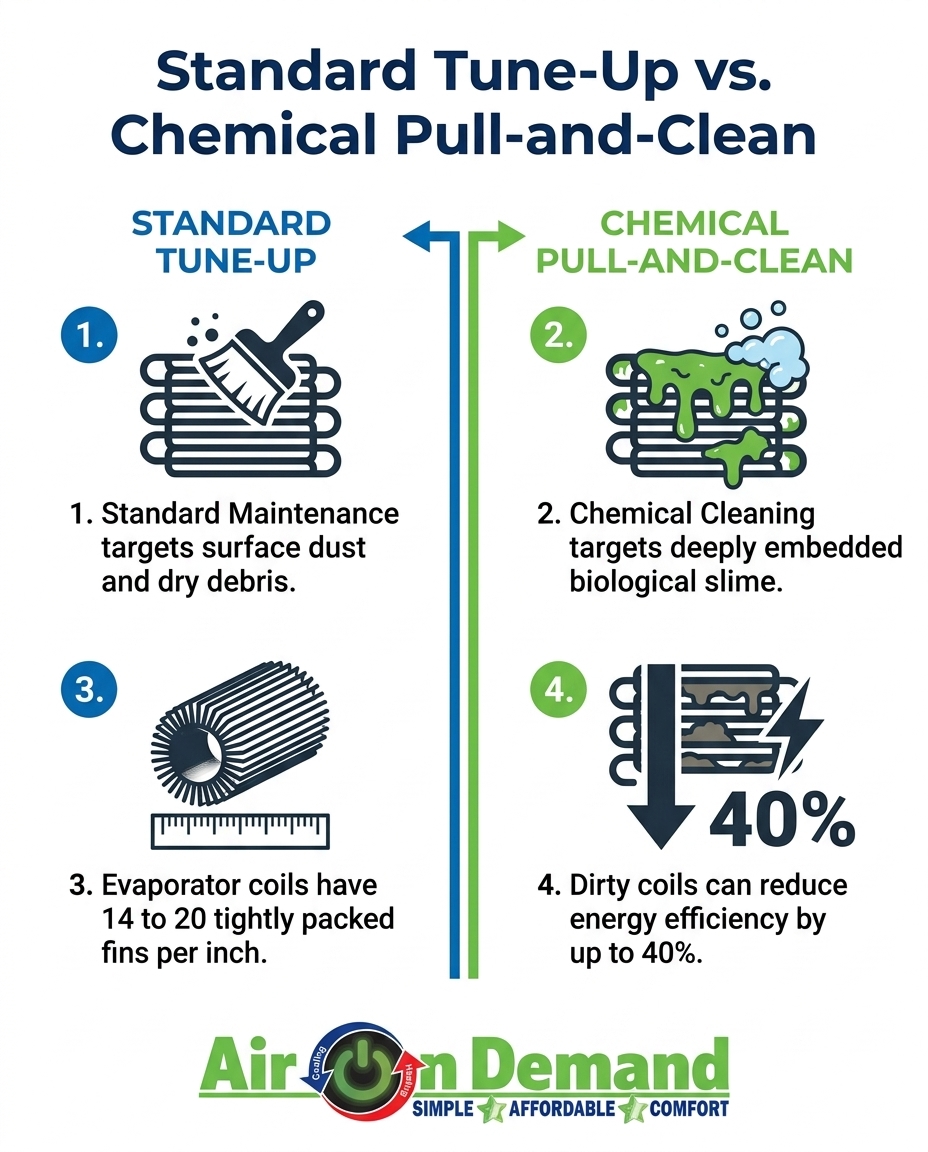
To understand why airflow drops so dramatically, you have to look at how an evaporator coil is built. These coils are not solid blocks of metal. They are made of copper or aluminum tubing surrounded by thousands of incredibly thin aluminum fins. Most modern cooling systems feature between 14 and 20 tightly packed fins per inch. These microscopic gaps maximize the surface area for heat transfer, but they also create the perfect trap for debris.
Living in Miami FL means your air conditioner handles a uniquely massive latent heat load. Latent heat refers to the energy required to remove moisture from the air. In our years of servicing local HVAC systems, we've seen firsthand how our subtropical climate's year-round high humidity leaves your evaporator coil constantly dripping with condensation. This relentless moisture turns the dark, enclosed space of your air handler into an ideal breeding ground for biological slime.
The embedding process: As airborne dust, pet dander, and microscopic organic matter bypass your air filter, they stick to the wet coil. Over time, this mixture forms a thick, wet sludge. This biological matter does not just sit on the outer surface of the coil. The constant pull of the blower fan draws the slime deep into the tight spaces between the 14 to 20 fins per inch.
The impact on your energy bills and comfort is immediate. According to Department of Energy (DOE) data, dirty evaporator coils can reduce a cooling system's energy efficiency by up to 30% to 40%. The system has to run much longer to remove the same amount of heat, driving up your utility costs while failing to keep the house cool.
A standard maintenance visit is designed to keep a relatively clean system running at peak efficiency. It is a preventative measure, not a deep restorative procedure. When an Air On Demand technician performs a routine tune-up in Miami FL, coil cleaning is usually part of the checklist, but the methodology is strictly surface-level.
Here is exactly what our professionals do during a standard surface cleaning:
1. System Shutdown and Access: The technician turns off the power and removes the access panel on the indoor air handler to expose the A-coil or slab coil.
2. Visual Inspection: The technician checks the outer surface of the fins for visible dust blankets, pet hair, and light debris.
3. Soft-Bristle Brushing: Using a specialized soft brush, the technician gently sweeps the outer surface of the fins, always moving in the direction of the grain to avoid bending the delicate aluminum.
4. Light Vacuuming: A shop vacuum with a brush attachment pulls away the loosened dry debris from the surface and the drain pan.
This method is highly effective for removing dry dust and light surface accumulation. If you are diligent about keeping your air conditioner clean with regular filter changes, a standard wipe-down is usually all your system needs to maintain strong airflow. However, it is explicitly not designed to extract deeply embedded, wet biological matter.
Applying the wrong cleaning method to a heavily choked coil can actually make your airflow problems worse. Misdiagnosing deep biological embedding is a common issue that leads to recurring service calls and ongoing frustration.
The Problem: When an evaporator coil is packed with wet biological slime, the restricted airflow forces the blower motor to work harder. The system runs continuously during the peak July summer heat, but the house stays warm. A pattern we see often is homeowners requesting a standard tune-up, hoping a quick brush will solve the issue.
The Cause: Using a standard maintenance brush on thick, wet biological growth is physically counterproductive. Because the fins are packed 14 to 20 per inch, brushing the surface often pushes the wet matter deeper into the microscopic gaps. Instead of removing the blockage, the brush acts like a trowel, packing the slime tightly into the center of the coil. This creates a solid plug that completely chokes off the air supply.
The Solution: Once biological growth has embedded beyond the outer surface, mechanical brushing is physically incapable of reaching it. Pushing the system to operate with a plugged coil increases internal wear and tear, often leading to frozen lines, overheated compressors, and unexpected breakdowns. If your system reaches this point, you will likely need professional AC repair to resolve the underlying restriction through specialized chemical extraction.
When our technicians encounter a severely plugged coil, a chemical pull-and-clean is the definitive technical solution we recommend. This is a major restorative procedure designed to return a heavily neglected coil to factory airflow specifications. Because this process involves handling high-pressure refrigerants, it must only be performed by a licensed professional.
The "Pull" Process: Unlike a standard wipe-down, a deep chemical clean usually requires safely removing the entire evaporator coil from the indoor air handler. A technician must safely recover the system's refrigerant using specialized, EPA-approved equipment. Once the refrigerant is secured, the copper lines are cut, and the heavily soiled coil is physically pulled out of the unit and taken outside.
The Chemical Extraction: Once outside, the technician applies specialized, heavy-duty foaming chemicals directly to the aluminum fins. These chemicals are specifically formulated to break down biological growth and heavy grime. As the chemical reacts, it creates a thick foam that expands outward. This expansion physically pushes the deeply embedded slime out from between the tight 14-20 fins per inch.
Neutralization and Reinstallation: After the foaming action extracts the debris, the coil is thoroughly rinsed with water to neutralize the chemicals and wash away the sludge. The newly cleaned coil is then reinstalled in the air handler in Miami FL. The technician brazes the copper lines back together, pulls a deep vacuum to remove any moisture from the refrigerant lines, and recharges the system to the exact factory specifications. The result is a total restoration of airflow and cooling capacity.
To help you understand exactly what each service provides during the peak July summer heat, here is a direct comparison of the two approaches.
• Target Contaminants — Standard Maintenance Wipe-Down: Dry dust, pet hair, and light surface debris. — Deep Chemical Pull-and-Clean: Deeply embedded biological slime and heavy grime.
• Methodology — Standard Maintenance Wipe-Down: In-place brushing and light vacuuming. — Deep Chemical Pull-and-Clean: Complete coil removal and expanding chemical foaming.
• Primary Goal — Standard Maintenance Wipe-Down: Preventative upkeep and efficiency maintenance. — Deep Chemical Pull-and-Clean: Restorative airflow recovery and deep sanitization.
• Airflow Impact — Standard Maintenance Wipe-Down: Maintains current factory efficiency. — Deep Chemical Pull-and-Clean: Restores severely restricted airflow to factory specs.
• Time Required — Standard Maintenance Wipe-Down: Typically completed within a standard 1-2 hour visit. — Deep Chemical Pull-and-Clean: Requires several hours of intensive technical labor.
You should never have to guess which cleaning method your system requires. At Air On Demand, our decades of hands-on technical expertise allow us to accurately diagnose when an AC system requires a comprehensive chemical pull-and-clean versus a basic tune-up. We position ourselves as honest diagnostic experts because we believe in solving the root cause—a philosophy we've maintained through countless Miami summers.
Static Pressure Testing: Professionals do not just look at a coil; they measure the airflow resistance. By performing a static pressure test, a technician can determine exactly how hard the blower motor is working to push air through the system in Miami FL. If the static pressure drop across the evaporator coil is significantly higher than the manufacturer's specifications, it indicates a severe internal blockage.
Temperature Drop Measurements: Technicians also measure the Delta T—the temperature difference between the air entering the system and the air leaving it. If the airflow is weak but the temperature drop is unusually high, it confirms that the air is moving too slowly across the coil due to a restriction.
Visual Borescope Inspections: Because the human eye cannot see deep into the center of a dense coil block, professionals often use digital borescopes. These tiny cameras slide between the fins to reveal hidden biological embedding that a surface inspection would miss.
Honest diagnostics prevent you from paying for a wipe-down that won't work, or a chemical clean you don't actually need. If biological growth is a recurring issue in your home, our technicians may also recommend integrating specialized air cleaners and purifiers to neutralize organic matter before it ever reaches the coil.
It depends entirely on the depth and type of the debris restricting your airflow. If your coil only has a light blanket of dry surface dust, a regular service wipe-down is sufficient to keep it running smoothly. However, if your system has embedded biological growth trapped deep between the fins, a chemical cleaning is required. A professional static pressure test will definitively reveal which service you need.
In our experience, if your airflow remains weak after a standard maintenance visit, the technician likely misdiagnosed deep biological embedding. A standard brush can only clean the outer edges of the fins. If the coil was packed with wet slime, the brushing motion may have actually pushed the debris further into the microscopic gaps, creating a tighter plug that further restricts the air.
Light surface cleaning can easily be done while the coil remains in place inside the air handler. However, deep chemical cleaning requires safely removing the coil to protect the rest of the system. Applying heavy-duty expanding foams and high-volume water rinses inside your home could flood the air handler, damage electrical components, and cause water damage to your property.
There is no set schedule for a chemical pull-and-clean, as it is a restorative procedure rather than routine maintenance. It varies based on usage, indoor air quality, and local humidity levels. Typically, a chemical clean is only performed when diagnostics show severe embedded restriction. If you keep up with regular preventative maintenance and frequent filter changes in Miami FL, you may rarely or never need a full chemical extraction.
The most obvious sign is a musty, dirty-sock odor coming from your vents when the air conditioner kicks on. You will also notice weak airflow, longer cooling cycles, and higher energy bills as the system struggles to breathe. Visually, you may see a dark, wet sludge accumulating on the outer fins or inside the condensate drain pan.
Understanding the physical difference between dry surface dirt and deeply embedded biological growth is the key to solving chronic airflow issues. A standard brush-and-wipe is excellent for preventative care, but it simply cannot fix a coil that has been choked by the relentless humidity of the peak July summer heat.
If your system is running constantly but failing to keep you comfortable, a proper technical diagnosis will provide the exact solution you need. Do not settle for a temporary fix that leaves you sweating in your own home. Schedule your routine AC maintenance or diagnostic inspection today, and let our experts restore your system's cooling power to exactly where it should be.