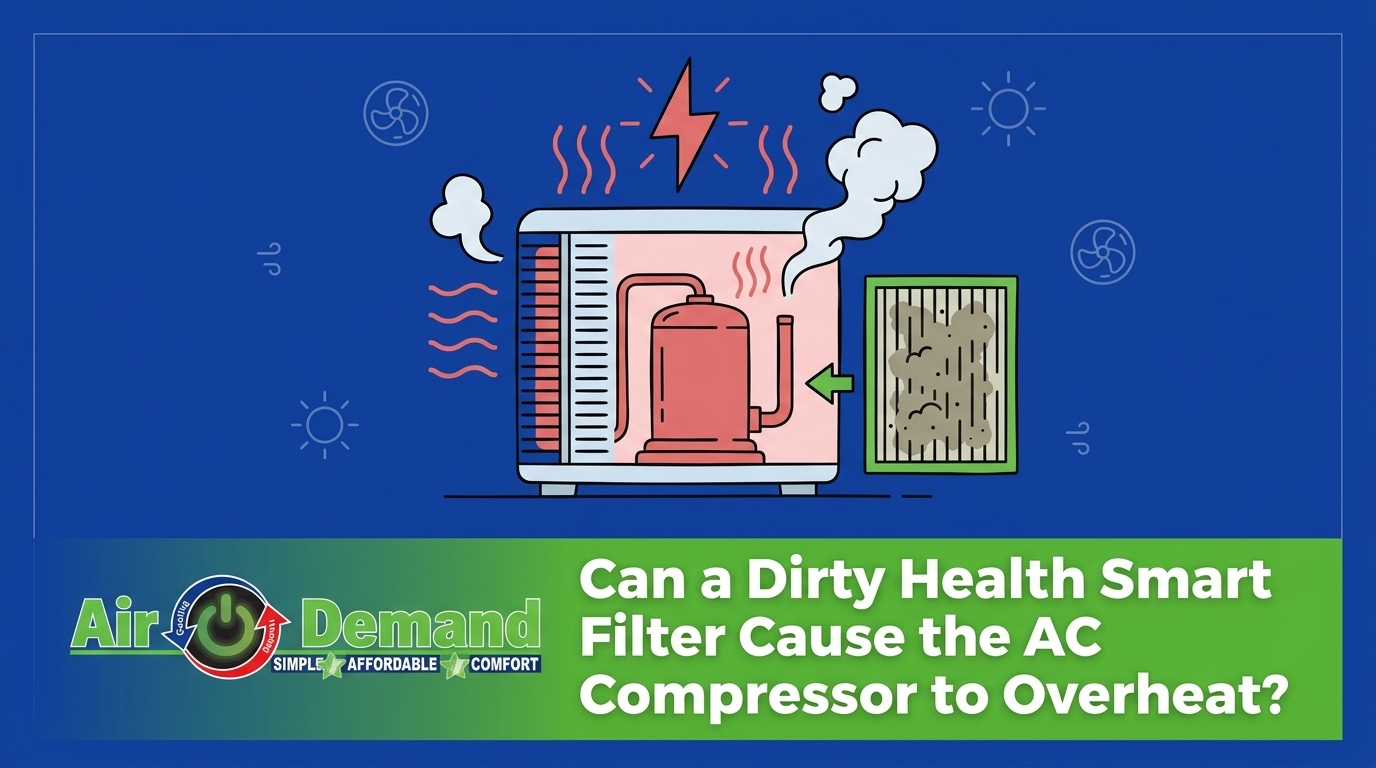
Can a Dirty Health Smart Filter Cause the AC Compressor to Overheat?
October 24, 2026
Is the high-end air filter you bought to protect your family's lungs actually destroying your air conditioner? It is a question our technicians at Air On Demand hear frequently when a homeowner's cooling system suddenly starts blowing warm air or shuts down entirely. If you are wondering, can a dirty Health Smart filter cause the AC compressor to overheat?, the short answer is a resounding yes. Homeowners often upgrade to premium, high-MERV filters to capture microscopic particles and improve indoor air quality. However, a pattern we see often is that when these dense filters are neglected, they turn from a protective shield into a suffocating barrier for your HVAC equipment.
A plugged media filter creates a severe restriction in return airflow, triggering a complex mechanical chain reaction that directly threatens the most expensive component of your system: the compressor. What starts as a simple layer of trapped dust quickly escalates into a major mechanical failure. Understanding how this process unfolds is the first step in protecting your investment. If you want to keep the air in Miami area homes clean without sacrificing system longevity, optimizing your indoor air filtration strategy requires balancing air purity with proper system airflow.
The direct answer to whether a clogged premium filter can damage your outdoor unit is absolute: yes, a dirty Health Smart filter can indeed cause an AC compressor to overheat. In our years of servicing local HVAC systems, we have found that the process does not happen instantly, but rather through a predictable, destructive sequence of events driven by air starvation.
Here is how the chain reaction works. First, the densely packed, dirt-clogged filter severely restricts return airflow from entering the indoor air handler. Without enough warm indoor air passing over the indoor equipment, you will experience low return airflow and frozen evaporator coils. Because the refrigerant inside the coil cannot absorb enough heat to vaporize properly, it remains far too cold. This frozen coil acts as a solid physical block, further stopping air from moving through the system.
Once the coil freezes solid, the system can no longer send cool, low-pressure gaseous refrigerant back to the outdoor compressor. Instead, it either sends liquid refrigerant back down the line, or it starves the compressor of the cool return gas it desperately needs to keep its internal motor from burning up. Without that cooling mechanism, the compressor's internal temperature spikes rapidly. Eventually, this extreme heat triggers a thermal overload shutdown, cutting power to prevent a catastrophic blowout. Keeping up with standard air conditioner filters in Miami is the single most effective way to stop this failure before it begins.
To understand why premium filters pose a unique risk when ignored, you have to look at how they are built. A standard fiberglass filter is designed primarily to keep large debris like hair and heavy dust out of the blower motor. It is highly porous and allows air to flow freely. A Health Smart or high-MERV (Minimum Efficiency Reporting Value) filter is designed to do much more. These filters feature tightly woven synthetic media meant to capture microscopic particulates, including pollen, pet dander, and biological contaminants found in many Miami area homes.
Because the weave is so tight, high-efficiency media filters inherently have a higher pressure drop than standard filters. The blower motor has to work harder just to pull air through a brand-new premium filter. As the filter does its job and captures dust, the available pathways for air to travel become blocked. This means they load with dust and become restrictive much faster than cheaper alternatives. Upgrading to a premium indoor air quality product requires more frequent monitoring, not less.
Static pressure is the resistance to airflow in your heating and cooling system. Higher MERV ratings mean smaller pores for air to pass through, which increases the baseline static pressure.
• Standard Fiberglass (MERV 1-4) — Primary Purpose: Protecting the blower motor from large debris — Airflow Resistance (Static Pressure): Very Low — Risk of Rapid Clogging: Low (pores are large)
• Pleated Media (MERV 5-8) — Primary Purpose: Capturing common household dust and pollen — Airflow Resistance (Static Pressure): Moderate — Risk of Rapid Clogging: Moderate
• Health Smart / Premium (MERV 11-16) — Primary Purpose: Trapping microscopic allergens and bacteria — Airflow Resistance (Static Pressure): High — Risk of Rapid Clogging: High (requires strict monitoring)
As dust accumulates on a high-MERV filter, the remaining open pores clog rapidly. This exponentially increases the static pressure, choking the blower motor and drastically reducing the volume of air reaching the heat exchange components.
The first major mechanical failure in this chain reaction happens indoors. Your air conditioner does not actually "create" cold air; it removes heat from the air inside your house. It does this by blowing warm indoor air over the evaporator coil, which is filled with cold liquid refrigerant.
When a dirty Health Smart filter restricts the return airflow, it prevents enough warm indoor air from reaching that coil. Without a steady supply of warm air to absorb, the refrigerant temperature inside the coil drops rapidly below freezing. Any moisture in the surrounding air condenses on the freezing metal fins. Because the coil is now below 32 degrees Fahrenheit, that condensation immediately turns to ice.
Within a matter of hours, this thin layer of frost grows into a solid block of ice, encasing the entire coil. This creates a secondary, impenetrable barrier to airflow. At this stage, you are dealing with severely low return airflow and frozen evaporator coils, meaning zero cooling is taking place. In our experience, diagnosing and thawing frozen coils safely requires specialized knowledge of refrigerant pressures and electrical systems. This is why scheduling routine AC maintenance is so critical—it ensures these airflow restrictions are caught long before a block of ice forms inside your air handler.
Refrigerant relies on a steady stream of heat from the home to vaporize properly from a liquid into a gas. When the filter chokes the air supply, the heat exchange process halts completely. The refrigerant stays dangerously cold, and the natural humidity in the air provides endless moisture to feed the growing ice block. Attempting to chip this ice away yourself can puncture the delicate copper lines, turning a simple airflow issue into a massive repair bill.
Once the indoor coil freezes, the danger moves outside to the compressor. The compressor is the heart of your air conditioning system, responsible for pumping refrigerant through the lines. To survive the intense friction and heat of its own operation, the compressor relies heavily on the cool, low-pressure gaseous refrigerant returning from the indoor evaporator coil to cool its internal motors.
When you have low return airflow and frozen evaporator coils indoors, the refrigerant never absorbs enough heat to fully boil into a gas. This leads to a dangerous condition known as "liquid slugging." Liquid slugging occurs when the frozen coil allows liquid refrigerant to travel all the way back down the suction line and into the compressor. Compressors are designed to compress gas, not liquid. When incompressible liquid hits the internal valves, it causes violent mechanical stress.
Even if liquid slugging does not destroy the valves immediately, the complete lack of cool return gas strips the compressor of its only cooling mechanism. The internal motor begins to bake. As the temperature skyrockets, an internal safety switch trips. This extreme heat triggers the thermal overload switch to shut down the system entirely to prevent the motor windings from melting. Understanding why fan motors shut down from thermal overload is key to recognizing that the system is trying to save itself from a dirty filter.
While both conditions are triggered by poor airflow, they damage the equipment differently. Slugging involves incompressible liquid physically damaging and breaking the compressor's internal metal valves. Standard overheating happens when the electrical motor simply bakes due to a lack of cool return gas, degrading the internal wiring insulation over time until it shorts out.

The mechanical failure caused by a clogged filter does not happen in a vacuum; it is heavily influenced by the local climate. South Florida's heavy cooling demand means AC filters load with dust, pet dander, and biological particulates much faster than the national average. While homeowners in other parts of the country might safely stretch a premium filter replacement to three months, our team warns that doing so here is a recipe for disaster.
Our technicians typically see this risk peak during the fall. October lingering humidity in Miami maintains high moisture levels in the air, demanding constant dehumidification from your cooling system. High humidity provides an excess of moisture passing over the indoor coil. When airflow drops due to a clogged Health Smart filter, this abundant moisture condenses and freezes on the coil almost immediately.
This rapid freezing drastically accelerates the timeline from a simply dirty filter to a full thermal overload shutdown. What might take weeks to freeze up in a dry climate can freeze solid in just a few days during a humid Miami October.
We often see homeowners fall into a false sense of security during the autumn months. They forget to check their filters, assuming the system works less hard because the peak summer temperatures have passed. The reality is that in Miami, the system is still aggressively dehumidifying the home. Making sure you have a clean filter is just as critical in October as it is in July to keep the coil clear of ice.
Balancing excellent indoor air quality with the mechanical health of your air conditioner requires a proactive approach. You cannot simply install a high-MERV filter and forget about it. Establishing a strict monitoring schedule is the best defense against compressor strain.
For premium filters in Miami area homes, we recommend you pull the filter out and inspect it every 30 days. If it looks gray, heavily coated in dust, or if you cannot see light through the media when held up to a bulb, it is time to replace it. Waiting for the manufacturer's 90-day recommendation often leads to severely restricted airflow in our climate.
If you suspect your filter has already caused a problem, look for these warning signs:
• Short cycling: The outdoor unit turns on and off rapidly without cooling the house.
• Unusual noises: A loud humming, buzzing, or clicking noise coming from the outdoor compressor.
• Excessive heat: The outdoor unit feels dangerously hot to the touch.
• Visible ice: Frost or solid ice forming on the copper refrigerant lines outside or the indoor coil.
If your system is showing these symptoms or has completely shut down, do not attempt to reset the thermal overload switch or thaw the coil with a heat gun. These components involve high voltage and highly pressurized refrigerant. Our team's expertise at Air On Demand in diagnosing complex airflow and compressor issues in South Florida ensures that the root cause is identified safely. Proper professional diagnosis guarantees you replace the right parts and restore proper filtration without sacrificing system longevity. When in doubt, rely on professional AC repair services to get the system back online safely.
Yes, a dirty Health Smart filter can absolutely cause the AC compressor to overheat. By severely restricting return airflow, the filter causes the indoor evaporator coil to freeze solid. This freezing starves the outdoor compressor of the cool return gas it needs to regulate its internal temperature, causing the motor to overheat and eventually trip the thermal overload safety switch.
Restricted airflow disrupts the entire heat exchange process, drastically altering refrigerant pressures and temperatures throughout the system. Without enough warm air blowing over the indoor coil, the system cannot vaporize the refrigerant properly. This forces the compressor to pump liquid instead of gas, making it work much harder, run significantly hotter, and risk permanent mechanical damage.
An AC compressor goes into thermal overload when its internal motor temperature exceeds safe operating limits. This is most commonly caused by a lack of cool return gas from the evaporator due to low return airflow and frozen evaporator coils. It can also be triggered by electrical issues, failing capacitors, or extreme mechanical friction resulting from liquid slugging.
If you use a filter with a MERV rating that is too high for your specific HVAC system, it can drastically reduce airflow right out of the box. If the blower motor is not rated to handle that high level of static pressure drop, the system will struggle to pull air through the dense media. This mimics the exact symptoms of a severely dirty filter, leading to poor cooling, frozen coils, and compressor strain.
Your AC is likely freezing up because premium filters are much denser than standard fiberglass filters. If they load with dust quickly, or if their baseline static pressure exceeds your system's limits, the airflow drops significantly. Without enough airflow to provide heat to the refrigerant, the moisture in the air condenses and freezes directly onto the indoor coil.
Due to the heavy year-round usage and constant demand for dehumidification, Health Smart filters in South Florida should be checked at least once a month. Because they capture microscopic particles, they clog much faster than standard filters. You should replace them as soon as they appear visually loaded with dust, rather than waiting for an arbitrary 90-day mark.
Balancing exceptional indoor air quality with system longevity requires vigilance. Upgrading to a premium filter is a great way to protect the air in Miami area homes, but it comes with the responsibility of strict maintenance. A pattern we see often on fall service calls is that a completely avoidable issue—a dirty filter—is one of the leading causes of complex, expensive mechanical failures.
By understanding the chain reaction that leads from restricted airflow to a frozen coil and ultimately to compressor thermal overload, you can take action before permanent damage occurs. If your system is already showing signs of struggling, short cycling, or freezing up, do not wait for the thermal overload switch to trip. Schedule a professional inspection today to restore proper airflow and ensure your compressor operates safely for years to come.