Thermal Overload: Why Your Fan Motor Shuts Down While the Compressor Keeps Pumping
September 23, 2026
Understanding Thermal Overload: Why Your Fan Motor Shuts Down While the Compressor Keeps Pumping is your most urgent priority when your air conditioner runs nonstop but only blows lukewarm air. When you step outside into the brutal August late-summer heat to investigate, you are met with a highly specific and alarming scenario: the loud, vibrating hum of the compressor is echoing through the casing, but the fan blades on top of the unit are sitting dead still. If you are facing this exact mechanical mismatch, you need to act quickly.
If you need immediate assistance with this specific breakdown, scheduling professional AC repair in Miami is the safest way to restore your cooling and protect your system.
This combination of symptoms is not a minor glitch or a temporary pause in the cooling cycle. It is a critical mechanical failure. The loud buzzing you hear is the compressor actively trying to pump refrigerant through the system, completely unaware that its cooling partner—the condenser fan—has been forced off line. In the vast majority of cases, this sudden shutdown is triggered by a thermal overload event. The fan motor has grown dangerously hot, and an internal safety switch has deliberately severed its power supply to prevent a catastrophic meltdown. Recognizing this distinct sound profile is your immediate warning sign that the system is in distress and must be shut down at the thermostat right away before secondary damage occurs.
It is easy to view a dead fan motor as nothing more than a broken part, but the reality is slightly more complex. The sudden shutdown is actually a vital safety mechanism working exactly as intended. Inside the casing of your condenser fan motor is a small, specialized component known as a thermal overload protector. This switch is designed to monitor the internal temperature of the motor windings. When the heat exceeds safe operational limits—a frequent occurrence in Miami FL during peak cooling season—the switch trips, cutting electrical power to the fan motor instantly.
This mechanism exists for one primary reason: to prevent electrical fires and stop the motor from literally melting its own internal components. While the switch successfully saves the fan motor from catching fire, the system's wiring configuration often allows the compressor to continue receiving power, creating a dangerous imbalance.
Understanding how this hidden protector functions helps clarify why your system is behaving so strangely. The process follows a specific sequence of events:
1. Heat accumulation: Friction, electrical resistance, or extreme ambient temperatures cause the motor's internal heat to rise steadily.
2. Physical reaction: A bimetallic disc inside the thermal overload protector responds to the heat. Because it is made of two different metals, it warps or bends as temperatures peak.
3. Circuit break: As the disc bends, it physically breaks the electrical connection, instantly stopping the flow of electricity to the fan motor.
4. Cooling phase: Once the motor cools down sufficiently, the disc snaps back into its original position, theoretically restoring the connection.
While the switch will eventually reset once cooled, the underlying problem that caused the extreme heat remains unresolved. The motor will simply overheat and trip again if the root cause is not addressed.
According to National Electrical Manufacturers Association (NEMA) and Department of Energy (DOE) standards regarding motor safety, these protectors are highly calibrated. They typically trip when internal temperatures reach between 105 and 130 degrees Celsius (220 to 266 degrees Fahrenheit). Reaching these extreme thresholds indicates that the motor is operating far outside its intended limits, requiring professional intervention to diagnose the strain.
The Problem: The outdoor unit of your air conditioner relies on a symbiotic relationship between two main components: the compressor and the condenser fan. The compressor's job is to pressurize warm refrigerant gas, while the fan's job is to pull massive volumes of outdoor air across the condenser coils to dissipate that heat into the atmosphere. When the fan shuts down due to thermal overload, this delicate balance is shattered.
The Cause: Without the fan actively pulling air across the coils, the heat generated by the compressor has nowhere to go. The refrigerant remains hot and highly pressurized. As the compressor continues to run in the August late-summer heat, the internal pressure and temperature inside the compressor shell begin to skyrocket. Unlike the fan motor, the compressor does not always have a rapid-response secondary safety switch that will trip in time to save it from this specific type of pressure buildup.
The Solution: A compressor running without a functioning condenser fan will rapidly burn out its own electrical windings or suffer catastrophic mechanical failure. What started as a relatively simple fan motor issue can quickly escalate into a full-system failure requiring extensive emergency AC repair. The only solution is immediate human intervention to break the cycle.
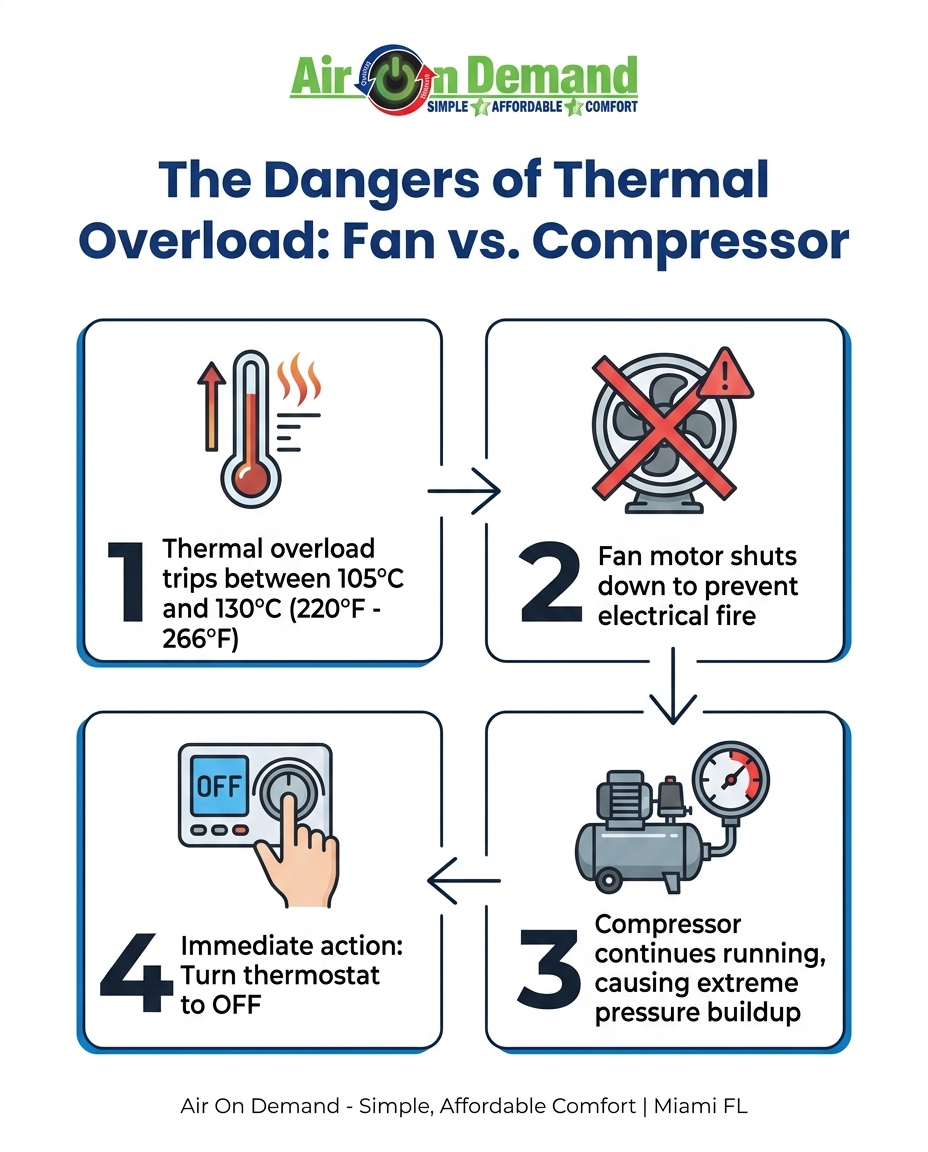
If you walk outside and observe a silent fan paired with a humming compressor, you must take immediate action to prevent further damage. Your very first step is to go straight to your indoor thermostat and switch the cooling system to the OFF position. Do not wait to see if the fan will restart on its own, and do not lower the temperature setting hoping to force a reset.
Turning the system off at the thermostat stops the electrical signal calling for cooling, which immediately stops the compressor from pumping. Halting the compressor stops the dangerous pressure buildup and gives the entire outdoor unit a chance to cool down safely.
Critical safety warnings for homeowners in Miami FL:
• Never try to manually spin the fan blades: Sticking a tool or stick through the top grate to "jump-start" the blades is highly dangerous and will not fix a thermally overloaded motor.
• Do not force a restart: Flipping the breaker on and off repeatedly will only subject the struggling motor to damaging voltage spikes.
• Leave the wiring alone: Bypassing a thermal switch or attempting internal electrical repairs requires a licensed professional. High-voltage capacitors retain a lethal electrical charge even when the power is turned off.
Thermal overload events rarely happen on a mild spring morning. In our years of keeping homes cool across Miami, our team at Air On Demand typically sees a massive spike in these specific service calls right as kids head back to school and late-summer wear catches up with aging equipment. The brutal subtropical climate and high humidity of our region create the perfect storm for this specific mechanical failure.
During the peak of August late-summer heat, your air conditioner is forced into continuous operation. This relentless demand pushes the system's duty cycle—the percentage of time the unit is actively running versus resting—near 100 percent. In a typical climate, an AC unit might run for twenty minutes and then rest for twenty minutes, allowing the fan motor to naturally dissipate its internal heat. In extreme subtropical humidity, those natural cool-down periods are completely eliminated.
• Mild Spring Weather — Typical Duty Cycle: 30% to 40% — Motor Heat Dissipation: Excellent (frequent rest periods) — Thermal Overload Risk: Very Low
• Early Summer Days — Typical Duty Cycle: 50% to 70% — Motor Heat Dissipation: Adequate (moderate rest periods) — Thermal Overload Risk: Low to Moderate
• Late-Summer Heat Waves — Typical Duty Cycle: 90% to 100% — Motor Heat Dissipation: Poor (zero cool-down time) — Thermal Overload Risk: Extremely High
When you combine ambient outdoor temperatures hovering near 95 degrees with the internal mechanical heat generated by a motor running non-stop for hours, the combined temperature easily pushes the motor past its thermal overload threshold. The motor simply cannot shed heat fast enough to survive.
A tripped thermal switch is a symptom, not the root disease. While the switch itself did its job perfectly, something caused the motor to run dangerously hot in the first place. Diagnosing this requires looking past the safety feature to find the underlying mechanical or electrical stressor. Because these diagnostics involve testing live high-voltage components, they must be handled by a licensed HVAC technician. Air On Demand provides rapid emergency diagnostics to accurately pinpoint the root cause of the overload, preventing catastrophic compressor failure for homeowners across Miami FL.
One of the most common culprits behind thermal overload is a failing run capacitor. The run capacitor provides a continuous, steady supply of electrical energy to keep the fan motor spinning efficiently.
1. When a capacitor begins to degrade, its electrical output drops.
2. The fan motor receives less voltage than it needs to operate.
3. To compensate for the lower voltage, the motor pulls higher amperage.
4. Higher amperage creates excessive electrical resistance, which generates massive amounts of heat, quickly triggering the thermal overload switch.
If the electrical supply is sound, the heat is likely being generated by physical friction. Over time, the sealed bearings inside the fan motor can lose their lubrication or wear down. When bearings fail, the motor has to fight against severe mechanical resistance just to turn the blades. This is often the primary cause of a seized condenser fan motor. Alternatively, thick debris, vines, or sticks blocking the fan blades can create physical resistance, forcing the motor to work twice as hard and overheat rapidly.
The best way to handle a thermal overload event is to prevent it from happening in the first place. Proactive care reduces the workload on your fan motor, ensuring it stays well below its critical temperature thresholds even during the worst of the August late-summer heat. By implementing a few straightforward preventative measures, you can dramatically extend the life of both your fan motor and your compressor.
The Thermal Overload Prevention Checklist:
• Maintain clear airflow: Keep the outdoor condenser unit entirely clear of debris, fallen leaves, and overgrown vegetation. Trim bushes back at least two feet from the casing to ensure the fan doesn't have to struggle to pull air.
• Schedule professional coil cleaning: Routine professional cleaning of the aluminum condenser coils removes insulating dirt and grime, vastly reducing the workload on the fan motor.
• Invest in pre-season inspections: Scheduling routine AC maintenance allows a technician to test the microfarad readings on your capacitors and check the motor bearings for friction before they fail.
• Monitor aging units: If your air conditioner has endured more than a decade of harsh subtropical summers, pay close attention to unusual noises. A grinding or squealing sound is often the first sign of failing bearings that will soon lead to thermal overload.
Why is my AC compressor running but the fan is not?
When the compressor is running but the fan is not, it usually indicates that the fan motor's internal thermal overload switch has tripped to prevent an electrical fire. The fan motor shuts down due to extreme heat, but the system's wiring allows the compressor to keep receiving power. Other causes can include a blown fan capacitor or a burnt-out fan motor winding.
What happens if the AC compressor runs without the fan?
If the AC compressor runs without the fan, the system loses its ability to dissipate heat into the outdoor air. This causes the internal pressure and temperature of the compressor to spike rapidly. Left running in this state, the compressor will eventually overheat and suffer permanent, catastrophic failure.
Is it bad if the AC fan is not spinning?
Yes, it is a critical emergency if the AC fan is not spinning while the rest of the unit is active. The fan is essential for removing heat from the refrigerant cycle. Without it, the entire cooling process breaks down, and the expensive compressor is put at immediate risk of burning out.
How do you fix an AC fan that won't spin?
Fixing an AC fan that won't spin begins by turning off the thermostat immediately to protect the equipment. A licensed technician must then use a multimeter to test the dual run capacitor, check the motor for seized bearings, and verify voltage at the contactor to determine the exact component failure.
How do I know if my AC fan motor is burnt out or just overheated?
An overheated motor will often reset and try to run again once the thermal overload switch cools down, whereas a burnt-out motor will remain completely dead regardless of temperature. A professional technician determines the difference by testing the electrical continuity of the motor's internal windings using specialized diagnostic meters.
Can a tripped thermal overload switch reset itself?
Yes, most thermal overload switches in HVAC motors are automatic-reset devices that reconnect the circuit once the motor cools to a safe temperature. However, the switch will simply trip again as soon as the motor heats back up, meaning the underlying mechanical or electrical issue in Miami FL must still be repaired.
Discovering a silent fan and a humming compressor is a stressful moment for any homeowner, especially during the relentless August late-summer heat. However, recognizing that the thermal overload switch is a built-in safety mechanism gives you the knowledge you need to react properly. Your immediate action—shutting the system off at the thermostat—is the critical step that saves your compressor from secondary damage.
Because thermal overload always points to a deeper electrical or mechanical strain, trusting expert diagnostics is the only way to break the cycle of overheating. By seeking professional help promptly, you can ensure the root cause is resolved safely, restoring reliable, efficient cooling to your home without risking your most expensive system components.