Diagnosing a Seized Condenser Fan Motor Bearing After Heavy Summer Usage
September 23, 2026
By the time August arrives in South Florida, your cooling system has already endured months of relentless heat. At Air On Demand, our technicians see a massive spike in late-summer service calls, making diagnosing a seized condenser fan motor bearing after heavy summer usage a common reality for many Miami homeowners. You might walk outside because your house feels unusually warm, only to discover that the outdoor unit is making a low humming noise, but the large fan blades at the top are completely stationary. This specific symptom points to a system that is desperately trying to run but is being blocked by either a physical barrier or an electrical failure.
When your AC condenser fan stops spinning in late summer, you are faced with a critical decision point: determining whether the issue is a mechanical breakdown of the motor's bearings or an electrical failure of the run capacitor. Understanding the difference between these two issues can save you from unnecessary panic and help you communicate effectively with a technician. Fortunately, the initial steps of this diagnosis require zero tools and can begin with safe, hands-off observation before you ever need to call our professionals to open the cabinet.
Need immediate assistance? Explore our AC repair solutions to restore your home's comfort.
To understand why a fan motor stops spinning, you first have to understand the immense mechanical workload it carries. The condenser fan is responsible for pulling vast amounts of air through the outdoor coil, exhausting the heat that the refrigerant has absorbed from inside your home. At the heart of this spinning motion are the motor bearings—small, precision-engineered metal spheres housed around the motor shaft. These bearings allow the heavy fan blades to rotate thousands of times per minute with almost zero friction.
In our years of providing AC solutions, we've learned firsthand that the Miami FL high-humidity environment changes the operational rules for HVAC equipment. In milder climates, an air conditioner might cycle on and off, giving the motor time to cool down. In South Florida, the relentless heat forces condenser units to run almost non-stop throughout the summer. This extreme, continuous heavy load generates intense internal heat within the motor housing, placing severe stress on the components that keep the system moving.
Modern residential HVAC fan motors utilize sealed bearings. This means the manufacturer packs the bearing housing with a specific amount of high-grade lubricating oil and seals it permanently at the factory. Under normal conditions, this oil maintains its viscosity and keeps the metal parts gliding smoothly.
When our technicians inspect systems that have run continuously for months, we frequently find that the internal temperature of the motor has stayed elevated for excessive periods. Over time, this extreme heat causes the factory-sealed oil to break down, thin out, and eventually evaporate or degrade into a sticky sludge. Once the lubrication fails, metal begins grinding directly against metal. This friction generates even more heat, which causes the metal shaft and bearing components to expand. Eventually, the expansion and physical scoring become so severe that the shaft physically locks in place—a condition known as a seized bearing. While standard motors are designed to last 10 to 12 years, the environmental stressors of continuous high-load operation can drastically reduce this lifespan, which is a pattern we see often when explaining why your AC fan motor stops working prematurely.
Before any physical testing occurs, your outdoor unit will usually provide clear visual and auditory clues that the motor is struggling. By August / Late Summer, a failing motor rarely dies silently; it usually exhibits a pattern of distress that you can observe from a safe distance without touching the equipment.
Listen for the hum: When your thermostat calls for cooling, a switch inside the outdoor unit (the contactor) pulls in, sending high-voltage electricity to both the compressor and the fan motor. If the fan motor is seized, it cannot convert that electrical energy into mechanical rotation. Instead, the electricity surges through the motor windings, creating a very distinct, loud humming or buzzing sound. This sound tells you that the system is receiving power, but physical movement is blocked.
Observe the fan blades: Look straight down through the top grille of the condenser. Are the blades completely frozen in place, or are they twitching slightly? Sometimes, a motor with badly worn—but not completely seized—bearings will attempt to start, causing the blade to shudder or twitch before giving up. If the blade is dead still while the unit hums, the shaft is likely locked.
Feel for radiating heat: Because the motor is receiving electricity but cannot spin, it draws what is known as "locked rotor amps" (LRA). This massive draw of electrical current converts directly into heat. If you stand near the unit or carefully hover your hand a few inches above the fan grille (without touching the metal cabinet), you will often feel an intense wave of heat radiating upward. Eventually, a built-in safety device called a thermal overload protector will trip, shutting off the motor entirely to prevent it from catching fire. When this happens, the humming will stop, but the fan will remain dead.
If you suspect your fan motor is seized, there is one safe, purely mechanical test you can perform to confirm physical resistance. This test does not require opening any panels, and it strictly avoids any dangerous electrical components. Because the Miami FL high-humidity environment frequently causes both bearing failures and electrical failures, our team often recommends this test as the fastest way for homeowners to differentiate between the two.
1. Shut off all power immediately: This is the most critical step. Turn your thermostat to the "Off" position. Next, go to your main electrical panel and flip the dedicated breaker for the AC condenser to the "Off" position. Do not skip this step, as a sudden startup while you are testing the blade could cause severe injury.
2. Find a non-conductive probing tool: Locate a long, thin object made of wood or plastic. A wooden dowel, a long wooden spoon, or a sturdy plastic rod works perfectly. Never use a metal screwdriver, a metal measuring tape, or your bare fingers.
3. Gently push the fan blade: Insert the wooden or plastic stick through the top metal grille of the condenser unit. Carefully press it against one of the fan blades to try and manually rotate the fan in its natural spinning direction.
4. Analyze the mechanical resistance: If the blade feels incredibly stiff, requires significant force to move, grinds, or completely refuses to budge, the bearings are mechanically seized. The motor has failed physically and must be replaced.
5. Analyze the electrical alternative: If the blade spins smoothly and freely, rotating several times with just a gentle push, the bearings are intact. This indicates that the failure is likely electrical—most commonly a blown run capacitor—meaning the motor simply isn't receiving the "jolt" it needs to start.
If your system fails the spin test or you are unsure of the results, it is time to call in professionals who provide expert Miami AC repair services to diagnose the root cause safely.
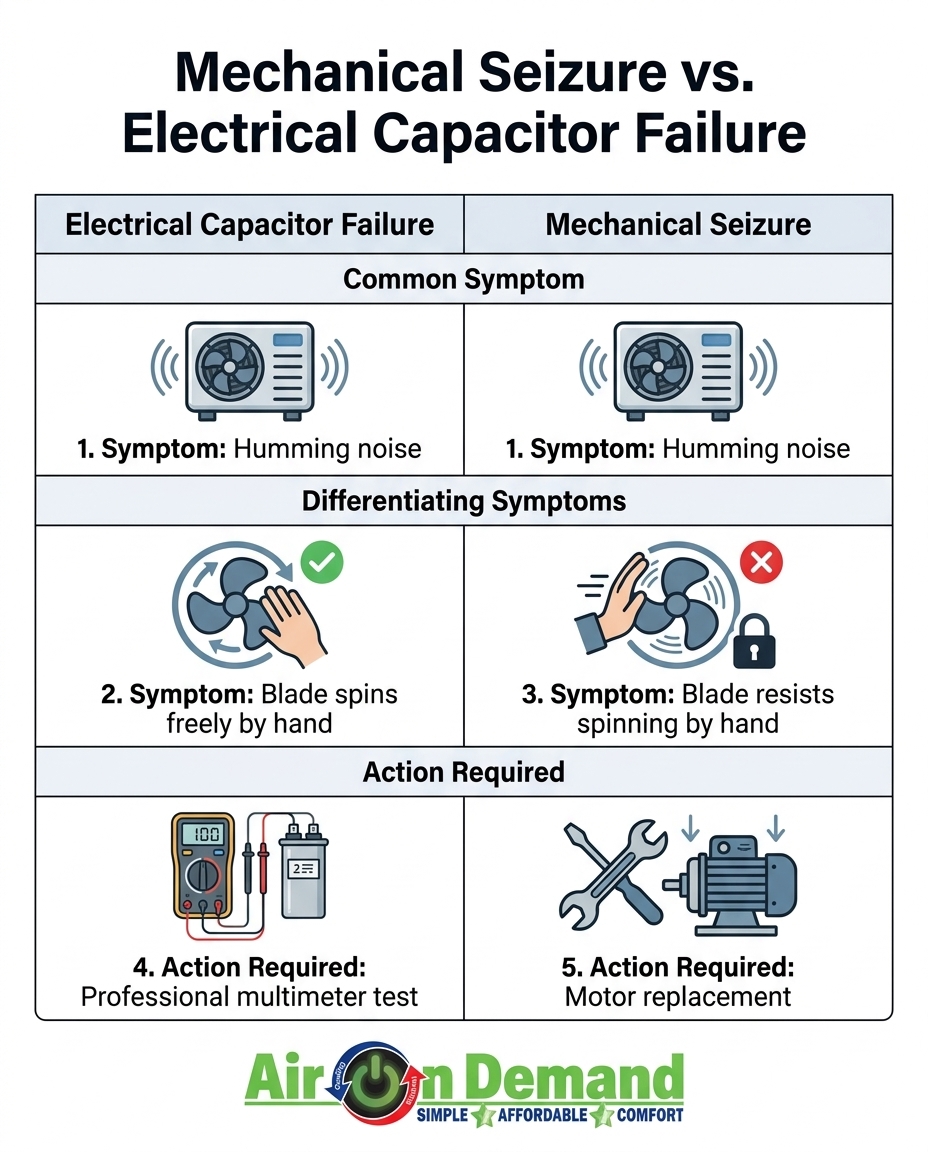
Understanding the distinction between a mechanical seizure and an electrical capacitor failure is vital. The run capacitor is a small, cylindrical component that stores electricity and delivers a continuous, precise jolt of voltage to keep the fan motor spinning. When a capacitor fails—a common occurrence during August / Late Summer due to heat exposure—the motor loses its electrical support, but the physical shaft remains perfectly fine.
We constantly see how confusing these two issues leads homeowners down a frustrating path. Assuming a motor is dead when it only needs a capacitor wastes time and money. Conversely, replacing a capacitor when the motor shaft is physically locked will not solve the problem, and the new capacitor will quickly burn out as the system repeatedly tries to start a seized load.
• The Spin Test Result — Mechanical Seizure (Bad Bearings): Blade is stiff, grinds, or will not move by hand. — Electrical Failure (Bad Capacitor): Blade spins freely and smoothly by hand.
• Auditory Cues — Mechanical Seizure (Bad Bearings): Loud humming followed by a thermal overload click. — Electrical Failure (Bad Capacitor): Humming sound, but no physical grinding.
• Primary Cause — Mechanical Seizure (Bad Bearings): Lubrication breakdown from extreme heat and heavy use. — Electrical Failure (Bad Capacitor): Electrical component degradation or power surges.
• Risk of Cascading Damage — Mechanical Seizure (Bad Bearings): High. A seized motor can destroy a good capacitor. — Electrical Failure (Bad Capacitor): Moderate. Can cause the compressor to overheat.
• Professional Resolution — Mechanical Seizure (Bad Bearings): Complete replacement of the condenser fan motor. — Electrical Failure (Bad Capacitor): Replacement of the dual run or single run capacitor.
If your system requires a new motor or more extensive work, exploring professional AC replacement services ensures the new components are properly matched to your system's exact specifications.
Once you have safely observed the symptoms and performed a power-off spin test, your diagnostic journey should end. The internal cabinet of an air conditioner houses high-voltage components that present severe safety hazards. The run capacitor, for instance, acts like a powerful battery. It can hold a lethal electrical charge long after the main power to the unit has been turned off. Attempting to test a capacitor with a DIY multimeter without properly discharging it first is incredibly dangerous.
Additionally, the internet is full of outdated advice suggesting that homeowners can "unseize" a motor by spraying WD-40 or applying 3-in-One oil to the shaft. On modern HVAC equipment, this is a dangerous myth. Because the bearings are factory-sealed, external oil cannot reach the internal mechanism. Even if it could, the metal-on-metal scoring has already permanently damaged the spherical bearings. External oil will only attract dust and dirt, creating a fire hazard without restoring the motor's function.
This is exactly why our team at Air On Demand emphasizes a professional diagnostic process. Our licensed technicians use precise, specialized tools to verify both electrical continuity and mechanical integrity. By properly distinguishing between a mechanically seized bearing and a blown capacitor, we prevent the frustration of unnecessary part replacements. We ensure that the root cause of the failure in the Miami FL high-humidity environment is addressed correctly the first time. Investing in routine AC maintenance can also help our team catch these bearing wear issues long before they result in a complete system lockup.
Your AC condenser fan typically stops spinning due to either an electrical failure or a mechanical blockage. Electrically, a blown run capacitor or a bad contactor can prevent voltage from reaching the motor. Mechanically, the motor's internal bearings can lose their lubrication and seize up, locking the shaft in place. A tripped breaker or blown fuse can also cut power entirely to the outdoor unit.
The safest way to tell the difference is the power-off spin test. Turn off all power to the unit, then use a wooden stick to gently push the fan blade. If the blade spins freely but the unit only hums when turned on, the capacitor is likely bad. If the blade is stiff, difficult to push, or grinds, the motor bearings have failed, indicating the motor itself is bad.
No, a mechanically seized AC fan motor cannot be reliably fixed and must be replaced. Modern HVAC motors use factory-sealed bearings that cannot be repacked with grease or oil once they fail. Any metal-on-metal friction that causes a seizure permanently damages the internal components, making replacement the only safe and effective solution.
An AC fan motor seizes up when the internal bearing lubrication breaks down due to age, extreme heat, or continuous heavy usage. By August / Late Summer, units that have run non-stop experience severe thermal stress, which degrades the oil inside the sealed bearings. Once the oil fails, friction causes the metal parts to expand and lock together.
No, it is never safe to leave your AC running if the outside fan is not spinning. You should immediately turn the thermostat to the "Off" position. The fan is responsible for cooling the compressor; without it, the compressor will rapidly overheat, potentially causing catastrophic and expensive damage to the heart of your cooling system.
Distinguishing between a mechanically seized bearing and a simple electrical issue is the first step in protecting your cooling system from further cascading damage. By recognizing the physical resistance of a locked shaft versus the free-spinning nature of a bad capacitor, you can prevent the Miami FL high-humidity environment from taking a heavier toll on your equipment.
Remember that while observation is safe, any internal testing, capacitor discharging, or motor replacement requires the specialized tools and training of a licensed professional. If your condenser fan has stopped spinning, turn off the system immediately and contact our team at Air On Demand to restore your home's cooling safely, accurately, and efficiently.