
Why Pinecrest Residents Are Upgrading to Daikin VRF Systems This Fall
November 17, 2026
In our years of serving Miami-Dade, we frequently hear the same complaint: your aging dual-system HVAC setup is running constantly, creating a racket on the patio, yet half the house still feels uncomfortably warm. If you are researching why Pinecrest residents are upgrading to Daikin VRF systems this fall, it usually comes down to this exact frustration. In our experience, large Pinecrest estates feature sprawling layouts, high ceilings, and extensive glass windows that trap heat unevenly. When traditional cooling setups begin to fail, they struggle to maintain a consistent temperature across these massive square footages, leaving certain rooms freezing while others remain stubbornly hot.
To explore the full range of modern solutions, upgrading to Daikin equipment is the strategic choice our team recommends for high-end properties. As we move deeper into late fall, the impending stress of holiday hosting brings this issue to the forefront. You want your home to be a welcoming, comfortable environment for guests, not a battleground of competing thermostats and noisy air handlers. Replacing these failing traditional setups with ultra-quiet, unified Variable Refrigerant Flow (VRF) technology before the holiday rush is a proactive decision. High-end properties require specialized, modern climate solutions that adapt to the home's unique architectural demands, rather than just swapping out another standard box unit.
Our technicians at Air On Demand see this constantly: traditional HVAC configurations were designed for standard residential footprints, not sprawling, multi-wing properties. In a conventional setup, cooling a large home usually involves installing two or more bulky outdoor units that operate completely independently of one another. These systems rely on basic, single-stage or two-stage compressors. When the thermostat detects a temperature change, the system blasts on at full capacity, pumps cold air until the target temperature is reached, and then abruptly shuts off. This binary operation leads to massive temperature swings, uneven cooling, and severe operational wear over time.
For some isolated rooms or additions, ductless mini split systems provide an excellent targeted fix, but entire Pinecrest estates require a comprehensive, whole-home approach to overcome their architectural limitations. Multi-story designs further exacerbate the inefficiencies of standard dual-systems. Heat naturally rises, meaning the upper floors of a large home often require significantly more cooling than the shaded ground floor. With a traditional system, you are forced to overcool the downstairs living areas just to make the upstairs bedrooms tolerable. Modern VRF solutions address these structural challenges head-on by rethinking how refrigerant is distributed throughout the property.
The core limitation: When we perform thermal assessments, we find that traditional systems lack the precision to micro-manage distinct zones effectively. A standard dual-system might split a home into an "upstairs" and "downstairs" zone, but it cannot account for the subtle thermal differences from room to room. For example, an east-facing master suite will absorb massive amounts of solar heat in the morning, while a west-facing kitchen will bake in the late afternoon.
• Broad thermostat averaging: Standard thermostats read the temperature in one hallway and force the system to cool the entire zone based on that single data point.
• Trapped air mapping: Upper floors often remain too warm because the system shuts off as soon as the downstairs thermostat is satisfied.
• Ductwork pressure loss: Pushing air from a central air handler to the far corners of a sprawling estate results in weak airflow in distant rooms.
The cost of cycling: Constant on/off cycling spikes energy consumption dramatically. Every time a traditional, non-variable speed compressor starts up, it draws a massive surge of electricity. Because these systems run at 100% capacity even when only a tiny amount of partial cooling is needed to maintain the temperature, they waste an incredible amount of power.
Without inverter technology, traditional units cannot "ramp down" to a low, steady speed. They are either entirely on or entirely off. This constant starting and stopping not only drives up utility bills but also shortens the lifespan of the mechanical components, leading to frequent breakdowns right when you need the system the most.
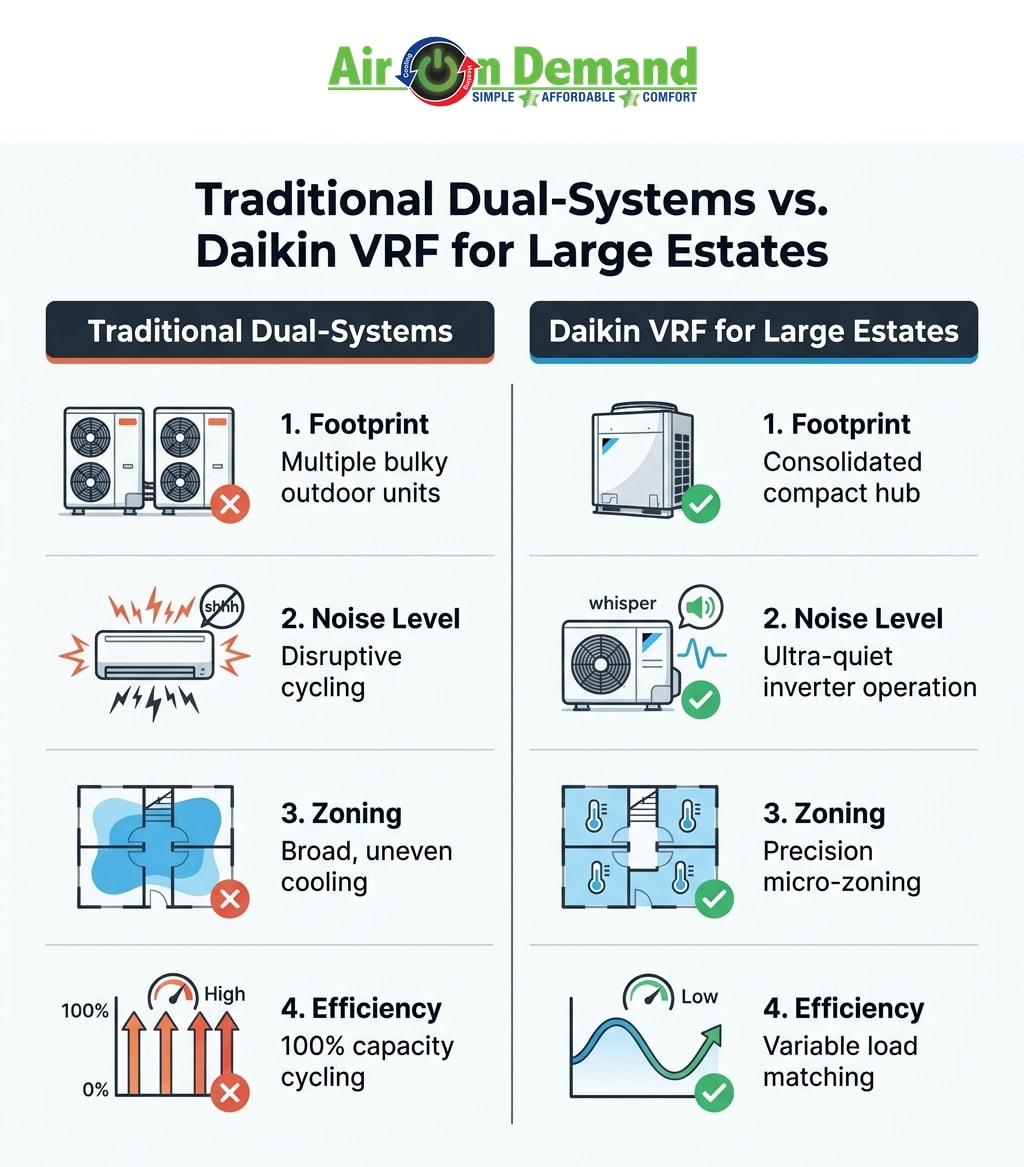
During our fall AC maintenance visits, one of the most overlooked drawbacks homeowners mention is the sheer volume of noise older traditional systems produce. When a massive, single-stage compressor kicks on, it often creates a loud "clunk" followed by a constant, low-frequency roar. If your outdoor units are located near a patio, pool deck, or outdoor dining area, this noise can completely ruin a quiet evening. Inside the home, high-velocity air handlers push air through the ducts with a rushing sound that forces you to turn up the television or speak louder just to be heard across the room.
As you prepare for late fall and November holiday prep, creating a peaceful environment for entertaining guests becomes a top priority. Inverter-driven compressors, the heart of VRF technology, operate at variable speeds. Instead of blasting on at full power, an inverter compressor starts slowly and smoothly ramps up to the exact speed required to meet the cooling demand. Once the target temperature is reached, it scales back to a low, whisper-quiet idle to maintain the climate.
This variable operation virtually eliminates the disruptive operational noise associated with older units. You can host an outdoor dinner party right next to the condenser without your guests even realizing the system is running. Upgrading to this technology is a necessary step for achieving a peaceful, luxurious home atmosphere, ensuring that your holiday gatherings are remembered for the conversation, not the background mechanical racket.
Having worked extensively within the strict zoning standards of high-end Pinecrest neighborhoods, we know homeowners invest heavily in creating beautiful exterior environments. However, those aesthetics are often compromised by the need to hide a "farm" of three or four massive traditional AC condensers along the side of the house. These bulky units take up valuable square footage, require extensive clearance for airflow, and create visual clutter that detracts from the property's curb appeal.
Daikin VRF technology solves this spatial dilemma by consolidating the footprint of multiple traditional outdoor units into a single, compact hub. Because VRF systems are designed to handle massive capacities and route refrigerant to multiple indoor air handlers simultaneously, one advanced outdoor unit can often do the work of several conventional condensers.
• Outdoor Footprint — Traditional Dual-System Setup: Requires 2 to 4 separate, bulky condensers — Daikin VRF Technology: Consolidated into a single, compact outdoor hub
• Visual Impact — Traditional Dual-System Setup: Creates a cluttered "equipment farm" on the property line — Daikin VRF Technology: Minimal visual intrusion; easily hidden by light landscaping
• Space Utilization — Traditional Dual-System Setup: Eats up valuable side-yard or patio space — Daikin VRF Technology: Frees up exterior square footage for gardens or walkways
• HOA Compliance — Traditional Dual-System Setup: Often requires custom fencing to hide multiple units — Daikin VRF Technology: Easier compliance with strict neighborhood aesthetic guidelines
By consolidating the equipment, you free up valuable outdoor space that can be repurposed for expanded patios, side gardens, or pool access pathways. Fewer outdoor units mean less visual clutter, less noise, and a much easier time complying with local aesthetic guidelines or homeowner association rules. The exterior of your estate remains as pristine and thoughtfully designed as the interior.
Variable Refrigerant Flow is not just a buzzword; it is a fundamental shift in how a home is cooled. Instead of pushing massive volumes of conditioned air through long, leaky ductwork from a central location, VRF systems route refrigerant directly to smaller, strategically placed indoor units (or zoned air handlers) throughout the home. This allows the system to precisely match the cooling or heating load of each specific zone.
If you want to understand how Daikin VRF heat recovery systems save energy, it comes down to this targeted approach. The system constantly communicates with the indoor units, adjusting the flow of refrigerant based on real-time demands. If the kitchen is hot from cooking, but the guest bedrooms are empty and cool, the system sends maximum cooling capacity to the kitchen while dialing back the bedrooms to a low-energy idle.
The mechanics of true zoning:
• Independent temperature control: Every zone can be set to a different temperature, ending the thermostat wars between family members.
• Simultaneous heating and cooling: Advanced VRF heat recovery systems even have the capability to heat one area of the home while cooling another—perfect for large estates with varying sun exposure during the transitional fall months.
• Elimination of energy waste: By only conditioning occupied spaces to the exact required degree, the system drastically reduces wasted electricity.
Because these systems operate with such incredibly high efficiency, homeowners should note that qualifying high-efficiency heat pump and VRF installations may be eligible for general federal tax credits or local utility incentives. We always advise readers to consult a tax professional or their local utility provider to verify current program eligibility.
As local HVAC experts, we know that timing a major home improvement project is just as important as selecting the right equipment. In South Florida, undergoing a massive, multi-day HVAC retrofit in the middle of July is a miserable experience. The extreme summer heat makes it dangerous to leave a home without air conditioning for even a few hours, risking severe humidity buildup that can damage artwork, hardwood floors, and high-end finishes.
This is why capitalizing on Miami's brief fall weather window is so critical. November brings average highs down to the upper 70s and low 80s, accompanied by a significant drop in humidity. This reduction in immediate cooling loads creates a comfortable, safe environment for multi-day installations. Technicians can work efficiently, and your home's interior won't suffer from rapid heat gain while the old systems are being dismantled and the new VRF network is being piped in.
There is a moderate urgency to complete this type of extensive estate retrofit while the weather permits. As we push closer to late fall and November holiday prep, the window to act narrows. By scheduling the upgrade during this brief respite from the extreme heat, you ensure the project is completed smoothly and the system is perfectly calibrated before your first holiday guests arrive.
Installing advanced Daikin VRF technology is not a standard equipment swap. It requires a deep understanding of thermodynamics, intricate load calculations, and custom design work. Every estate has a unique architectural footprint, and the system must be mapped precisely to that layout to function correctly.
Our team at Air On Demand brings years of specialized experience in designing and installing complex Daikin VRF systems tailored specifically to high-end South Florida residential properties. We understand that a cookie-cutter approach will not work for a multi-story home with vaulted ceilings, wine cellars, and expansive glass facades. We perform detailed Manual J load calculations for every single room, ensuring that the indoor units are sized perfectly to handle the specific thermal dynamics of that space.
This specialized contractor experience ensures seamless integration with the home's existing structure. We evaluate the current ductwork, identify areas where refrigerant lines can be routed invisibly, and design a control network that gives you complete command over the home's climate from a single smart interface. For property layouts where a full VRF network isn't entirely necessary, or for outbuildings like a guest house, integrating Daikin Fit systems offers an alternative high-efficiency, compact solution that still delivers the quiet, variable-speed benefits of inverter technology.
The primary benefits of a VRF system in a large home include precision zoning, ultra-quiet operation, and massive energy savings. Because VRF systems use variable-speed compressors, they only consume the exact amount of energy needed to cool specific rooms, rather than blasting the whole house. This eliminates hot and cold spots, ensuring consistent comfort across sprawling square footages.
Yes, a single VRF outdoor unit can easily replace multiple traditional dual HVAC condensers. VRF technology is designed to handle large capacities and can route refrigerant to numerous indoor air handlers simultaneously. This consolidation frees up outdoor space and dramatically reduces the exterior noise footprint of your home.
A Daikin VRF system works by using an inverter-driven compressor to modulate the flow of refrigerant directly to individual indoor units based on real-time demand. Instead of turning on and off at 100% capacity, the compressor smoothly ramps up and down. This allows the system to provide exact, targeted cooling to different zones independently, maintaining perfect temperatures without energy waste.
VRF systems are exceptionally good for large residential use, particularly in estates, multi-story homes, or properties with complex layouts. While they were originally developed for commercial buildings, modern residential VRF systems offer homeowners unparalleled control, whisper-quiet operation, and the ability to eliminate the uneven temperatures common in large traditional homes.
Retrofitting a large estate with VRF technology typically takes several days, depending on the complexity of the home's footprint and the amount of existing ductwork that needs modification. Because it is a multi-day process, the mild weather of late fall in Miami provides the perfect window for our installation teams to work without the house becoming dangerously hot.
Absolutely, a VRF system will significantly reduce outdoor equipment noise. Traditional AC units are notorious for loud, clunky start-ups and a constant roaring sound while running. VRF inverter compressors operate at low, variable speeds, making them so quiet that you can comfortably host a patio dinner party right next to the unit without raising your voice.
At Air On Demand, we've helped countless homeowners upgrade to modern, variable-speed technology to solve the persistent noise and frustrating zoning issues that plague traditional dual-systems in large homes. By consolidating your outdoor equipment and utilizing precision micro-zoning, you gain complete control over your indoor environment while eliminating the energy waste of constant on/off cycling.
Late fall is the strategic time to act. Taking advantage of Miami's brief weather window ensures a smooth, comfortable installation process before the rush of the season begins. If you are ready to see exactly why Pinecrest residents are upgrading to Daikin VRF systems this fall, we encourage you to consult with our local experts to evaluate your property's specific architectural needs. Schedule a comprehensive inspection today to ensure your Pinecrest estate is perfectly conditioned, whisper-quiet, and ready for holiday hosting.