How Long Does It Take to Become a Lead Service Technician in Miami?
August 17, 2026
Are you looking at the path ahead and wondering exactly how long does it take to become a lead service technician in Miami? At Air On Demand, we have mentored countless apprentices, and we know firsthand that navigating Florida's specific apprenticeship hours and certification timeline can feel overwhelming when you are just starting out. You might be asking yourself if trade school is enough, or if you need to log thousands of hours in the field before you can run your own service truck. The transition from an entry-level helper to a fully independent lead technician is a challenging, highly rewarding journey that requires far more than just passing a multiple-choice test.
If you are serious about building a long-term future in the trades, exploring the right HVAC careers is your crucial first step. Achieving lead status means mastering high-stress field conditions, understanding complex electrical diagnostics, and earning your mandatory EPA Section 608 Certification. Drawing from our years of experience serving Miami-Dade County, this guide provides a realistic, step-by-step roadmap for dedicated professionals who want to know exactly what it takes to succeed in the South Florida market.
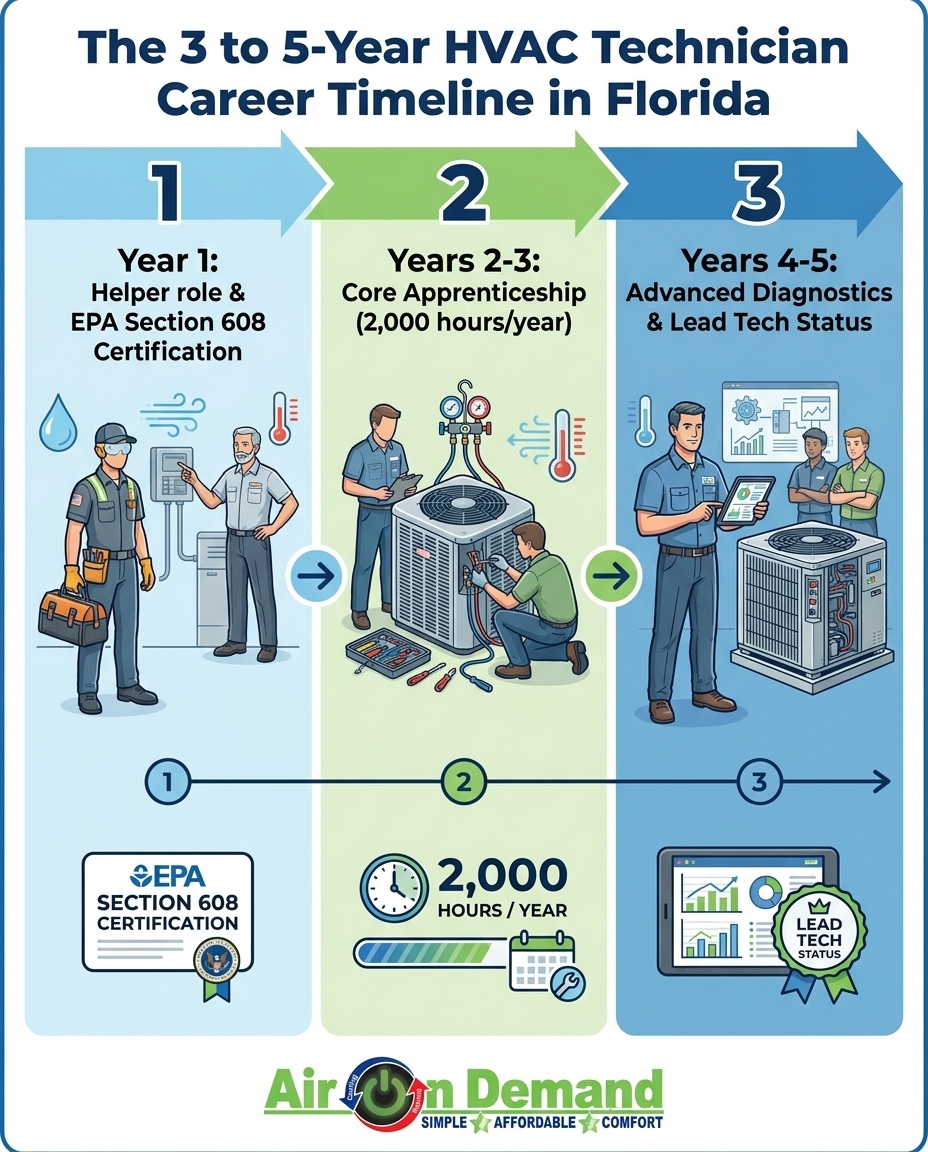
The journey to the top of the HVAC field is not an overnight process. For most dedicated professionals we train, the timeline spans three to five years of continuous learning, hands-on application, and rigorous testing. This progression ensures that by the time you are running diagnostic calls during the peak of August late-summer cooling demand, you have the field-tested experience to handle any system failure safely and accurately.
The standard progression timeline our team typically sees:
1. Year 1: Foundation and Federal Requirements. You will enter the field as a helper, focusing heavily on safety protocols, basic preventative maintenance, and securing your required federal certifications.
2. Years 2-3: Core Apprenticeship and Supervised Repairs. During this phase, you will log thousands of required on-the-job training hours, transitioning from simple maintenance tasks to performing basic component replacements under the supervision of a senior technician.
3. Years 4-5: Advanced Diagnostics and Lead Status. This is where you make the leap from replacing parts to true system diagnostics, mastering complex failures, and eventually earning the right to run a dedicated service truck independently.
Your first twelve months are all about building a rock-solid foundation. As a helper, you will assist senior technicians with heavy lifting, equipment staging, and basic maintenance tasks like coil cleaning and filter replacements. More importantly, our service managers always emphasize that this year is dedicated to studying for and passing the EPA Section 608 Certification, which is legally required to handle refrigerants. You will learn how to safely recover, recycle, and charge refrigerants without violating federal environmental laws.
Once you have your federal credentials, you move into the core apprenticeship phase. This period is defined by repetition and exposure. You will start handling supervised repairs, such as swapping out failed capacitors, replacing contactors, and wiring in new blower motors. You will also begin to understand the critical soft skills required in this industry. A pattern we see often is that learning how to communicate effectively with homeowners and explain basic mechanical issues clearly is just as critical as turning a wrench.
The final phase of your training separates the entry-level workers from the true career professionals. Advanced diagnostics require a deep understanding of thermodynamics, electrical theory, and airflow dynamics. You will learn how to troubleshoot complex communicating systems, variable-speed compressors, and intricate heat pump reversing valves. By the end of year five, you should possess the technical mastery and the problem-solving confidence to operate as a lead diagnostic technician.
Before you can hook up a set of gauges to an air conditioning system, you must meet federal standards. The EPA Section 608 Certification is a non-negotiable federal mandate for anyone who maintains, services, repairs, or disposes of equipment that could release refrigerants into the atmosphere. Studying for this exam is typically your primary academic goal during your first year in the field.
The exam is broken down into four parts:
• Core: Covers general safety, environmental impacts of refrigerants, and basic regulations.
• Type I: Covers servicing small appliances like window units and domestic refrigerators.
• Type II: Covers servicing high-pressure systems, which includes residential split-system air conditioners and heat pumps.
• Type III: Covers servicing low-pressure systems, typically found in large commercial chillers.
We highly recommend residential technicians aim for Universal Certification, which means passing all four sections. While you are studying for these exams, your day-to-day reality involves working as an HVAC Apprentice or helper. This role is physically demanding but incredibly educational. You will learn how to properly navigate attics, safely handle heavy equipment, and identify every component of an HVAC system by sight. This first year is about building a reputation for reliability, punctuality, and basic mechanical aptitude. When we bring on new helpers, our service managers are watching closely to see if they possess the work ethic required to survive in this trade.
Once you have proven your reliability and secured your EPA credentials, the real hands-on training begins. The Florida Department of Education guidelines for apprenticeship programs emphasize sheer volume of experience. To progress, you need to log approximately 2,000 hours of on-the-job training per year. If you work a standard 40-hour week for 50 weeks out of the year, you will hit this target, but our team typically sees apprentices logging these hours quickly due to the reality of longer shifts during Miami's peak cooling seasons.
What does logging 2,000 hours actually look like in the field? It means you are no longer just carrying tools; you are using them. Under the watchful eye of a senior technician, you will transition from performing basic tune-ups to executing supervised repairs. You will learn the correct techniques for brazing copper lines with nitrogen, pulling a proper deep vacuum to remove moisture from a system, and safely discharging and replacing dual-run capacitors.
Key skills developed during the core apprenticeship phase:
• Electrical safety and multimeter usage: Learning how to read voltage, amperage, and resistance accurately without putting yourself at risk.
• Refrigerant cycle mastery: Understanding exactly how superheat and subcooling measurements indicate the health of a system.
• Component replacement: Swapping out contactors, condenser fan motors, and indoor blower motors efficiently.
• Customer communication: Learning how to speak with homeowners respectfully, explaining what went wrong with their system without using overwhelming technical jargon.
By the time you face your second or third August late-summer cooling demand, you will have seen hundreds of different failure scenarios, building the mental database required to eventually diagnose these issues on your own.
The final hurdle separating a junior technician from a true lead technician is diagnostic mastery. Anyone can be taught to swap out a broken part, but our decades of experience running service calls across Miami have taught us that a lead technician knows exactly why that part failed in the first place. This shift from being a "parts-replacer" to a diagnostician is what takes years to develop. At Air On Demand, our commitment to high standards, rigorous apprenticeship, and continuous EPA and brand-specific training ensures that our lead technicians are equipped to handle the most complex challenges in the industry.
When you are part of our team of HVAC professionals, you are expected to understand the intricate details of modern, high-efficiency systems. This includes troubleshooting variable-speed compressors that operate on direct current, diagnosing electronic expansion valves (EEVs), and understanding the specific wiring of communicating thermostats. You must also master heat pump reversing valves, which are notorious for presenting tricky diagnostic symptoms when they fail to shift properly.
Local service managers expect independent problem-solving at this stage. When you are running a dedicated service truck, you are the final line of defense for a homeowner whose system has failed during an August late-summer cooling demand spike. You must be able to arrive on site, systematically rule out potential issues using your multimeter and gauges, and pinpoint the exact point of failure quickly and accurately. This level of confidence only comes from years of supervised repetition and a commitment to ongoing, brand-specific training as technology evolves.
One of the most common points of confusion we hear from aspiring technicians is the legal and licensing framework in Florida. Many people mistakenly believe they need a state contractor's license just to turn a wrench or run a service call. The short answer is: you do not.
In Florida, individual service technicians do not require a state-level license to perform repairs or installations, provided they are working as a W-2 employee under the umbrella of a licensed Certified Air-Conditioning Contractor (CAC), just as our technicians do at Air On Demand. The licensed contractor holds the legal responsibility, pulls the necessary permits, and ensures that all work meets local building codes. Your job as a lead technician is to execute the work to the exact standards set by your employer and the state.
However, while a state license isn't required to be a technician, holding specific credentials heavily impacts your career trajectory. Securing your EPA Section 608 Certification is federally mandated. Beyond that, we always advise our technicians to pursue local county options, such as the Miami-Dade Journeyman exam. Passing a journeyman exam proves to your employer and your customers that you have mastered the trade code and logged the requisite thousands of hours of supervised work. It is a badge of honor that separates a seasoned professional from an entry-level worker.
Ultimately, you only need to pursue a state contractor license if your goal is to eventually open your own independent HVAC business, hire other technicians, and pull your own permits. If your goal is to be a highly respected, well-compensated lead technician running a truck for an established company, your focus should remain on field hours, EPA certifications, and diagnostic mastery.
The timeline to become a lead technician can actually vary depending on where you live. In Miami, the subtropical climate acts as an accelerator for hands-on learning. Unlike northern climates where technicians might spend half the year working on gas furnaces and boilers, working in Miami heat is something our Air On Demand crews know intimately. The lack of a true off-season means you are constantly working on high-demand cooling systems and heat pumps.
This year-round extreme heat, combined with high humidity and heavy AC usage cycles, requires lead techs to master high-pressure diagnostics and constant-run system wear. Systems in South Florida run thousands of hours more per year than systems in cooler regions. This constant-run wear and tear provides technicians with non-stop diagnostic opportunities. In our daily operations, we see premature capacitor failures, stressed compressor windings, and heavily taxed condenser fan motors on a regular basis.
Furthermore, extreme humidity requires specialized knowledge. Managing condensate is a massive part of a day in the life of a Miami HVAC technician. You must understand how to properly pitch drain lines, clear stubborn algae clogs, and calculate proper airflow to ensure a system is removing enough latent heat (humidity) from the home, not just dropping the temperature. Surviving the peak cooling season, especially the brutal August late-summer cooling demand, is the ultimate proving ground. If you can accurately diagnose and repair systems in a 130-degree Miami attic in the middle of summer, you have earned the title of lead technician.
Trade school programs in Florida typically range from 6 to 12 months, depending on whether you attend full-time or part-time. Our team considers these programs excellent for learning electrical theory, basic thermodynamics, and preparing for your EPA exams in a controlled environment. However, it is important to understand that schooling only provides foundational knowledge; you will still need to log several years of field apprenticeship hours to reach lead technician status.
The only legally mandated certification for a technician is the federal EPA Section 608 Certification, which is required to handle, recover, and charge refrigerants. Without this, you cannot legally connect gauges to an air conditioner. While not legally required, we highly recommend obtaining a NATE (North American Technician Excellence) certification for career advancement, as it proves your diagnostic expertise to employers and customers alike.
We recommend starting by obtaining basic foundational knowledge, either through a local trade school program or by studying independently for your EPA exams. Once you have a basic understanding, your next step is to secure a helper or apprentice position with a licensed local HVAC contractor like Air On Demand. This allows you to begin logging the mandatory field hours required to learn the trade hands-on under the supervision of experienced professionals.
In our experience, it generally takes 3 to 5 years of documented, full-time field experience to reach the level of a journeyman or lead diagnostic technician. During this time, you will log roughly 2,000 hours per year of on-the-job training. If you plan to take local county exams, such as the Miami-Dade Journeyman test, you will be required to provide verified proof of these thousands of hours of supervised work.
No, lead technicians work legally under the umbrella of their employer's state Certified Air-Conditioning Contractor (CAC) license. You do not need your own state license to perform repairs, run a service truck, or diagnose systems as an employee. A state contractor license is only legally required if you intend to pull permits, operate your own independent HVAC business, and hire your own employees.
The path to becoming a lead technician is built on a realistic, clear timeline of logging apprenticeship hours, passing required federal testing, and gaining specific, hands-on field experience. Mastering the trade in Florida takes intense dedication, especially when you are tasked with solving complex electrical failures during peak August late-summer cooling demand. It requires patience, a willingness to learn from senior mechanics, and a commitment to doing the job right every single time.
If you are ready to put in the work and build a rewarding, long-term career in a high-demand industry, it is time to take action. Explore local opportunities, commit to the learning process, and take the next step by learning more about becoming an HVAC Service Technician with a team that values your growth today. Your future as an independent diagnostic professional starts with the decision to begin.