A Day in the Life of a Miami HVAC Technician During Extreme Heat Alerts
August 17, 2026
It is 2:00 PM on a sweltering Tuesday afternoon, the local meteorologist has just extended the July extreme heat alerts, and the thermostat inside a stifling Kendall home is stubbornly stuck at 88 degrees. For the homeowner, it is a miserable waiting game, but for our crew, experiencing a day in the life of a Miami HVAC technician during extreme heat alerts is just hitting its peak intensity. In our years of keeping South Florida cool, we know the real challenge is not just diagnosing the failing equipment; it is navigating the delicate balance between executing rapid, urgent technical fixes and maintaining strict safety protocols to prevent heat stroke in a brutally hot environment.
When your system fails, you need reliable air conditioning services to restore your comfort, which is why our professional AC repair in Miami is so critical during these demanding summer months.
The continuous cycle of heat stress: Unlike other regions where the sun goes down and the air cools off, Miami's subtropical climate prevents significant overnight cooling. The concrete, asphalt, and building materials retain the day's thermal energy, meaning the heat stress on your home and your air conditioning equipment is continuous. Your AC unit rarely gets a chance to rest, and neither do the technicians tasked with keeping those units running. By the time a system breaks down in the middle of a July heatwave, we typically see equipment that is already pushed to its absolute limits, and the environment our technicians must enter to fix it is dangerously hot.
For the homeowner, a broken AC is an emergency. For our technicians, fixing it is a high-stakes physical and mental marathon. They must arrive with a clear head, diagnose complex electrical and mechanical failures, and perform precise repairs while enduring conditions that would send most people running for the nearest cold shower.
Long before the sun reaches its punishing afternoon peak, our day begins at the shop. Prepping for a full schedule of emergency calls requires intense coordination. Technicians cannot simply grab their tool bags and drive off; survival and success on these days require meticulous preparation.
At Air On Demand, we implement rigorous morning training and strict safety protocols to ensure our technicians are physically and mentally prepared for the day. This preparation is what separates a chaotic response from a precise, professional resolution.
Extreme heat changes the way mechanical components behave. Parts that might last years in a mild climate can degrade rapidly under the constant strain of a Miami summer. Before leaving our lot, our technicians run through a strict inventory checklist:
1. Capacitor verification: Capacitors are the batteries that jump-start your compressor and fan motors. Heat is their number one enemy, causing the internal oils to expand and the part to bulge and fail. We heavily stock our trucks with dual-run capacitors of every size.
2. Contactor replacements: The electrical switches that pull power to the outdoor unit take a massive beating when the system cycles on and off hundreds of times a day. We consider extra contactors a mandatory stock item.
3. Refrigerant reserves: While an AC shouldn't "use up" refrigerant, extreme heat makes existing micro-leaks more apparent as the system struggles to absorb heat.
4. Motor and blade checks: Condenser fan motors are subjected to ambient outdoor heat plus the heat they pull out of the house. Our team loads extra universal motors to ensure rapid replacements.
The most important asset on our trucks isn't a tool; it is the technician. Before dispatching, our crews load heavy-duty coolers with ice, water, and electrolyte replacement drinks. Our dispatch managers review the latest OSHA heat illness prevention guidelines, reminding the team of the warning signs of heat exhaustion. When the July extreme heat alerts are active, our morning briefing sets the tone: safety first, precision second, speed third.
While the outdoor condensing unit sits in the blazing sun, the most grueling part of the job happens inside the house—specifically, above it. In our experience servicing homes throughout Miami-Dade, the indoor air handler is often located in the attic, a space that transforms into a literal oven by mid-morning.
The compounding effect of Miami's high humidity makes 100+ degree attic temperatures feel significantly more oppressive. Humidity severely limits sweat evaporation, which is the human body's primary mechanism for cooling itself. When sweat cannot evaporate, the technician's core temperature rises rapidly.
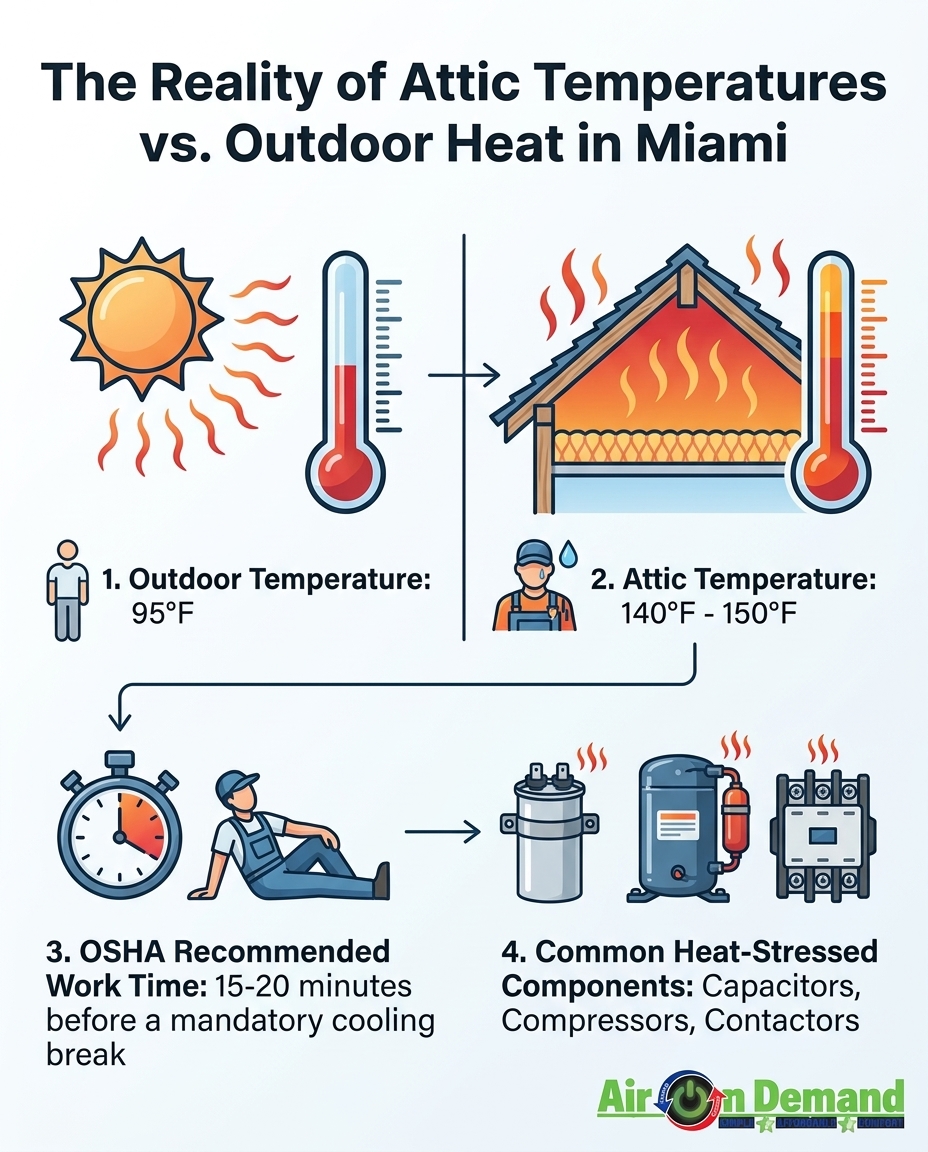
The physics of trapped heat: Radiant heat from the sun beats down on the roof shingles, transferring thermal energy through the roof deck and into the attic space. Because older Miami homes often suffer from poor ventilation, that heat gets trapped. When the outdoor temperature is 95 degrees, our technicians regularly record attic temperatures soaring past 130 or 140 degrees.
• Living Room (No AC) — Typical July Temperature: 85°F - 90°F — Humidity Impact: High (Stagnant air) — Working Condition: Uncomfortable, sweating
• Outdoor Condenser — Typical July Temperature: 95°F - 100°F — Humidity Impact: High (Direct sun) — Working Condition: Harsh, requires frequent water breaks
• Attic Space — Typical July Temperature: 130°F - 150°F — Humidity Impact: Extreme (No evaporation) — Working Condition: Dangerous, strict time limits required
Reaching the air handler isn't as simple as walking into a room. Our technicians must wear protective gear—including long pants, gloves, and sometimes respirators to protect against fiberglass insulation—while army-crawling over wooden joists. One slip of the foot means falling through the customer's drywall ceiling. Maneuvering around thick ductwork, balancing on narrow beams, and hauling heavy tools into this stifling darkness requires immense physical endurance before the actual repair even begins.
Once in the attic or kneeling beside the outdoor unit, our technicians must transition from physical endurance to sharp mental focus. Troubleshooting complex mechanical and high-voltage electrical systems requires a steady hand and a clear mind, both of which are difficult to maintain when sweat is stinging your eyes.
When a homeowner calls us for emergency AC repair, they expect an accurate diagnosis. We never rush the process because of the heat, as that leads to misdiagnoses, callbacks, and further frustration. Therefore, our technicians execute a systematic problem-cause-solution workflow under extreme pressure.
• The Problem: The system is humming loudly, but the fan blade isn't spinning, and the house is getting hotter.
• The Cause: A pattern we see often is the dual-run capacitor swelling and failing due to prolonged heat exposure, preventing the required voltage from reaching the motors. Furthermore, neighborhood grid strain during heatwaves can cause voltage drops that put extra wear on these components.
• The Solution: The technician must safely isolate the power, discharge the stored high voltage in the failed capacitor (a critical safety step), test the surrounding wires for heat damage, and install a properly rated replacement.
• The Problem: The system is running constantly, but airflow from the vents is incredibly weak and barely cool.
• The Cause: The evaporator coil inside the attic air handler has frozen over, or the blower motor is failing under the heavy static pressure load.
• The Solution: The technician must evaluate the blower motor's amp draw, check the coil for ice buildup, and ensure proper airflow. If the coil is frozen, they must find the root cause—whether it is a severely clogged filter, a collapsed return duct, or a refrigerant issue—without compromising the system's integrity.
Homeowners waiting in a hot house are understandably anxious for the repair to be finished. Sometimes, they might look out the window and see our technician sitting in the driver's seat of the service van with the engine running. It is vital to understand that this is not a break; it is a mandatory, life-saving safety protocol.
The physical resilience of our Air On Demand technicians is directly connected to our company's commitment to safety. Ensuring that no technician is pushed past safe physiological limits results in better, more accurate service for our customers.
Protecting the core temperature: When working in 100+ degree attic temperatures, the human body absorbs heat faster than it can expel it. OSHA guidelines strongly recommend strict work-rest cycles for these extreme environments. We mandate that a technician can safely remain in a 140-degree attic for roughly 15 to 20 minutes before their core body temperature reaches a dangerous threshold.
They must exit the attic, climb down the ladder, and spend 10 to 15 minutes in an air-conditioned vehicle drinking electrolytes to bring their core temperature back to a safe baseline. Skipping this step leads to heat cramps, dizziness, confusion, and eventually heat stroke—which can be fatal in an attic.
The buddy system and dispatch monitoring: Throughout the day, our dispatchers monitor the technicians. If a technician is on an attic call for too long without checking in, dispatch will call to verify their safety. Our technicians are trained to recognize the early signs of heat exhaustion in themselves, such as heavy sweating suddenly stopping, nausea, or a rapid pulse. Managing these risks takes time, which is why emergency repairs during a heatwave simply cannot be rushed.
As the clock strikes 4:00 PM, the ambient outdoor temperature is peaking, and our dispatch board lights up. This is the time of day when struggling AC units finally give up. The surge of service requests between 2:00 PM and 6:00 PM requires immense logistical coordination and mental stamina from our entire team.
Prioritizing vulnerability: Our dispatchers and technicians communicate constantly to triage calls based on severity. A home with elderly residents, infants, or a completely dead system takes priority over a home where the AC is running but struggling to keep the temperature below 75 degrees. This triage process is similar to an emergency room.
For more insight on how our team handles off-hours emergencies, you can learn about triaging midnight AC failures during peak heat waves. Routing technicians efficiently is paramount; minimizing "windshield time" (time spent driving) means more time spent fixing systems. Managing customer expectations when the schedule is backed up requires a calm, professional, and empathetic demeanor, even when our technicians are physically exhausted and soaked in sweat.
By the time the sun finally begins to set, our technicians may have crawled through half a dozen attics and revived several completely dead systems. Despite the intense physical exhaustion, the final call of the day brings a unique sense of accomplishment.
The payoff: For our crew, there is a distinct, satisfying moment when the multimeter confirms the voltage is correct, the disconnect switch is flipped, the compressor roars to life, and cold air begins blasting through the vents. Seeing the immediate relief on a homeowner's face makes the brutal conditions worthwhile.
However, many of these emergency breakdowns are entirely preventable. We always remind homeowners that they can drastically reduce their risk of a mid-July failure by investing in preventative AC maintenance. Having our professionals clean the coils, check the electrical connections, and measure the refrigerant levels before the extreme heat arrives ensures the system can handle the load, keeping both your family comfortable and our technicians out of a dangerous emergency scenario.
In our daily service calls, we find that a Miami attic can easily exceed 140 to 150 degrees during peak summer heat. Because the sun's radiant heat bakes the roof and poor ventilation traps that air inside, the attic is usually 40 to 50 degrees hotter than the outdoor temperature. This creates a highly dangerous environment for any work or storage.
AC repairs take longer during a heatwave due to mandatory safety breaks, high call volumes, and the time required to accurately diagnose heat-stressed parts. Technicians working in extreme attic heat must exit every 15 to 20 minutes to cool down and hydrate to prevent heat stroke. This work-rest cycle is critical for their survival and ensures they have the mental clarity to fix your system correctly.
Yes, being an HVAC technician requires immense physical endurance and mobility. Our technicians must regularly carry heavy equipment up ladders, navigate very tight, dark spaces, and endure extreme heat stress. The physical toll of working in 100+ degree environments day after day requires strict hydration and safety habits.
We recommend scheduling preventative maintenance before the summer peaks. Additionally, you should change your air filters regularly to ensure maximum airflow and keep the outdoor condensing unit clear of weeds, debris, and lawn furniture. Proper airflow is the most critical factor we see in preventing your system from overheating.
Yes, you should turn the system off at the thermostat immediately if it stops producing cold air. Leaving a malfunctioning system running can cause the compressor to overheat and fail entirely, or cause the indoor coil to freeze into a solid block of ice. Turning it off prevents further mechanical damage while you wait for one of our professional technicians to arrive.
For our team at Air On Demand, a day in the life of a Miami HVAC technician during extreme heat alerts is a testament to the dedication required to keep this city livable during the summer. Navigating 100+ degree attic temperatures, troubleshooting complex electrical systems under pressure, and prioritizing safety over speed are all part of our daily routine.
Understanding the physical reality of this work highlights exactly why proactive care is so valuable. Don't wait for your system to fail on the hottest day of the year. Take control of your home's comfort and protect your equipment from the brutal summer strain. Reach out to us today to schedule a comprehensive system evaluation or maintenance check, and ensure your home remains a cool, safe refuge all season long.