Triaging Midnight AC Failures in Kendall During Peak July Heat Waves
August 17, 2026
Triaging midnight AC failures in Kendall during peak July heat waves is a nightmare no homeowner wants to face, but it happens all too often. At Air On Demand, our team typically fields dozens of these frantic early-morning calls every summer. You wake up at 2 AM covered in sweat, only to realize the familiar, steady hum of your cooling system is completely gone. The house already feels heavy with the stagnant, oppressive overnight humidity that defines our inland Florida summers. Your immediate thought is panic, followed closely by a stressful decision. Do you need to request a late-night emergency dispatch right this second, or is it safe to wait until the sun comes up? Making the wrong choice here doesn't just cost you sleep—it can cause irreversible damage to your expensive cooling equipment.
If you are dealing with a sudden cooling loss, scheduling proper AC repair as soon as possible is the safest way to restore your comfort and protect your home.
A sudden midnight AC failure rarely happens out of nowhere. In our years of servicing Miami-Dade systems, we find that the AC has often been struggling against intense thermal loads for hours before you finally wake up to a hot house. The biggest mistake homeowners make in this situation is assuming that if the system is still making noise, it is still actively trying to cool the house. In reality, an air conditioner that has stopped dropping the temperature but continues to run is usually actively damaging itself.
Your air conditioner relies on a delicate balance of electrical and mechanical components. At the heart of the system is the compressor, the heavy-duty motor responsible for pumping pressurized refrigerant between the indoor evaporator coil and the outdoor condenser. When a supporting component fails—whether it is a blown dual-run capacitor, a severely clogged filter, or a slow refrigerant leak—the compressor has to work twice as hard to compensate for the loss in efficiency. This leads to a dangerous condition known as short-cycling, where the system rapidly turns on and off, creating massive electrical strain and overheating the motor.
Data from the Department of Energy consistently shows that prompt, proper intervention prevents premature HVAC replacement. We always recommend shutting down a struggling system immediately, because if you let it grind away in the dark, you risk burning out the compressor entirely. A burned-out compressor is not a simple fix; it often means replacing the entire outdoor unit. That is why your absolute priority at 2 AM is triage and damage control. You do not necessarily need an instant fix in the middle of the night, but you do need to stop the bleeding. By securing professional AC service to properly diagnose the root cause in the morning, you protect the most expensive parts of your cooling system from catastrophic, irreversible failure.
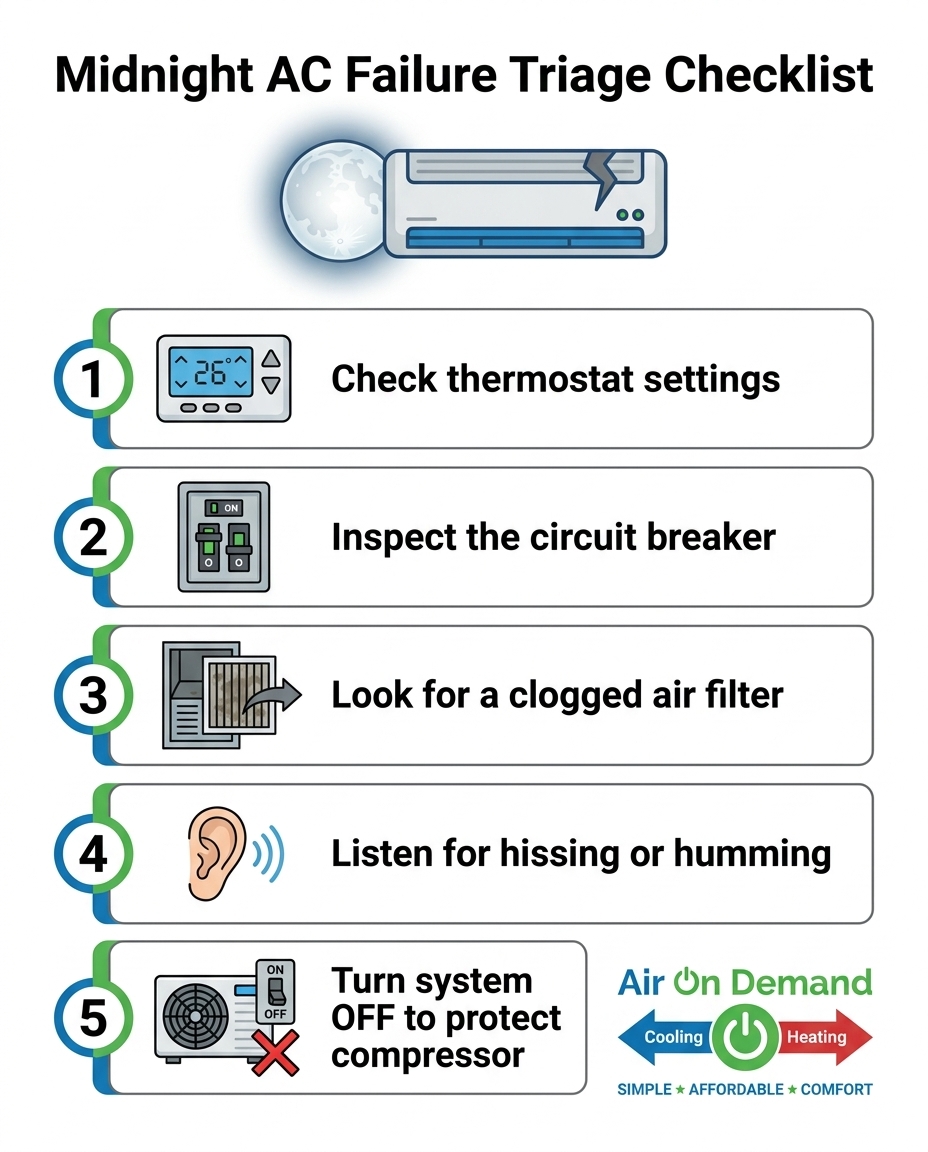
When you are faced with a midnight AC failure, your first job is to act as a first responder for your HVAC system. Before you decide whether to call our team or go back to sleep, we recommend performing a basic, safe diagnostic check. This checklist targets the most common, easily solvable issues our Air On Demand technicians see causing systems to shut down unexpectedly in the middle of the night.
1. Check the thermostat settings: It sounds incredibly simple, but always start here. Verify that the thermostat has not been accidentally bumped to "Heat" or "Off" by someone walking past in the dark. Check the screen to see if the batteries are dead. A blank digital screen often means the thermostat has lost low-voltage power entirely, which could point to a tripped breaker, a tripped float switch in the drain pan, or a blown fuse inside the air handler.
2. Inspect the circuit breaker panel: Go to your main electrical panel and look for the heavy-duty breaker labeled for your air conditioner. During intense summer electrical storms or grid fluctuations, a power surge can easily trip the AC switch to protect the system. If the breaker is sitting in the middle (neutral) position, firmly push it all the way to "Off," wait thirty seconds, then snap it back to "On." If it trips again immediately, stop. Do not reset it a second time, as this indicates a serious electrical short that requires one of our professional technicians.
3. Look at the indoor air filter: A severely clogged air filter acts like a brick wall, choking the airflow your system desperately needs to operate. When warm air cannot flow over the indoor evaporator coil, the temperature of the refrigerant drops rapidly, causing the condensation on the coil to freeze solid. Pull the filter out and hold it up to a lightbulb. If you cannot see light through it because it is caked in thick, gray dust, leave it out for the rest of the night to allow the system to breathe.
4. Listen for unusual sounds: Step outside to your condenser unit with a flashlight. Listen closely without touching the equipment. Are you hearing a loud hissing sound? Is there a harsh, metal-on-metal grinding noise? Do you hear a loud humming or buzzing noise, but the large fan blade at the top is completely stationary? These auditory clues are critical warning signs of mechanical failure that you can report to your Air On Demand technician.
5. Switch the thermostat to 'OFF': If none of the basic checks resolve the issue, you must protect the equipment. Go to your thermostat and switch the system from "Cool" to "Off." Leaving it on while it struggles will only cause further electrical damage and drive up your utility bill for zero cooling return.
Some symptoms go beyond a simple nuisance and require immediate action to prevent severe property damage or electrical hazards. A pattern we see often in Kendall homes is homeowners ignoring these warning signs in hopes the system will correct itself. If you notice any of the following red flags, do not just turn off the thermostat—go directly to your electrical panel and flip the dedicated AC breaker to the "Off" position to completely sever the power supply.
• Loud hissing noises: A distinct hissing or bubbling sound coming from the indoor air handler or the outdoor unit usually points to a severe refrigerant leak. Refrigerant operates under incredibly high pressure, and a sudden leak can quickly drain the system, causing the compressor to overheat and fail within minutes as it tries to pump a non-existent gas.
• A frozen evaporator coil: If you open the closet or garage door where your air handler lives and see a thick layer of white ice coating the copper pipes, your system is frozen solid. This ice acts as a powerful insulator, preventing the system from absorbing heat from your home. Continuing to run it will push liquid refrigerant backward into the compressor, which is designed only to pump gas. This will destroy the motor valves instantly.
• A humming outdoor unit with stationary blades: If you walk outside and hear a loud electrical hum, but the AC unit fan not spinning, you likely have a failed dual-run capacitor or a seized fan motor bearing. The humming sound is the compressor trying to run without the fan to exhaust the heat it generates. Left unchecked, the compressor will rapidly overheat and trip its internal thermal overload switch.
• Burning electrical smells: The unmistakable scent of burning plastic, melting wire insulation, or ozone is an immediate safety hazard. This indicates a failing blower motor, a melting contactor switch, or a dangerous electrical short in the wiring harness. Shut the power off at the breaker immediately to eliminate the risk of an electrical fire spreading through your walls.
Taking the proactive step to cut the power completely at the breaker is the smartest move a homeowner can make during a late-night breakdown. First, it stops all electrical strain on the system. Even if the thermostat is turned off, a failing high-voltage contactor switch outside can sometimes weld itself shut, sending continuous high voltage to the outdoor unit regardless of what the thermostat requests.
Second, if your system has a frozen evaporator coil, that ice has to melt entirely before any diagnostic work can begin. Our technicians cannot test refrigerant pressures, measure airflow, or inspect the aluminum fins while the coil is encased in a solid block of ice. By shutting the system down completely, you allow the warm ambient air to naturally thaw the coil overnight. By the time an Air On Demand professional arrives in the morning, the system will be ready for a proper, accurate repair, saving you hours of waiting.
Once you have triaged the immediate symptoms of a midnight AC failure, you face the main decision point: do you pick up the phone and request a 24-hour emergency dispatch, or do you wait for regular business hours? At Air On Demand, we believe in prioritizing what is best for your equipment. Our goal is to save your expensive compressor and help you avoid unnecessary after-hours service calls whenever possible, rather than making a quick dispatch at 2 AM.
Here is a reality of the HVAC industry we always share with our customers: supply houses are closed in the middle of the night. If your system requires a specialized OEM part, a technician will not be able to acquire it until 8 AM anyway. If you have safely powered down the system at the breaker and there is no immediate safety hazard, waiting until morning is almost always the smartest choice. Turning off the equipment protects the compressor, effectively turning what could have been a catastrophic replacement into a standard, routine repair.
To help you make the right call, use this comparison criteria to weigh your specific situation:
• Burning smells or visible sparks — Action Required: Call immediately (Emergency) — Why It Matters: Active electrical shorts pose a severe fire hazard to your home and family.
• Water leaking through ceiling/walls — Action Required: Call immediately (Emergency) — Why It Matters: A clogged drain line overflowing from the attic can cause extreme structural damage.
• System blowing warm, unconditioned air — Action Required: Shut off breaker, wait for morning — Why It Matters: Safely shutting it down prevents the compressor from overheating while you wait for regular hours.
• Frozen indoor/outdoor coils — Action Required: Shut off breaker, wait for morning — Why It Matters: The ice must melt completely before any technician can perform an accurate diagnostic or repair anyway.
If your situation falls into the "wait for morning" category, take a deep breath. You have done exactly what you need to do to protect your home and your investment. First thing in the morning, you can reach out for comprehensive Kendall AC repair services to get the system properly diagnosed by a fresh, fully equipped technician with full access to local supply houses.
Deciding to wait until morning is the smart move, but it still leaves you with a practical problem: surviving the rest of the night in peak July heat. In our experience working through Miami's most oppressive heat waves, we know that without a functioning air conditioner to remove moisture (latent heat), the stagnant air inside your home will slowly begin to rise, making it difficult to sleep. Fortunately, there are actionable steps you can take to mitigate the heat and stay reasonably comfortable until our technicians arrive.
• Lock down the building envelope: Your instinct might be to open a window to catch a breeze, but in South Florida, this is usually a massive mistake. Opening windows invites heavy, moisture-laden air into the house, which makes the air feel much hotter than the actual temperature reading. Keep all windows and exterior doors tightly closed to trap whatever cooled, dehumidified air remains in the living space.
• Create a wind-chill effect: Stagnant air feels significantly hotter than moving air because it prevents sweat from evaporating off your skin. Turn on all ceiling fans in the bedrooms you are occupying, and set them to rotate counterclockwise (pushing air straight down). If you have portable oscillating or box fans, set them up to cross-ventilate the room. The moving air helps evaporate moisture, making you feel several degrees cooler even if the room temperature is slowly rising.
• Block the morning sun: As dawn approaches, solar heat gain becomes your biggest enemy. Before you go back to sleep, close all blinds, shades, and blackout curtains, particularly on the east-facing side of the house. Blocking the early morning sunlight prevents radiant heat from warming up the rooms before the dispatch team arrives to fix the system.
• Relocate to a lower floor: Basic physics dictates that heat rises. If you live in a multi-story home, the second floor will always heat up much faster than the ground floor. If possible, bring your pillows and blankets downstairs to the lowest level of the house. Staying hydrated with ice water will also help regulate your core body temperature through the night.
Yes, you should immediately turn off your AC if it stops blowing cold air. Allowing the system to run while it is struggling puts massive strain on the electrical components. Shutting it down prevents severe damage to the compressor and stops a minor issue from becoming a major repair.
A broken AC is considered an emergency if it involves burning electrical smells, visible sparking, or severe water leaks that threaten your property. If the system simply stops cooling safely, it is usually best to turn off the power at the breaker and schedule a standard service call with our team for the next morning in Kendall.
In most cases, AC repair can and should wait until morning. By turning off the system at the breaker, you protect the equipment from further damage overnight. Waiting for regular business hours helps you avoid premium after-hours dispatch calls while ensuring a fully equipped technician arrives to diagnose the problem.
If your AC breaks during extreme heat, turn the system off immediately to prevent compressor burnout. Keep your windows and doors closed to trap the remaining cool air, turn on all ceiling fans to create a wind-chill effect, and stay hydrated while waiting for our professional repair team.
Running a broken AC will absolutely damage the compressor over time. When components like the fan motor or capacitor fail, the compressor works overtime to pump refrigerant, leading to overheating and short-cycling. A burned-out compressor is one of the most extensive repairs in HVAC, which is why a safe shutoff is critical.
Navigating a midnight AC failure is stressful, but by safely shutting down the system at the breaker, you have already taken the most important step to protect your expensive equipment. You now have a clear, actionable checklist to prevent catastrophic compressor damage and the peace of mind knowing you can safely wait until morning. Do not let a late-night breakdown ruin your summer comfort. Reach out to the Air On Demand team as soon as the sun comes up to secure your spot on the schedule and get the reliable emergency AC repair in Kendall you need when triaging midnight AC failures in Kendall during peak July heat waves.