Why Is My AC Unit Fan Not Spinning? Diagnosing Condenser Failures
August 17, 2026
Summer heatwaves in our region are unforgiving, and a struggling air conditioner quickly turns a comfortable home into an unbearable environment. If you walk outside and notice your outdoor unit is humming but the fan blades are completely still, you are facing a critical system failure. One of the most common homeowner questions answered by our technicians is exactly how to handle this stressful scenario. In fact, when we compile the most frequently asked questions about local services, condenser fan failures consistently rank at the top of the list.
During peak summer heatwaves, the prolonged running times of AC units make this a highly common failure. Your air conditioning system works incredibly hard to maintain indoor comfort, and the outdoor condenser fan plays a vital, non-negotiable role in that process. Knowing how to assess the situation, understanding when to check a simple breaker, and recognizing when to call for immediate professional dispatch can save your equipment from permanent, catastrophic damage.
To understand why a dead fan is an emergency, you must understand how your air conditioner actually cools your home. Your AC does not "create" cold air; it removes heat from your indoor air and pumps it outside. The refrigerant absorbs heat inside your house, travels through copper lines to the outdoor unit (the condenser), and releases that heat into the outdoor air.
The condenser fan is responsible for pulling massive amounts of ambient air across the hot condenser coils to dissipate that collected heat. If the fan stops spinning, the heat has nowhere to go. The system becomes trapped in a dangerous cycle, continuously absorbing heat from inside your home but failing to release it outside.
Identifying the problem early is your best defense against expensive secondary damage. Here is a breakdown of what normal operation looks like compared to a system suffering from fan failure:
• Fan Blades — Normal Operation: Spinning rapidly, blowing warm air upward — Fan Failure Symptoms: Completely stationary, or twitching slightly
• System Noise — Normal Operation: Steady, even mechanical drone — Fan Failure Symptoms: Loud buzzing, aggressive humming, or dead silence
• Air Temperature (Indoor) — Normal Operation: Cold air blowing from supply vents — Fan Failure Symptoms: Warm or room-temperature air blowing from vents
• Compressor Unit — Normal Operation: Warm to the touch, vibrating slightly — Fan Failure Symptoms: Excessively hot, potentially shutting off entirely
The problem: You realize the outdoor fan is not spinning, but the indoor blower is still pushing air through your vents. Your first instinct might be to leave the system running in hopes that it will eventually cool the house down.
The cause: Running the air conditioner without a functioning condenser fan traps all the rejected heat inside the outdoor unit. Because the heat cannot escape the condenser coil, the pressure and temperature of the refrigerant skyrocket. This forces the compressor—the heart of your air conditioning system—to work against extreme resistance.
The solution: You must turn off your air conditioning system immediately at the thermostat. Do not switch it to "fan only" if you suspect an outdoor unit issue; turn the cooling mode completely off. Continuing to run the system will cause the compressor to overheat rapidly. Modern compressors have an internal thermal overload switch designed to shut them down when they get too hot, but relying on this safety mechanism is dangerous. Repeatedly tripping the thermal overload will eventually cause the compressor windings to melt and short out. Ignoring a broken fan can quickly turn a straightforward component repair into a full, expensive system replacement.
Compressors are highly engineered, expensive components. When they overheat due to a lack of airflow, the internal lubricating oil begins to break down and turn acidic. This acid eats away at the electrical windings inside the compressor. By the time you notice a burning smell, the damage is already done. Shutting the system off the second you notice the fan is stationary is the single most important step a homeowner can take to protect their investment.
Before assuming a major component has failed, there is one safe, standard troubleshooting step every homeowner should perform. Sometimes, the issue is simply a loss of high-voltage power to the outdoor unit. Power surges, local grid fluctuations, or an overworked system can trip the dedicated AC circuit breaker.
Follow these exact steps to check your power supply safely:
1. Turn off the thermostat: Ensure the indoor control is set to the "Off" position so the system does not try to start while you are inspecting the panel.
2. Locate your main electrical panel: This is usually found in a garage, basement, utility room, or on the exterior of your home.
3. Identify the AC breaker: Look for a double-pole breaker (it will look like two switches tied together) labeled "AC," "Condenser," or "HVAC."
4. Check the breaker position: A tripped breaker does not always flip all the way to the "Off" position. It often rests in the middle, feeling slightly spongy if you push it.
5. Perform the "One-Reset Rule": Firmly push the breaker all the way to the "Off" position until it clicks, then firmly push it back to the "On" position.
The crucial warning: You may reset the breaker exactly once. If the breaker holds and the system turns on normally, monitor it closely. However, if the breaker trips again immediately, or trips a few minutes after the system starts, stop immediately. A repeatedly tripping breaker indicates a dead short to ground or a locked-up compressor. Continuing to reset the breaker forces high amperage through failing electrical components, which can cause electrical fires or permanent equipment destruction. At this point, professional diagnostics are required.
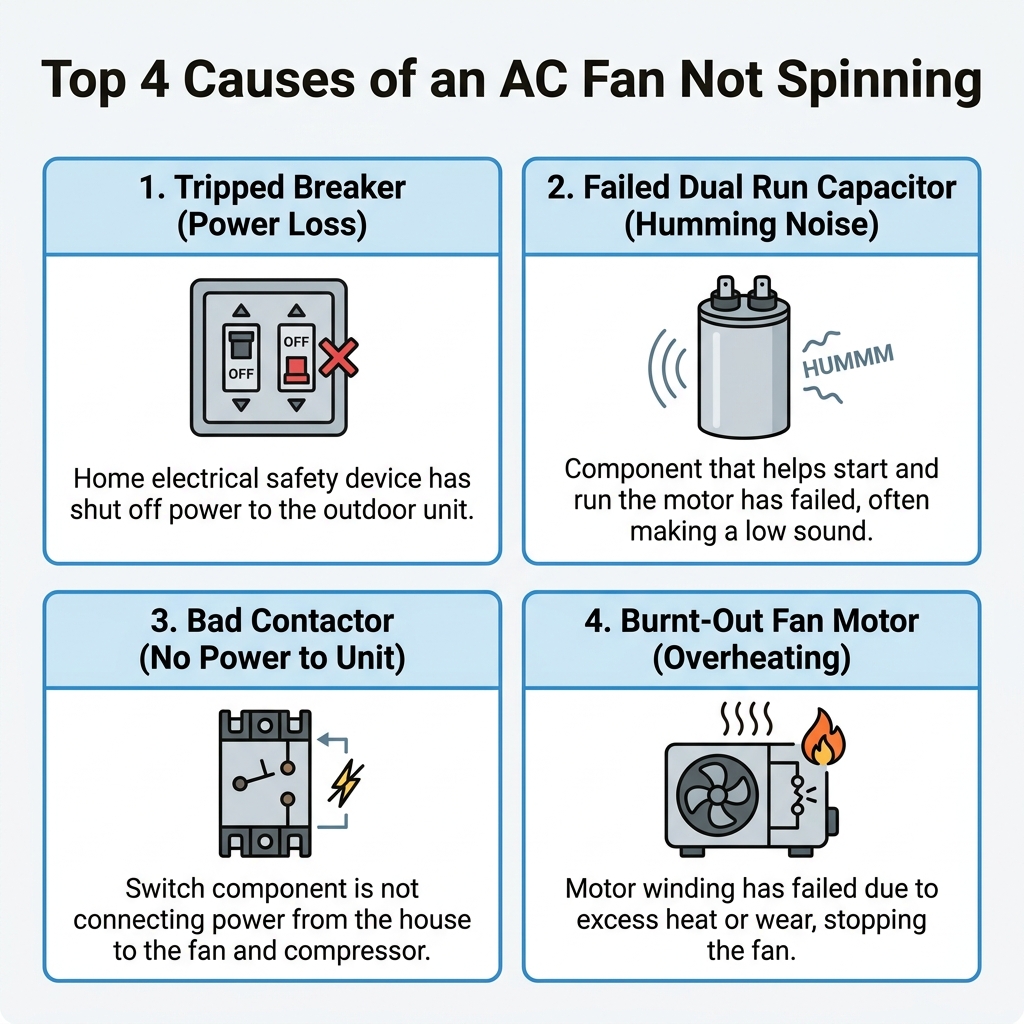
If your breaker is fine and the outdoor unit is receiving power, the number one most common reason an AC condenser fan stops spinning is a failed dual run capacitor. If you hear a distinct humming or buzzing noise coming from the outdoor unit but the fan blades are dead still, the capacitor is almost certainly the culprit.
Think of a capacitor as a large, powerful battery that stores electrical energy. Air conditioning motors require a massive jolt of electricity to start spinning—much more power than your home's standard electrical wiring can provide all at once. The dual run capacitor stores this energy and releases it in a fraction of a second to jumpstart both the compressor and the condenser fan motor (hence the term "dual"). Once the motors are running, the capacitor provides a continuous, even supply of voltage to keep them spinning smoothly.
In regions with intense heat and high humidity, the lack of system downtime prevents capacitors from cooling properly. Air conditioners run almost continuously during peak summer months. This constant electrical load generates immense internal heat within the capacitor. Over time, the dielectric fluid inside boils and expands, causing the top of the capacitor to bulge outward like a swollen tin can. This accelerated wear and tear means capacitors in hot climates fail much faster than those in milder regions.
Many online forums suggest a DIY trick known as the "stick test." The theory is that if the capacitor is dead, you can push the fan blades with a long stick to manually jumpstart the motor. While this sometimes forces the fan to spin temporarily, it is highly dangerous and explicitly advised against.
First, sticking objects into a live, high-voltage machine is an obvious safety hazard. Second, running a motor on a dead capacitor forces the motor to pull excessive amperage to keep spinning. This causes the motor windings to overheat rapidly, practically guaranteeing that you will burn out the fan motor within a few hours. What could have been a simple capacitor replacement now requires a brand new motor as well.
If the capacitor is functioning normally, the next potential point of failure is the mechanical fan motor itself. Condenser fan motors endure brutal operating conditions. They sit outside in the extreme heat, completely exposed to rain, dust, and debris, while running for thousands of hours every season.
Continuous operation degrades the motor's internal bearings and electrical windings. As the bearings lose their lubrication, the motor has to work harder to turn the heavy fan blades. This increased friction generates excess heat, leading to severe thermal stress. Understanding why your AC fan motor stops working is critical for recognizing when a system has reached the end of its mechanical lifespan.
Fan motors rarely fail in a vacuum. Very often, a burnt-out motor is the direct result of a weak, failing capacitor that was ignored. When a capacitor begins to lose its microfarad rating (its ability to store energy), it supplies inconsistent voltage to the motor. The motor attempts to compensate by pulling more electrical current, which overheats the internal copper windings until they literally melt and break the circuit.
• Excessive heat: The top of the condenser unit feels dangerously hot to the touch.
• Acrid smells: A distinct, harsh smell of burning plastic or ozone coming from the outdoor unit.
• Physical resistance: If the power is completely disconnected and a technician tries to spin the blades by hand, a seized motor will feel stiff or completely locked in place.
Sometimes, the issue is not the motor or the capacitor, but the component that tells them to turn on in the first place. The contactor is a high-voltage mechanical relay switch located inside the outdoor unit's electrical panel. When your indoor thermostat detects that the house is too warm, it sends a low-voltage signal outside to the contactor. This signal energizes a magnetic coil, which pulls a set of metal contacts closed. When these contacts touch, high-voltage electricity flows from your home's breaker panel into the AC unit.
Every time the contactor slams shut, a small electrical arc jumps between the metal plates. Over years of operation, this continuous arcing causes the metal contacts to become pitted, scorched, and covered in carbon buildup. Eventually, the carbon creates an insulated barrier, and the electricity can no longer cross the bridge. The thermostat is calling for cooling, but the voltage never reaches the fan motor.
Because contactors emit a low-level hum and generate warmth, they frequently attract insects. It is incredibly common for ants, spiders, or earwigs to crawl into the contactor housing. When the switch closes, the bugs are crushed between the metal plates, physically blocking the electrical connection. Whether the contactor is burnt out or blocked by debris, this communication breakdown requires professional replacement to restore power to the fan.
When researching AC repairs, homeowners often find videos detailing how to swap out capacitors or contactors. However, based on Department of Energy (DOE) and ASHRAE standard safety protocols, DIY high-voltage electrical repair is strictly warned against.
The most critical danger involves the dual run capacitor. By design, a capacitor stores a massive electrical charge. Standard AC capacitors hold a lethal high-voltage electrical charge even when the power is entirely disconnected at the breaker. Simply turning off the electricity to the house does not make the AC unit safe to touch. If a homeowner accidentally bridges the capacitor terminals with a screwdriver or their hand, the capacitor will discharge all of its stored energy instantly, resulting in severe electrical shock or worse.
Diagnosing electrical failure requires specialized, calibrated multimeters and the training to read microfarads safely. A visual inspection is never enough; a capacitor can look perfectly normal on the outside but be completely dead on the inside. Furthermore, replacing internal electrical parts requires exact OEM part matching. Installing a capacitor with the wrong microfarad rating will destroy the fan motor and compressor within days. For these reasons, opening the electrical access panel on an outdoor condenser is strictly a job for licensed HVAC professionals.
When an air conditioning system breaks down, homeowners need fast, accurate answers. We have compiled the most common questions regarding AC fan failures to help you understand your system better.
This symptom usually indicates a failed dual run capacitor. The humming noise means the system is receiving high-voltage power from the electrical panel, and the contactor has closed successfully. However, the motor lacks the stored energy required to overcome inertia and start spinning. The electrical current is bottlenecked at the motor, causing the audible vibration or buzzing sound. Immediate shutdown is required to prevent the motor from burning out.
Absolutely not. Running the air conditioner without a functioning outdoor fan will cause the compressor to overheat rapidly and suffer catastrophic damage. The fan is required to reject the heat absorbed from your home. Without airflow, the refrigerant pressure spikes to dangerous levels. While internal safety switches may temporarily shut the compressor off, relying on them will eventually lead to a permanent, highly expensive compressor failure.
Fan motors burn out due to age, lack of maintenance, and extreme thermal stress. Operating in brutal summer conditions takes a toll on the internal bearings and electrical windings. This degradation is often accelerated by a weak capacitor forcing the motor to pull higher amperage and work much harder than designed. Lack of airflow from dirty condenser coils can also trap heat around the motor, speeding up the breakdown of internal components.
It requires handling high-voltage wiring, safely discharging capacitors, and ensuring exact OEM part matching. Fan motors must be balanced perfectly and wired correctly to ensure the blades spin in the right direction (pulling air through the side coils and exhausting it out the top). Because of the lethal voltage risks and precise mechanical requirements, it is not a safe DIY project and requires a licensed professional technician.
While standard capacitors are designed to last several years, constant summer operation can significantly reduce their lifespan. In regions with intense heat and high humidity, the continuous electrical load prevents the capacitor from cooling down, causing the internal fluids to expand and degrade. Routine seasonal maintenance is critical because it allows technicians to measure the microfarad output and catch weak capacitors before they fail completely and leave you without cooling.
A stationary condenser fan is a clear signal that your air conditioning system is in distress. If you have checked your electrical panel and the circuit breaker is not the issue, the system requires professional electrical diagnostics. Ignoring the problem, attempting dangerous DIY repairs, or hoping the system will fix itself will only lead to more extensive damage to your compressor and internal components.
When the summer heat is rising, resolving the issue quickly is vital to prevent your indoor temperatures from reaching unsafe levels. Our team provides prompt, reliable emergency repair services to diagnose the exact point of electrical or mechanical failure safely. By relying on licensed professionals, you ensure that the repair is done accurately, restoring your comfort quickly while protecting the long-term health of your HVAC investment.