
Emergency Holiday AC Repair Rates vs. Proactive November Tune-Ups
November 9, 2026
Are you truly prepared for the sudden heat load of a house full of guests and an oven running all day, or is your cooling system secretly on the brink of failure? When weighing the realities of Emergency Holiday AC Repair Rates vs. Proactive November Tune-Ups, the deciding factor is almost always timing. At Air On Demand, our team sees a very specific pattern emerge every late fall across Miami: a sudden capacitor failure strikes right before dinner is served on Thanksgiving Day. Now, you are forced into a stressful decision point—do you risk paying premium holiday dispatch fees for a sudden breakdown, or do you secure peace of mind early?
Taking action before the holiday rush is the most reliable way to avoid a seasonal disaster. Scheduling your AC maintenance in advance ensures your system is physically prepared for the demands of holiday hosting.
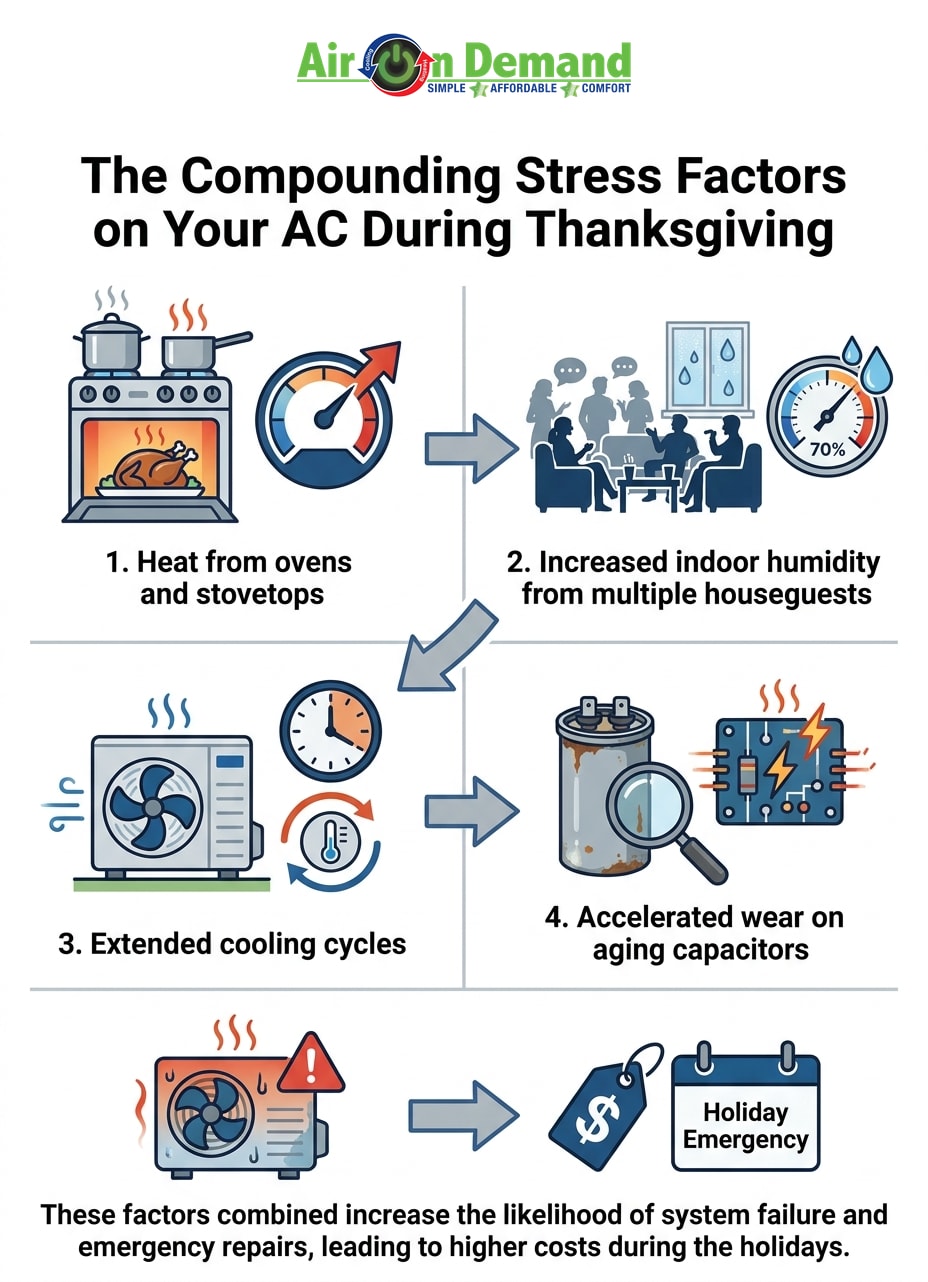
Hosting a major late fall gathering completely changes the environment inside your home. On a normal Tuesday, your cooling system manages the heat generated by a few family members and standard daily activities. On a major holiday, the variables shift dramatically. Your oven operates at high temperatures for hours. Boiling pots release heavy steam, spiking indoor humidity. A dozen or more guests radiate constant body heat. Every time the front door opens to welcome a new arrival, a wave of warm, humid air rushes inside.
Your thermostat registers this sudden, massive influx of heat and commands your air conditioner to work overtime. If your equipment has been neglected for months, this extreme surge in demand acts as a brutal stress test. Minor, hidden issues that went unnoticed during quieter weeks are suddenly pushed past their breaking point. By understanding the immense strain your equipment faces during these gatherings, you can see why waiting for a breakdown is a high-risk strategy that rarely pays off.
In our years serving Miami homeowners, we've found that a common misconception is that late fall means giving your air conditioner a rest. In northern regions, homeowners are actively winterizing their cooling equipment and firing up their furnaces. In South Florida, the climate dictates a completely different reality. Miami's warm and humid Novembers mean AC systems are still running constantly, making fall maintenance just as critical as spring preparation.
Because local temperatures frequently remain in the upper 70s and low 80s throughout the late fall, your system never truly gets an off-season. It continues to cycle on and off daily, pulling thick moisture out of the indoor air while fighting back the ambient heat. This constant operation means hidden wear and tear accumulates rapidly. Moving parts lose their lubrication, electrical connections experience microscopic loosening from vibration, and dust slowly blankets the sensitive evaporator coil.
Most homeowners do not realize that an air conditioner working in a humid environment works twice as hard. It must first expend energy to dehumidify the air before it can effectively lower the temperature. When your system operates under these conditions for months on end without a professional tune-up, its efficiency quietly plummets.
When you combine Miami's baseline late fall climate with the sudden shock of holiday entertaining, the results can be disastrous for an unmaintained system. Adding ten or more houseguests and hours of stovetop cooking to an already taxed system forces the equipment to run continuously without a cooling-off period.
The compressor, which is the heart of your cooling system, relies on periodic breaks to dissipate its own internal heat. When the indoor temperature keeps rising due to cooking and crowded rooms, the thermostat never signals the compressor to shut down. This relentless cooling cycle is exactly what causes borderline components to finally give out, leaving you scrambling for a solution on one of the busiest days of the year.
Air conditioners rarely fail without a mechanical reason. When a breakdown occurs exactly when you do not want it to, it is usually the result of compounding stress factors converging at the worst possible moment. Understanding the mechanics behind these failures helps clarify why preventative care is vastly superior to reactive panic.
In our experience responding to holiday emergency calls, one of the most frequent culprits behind a Thanksgiving Day failure is the dual run capacitor. This small, cylindrical component acts like a powerful battery, delivering a massive jolt of electricity to start your compressor and fan motors. Over time, heat and constant use degrade the capacitor's ability to hold a charge.
When weighing the logistics of emergency weekend service versus booking a standard appointment, the condition of your capacitor is a prime example of why early intervention matters. During a holiday gathering, the system cycles constantly. A weak capacitor struggles to provide the necessary voltage, forcing the compressor to pull more electrical current and run dangerously hot until the capacitor finally bursts or fails entirely.
When an air conditioner is pushed beyond its limits during a holiday gathering, the failure usually follows a predictable sequence of events:
1. Borderline failing components are pushed beyond their limit: Aging parts, particularly capacitors and contactors, degrade quietly over the summer. The sudden demand of constant cycling during a holiday party forces these weakened parts to work harder than ever, eventually causing them to snap.
2. Increased ambient heat forces extended cycles: The massive heat load from cooking and guests means the system cannot reach the target temperature on the thermostat. The equipment runs for hours without a break, causing the compressor to overheat and potentially trigger its internal thermal overload switch.
3. Clogged filters restrict vital airflow: Exactly when indoor occupancy and humidity are at their highest, a dirty air filter suffocates the system. Restricted airflow prevents the evaporator coil from absorbing heat properly, which can lead to the coil freezing into a block of solid ice, shutting down the entire cooling process.
When a breakdown strikes, the financial reality of the situation becomes immediately apparent. There is a stark difference between the predictable, flat-rate structure of a scheduled tune-up and the premium rates required to roll a service truck on a major holiday. Because a sudden failure often triggers a frantic search for Miami emergency holiday AC repair, our team wants you to understand how these fee structures work so you can protect your wallet.
HVAC companies operate on strict logistical schedules. During standard business hours, routing a technician for a preventative maintenance visit is highly efficient. The route is planned in advance, the necessary diagnostic tools are prepped, and the pricing is transparent and flat-rate. You know exactly what the visit entails and what the baseline costs will be before the technician ever knocks on your door.
Holiday dispatch is an entirely different operational reality. On days like Thanksgiving, most local businesses are closed, and service departments operate on skeleton crews. To incentivize highly trained technicians to leave their own families and handle urgent calls, companies must pay overtime or double-time wages. These increased operational costs are necessarily reflected in the emergency dispatch fees.
To illustrate the stark contrast in these two approaches, review how the different service scenarios impact your overall experience and budget:
• Rate Structure — Proactive November Tune-Up: Predictable, flat-rate standard pricing with transparent diagnostic fees. — Holiday Emergency Dispatch: Premium "double-time" or elevated emergency dispatch fees.
• Technician Availability — Proactive November Tune-Up: Scheduled at your convenience during regular business hours. — Holiday Emergency Dispatch: Subject to the availability of a limited on-call skeleton crew.
• Repair Options — Proactive November Tune-Up: Failing parts are identified early, allowing for standard-rate replacements. — Holiday Emergency Dispatch: Urgent part sourcing is required, often limited by closed supply houses.
• Stress Level — Proactive November Tune-Up: Zero stress; the system is optimized before guests arrive. — Holiday Emergency Dispatch: High stress; scrambling to find help while the house rapidly heats up.
The core differentiator here is transparent pricing. A proactive tune-up allows you to review the condition of your system calmly, make informed decisions about aging parts, and avoid the unpredictable sticker shock that inevitably accompanies an urgent holiday call.
While the premium dispatch fees are a significant deterrent, the financial cost is only half the story. The non-financial toll of a sudden AC failure during a major gathering is often much worse. A ruined holiday event creates stress, frustration, and deep discomfort that money simply cannot immediately fix.
In Miami's climate, a home without air conditioning does not stay comfortable for long. Once the compressor stops running, the indoor temperature begins to climb rapidly, accelerated by the heat from the kitchen and the body heat of your guests. Within an hour, a sweltering house quickly makes family members and visitors deeply uncomfortable. The festive atmosphere evaporates, replaced by guests fanning themselves, sweating, and retreating to the few rooms with ceiling fans.
Opening windows in late fall rarely provides relief. Instead of letting in a cool breeze, you are often just inviting thick, heavy humidity into the home, making the indoor air feel even more oppressive and sticky. The environment goes from welcoming to miserable in record time.
Beyond the physical discomfort, there is the intense distraction and stress placed on the host. Instead of managing the cooking timeline, carving the turkey, and entertaining loved ones, you are suddenly thrust into a logistical nightmare. You must step away from the gathering to frantically call local service providers, hoping to find someone who is actually answering the phone.
Because most companies operate with limited staff on holidays, you may find yourself placed on a long waiting list, crossing your fingers that a technician can arrive before the evening ends. The mental burden of managing a mechanical breakdown takes you entirely out of the moment, ruining the holiday experience you worked so hard to plan.
The most effective way to handle premium emergency dispatch fees is to ensure you never have to pay them. Positioning a tune-up and maintenance plan as a practical insurance policy against holiday disasters is the smartest financial move a homeowner can make. It shifts you from a reactive stance to a proactive strategy.
When Air On Demand performs a professional tune-up, it is far more than a simple filter change. It is a comprehensive diagnostic physical for your cooling equipment. During a late fall visit, our trained technicians use specialized multimeters to test the exact microfarad readings of your capacitors. We inspect the contactor for pitting and burn marks. We measure the refrigerant pressures to ensure the system isn't quietly starving for cooling capacity.
By catching these failing parts early, you allow for standard-rate replacements before they cause a total system shutdown. Replacing a weak capacitor on a Tuesday afternoon in early November is a minor, routine expense. Replacing that exact same capacitor on Thanksgiving afternoon carries a massive premium. The proactive approach eliminates the risk entirely.
Beyond the immediate tune-up, enrolling in a routine maintenance plan offers a secondary layer of vital protection. When you are a member of a preventative program, you secure priority scheduling. If a freak breakdown does occur—perhaps due to a sudden power surge or a severe weather event—you are not pushed to the back of the line behind dozens of other desperate callers.
Furthermore, maintenance programs often include tangible financial value that directly offsets the cost of the plan itself. Many programs waive or significantly reduce the premium dispatch fees that normally apply on holidays, weekends, or after hours. This means that even in a worst-case scenario, your financial exposure is strictly limited, and your transparent pricing remains intact.
Even with the best preparation, unexpected events can sometimes occur. If you find yourself facing a sudden loss of cooling while hosting a late fall gathering, how you react in the first twenty minutes dictates how much damage the system will sustain. Providing actionable, safe advice is essential while you wait for a technician to arrive.
If your system begins blowing warm air, making loud grinding noises, or simply shuts down entirely, you must take immediate steps to protect the equipment and your home's remaining comfort. Follow this checklist carefully:
• Turn off the system at the thermostat immediately: Do not let a struggling system continue to run. If the indoor fan is blowing but the outdoor compressor is stalled, leaving the thermostat set to "cool" will continuously send voltage to a failed part. This can easily turn a minor electrical issue into a catastrophic compressor failure.
• Close blinds and limit opening exterior doors: Your goal is to trap as much of the remaining cool, dehumidified air inside the house as possible. Draw the curtains on sun-facing windows to block radiant heat, and ask guests to minimize trips in and out of the house.
• Never attempt DIY electrical repairs: The capacitors inside your condensing unit store lethal amounts of high-voltage electricity, even after the power is disconnected at the breaker. Never open the electrical panel or attempt to bypass a component due to severe safety risks.
• Contact a professional immediately: The sooner you reach out, the sooner you get on the emergency dispatch board. Delaying the call only pushes your service window further into the evening.
By securing the system safely, you prevent further mechanical damage. Once the unit is powered down, your next step is to secure reliable emergency AC repair in Miami to restore your home's comfort as quickly and safely as possible.
Do HVAC companies charge extra on holidays?
Yes, holiday dispatch usually involves premium or double-time rates to compensate technicians for working during major events. Because service departments operate on skeleton crews during these times, the operational cost of routing a truck is significantly higher. Scheduling preventative maintenance ahead of time is the best way to avoid these elevated fees.
Is a Thanksgiving AC breakdown considered an emergency?
A total loss of cooling during a holiday gathering is absolutely treated as an emergency, especially in a warm, humid climate. The rapid rise in indoor temperature and humidity can quickly make a home unlivable for guests. Professional service teams prioritize these calls to restore comfort and prevent further damage to the overheating equipment.
Why is my AC struggling to cool when I have guests?
Extra people and running appliances add significant heat and humidity to your home, drastically increasing the thermal load. Your air conditioner has to work much harder to remove this added moisture and heat. If the system is dirty, low on refrigerant, or running with a weak capacitor, this sudden surge in demand can overwhelm it completely.
How often should AC be serviced in Florida's climate?
In a warm, humid environment, your system requires professional attention twice a year. Because the equipment runs almost constantly from spring through late fall, it accumulates wear and tear much faster than units in northern climates. A spring and fall tune-up ensures the system remains efficient and catches failing parts before they cause a breakdown.
What are the signs of a failing AC capacitor before it breaks?
You might notice your system struggling to start, clicking noises coming from the outdoor unit, or warm air occasionally blowing from the vents. Sometimes, the outdoor fan will hum but fail to spin unless pushed with a stick. If you notice any of these symptoms, turn the system off immediately and call a professional to prevent permanent damage to the compressor.
You deserve to enjoy your holiday gathering without the intense stress of a sweltering house or the unpredictable sticker shock of premium dispatch fees. Securing a proactive tune-up provides a clear understanding of your equipment's health and guarantees true peace of mind. Protect your home and your wallet by scheduling your maintenance well before the guests arrive.