Troubleshooting Heat Strip Failures in Homestead's Older Mobile Homes
November 7, 2026
You turn on the heat to take the chill out of the air, and suddenly, half the house goes dark. Dealing with a tripped breaker is frustrating, especially when you are just trying to keep your family comfortable. If you are troubleshooting heat strip failures in Homestead's older mobile homes, you already know this is a familiar headache during November pre-winter temperature drops. At Air On Demand, our team fields countless calls about this exact issue. South Florida does not experience freezing weather often, but when those infrequent cold snaps hit, residents across the region turn on their heating systems simultaneously. This sudden, massive demand stresses both the local electrical grid and your home's individual breaker panel after months of inactivity.
When your breaker trips the moment the heater kicks on, it often seems like a sudden appliance failure. However, our technicians typically find it is a systemic issue triggered by a sudden demand that exceeds your electrical panel's capacity. Navigating these sudden power failures means deciding whether you need a simple component repair, a mobile home electrical upgrade, or a completely different heating solution. For expert help, explore our Homestead HVAC services to evaluate your system safely.
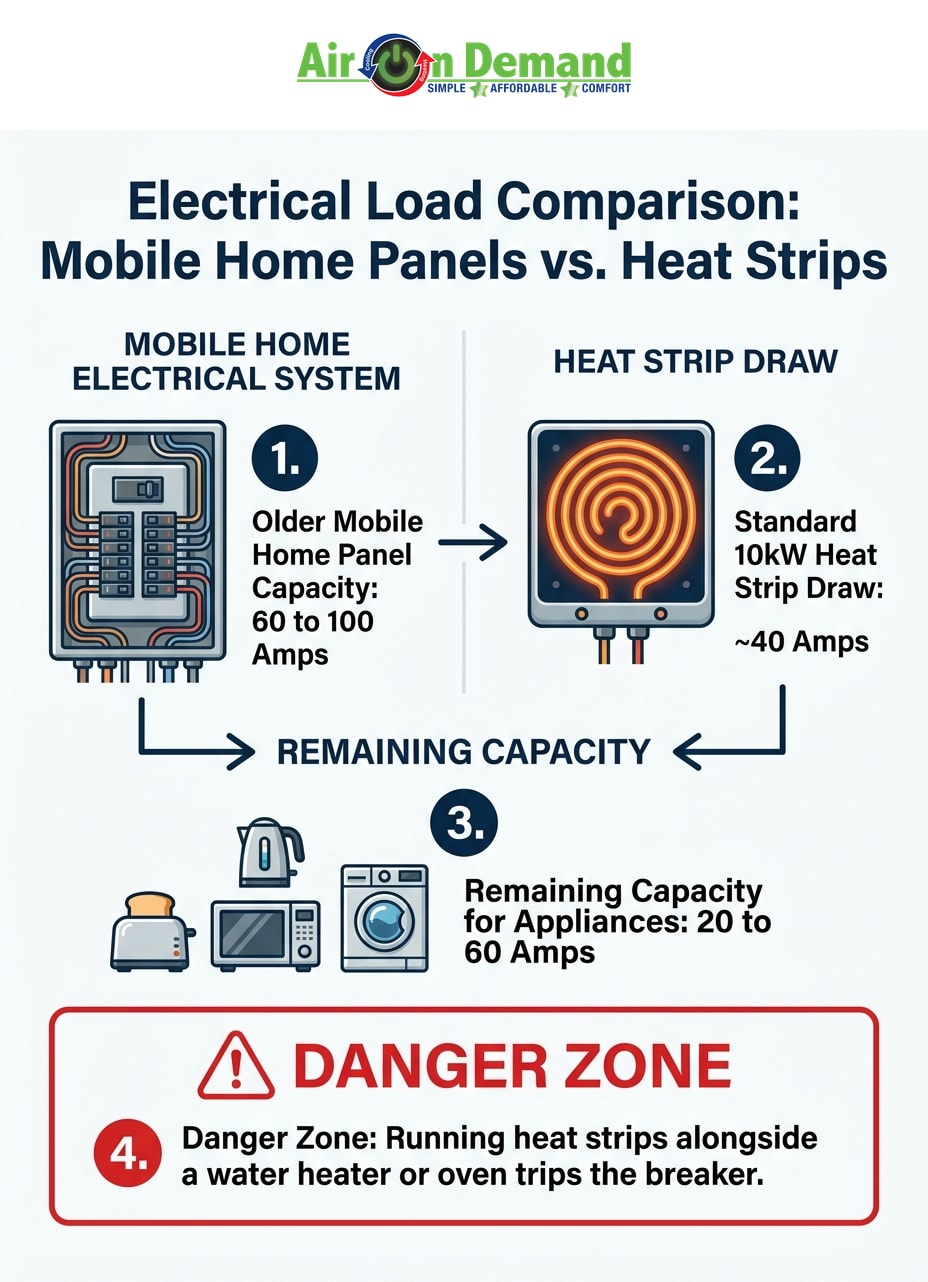
To understand why your heating system keeps shutting down your power, we have to look at the fundamental electrical math. In our years of servicing this area, our team typically sees a severe mismatch between the high amperage draw of modern heat strips and the limited capacity of older mobile home electrical systems. Heat strips generate warmth through electrical resistance, which requires a massive amount of power. A standard 10-kilowatt (kW) heat strip can draw upwards of 40 amps all on its own when running at full capacity.
Contrast this massive power requirement with the reality of older Homestead trailer parks. Many of these manufactured homes were built decades ago with electrical service panels rated for only 60 amps or 100 amps total. When your heat kicks on alongside a refrigerator, an electric water heater, or an oven, the panel's total safe capacity is instantly exceeded. The breaker tripping in this scenario is actually the safety mechanism working exactly as intended to prevent a catastrophic overload.
At Air On Demand, our deep familiarity with the structural and electrical realities of Homestead's older mobile home communities means we see this exact pattern every late fall and winter. Homeowners often assume their heater is broken, when in reality, their home's infrastructure simply cannot support the energy demand. If your system is constantly overloading your panel, reaching out for emergency AC and heating repair is the best way to get a safe, accurate diagnosis.
Decades ago, standard HUD manufactured home construction established electrical baselines that made sense for the appliances of that era. A 100-amp panel was considered more than enough to run basic lighting, a smaller refrigerator, and perhaps a window AC unit. However, our installation experts frequently find that modern HVAC upgrades often outpace the original electrical design.
• Total capacity limits: A 100-amp main breaker will trip if the combined draw of all running appliances exceeds 100 amps.
• The heating spike: Adding a 40-amp heat strip to a baseline load of 50 amps (lights, fridge, water heater) leaves almost no margin for error.
• The staging factor: Modern systems attempt to turn on heat strips in stages to prevent a sudden spike, but if the home's baseline usage is already high, even a staged startup will overload the system.
When the house is cold and the breaker trips, the most common habit is to walk over to the panel and simply flip the switch back on to stay warm. During sudden November pre-winter temperature drops, homeowners might reset their breaker three or four times in a single evening. Our technicians have seen firsthand how incredibly dangerous this practice is. A tripped breaker is not a nuisance; it is a critical warning that the electrical circuit is operating beyond its safe limits.
Repeatedly tripping and resetting a breaker physically degrades the internal switch mechanism. Circuit breakers are mechanical devices with internal springs and contacts. Every time they trip under a heavy load, a small electrical arc occurs inside the breaker, which slowly pits and damages the metal contacts. Over time, a degraded breaker loses its calibration.
The National Fire Protection Association (NFPA) provides strict electrical safety guidelines regarding overloaded circuits for exactly this reason. If a breaker is repeatedly reset instead of having the root cause addressed, it can eventually fail to trip during a true power surge or severe overload. When a compromised breaker fails to shut off the power, the electrical wires inside your mobile home's walls will continue to draw excessive current. These wires will rapidly overheat, melting their protective insulation and creating an immediate, severe risk of an electrical fire hidden within the walls.
The golden rule of electrical safety: If a breaker trips once, reset it. If it trips twice, leave it off and call a professional. Never force a breaker to stay on, and never tape a breaker switch in the "on" position.
While an undersized electrical panel is a common culprit in older Homestead trailer parks, it is not the only possibility. Sometimes, the heat strip itself, the sequencer, or the limit switch has genuinely failed and is causing a direct electrical short. Differentiating between a broken part and an overloaded panel requires professional diagnostic tools and training.
When an Air On Demand technician tests your system, they measure the actual amperage draw of the heating elements while they are running. Using a specialized multimeter, they can determine if a 40-amp heat strip is pulling its expected 40 amps (indicating an overloaded panel) or if it is pulling 60 amps (indicating a short circuit or failing component). We strictly advise against any DIY electrical testing or panel removal. The voltages inside an HVAC cabinet and an electrical panel are lethal, and one slip of a probe can cause severe injury or death.
It is also crucial to understand that replacing a perfectly good heat strip will not stop the breaker from tripping if the root cause is an undersized electrical panel. Professional diagnostics prevent you from wasting money on parts that do not solve the underlying infrastructure problem. If you suspect a failing component, reaching out for professional system repair services in Homestead ensures the issue is diagnosed safely and accurately.
The sequencer is a vital component that prevents all your heat strips from turning on at the exact same millisecond. If your system has multiple heating elements, the sequencer stages them—turning one on, waiting a moment, then turning on the next. This prevents a massive, instantaneous power spike.
A pattern we see often in the field is a sequencer failing in a closed position, which can dump the entire electrical load onto the panel at once. Symptoms of a failing sequencer or a damaged heating element include:
• Immediate breaker trips: The breaker trips the exact second the thermostat calls for heat, rather than a few minutes later.
• Burning smells: A strong, persistent smell of burning plastic or metal near the air handler.
• Inconsistent heating: The air coming from the vents is only lukewarm, indicating that only one stage of the heat strips is functioning.
Only a licensed technician can safely confirm this diagnosis by testing the sequencer's electrical continuity and staging delays.
Beyond electrical load limitations and component failures, secondary issues often cause heat strips to overheat and trip breakers. In South Florida, heating systems sit idle for eight to ten months out of the year. During our pre-winter readiness checks, our maintenance crews frequently discover a thick layer of dust and debris accumulated directly on the heating elements.
When you turn the system on for the first time during November pre-winter temperature drops, that dust acts as an insulator. It traps the heat against the metal coils instead of allowing it to transfer into the air. This causes the internal temperature of the air handler to skyrocket. Additionally, dirty air filters or blocked return vents restrict the airflow needed to carry the heat away from the strips.
To protect the system from catching fire, your air handler is equipped with a limit switch. This safety device monitors the internal temperature of the cabinet.
1. Normal operation: Air flows over the heat strips, warming the home and keeping the strips at a safe operating temperature.
2. Airflow restriction: A dirty filter blocks airflow, causing the heat strips to rapidly overheat.
3. Safety shutdown: The limit switch detects dangerous temperatures and trips the system off. If the limit switch itself is faulty, the resulting electrical strain can trip the main breaker.
This cycle of overheating highlights the critical importance of pre-season checkups. Having an Air On Demand technician clear away accumulated dust, test the limit switch, and verify proper airflow before the cold arrives can prevent sudden breakdowns. Scheduling routine preventative maintenance ensures your system is clean and safe to operate when you finally need it.
If professional diagnostics confirm that your older mobile home's electrical panel simply cannot handle the load of resistance heat strips, you need a long-term, systemic solution. Continually resetting breakers or avoiding using your heater are not viable options. When we consult with homeowners in older Homestead trailer parks, they generally face two safe paths forward: upgrading the electrical infrastructure or changing the heating technology.
Upgrading the mobile home's electrical service panel to a 150-amp or 200-amp service will safely accommodate high-draw heat strips. However, this process often requires coordination with the local utility company, new wiring from the pole, and significant electrical labor. It solves the capacity problem but keeps you reliant on highly inefficient resistance heating.
At Air On Demand, we often recommend transitioning to a modern heat pump instead. Heat pumps are a highly efficient, lower-draw alternative specifically suited for mobile homes. Instead of burning massive amounts of electricity to generate heat through resistance, a heat pump uses a small amount of electricity to transfer existing heat from the outside air into your home. Because they move heat rather than create it, they draw significantly less amperage, solving the breaker issue systemically without requiring a massive panel upgrade. If you are preparing for the holiday season, testing your heat strips before a cold snap is a great way to determine if it is time to consider a system replacement.
South Florida's climate makes heat pumps incredibly efficient. Because our winters are relatively mild, our team finds there is always plenty of ambient heat in the outdoor air for the system to capture and move indoors. Furthermore, generally applicable energy rebates or federal tax credits may apply to qualifying heat pump installations, making the transition more accessible. We always advise readers to verify current programs with their utility provider or a tax professional.
• Electrical Panel Upgrade — How It Works: Increases total home capacity to 150A or 200A. — Impact on Electrical Panel: Safely supports the 40+ amp draw of traditional heat strips. — Long-Term Efficiency: Low. Resistance heating remains highly inefficient and costly to run.
• Modern Heat Pump Installation — How It Works: Replaces resistance heating with heat transfer technology. — Impact on Electrical Panel: Drastically lowers amperage draw, fitting easily within older 100A panels. — Long-Term Efficiency: High. Provides both efficient cooling in summer and affordable heating in winter.
Your mobile home heater likely keeps tripping the breaker because the electrical load exceeds your panel's capacity. Older manufactured homes often have 60-amp or 100-amp panels, while modern heat strips can draw over 40 amps alone. When the heater runs at the same time as other major appliances, the breaker trips to prevent an electrical fire.
A standard mobile home electric furnace using resistance heat strips typically uses between 40 and 60 amps, depending on the kilowatt rating of the elements. A 10kW heat strip draws roughly 41 amps at 240 volts. This massive power requirement is why they frequently overload older, smaller electrical panels.
It is safe to reset a tripped breaker exactly once to see if it was a temporary surge. However, if the breaker trips a second time, it is absolutely not safe to reset it again. Repeatedly resetting a tripped breaker degrades the internal safety mechanism and can lead to overheated wires and severe fire hazards within your walls.
If your electric furnace trips the breaker the exact second it turns on, you likely have a direct short circuit or a failed sequencer. A broken sequencer can cause all heating stages to turn on simultaneously, creating an instant, massive power spike. This requires immediate professional testing and repair.
In many cases, an older mobile home electrical panel cannot handle the load of new, high-capacity heat strips without an upgrade. If your home has a 100-amp main service panel, dedicating nearly half of that capacity to heating leaves very little room for your water heater, oven, and refrigerator to operate safely.
A modern heat pump is the most energy-efficient heating option for a manufactured home, especially in mild climates like South Florida. Heat pumps use electricity to move heat rather than create it, resulting in a much lower amperage draw and significantly lower monthly energy usage compared to traditional electric resistance furnaces.
Recurring breaker trips are a serious safety warning, not a minor seasonal nuisance. When your heating system repeatedly shuts down the power in older Homestead trailer parks, it is a clear signal that your home's electrical infrastructure is buckling under the demand. Ignoring this warning by constantly resetting the breaker puts your home at severe risk of electrical fires and permanent wire damage.
Understanding exactly why your specific electrical system cannot handle the heat strip's load is the first step toward a permanent solution. Whether you are dealing with a faulty sequencer that needs replacing, considering a panel upgrade to support your current system, or looking to transition to a highly efficient, lower-draw heat pump, professional evaluation is mandatory. Do not wait for the next cold snap to leave you in the dark. Reach out to the local specialists at Air On Demand who understand mobile home infrastructure to evaluate your heating system safely and restore your peace of mind before the holiday season.