
The Impact of Holiday Guest Traffic on Your Home's Indoor Air Quality
November 6, 2026
With Thanksgiving rapidly approaching, our team at Air On Demand knows firsthand that understanding the impact of holiday guest traffic on your home's indoor air quality is an essential part of preparing your household for visitors. Before the first suitcase rolls through the front door, your home operates in a predictable rhythm. Your air conditioning system knows exactly how to manage the humidity, dust, and biological load of your immediate family. But when out-of-town visitors arrive, everything changes overnight. Extra bodies, luggage from cross-country travels, and visiting pets immediately introduce a massive spike in airborne particulates that your standard HVAC setup simply isn't prepared to handle. If you want to tackle this sudden shift before your house feels stuffy, upgrading to professional air cleaners and purifiers as part of a comprehensive air filtration strategy is the most effective approach.
Most homeowners don't realize that a sudden influx of people fundamentally alters the chemistry of the air inside their homes. Every person entering your house brings in new variables. The carbon dioxide levels naturally rise as more people breathe in enclosed spaces. Humidity ticks upward from extra showers, heavier cooking, and simple respiration. When you multiply this by a houseful of relatives staying for several days, we often see the indoor environment quickly reach a tipping point.
The decision you face right now is straightforward: you can address this biological load proactively, or you can deal with the consequences of stuffy, allergen-filled air while you are trying to host. Waiting until your guests are already sneezing or complaining about heavy air means the problem has already overwhelmed your system. Preparing your home for the November holiday guest season requires recognizing that your HVAC system needs a helping hand to process the sudden surge in airborne pollutants. Establishing a robust filtration strategy now ensures that your home smells fresh, feels comfortable, and remains healthy throughout the busiest weeks of the year.
The sudden drop in air quality isn't just about oxygen and carbon dioxide. It is about the physical, microscopic invaders that hitch a ride into your living space. When you host during the November holiday guest season, you are inviting a complex mix of new particulates into a closed environment. Understanding exactly what is floating through your home is the first step in neutralizing it.
• Luggage dust and travel debris: Suitcases spend time in airplane cargo holds, car trunks, and hotel lobbies before rolling across your living room rug. They track in non-native allergens, dust mites, and microscopic dirt that your local environment doesn't typically produce.
• Unfamiliar pet dander: If your relatives bring their dog or cat, they are introducing a completely new type of dander into your home. Even if you already own pets, your HVAC system isn't accustomed to filtering this additional volume or specific protein strain, leading to rapid accumulation in your air.
• Airborne viruses and seasonal colds: Larger groups of people gathered indoors inevitably mean a higher concentration of germs. Travel weakens immune systems, and guests often bring seasonal colds that circulate freely through your home's ductwork if not actively purified.
• Intense cooking odors and particulates: Preparing massive holiday meals generates smoke, grease, steam, and fine particulate matter. Without proper ventilation and filtration, these microscopic cooking byproducts linger in the air long after the meal is over, settling into fabrics and carpets.
• Personal care products: Extra showers mean extra hairspray, cologne, perfume, and aerosol deodorants. These volatile organic compounds (VOCs) build up rapidly when multiple guests are getting ready for holiday dinners at the same time.
The bottom line: Your home is suddenly processing the biological footprint of a much larger household. Without an upgraded defense mechanism, these hidden invaders will continuously cycle through your living spaces, degrading the comfort of your home.
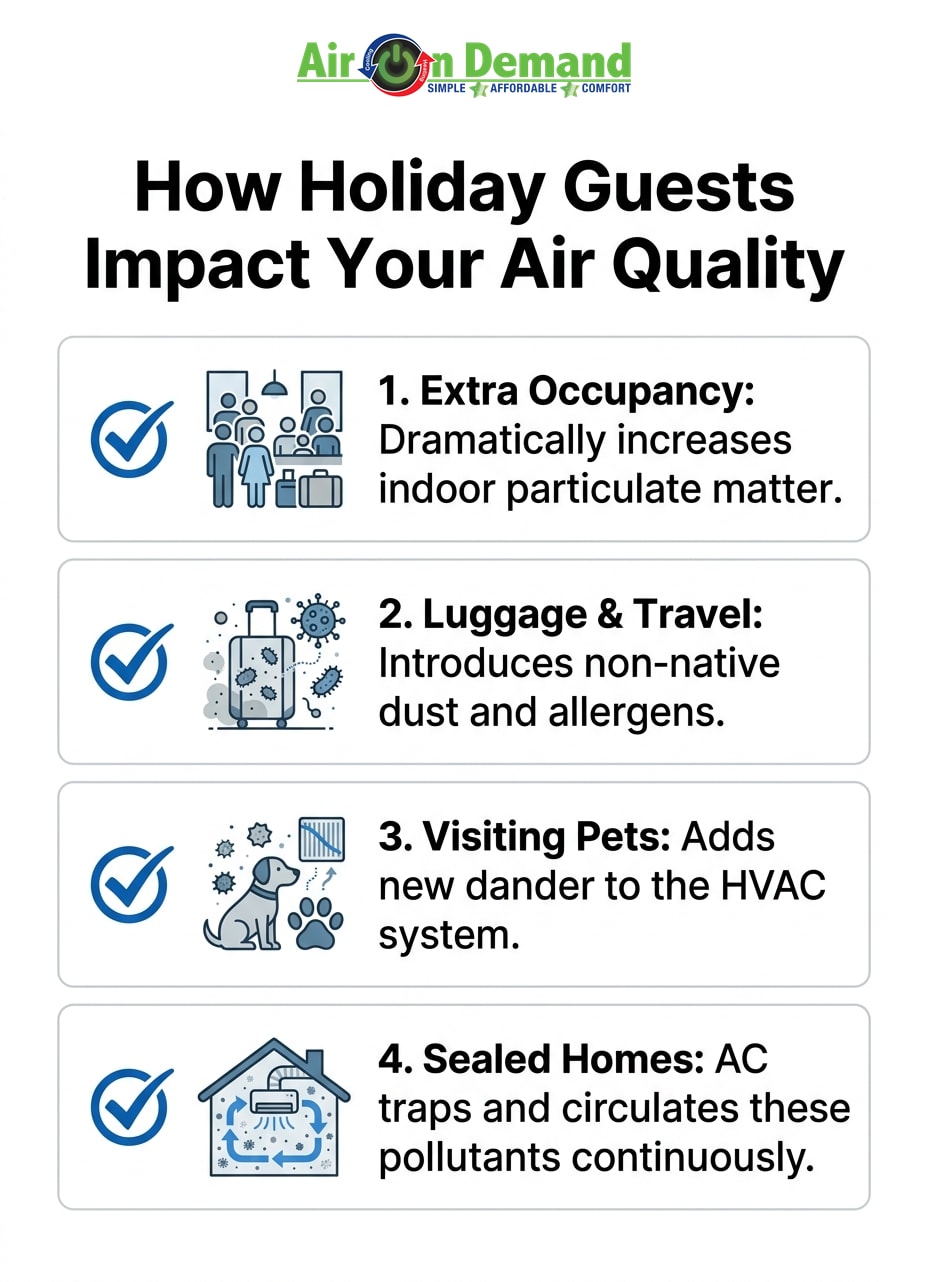
While homeowners in northern states are turning on their furnaces and dealing with dry, cracked winter air, our experience servicing Miami-area homes shows that the dynamic in South Florida is entirely different. Our regional climate creates a unique set of challenges for holiday hosting. Miami's mild November weather means that our homes typically stay sealed tight, with the air conditioner still running to manage the ever-present humidity. This continuous cooling cycle actively traps guest-introduced pollutants indoors rather than venting them out.
Up north, a stuffy house might be remedied by cracking a window to let in a crisp winter breeze. Here, opening a window in late fall often just invites more moisture into the home. Because Miami-area homes rely heavily on continuous AC operation to keep indoor spaces comfortable, the blower fan acts as a distribution network for every new allergen introduced by your guests. When Aunt Mary's dog shakes off in the hallway, that dander is immediately pulled into the return vent and redistributed to every bedroom in the house.
Furthermore, there is a direct interaction between high guest occupancy and elevated relative humidity. More people breathing, showering, and cooking means more moisture in the air. When indoor humidity rises, the air literally feels heavier. This heavy, moist air is highly effective at trapping fine particulates, making them linger at breathing level rather than settling to the floor. To manage this sudden bio-load, our AC installation experts always recommend a cooling-based filtration strategy. You cannot rely on winterizing tactics; you need a system designed to strip moisture and capture contaminants simultaneously while the AC runs.
During routine pre-winter HVAC inspections, our technicians frequently see homeowners relying on the cheap, standard 1-inch fiberglass filters you buy in bulk at the hardware store. Unfortunately, this leaves your home highly vulnerable to the holiday guest influx. Here's the thing: those basic filters were never designed to purify the air you breathe. Their sole purpose is to protect the internal mechanical components of your HVAC equipment from large debris like hair and heavy dust bunnies.
When your home experiences a sudden surge in microscopic particulates—like pet dander, travel dust, and airborne viruses—a standard 1-inch filter is practically useless. The weave of fiberglass is too loose to catch anything smaller than a golf ball of dust. The fine contaminants introduced by your guests simply pass right through the filter media, travel through the blower motor, and are blown back into your living spaces.
Even if you use a slightly better 1-inch pleated filter, the sheer volume of new pollutants generated by Miami-area homes full of guests will cause it to clog at an alarming rate. What normally takes thirty days to accumulate can build up in just a week of heavy hosting. Once that filter is choked with dander and dust, your AC system has to work twice as hard to pull air through it. This leads to reduced airflow, uneven cooling, and a significant spike in energy consumption right when you need your system to be most reliable.
Ignoring filter maintenance during high-occupancy periods is a recipe for a mid-holiday breakdown. The most immediate fix is scheduling a timely, professional-grade air filter replacement before your guests arrive. Upgrading your filter media ensures your system can handle the extra load without choking off the airflow required to keep your house cool and dry.
• Primary Purpose — Standard 1-Inch Fiberglass Filter: Protects HVAC machinery from large debris — High-Efficiency Pleated Filter: Improves indoor air quality for breathing
• Particle Capture Size — Standard 1-Inch Fiberglass Filter: Only large particles (dust bunnies, hair) — High-Efficiency Pleated Filter: Microscopic particles (dander, pollen, smoke)
• Holiday Guest Readiness — Standard 1-Inch Fiberglass Filter: Poor – allows viruses and fine dust to bypass — High-Efficiency Pleated Filter: Excellent – captures sudden spikes in bio-load
• Replacement Frequency — Standard 1-Inch Fiberglass Filter: Every 30 days (clogs rapidly with guests) — High-Efficiency Pleated Filter: Varies by thickness (handles heavy loads better)
To truly protect your indoor environment during the November holiday guest season, you need to move beyond standard maintenance and consider advanced filtration. This is where a "health smart filter" becomes a game-changer for holiday hosting. A health smart filter is a high-efficiency media filter designed specifically to capture the microscopic particulates that standard 1-inch filters completely miss.
Health smart filters utilize higher MERV (Minimum Efficiency Reporting Value) ratings. The higher the rating, the finer the mesh, and the smaller the particles it can trap. Upgrading to a filter with a MERV rating designed for residential purification means your system will actively pull pet dander, fine travel dust, and even certain airborne viruses out of circulation. When you are evaluating health smart filters, it is crucial to find the sweet spot between high filtration and adequate airflow, which is why professional guidance is necessary.
For the ultimate pre-holiday upgrade, many homeowners pair health smart filters with active purification technologies. Ultraviolet (UV) lights installed directly inside the air handler neutralize airborne germs, bacteria, and mold spores before they can multiply. Whole-home purifiers take this a step further by actively ionizing the air, causing fine particles to clump together so the filter can catch them more easily.
Because Air On Demand provides tailored, high-performance filtration solutions specifically designed to keep South Florida homes healthy and comfortable during the busy holiday hosting season, we always advise against DIY installations for these upgrades. A licensed professional must ensure that any new, thicker filter or purification device does not restrict your HVAC system's static pressure or compromise its ability to cool your home.
Upgrading your air filter is a fantastic first step, but it only addresses the air currently passing through your system. What about the distribution network itself? Your ductwork acts as the respiratory system of your home. Over the course of the year, fine dust, pet hair, and allergens settle quietly into the ridges and corners of your air ducts. When your AC begins running constantly to accommodate the heat and humidity of a house full of guests, that settled debris gets stirred up and blown directly into your living spaces.
If you install a brand-new health smart filter but ignore dirty ductwork, you are undermining your own investment. In our years of performing professional air duct cleaning across Cutler Bay and Miami, we've seen how a completely clean slate complements a new filtration system. It ensures that the pathways delivering air to your guest bedrooms are free of the dust that causes nighttime sneezing.
Furthermore, duct maintenance is a highly proactive step for odor control. Ducts often harbor stale smells from past cooking, old pet accidents, or general mustiness that you may have gone "noseblind" to over time. Clearing these pathways removes those lingering odors from Miami-area homes before visitors even arrive. Keep in mind that this level of deep, restorative cleaning requires specialized negative-pressure equipment and agitation tools that only a licensed professional can operate safely without damaging your flexible ductwork.
Preparation is the key to a stress-free hosting experience. To ensure your home is ready for the November holiday guest season, follow this synthesized, actionable timeline our team recommends to get your indoor air quality under control before the doorbell rings.
1. 2 to 3 Weeks Before Arrival: Schedule an HVAC Inspection. Do not wait until the week of Thanksgiving. Bring in a professional now to evaluate your system's performance and discuss health smart filter upgrades. This gives you plenty of time to have new filtration media or UV lights installed without rushing.
2. 1 Week Before Arrival: Evaluate and Clean Ductwork. Have your ducts visually inspected. If there is visible buildup, schedule a professional cleaning. This ensures that the air pathways are clear and removes any stale odors that might greet your guests at the front door.
3. The Day Before Arrival: Pre-Condition the Home. Before the house fills with people and luggage, set your AC to a comfortable, slightly cooler temperature. This helps pull excess humidity out of the air early, creating a dry, comfortable baseline before the biological load of your guests spikes the indoor moisture levels.
4. During the Visit: Utilize the "ON" Fan Setting. While your guests are in the home, switch your thermostat fan setting from "AUTO" to "ON." This forces the blower to run continuously, constantly cycling the indoor air through your newly upgraded health smart filter, even when the cooling cycle isn't actively running. This is the best way to continuously scrub pet dander and travel dust from the air.
Taking proactive steps to manage your indoor air quality prevents your home from feeling heavy, stuffy, and smelling like a mix of travel luggage and unfamiliar pets. The November holiday guest season should be about creating memories with your family, not apologizing for a dusty guest room or worrying about circulating colds. A tailored air filtration strategy is your absolute best defense against the sudden spike in seasonal indoor pollutants.
Don't wait until your house is full and your standard filter is overwhelmed. Talk to our local experts at Air On Demand today about your specific home layout, your current HVAC capabilities, and your upcoming holiday hosting plans. By securing the right high-performance filtration solution now, you can guarantee a clean-smelling, healthy, and welcoming environment for everyone who walks through your doors this season.
How do extra people affect indoor air quality?
Extra people significantly increase the indoor biological load by introducing more carbon dioxide, moisture, and shed skin cells into the environment. When multiple guests occupy a home, the HVAC system must work harder to filter out these sudden spikes in particulates. This rapid accumulation can quickly overwhelm standard air filters, leading to stuffy, heavy-feeling air.
Why does my house get dusty when guests visit?
Guests inadvertently bring non-native dust, dirt, and microscopic debris into your home on their shoes, clothing, and travel luggage. Additionally, the increased foot traffic stirs up existing dust that has settled into carpets and upholstery. Because the AC runs more frequently to cool the extra bodies, this dust is continuously kept airborne rather than settling.
What is the best health smart filter for Miami homes?
The best health smart filter for South Florida balances a high MERV rating (usually between 11 and 13 for residential use) with the specific airflow requirements of your air handler. Because our climate demands continuous AC operation to manage humidity, the filter must trap fine allergens like pet dander without choking the blower motor. A licensed HVAC technician can measure your system's static pressure to recommend the exact right fit.
Do more people in a house increase indoor humidity?
Yes, an influx of guests directly increases indoor humidity levels through simple respiration, extra showers, and additional cooking. Every time a person exhales, they release moisture into the air. In a sealed home running the AC, this sudden spike in moisture can make the air feel clammy and trap airborne particles at breathing level if the cooling system isn't running long enough to dehumidify properly.
How can I improve air quality before a holiday party?
The most effective immediate step is upgrading your standard AC filter to a high-efficiency pleated filter and having your ductwork professionally cleaned. On the day of the party, lower the thermostat slightly to pre-dehumidify the space and set the HVAC fan to the "ON" position. This ensures the air is constantly being pushed through the filter to capture cooking smoke and cosmetic VOCs as they are generated.
Will running the AC fan constantly help filter out pet dander?
Yes, switching your thermostat fan from "AUTO" to "ON" forces the system to continuously circulate air through the filter, even when the compressor isn't actively cooling. This is a highly effective tactic for capturing visiting pet dander before it settles into your furniture. However, this strategy only works well if you have upgraded to a filter capable of trapping microscopic dander particles.