
Evaluating Health Smart Filters for South Florida Humidity Management
August 17, 2026
A common misconception among homeowners is that the thickest, most restrictive air filter available is the ultimate solution for a healthy home, but when evaluating Health Smart Filters for South Florida humidity management, this assumption quickly falls apart. National hardware stores and online advice columns frequently push the idea that upgrading to a dense, heavily pleated filter will automatically purify your indoor air and eliminate dust. While these products are highly effective at capturing microscopic particles, our AC repair technicians at Air On Demand know firsthand that they introduce a significant, often hidden complication for your HVAC system's mechanical operation.
The concrete problem we see Miami homeowners face daily is that overly restrictive filters can severely choke off the return airflow to the air handler. When an air conditioner cannot pull enough air through the system, it fundamentally fails at its secondary, yet equally important job: dehumidifying the home. This leaves you at a difficult decision point. You must choose between the perceived indoor air quality benefits of a dense filter and maintaining the critical airflow required to protect your equipment and keep your living space comfortable.
The reality of high-MERV filtration:
• Airflow reduction: Thick filter media creates a physical wall that the blower motor must work harder to overcome.
• Moisture retention: Without adequate air passing over the cooling coils, humidity remains trapped in your living spaces.
• Equipment strain: The constant struggle to pull air through a dense barrier accelerates mechanical wear and tear.
For comprehensive guidance on keeping your home's air clean without damaging your equipment, exploring dedicated indoor air filtration solutions is a much safer path. Achieving excellent indoor air quality is entirely possible, but it requires understanding how your specific air conditioner interacts with the filter you place inside it.
To understand why a seemingly harmless filter can cause so much trouble, you need to look at the physics of how air moves through a confined space. In the HVAC industry, resistance to airflow is measured as static pressure. You can think of static pressure much like human blood pressure; a certain amount is necessary for the system to function, but if the pressure climbs too high, the system is forced to overwork itself just to maintain basic circulation.
Standard fiberglass or basic pleated filters offer very little resistance, keeping static pressure low. However, when you install high-efficiency filters (typically rated MERV 13 or higher), the dense weave of synthetic fibers dramatically increases the resistance. This spike in static pressure can reduce the total system airflow by up to 20 percent. During July heavy cooling loads, when your system needs every cubic foot of air it can get to cool the house, this reduction forces the blower motor to strain continuously against a bottleneck of its own making. In our years of providing AC installation and repair, we've found this to be a leading cause of premature system failure.
Your air conditioner operates on a closed loop of supply and return air. The volume of air pushed out of the supply vents must exactly match the volume of air pulled in through the return grilles. The blower motor sits in the middle of this process, acting as the heart of the system. It relies entirely on uninhibited airflow to function efficiently and keep its internal components cool.
When you place a restrictive barrier in the return duct, you starve the blower motor of the air it needs. The motor must either spin faster to compensate—drawing more electricity and generating excess heat—or it will fail to move enough air, causing a pressure imbalance throughout the ductwork. If you are interested in learning more about the specific ratings and materials that cause this resistance, understanding different types of air filters is a crucial next step.
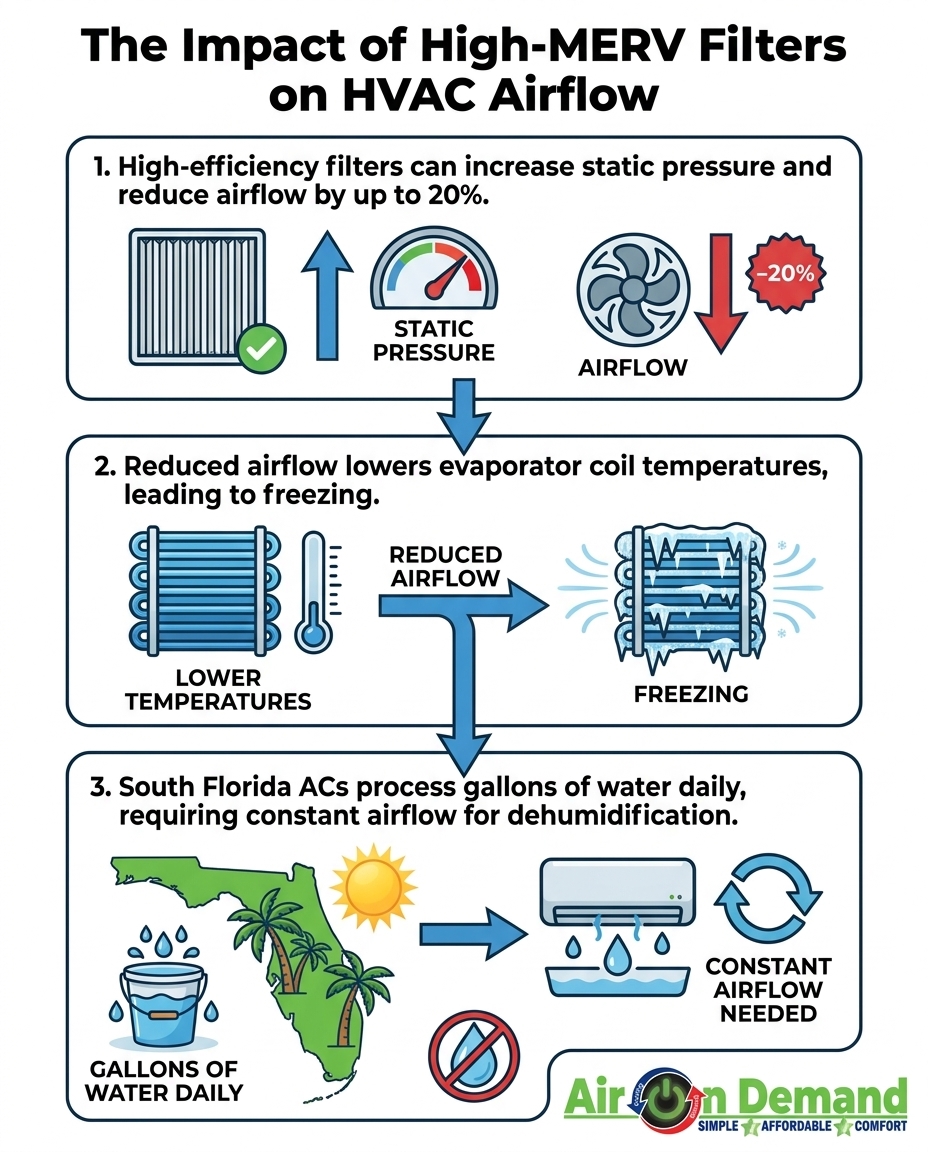
Air conditioning performs two distinct functions simultaneously: sensible cooling and latent cooling. Sensible cooling is the process of dropping the actual temperature of the air, which is the number you see on your thermostat. Latent cooling is the process of removing moisture from the air. In dry climates, sensible cooling is the primary focus. However, the environmental reality of Miami FL / South Florida changes the rules entirely.
With South Florida's 80%+ average summer morning humidity, our team knows that latent cooling is arguably more important than sensible cooling. A properly functioning air conditioner processes gallons of water out of your indoor air every single day. As warm, humid air passes over the cold evaporator coil, the moisture condenses into water droplets and drains away. This process requires a constant, steady volume of air moving over the coil at a very specific speed.
The differences between cooling types:
• Sensible Cooling — Primary Function: Lowers the room temperature — Requirement for Success: Cold evaporator coil — Impact of Reduced Airflow: Rooms take longer to cool down, system runs longer.
• Latent Cooling — Primary Function: Removes airborne moisture — Requirement for Success: High volume of air passing over the coil — Impact of Reduced Airflow: Moisture remains in the air, creating a clammy, damp environment.
When a restrictive filter chokes the airflow, the air moves too slowly, or not enough air reaches the coil at all. The system might still drop the temperature (sensible cooling), but it loses its ability to extract large volumes of water (latent cooling). Paradoxically, trying to improve your air quality with a dense filter can actually worsen it by trapping moisture indoors, creating a damp environment where organic growth thrives. This is why generic, national filtration advice often fails spectacularly in extreme humidity environments like ours.
The mechanical consequences of starving your HVAC system of air are severe, particularly during peak summer usage. The blower motor is designed to operate within a specific static pressure range. When a dense filter pushes the resistance beyond that designed capacity, the motor experiences immediate and continuous stress.
Modern variable-speed ECM (Electronically Commutated Motor) blowers are programmed to maintain a specific airflow volume regardless of resistance. If the filter restricts the air, the motor automatically ramps up its RPMs to pull harder. This increased exertion requires a higher electrical amp draw, which in turn generates significant excess heat within the motor housing. Because the motor relies on the very air it is pulling to cool itself, the reduced airflow creates a dangerous feedback loop of rising temperatures.
The progression of blower motor failure:
1. Initial restriction: The dense filter is installed, immediately reducing the volume of return air.
2. Compensation: The motor spins faster and works harder to overcome the new static pressure barrier.
3. Overheating: The combination of high amp draw and low cooling airflow causes the motor's internal temperature to spike.
4. Insulation degradation: The protective insulation around the motor's electrical windings begins to melt and break down.
5. Complete burnout: The motor shorts out and fails entirely, resulting in a costly replacement.
This process is vastly accelerated during July heavy cooling loads, where the system is already running near-constantly to combat the outside heat. Our AC repair team at Air On Demand regularly replaces burned-out motors that never got a chance to cool down between cycles. To prevent this type of catastrophic failure, keeping up with routine AC maintenance is vital, as a technician can measure your system's static pressure and ensure the motor is operating safely.
One of the most alarming sights for a homeowner—and a frequent summer AC repair call we receive at Air On Demand—is finding their indoor air conditioning unit encased in a block of solid ice. While low refrigerant is a common culprit, restricted airflow caused by a high-MERV filter is an equally frequent cause of frozen evaporator coils. Understanding the chain reaction that leads to this freeze-up helps illustrate just how critical airflow is to your system's health.
The evaporator coil is filled with extremely cold liquid refrigerant. Its job is to absorb heat from the warm indoor air blowing across it. Under normal conditions, the constant flow of warm air keeps the coil's temperature just above the freezing point of water. However, when a thick filter chokes off that warm airflow, the refrigerant has no heat to absorb. As a result, the temperature of the evaporator coil plummets rapidly.
As the coil drops below 32 degrees Fahrenheit, the heavy South Florida condensation that normally forms and drips into the drain pan begins to freeze directly onto the metal fins. This creates a thin layer of frost. Ice acts as an insulator, further preventing the refrigerant from absorbing heat, which causes even more ice to form. Within a matter of hours, the entire coil becomes a solid block of ice, completely blocking whatever little airflow was left.
What to do if your system freezes:
• Turn the thermostat to OFF: Stop the cooling cycle immediately to prevent liquid refrigerant from flowing back to the compressor and destroying it.
• Turn the fan to ON: Force the blower motor to circulate unconditioned room air over the ice to help it melt faster.
• Check the filter: Remove the restrictive filter immediately. Often, simply swapping it for a standard flow filter resolves the underlying issue.
• Wait for a complete thaw: Never try to chip the ice away with a tool, as you will puncture the delicate refrigerant lines.
If you find yourself repeatedly dealing with airflow issues, consulting our professionals about the right air conditioner filters in Miami will save you from enduring a sweltering afternoon without cooling while you wait for the ice to melt.
None of this means that you must abandon the goal of clean indoor air. Health Smart filters and other high-efficiency pleated options offer genuine, measurable benefits for capturing pet dander, pollen, mold spores, and fine particulate matter. The key is striking the right balance between filtration efficiency and mechanical safety.
Leveraging our local expertise at Air On Demand in balancing superior indoor air quality with safe, efficient HVAC airflow tailored for Miami's demanding climate means you don't have to guess which filter is safe. A professional evaluation of your ductwork and air handler by our team can determine the exact maximum MERV rating your specific system can handle without stressing the blower motor. Some modern systems are designed with oversized return ducts specifically to accommodate thicker filters, while older systems may only tolerate a MERV 8 rating.
If your system cannot handle a dense 1-inch return filter, we typically recommend several highly effective alternatives that improve air quality without disrupting static pressure.
1. Media Filter Cabinets: These are installed directly into the ductwork next to the air handler. They use 4-inch or 5-inch thick filters. Because the surface area of the filter is massive, it can achieve a MERV 11 or 13 rating while actually offering less airflow resistance than a standard 1-inch pleated filter.
2. UV Germicidal Lights: Installed inside the coil cabinet, these lights neutralize mold spores, bacteria, and viruses without impeding airflow whatsoever.
3. Electronic Air Cleaners: These systems use an electrical charge to trap particles, providing excellent filtration with incredibly low static pressure drops.
For homes in Miami FL / South Florida where humidity control is non-negotiable, moving away from restrictive 1-inch filters and toward dedicated air cleaners and purifiers is our definitive recommendation for achieving pristine air without sacrificing comfort.
Yes, high-MERV filters significantly restrict airflow by creating a dense barrier of synthetic fibers that the HVAC blower motor must push through. While they are excellent at trapping microscopic particles, this resistance increases the system's static pressure. If the HVAC system is not designed to handle this increased pressure, total airflow can drop by up to 20 percent, leading to mechanical strain and poor cooling performance.
A thick, restrictive filter is a leading cause of frozen air conditioning systems. By blocking the flow of warm return air, the filter prevents the evaporator coil from absorbing enough heat to stay above freezing. The coil's temperature plummets, causing the natural condensation from the humid air to freeze onto the metal fins, eventually encasing the entire unit in solid ice.
For most standard residential HVAC systems in South Florida, a MERV 8 filter offers the best balance between capturing common household dust and maintaining the critical airflow needed for dehumidification. Ratings of MERV 11 or 13 should generally only be used if the system features a 4-inch or 5-inch media cabinet designed to handle the increased resistance without choking the blower motor.
High-MERV filters can severely hurt your AC in humid climates by crippling the system's latent cooling capacity. Because air conditioners require a steady, high volume of airflow to extract moisture from the air, the restriction caused by a high-MERV filter leaves humidity trapped indoors. Furthermore, the constant strain of pulling air through a dense filter during long summer cooling cycles frequently leads to premature blower motor burnout.
Airflow directly dictates how much moisture your air conditioner can remove from your home. The system relies on a specific volume of warm, humid air passing over the cold evaporator coil to facilitate condensation. If airflow is too slow or restricted, the system will cool the room prematurely (satisfying the thermostat) before it has had enough time to extract the airborne moisture, resulting in a cold but clammy and damp indoor environment.
Ultimately, managing your indoor environment requires acknowledging the strict tradeoff between filter thickness and blower motor stress. While the appeal of hospital-grade air filtration is understandable, installing a highly restrictive filter without verifying your system's capabilities often leads to reduced dehumidification, frozen coils, and expensive motor failures.
For homeowners in Miami FL / South Florida, prioritizing unrestricted airflow is the most effective way to ensure your air conditioner can extract the heavy summer humidity. Before upgrading to a denser filter, we highly recommend scheduling a consultation with our Air On Demand experts. We can evaluate your system's static pressure and guide you toward AC installation and filtration solutions that clean your air without compromising your comfort or your equipment.