Zoned Daikin VRF Systems vs. Multiple Mini Splits for Large Miami Properties
November 5, 2026
Are you sacrificing the architectural beauty of your home just to keep it adequately cooled and heated? When evaluating Zoned Daikin VRF Systems vs. Multiple Mini Splits for Large Miami Properties, our team at Air On Demand frequently finds that the decision comes down to exterior aesthetics as much as indoor comfort. Over our years of serving Miami homeowners, we've seen how cooling and heating a sprawling estate efficiently often forces homeowners to compromise on exterior architectural beauty, leaving them with an unwanted collection of bulky hardware scattered around the property line.
The primary dilemma involves dealing with the aesthetic and spatial clutter of mounting five or more individual mini-split condenser units on a home's exterior walls or ground-level pads. You are forced to decide between the exterior clutter of multiple standalone mini-split condensers versus the streamlined footprint of a single centralized system. Before you upgrade your climate control, it helps to look beyond basic definitions and explore the spatial mechanics of high-efficiency Daikin equipment designed specifically for expansive residential properties.
Standard ductless air conditioners are fantastic solutions for single rooms or smaller homes, but they require significant exterior wall or ground space when scaling up for whole-home climate control. If your property requires five, six, or seven indoor zones, a traditional multi-split approach often means installing an equal or near-equal number of outdoor condensers. This creates an immediate spatial deficit on your property.
The visual impact of five or more condensers disrupting premium landscaping and clean architectural lines cannot be overstated. High-end residential properties often feature meticulously designed exteriors, custom stucco work, and curated tropical plants. Bolting multiple metal boxes to the side of the house—along with the required line hide covers running down the exterior walls—detracts heavily from the property's curb appeal and overall aesthetic value. In our experience, nothing ruins a beautiful Miami courtyard faster than a wall of noisy condensers.
Beyond looks, grouped outdoor units create unintended spatial bottlenecks along property perimeters. Large Miami residential properties often have specific setback requirements or narrow side yards. When you line up multiple condensers, you create:
• Restricted pathways: Blocking side gates and walkways with bulky equipment pads.
• Maintenance hurdles: Creating logistical challenges for landscaping crews trying to trim hedges or mow around a maze of metal boxes.
• Service complications: Forcing technicians to navigate a sprawling, dispersed footprint to service multiple independent units during routine maintenance.
• Increased structural load: Adding unnecessary weight and vibration to exterior walls if units are mounted on heavy-duty brackets rather than ground pads.
While traditional ductless systems provide excellent indoor comfort, scaling them up for a massive estate demands a heavy toll on your exterior square footage.
To solve the problem of exterior clutter, we recommend bypassing basic ductless definitions and exploring centralized refrigerant routing. Variable Refrigerant Flow (VRF) technology fundamentally changes how a large home handles zoned cooling and heating. Instead of running a dedicated set of copper lines from every single indoor air handler to its own dedicated outdoor condenser, VRF centralizes the process.
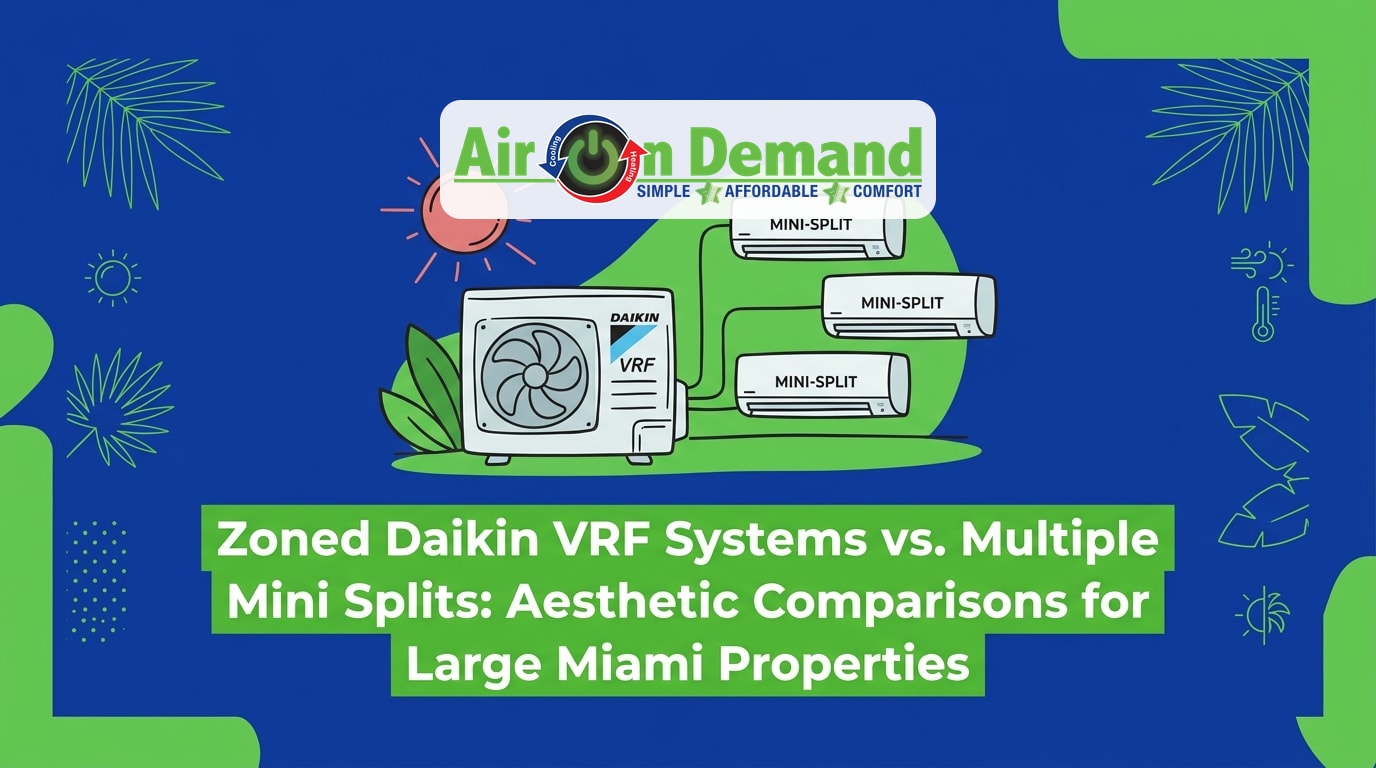
The core solution lies in how a Daikin VRF branch box connects a single high-capacity outdoor heat pump unit to multiple indoor zones. The outdoor unit acts as the powerhouse, sending a single main set of refrigerant lines into the home. These lines connect to a discrete, hidden branch box located inside the house—often tucked away in an attic, utility closet, or mechanical room. From that central hub, smaller line sets branch out to the individual indoor air handlers.
This engineering approach consolidates the equipment footprint to a single, discreet location on the property. You no longer need a condenser outside the master bedroom, another outside the living room, and a third outside the guest suite. The single VRF outdoor unit can be placed in a remote, strategically chosen utility area where it is completely out of sight from main entertaining spaces and street views.
By routing the refrigerant internally through the branch box rather than running multiple lines down the exterior walls, you preserve the architectural integrity of the home. It eliminates the need for scattered wall-mounted condensers and the unsightly plastic line covers that inevitably fade in the sun. The result is a clean, unblemished exterior that maintains the aesthetic standards of a luxury estate.
When engineering climate control for large Miami residential properties, seeing the differences laid out side-by-side helps clarify which system aligns with your property goals. While our technicians also install high-efficiency central options like Daikin Fit systems for ducted applications, the choice for pure ductless or hybrid zoning usually comes down to VRF versus standard multi-splits.
• Equipment Footprint — Daikin VRF System: 1 high-capacity centralized outdoor unit — Multiple Mini Splits: 5+ standalone outdoor condensers
• Aesthetic Impact — Daikin VRF System: Hidden centralized placement; preserves clean exterior walls — Multiple Mini Splits: Highly visible exterior wall clutter; multiple line set covers
• Installation Complexity — Daikin VRF System: Advanced internal branch box routing from a single main line — Multiple Mini Splits: Multiple individual exterior line sets running to separate units
• System Scalability — Daikin VRF System: Exceptional for sprawling estates and multi-story luxury homes — Multiple Mini Splits: Limited by available exterior wall space and ground clearance
• Line Set Limitations — Daikin VRF System: Supports extended piping lengths for massive floor plans — Multiple Mini Splits: Strict distance limits between indoor heads and outdoor condensers
The takeaway: If your property requires more than three or four zones, our team typically sees the spatial efficiency of VRF heavily outweighing the traditional multi-split approach.

The necessity of robust, continuous cooling—and reliable heating for those sudden November cold fronts—is a reality for any South Florida homeowner. However, the operational mechanics of how that thermal energy is transferred varies wildly between system types. Heat pumps do not actually create cold or hot air; they move heat from one place to another.
With Miami's intense climate requiring continuous climate control, running five separate condensers simultaneously generates significantly more concentrated exterior noise and heat exhaust than one centralized VRF unit. If you have multiple condensers lined up along a side yard or near a patio, those units are constantly blasting hot air into that specific microclimate. We've seen multi-unit heat exhaust damage sensitive tropical landscaping, dry out expensive palms, and ruin the ambiance of nearby outdoor living areas.
Conversely, a system utilizing a Daikin VRF branch box relies on a single, highly efficient outdoor unit to manage heat rejection safely. Because you only have one unit to place, it can be strategically located far away from delicate foliage, pool decks, and outdoor dining areas. The advanced inverter technology inside the VRF unit also manages output more efficiently, ramping up and down as needed rather than blasting at full capacity constantly, protecting both your landscaping and your outdoor comfort.
Upgrading the climate control for a sprawling estate is a major logistical project, and timing that project correctly ensures your property is ready for guests. The importance of pristine exterior aesthetics becomes especially apparent during outdoor gatherings. You want your guests admiring your architecture and landscaping, not a bank of noisy air conditioning condensers.
As you prepare for the November holiday entertaining season, minimizing patio HVAC noise ensures guests can enjoy outdoor spaces comfortably. A centralized VRF system keeps the mechanical noise far away from the action, allowing for quiet, uninterrupted evenings on the terrace. Furthermore, a properly zoned heat pump system ensures reliable, customized indoor comfort for varying guest preferences—allowing the kitchen to stay cool while the guest wing remains cozy during a late fall chill.
There is a distinct strategic advantage to scheduling complex installations before the peak holiday rush. Moving forward with a VRF upgrade in the late fall ensures the heavy lifting, branch box routing, and equipment placement are completely finished before the first invitations are even mailed out, and ensures your heating is reliable before winter arrives.
Designing aesthetically conscious HVAC solutions is not a standard wall-mount job. Bolting a single mini split to a garage wall is straightforward, but engineering a whole-home VRF system requires an entirely different level of precision. The precision engineering required for centralized branch box routing across large square footage demands a deep understanding of fluid dynamics, refrigerant piping rules, and advanced electrical controls.
This is where localized expertise becomes critical. Our team at Air On Demand brings specialized, first-hand experience in designing aesthetically conscious Daikin VRF installations and premium, complex multi-zone systems tailored specifically for high-end Miami estates. Proper design ensures that the system not only looks invisible from the outside but performs flawlessly on the inside.
Protecting your investment through proper installation is also tied directly to your comprehensive warranty coverage. A system that is poorly designed or installed with improper line set lengths will suffer from premature compressor failure. Ensuring that every technical specification is met guarantees that your Daikin mini split warranty coverage remains fully intact, providing long-term security for your property's climate infrastructure.
A VRF system utilizes one centralized outdoor unit to power the entire home. In contrast, multi-split systems may require one outdoor unit per indoor head, or one unit for every two to three heads. By consolidating the equipment, VRF drastically reduces the exterior square footage required for HVAC equipment, freeing up side yards and preserving landscaping on large Miami residential properties.
A Daikin VRF system uses a branch box to route refrigerant only where it is actively needed in the home. This allows for independent temperature control across numerous zones simultaneously. The system's advanced engineering maintains high efficiency over the long refrigerant line runs that are common in sprawling estates and multi-story luxury homes.
VRF is generally superior for large properties requiring five or more indoor zones. It offers better aesthetic preservation, a smaller outdoor footprint, and advanced heat recovery options. However, traditional multi-zone mini splits are often perfectly sufficient and highly efficient for smaller homes that only require two or three zones.
A residential VRF system typically requires only one outdoor unit. This single powerhouse can connect to a high volume of indoor units through the internal branch box network. This centralized approach completely eliminates the need for a bank of outdoor condensers lining the perimeter of your property.
No, one premium VRF unit often operates quieter than multiple standard condensers running simultaneously. The advanced inverter technology allows the single unit to run at lower, quieter speeds most of the time. Additionally, centralizing the unit allows it to be placed much further from patio and entertaining areas, completely removing mechanical noise from your outdoor living spaces.
Consolidating your outdoor equipment with a VRF system offers unmatched aesthetic and spatial benefits for large properties. By eliminating the clutter of multiple standalone condensers, you protect your landscaping and maintain your home's architectural integrity. Prioritize your exterior preservation and heating reliability ahead of the November holiday entertaining season so your home looks and feels perfect for your guests. Reach out today to schedule an estimate for premium Miami mini split installation and customized VRF zoning.