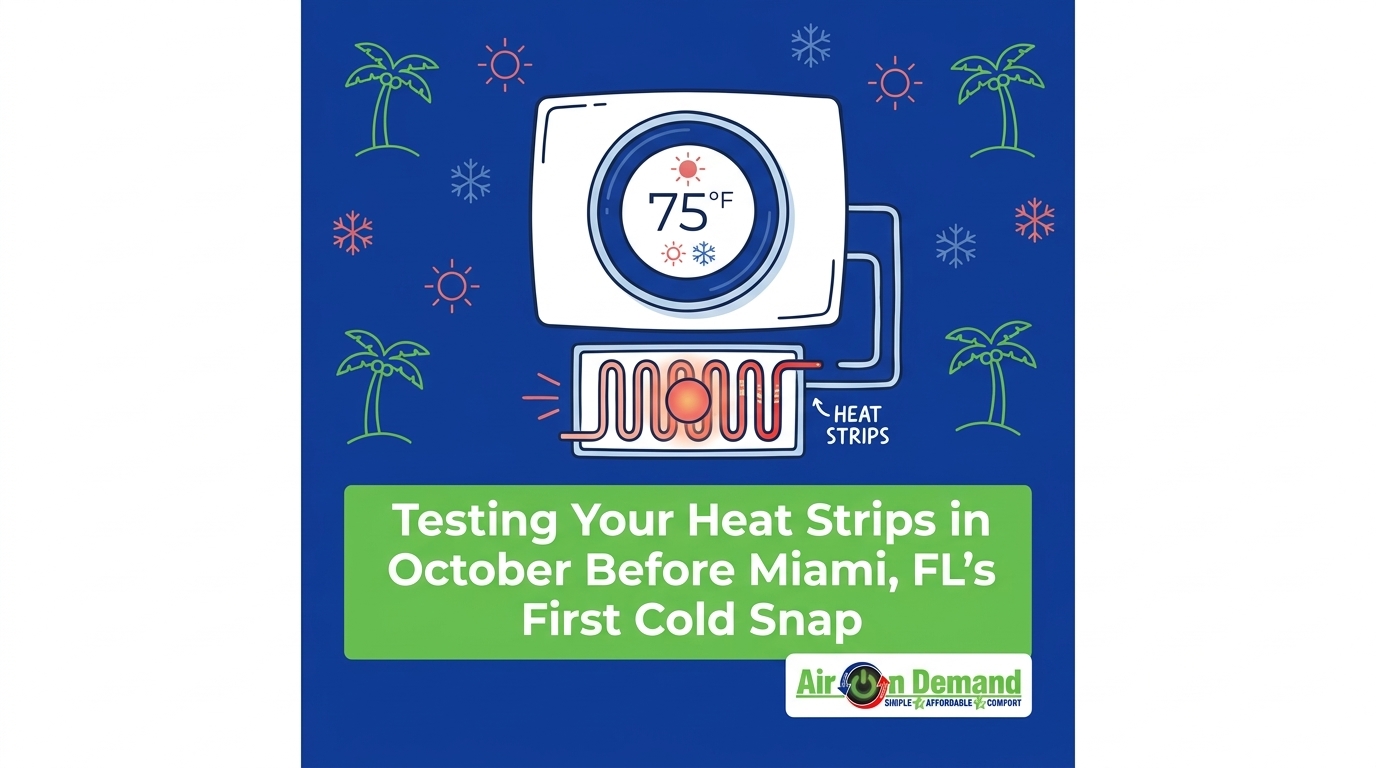
Testing Your Heat Strips in October Before Miami's First Cold Snap
October 1, 2026
October is fading, and while the rest of the country is already bundling up, we are just weeks away from that inevitable first real cold front dropping evening temperatures into the 50s. Testing your heat strips in October before Miami's first cold snap is the single best way to avoid a midnight panic when you finally need to warm up your home. In our years of providing HVAC services across Miami, our technicians at Air On Demand have seen too many homeowners wait until that first chilly November night to switch their thermostats from cool to heat. Within minutes, a heavy, alarming burning smell floods the house, followed closely by blaring smoke detectors.
If you are looking for proactive AC maintenance to prepare your system for the changing seasons, our team is ready to help you navigate this transition smoothly.
The climate factor: Here in Miami FL, our HVAC systems operate under a highly unique set of demands. Our region experiences over 4,000 cooling degree days annually compared to less than 200 heating degree days. This extreme ratio means that your heating components sit completely dormant for the vast majority of the year. When you finally call upon them, our technicians usually find they are heavily coated in a season's worth of settled particulates.
Why early action matters: At Air On Demand, our deep local expertise means we understand exactly how Miami's specific climate impacts your equipment. We want to save homeowners the stress, panic, and expense of an unnecessary emergency service call at 2 AM—a pattern we see often during the first freeze. By understanding what happens inside your air handler and taking a few proactive steps weeks before the cold arrives, you can ensure your family stays warm, safe, and completely undisturbed when the temperatures finally dip.
To understand why your heating system produces such a startling odor, you have to look at the mechanics of how a heat pump operates in a subtropical climate. Unlike gas furnaces found in northern states, our installation crews at Air On Demand know that most homes in Miami FL rely on electric heat pumps. These systems are incredibly efficient at moving heat, but they occasionally need assistance when the outdoor temperature drops sharply.
The dormancy period: For 9 to 10 consecutive months during our extended cooling season, the auxiliary heating components sit completely inactive. During this time, the system is constantly pulling indoor air through the return vents. Even with a good filter, microscopic dust particles, pet dander, and household debris bypass the media and settle onto the internal metallic surfaces of the air handler.
For comprehensive care of these internal components, scheduling routine Miami AC maintenance ensures your system remains clean and efficient year-round.
Inside your air handler, there is a component called the auxiliary heat strip. These are essentially heavy-duty electrical resistance coils, functioning very much like the glowing coils inside a standard toaster or a hairdryer. They are designed to automatically engage when the primary heat pump needs a boost to meet the thermostat's demand.
• Extreme temperatures: When activated, these coils heat up incredibly fast, often reaching temperatures well over 130 degrees Fahrenheit in a matter of seconds.
• Instant incineration: Because they have been sitting unused for nearly a year, they are covered in a thick layer of settled dust. The intense heat instantly incinerates this dust layer.
• Airflow distribution: The blower motor then pushes the resulting particulate matter and the strong, singed odor directly into your ductwork, distributing it into every room of your house simultaneously.
This process is entirely normal, but it is highly unsettling if you are not expecting it. We always tell our customers that the key is controlling exactly when this incineration process happens.
Instead of waiting for a freezing night, you can take control of the situation by performing a simple, proactive test. This strategy involves manually forcing the system to burn off the accumulated dust during a controlled timeframe when you are awake, prepared, and able to ventilate the house. In our experience, a standard 10 minutes of emergency heat operation is usually all it takes to clear the coils.
Important safety note: This is strictly a user-facing thermostat operation. You are simply changing the settings on your wall unit. You should never attempt a physical DIY cleaning of the internal heat strips, as they are connected to high-voltage electrical lines that pose a severe shock hazard. Leave the internal physical maintenance to our licensed professionals.
We recommend following these steps on a mild October afternoon to safely clear your system:
1. Prepare the home: Open several windows across the house to create a cross-breeze. Turn on your ceiling fans to help circulate the air and push any odors outdoors.
2. Adjust the thermostat: Go to your thermostat and switch the system mode from "Cool" to "Emergency Heat" (sometimes labeled as "Aux Heat"). If your thermostat does not have this specific setting, simply switch it to "Heat" and raise the target temperature 3 to 5 degrees above the current room temperature to force the strips to engage.
3. Monitor the system: Let the system run under your direct supervision. You will likely notice the burning dust smell within the first two minutes.
4. Time the burn-off: Allow the system to run for exactly 10 minutes of emergency heat operation. You should notice the smell peaking early and then steadily dissipating as the dust is cleared away.
5. Return to normal: Once the 10 minutes are up, switch your thermostat back to "Cool" or "Off," and leave the windows open for another half hour to clear any lingering scent.
The burning dust phenomenon is more than just a nuisance odor; it is a common trigger for residential smoke detectors. Standard smoke detectors are highly sensitive to incinerated particles. When a thick layer of dust burns off all at once, the sudden rush of airborne particulates blowing out of your vents can easily trip the sensors, even if there is no actual smoke or fire present.
The psychological impact: The National Fire Protection Association (NFPA) notes that sudden bursts of dust and debris are frequent non-fire triggers for alarms. At Air On Demand, we frequently hear from customers who experienced the sheer panic of a blaring smoke alarm at 2 AM on a Tuesday during a sudden cold front. Waking up to sirens and a burning smell causes severe stress for families and pets alike.
By conducting a controlled test during the day, you eliminate the element of surprise. Understanding why Miami needs heat strip inspections and early testing gives you the power to manage this seasonal quirk on your own terms. When the real cold weather arrives in November, you can turn on your heat with total confidence, knowing the coils are already clean and your smoke alarms will remain silent.
You might wonder why this burning smell seems so much more intense in Miami FL compared to homes in northern states. The answer lies in our unique combination of climate factors: continuous cooling, extreme humidity, and airborne particulates.
The South Florida difference: In colder climates, heating systems cycle on and off frequently throughout the fall, winter, and even early spring. This frequent use burns off dust in tiny, unnoticeable increments. Here, our systems run almost exclusively on cooling mode for 9 straight months. That means 9 months of constant airflow over dormant metallic components.
Furthermore, our high indoor humidity plays a significant role. When our technicians open up air handlers for fall tune-ups, a pattern we see often is that condensation has caused airborne dust to become heavy, sticky, and caked onto the dormant heat strips. Instead of a light dusting, our heat strips develop a thick, baked-on layer of debris.
The role of filtration: This emphasizes the critical importance of high-quality air filters during the long summer months. We always advise our customers that changing your air filter regularly reduces the volume of dust that makes it into the air handler, ultimately minimizing the severity of the winter burn-off.
While a burning smell is almost always harmless dust, it is vital to know the difference between a routine seasonal quirk and a genuine electrical emergency. At Air On Demand, our AC repair crews prioritize homeowner safety above all else. We want you to feel empowered to recognize when a smell is normal and when it requires immediate professional intervention.
If you notice anything outside the normal parameters of the 10 minutes of emergency heat operation, you need a professional to assess the situation. For any warning signs, scheduling professional AC repair in Miami is the safest course of action.
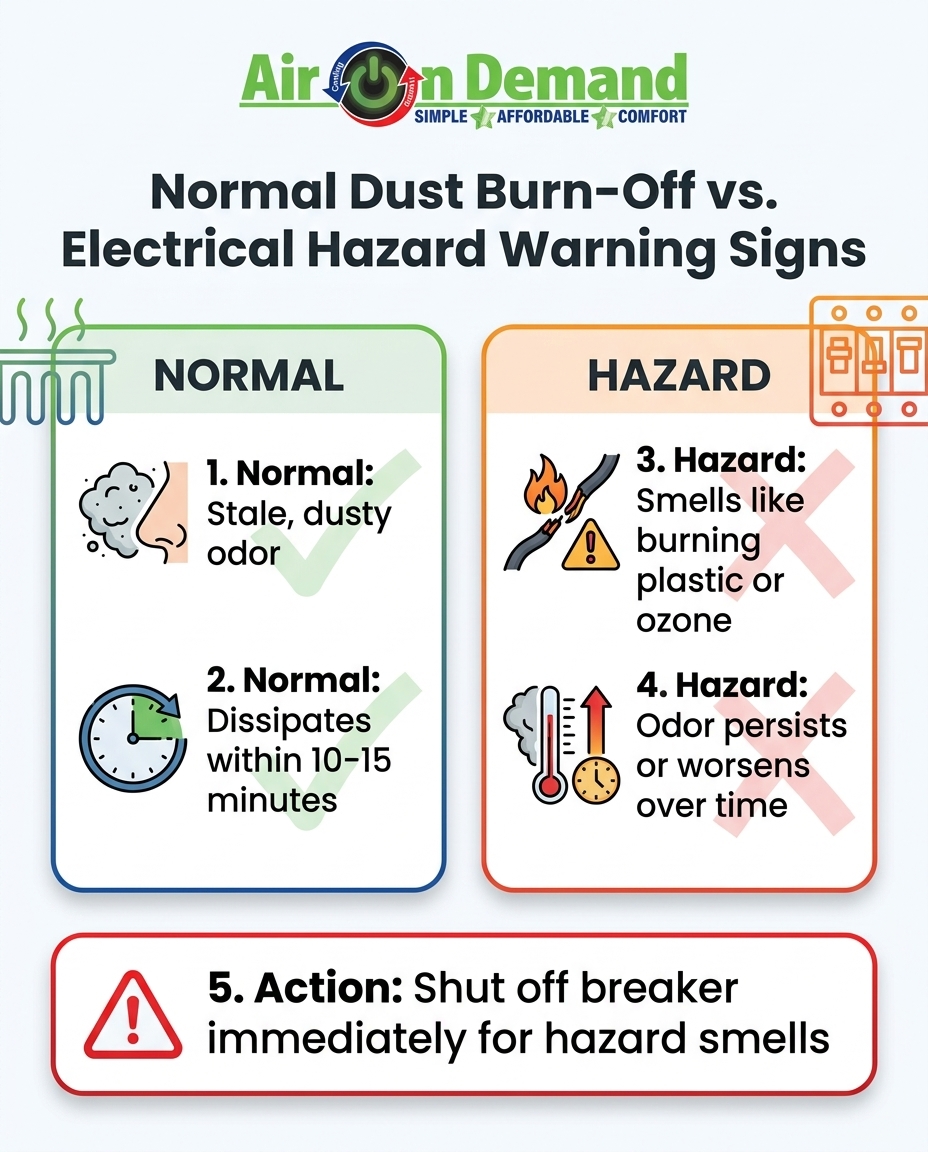
Use this guide our technicians put together to evaluate the odors coming from your vents:
• Scent Profile — Normal Dust Burn-Off: Stale, dusty, slightly singed, similar to a hot hairdryer. — Electrical Hazard Warning Sign: Acrid, melting plastic, ozone, burning rubber, or fishy electrical smells.
• Duration — Normal Dust Burn-Off: Peaks in the first 3-5 minutes, dissipates rapidly after 10 minutes. — Electrical Hazard Warning Sign: Persists, grows stronger over time, or remains long after the system shuts off.
• Visual Signs — Normal Dust Burn-Off: None. Invisible particulate matter only. — Electrical Hazard Warning Sign: Visible smoke coming from the vents or the air handler unit itself.
• Action Required — Normal Dust Burn-Off: Open windows, monitor for 10 minutes, allow to clear naturally. — Electrical Hazard Warning Sign: Shut off the system immediately at the breaker panel and call an HVAC professional.
The 10-minute thermostat test is an excellent first step, but a mid-fall October pre-winter startup routine should involve a broader look at your system's overall health. Preparing your equipment before the first cold snap ensures efficiency and extends the lifespan of your unit.
Start with the filter: We always remind our customers to replace their HVAC filter before conducting the heat strip test. A clogged filter restricts airflow, which can cause the internal components to overheat and trip safety limits. Starting with a fresh, clean filter ensures maximum airflow to push the incinerated dust out of the system quickly.
Professional oversight: While the thermostat test is perfectly safe for a homeowner to perform, physically inspecting the internal wiring, testing the amperage of the heat strips, and verifying the defrost cycle requires a licensed technician. Heat strips draw a massive amount of electricity, and our field teams have seen firsthand how corroded connections can become serious fire hazards if left unchecked.
Scheduling a comprehensive AC inspection allows our professionals to vet every electrical connection, test the safety limit switches, and ensure your system is fully prepared to handle the sudden load of heating your home.
Taking just 10 minutes out of a mild October afternoon to test your system can save you from a highly stressful night in November. By proactively burning off the accumulated summer dust, you ensure a smooth, panic-free transition into the cooler months.
A brief burning smell is a completely normal part of owning a heat pump in a subtropical climate, provided it dissipates quickly. However, if you have any lingering concerns, notice unusual electrical odors, or simply want the reassurance of a fully vetted system, reach out to our team at Air On Demand to secure your peace of mind before the real cold sets in.
Why does my heat smell like burning dust?
Your heat smells like burning dust because the auxiliary heat strips have been sitting unused for months, collecting debris. When these electrical coils finally turn on, they heat up rapidly and incinerate the settled dust layer. We find this releases a temporary, singed odor into your ductwork that usually clears up quickly.
How long does it take for dust to burn off heat strips?
In our experience, it typically takes about 10 to 15 minutes for the accumulated dust to completely burn off the heat strips. The smell will be strongest in the first few minutes and should steadily dissipate as the system runs. If the smell lasts longer than 30 minutes, you should turn off the unit and have our team inspect it.
Can a heater burning dust set off smoke alarms?
Yes, a heater burning off dust can easily trigger standard residential smoke alarms. Smoke detectors are highly sensitive to sudden rushes of airborne particulates, even if there is no actual fire. Performing a controlled burn-off during the day allows you to ventilate the home and prevent false alarms.
When should I worry about a burning smell from my AC?
You should worry if the smell resembles melting plastic, burning rubber, ozone, or fishy electrical odors. Additionally, if the smell persists for more than 15 minutes, grows stronger, or is accompanied by visible smoke, shut off the breaker immediately. These are strong indicators of an electrical hazard requiring a professional AC repair technician.
Is it safe to run emergency heat just to test it?
Yes, it is perfectly safe to run your emergency heat for a short duration to test it and clear off the dust. Operating the system from the thermostat for about 10 minutes in a controlled manner is a recommended proactive step. However, you should never open the unit to clean the high-voltage coils yourself.
Why do Miami heat pumps get so dusty during the summer?
Miami heat pumps get exceptionally dusty because they run in cooling mode for 9 to 10 months straight, constantly pulling airborne particles through the system. Combined with high indoor humidity, our technicians see this constant airflow cause dust to become heavy and cake onto the dormant heating elements much faster than in northern climates.