The September Pre-Heating Tune-Up: Why Miami Needs Heat Strip Inspections
September 23, 2026
Before the first winter chill arrives, prioritizing The September Pre-Heating Tune-Up: Why Miami Needs Heat Strip Inspections is the smartest move a homeowner can make. September is here, and while the outdoor temperatures haven't broken just yet, the clock is ticking toward that inevitable first cold snap. After a long, relentless summer of non-stop air conditioning, your heating system is entirely out of sight and out of mind. But ignoring it now sets the stage for a stressful surprise later.
Here is the concrete problem most homeowners face: when that first 50-degree night finally hits, you turn on the emergency heat to warm up the house. Instead of immediate comfort, you are greeted by an alarming, heavy burning dust smell that quickly fills every room. The odor is unmistakable, and it instantly triggers panic. You are left wondering if your house is catching fire or if your HVAC system is destroying itself.
This puts you at a critical decision point right now during the September pre-heating transition. You can proactively schedule a tune-up to professionally clear the system, or you can wait until the temperature drops and risk panic, potential safety hazards, and shivering through the night while waiting for an emergency repair. Taking action now ensures your system is clean, tested, and ready long before the emergency heat is actually required. To get ahead of the rush, booking AC maintenance in Miami that includes a full heat strip inspection is the most effective way to protect your home and your peace of mind.
To understand why your heating system requires specialized attention in our specific climate, you have to look at the unique lifecycle of a Miami HVAC unit. In northern climates, the transition from cooling to heating is gradual, spanning several months of mild weather. Here, the local climate dictates 300 or more days of intense, continuous cooling. This means the internal environment of your HVAC system is uniquely prone to heavy dust accumulation on components that are completely unused for most of the year.
Your electric resistance heating coils—commonly known as heat strips—act like giant toaster wires inside your air handler. Even though they remain turned off for 10 or 11 months straight, they are not isolated from the rest of the system. While you enjoy chilled air all summer long, the air handler is constantly pulling air from your home, pushing it through the filter, over the evaporator coil, and past those dormant heat strips.
Over the course of this 300-day slumber, microscopic particles of lint, pet dander, dead skin cells, and household dust inevitably bypass the air filter. Because the heat strips sit directly in the path of the airflow, this debris settles directly onto the cold, inactive heating elements. By the time winter arrives, those coils are wearing a thick blanket of highly flammable material.
The core issue stems from the fact that your air handler plays a dual role. The exact same blower motor is responsible for pushing chilled air in the summer and heated air in the winter through the exact same internal compartment. The heat strips do not have their own separate, dust-free housing.
Furthermore, the cooling process naturally creates a highly humid environment inside the air handler. The evaporator coil generates significant condensation as it removes humidity from your home. This moisture in the air stream causes the bypassing dust and lint to become slightly damp and sticky. When this sticky debris hits the dormant heat strips, it clings tenaciously, baking onto the metal surfaces and creating a dense layer of buildup that cannot be removed by airflow alone.
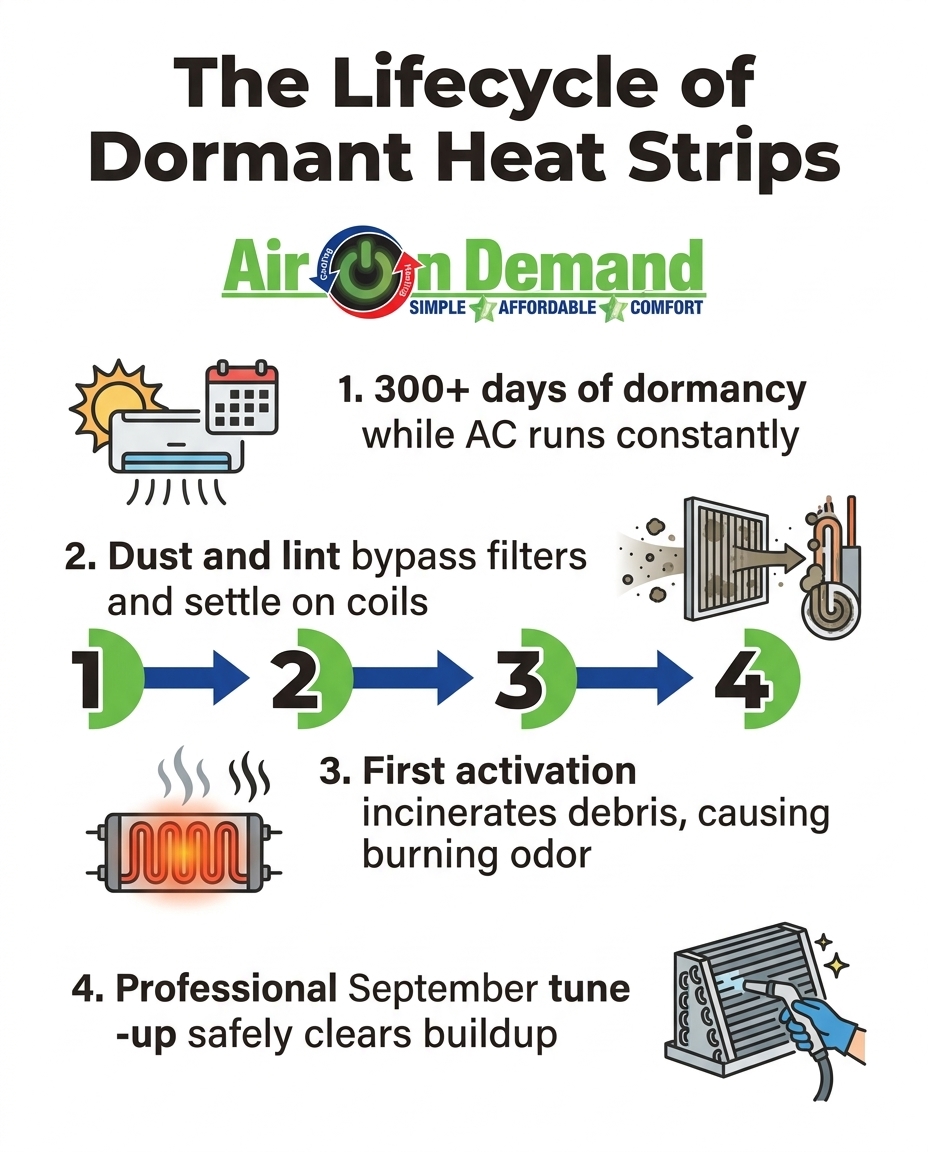
When the temperature drops and your thermostat finally calls for heat, the system energizes those dust-caked coils. High-voltage electricity surges through the elements, causing them to glow red-hot almost instantly. The immediate result is a scientific certainty: the thick layer of accumulated debris incinerates on contact. This is the exact phenomenon that causes the infamous burning dust smell to blast through your air vents.
Your alarm in this situation is completely validated. The smell is incredibly pungent, often resembling burning plastic, singed hair, or a potential house fire. It is a terrifying experience for a homeowner who simply wanted to take the chill out of the air. The National Fire Protection Association (NFPA) consistently cites heating equipment as a leading cause of home fires, which underscores exactly why neglected, dust-covered systems are a genuine, documented risk rather than just a minor nuisance.
While a brief, mild odor might be expected, heavy accumulation changes the dynamic from a simple nuisance to a potential hazard. It is vital to know the difference between a normal "burn-off" and a dangerous electrical malfunction.
• Odor Type — Normal Dust Burn-Off: Smells like dry, dusty heat or singed lint. — Dangerous Electrical Issue: Smells like melting plastic, ozone, or burning rubber.
• Duration — Normal Dust Burn-Off: Fades away completely within 15 to 30 minutes. — Dangerous Electrical Issue: Persists continuously or grows stronger over time.
• Visual Signs — Normal Dust Burn-Off: No visible smoke in the home; just the odor. — Dangerous Electrical Issue: Visible smoke from vents or the air handler unit.
• System Behavior — Normal Dust Burn-Off: Heater operates normally and warms the house. — Dangerous Electrical Issue: System short-cycles, trips breakers, or blows cold air.
If you experience any of the symptoms in the "Dangerous Electrical Issue" column, shut your system down immediately at the thermostat and the breaker panel. Do not wait to see if it improves. Neglected heat strips in Miami can cause cascading electrical failures if the buildup causes the elements to overheat and short out against their housings.
The suddenness of local winter cold snaps makes proactive fall testing absolutely critical. We do not experience a gradual, lingering autumn; the temperature drops rapidly overnight, forcing you to rely on a heating system that hasn't been tested in nearly a year. This is why the September pre-heating transition is the ideal, low-stakes time to prepare.
Right now, outdoor temperatures are still sitting comfortably in the upper 80s. This means that if a technician discovers a failing sequencer, a burnt wire, or a damaged heat strip during an inspection, your home will not freeze while you wait for a replacement part. You have the luxury of time, which vanishes completely on the first cold night of the year when every HVAC company in the region is swamped with emergency "no heat" calls.
By taking action now, you allow a technician to perform a "controlled burn-off." This is a critical seasonal step for a safe transition.
1. System Isolation: The technician safely isolates the heating elements to check for excessive, dangerous buildup before any power is applied.
2. Monitored Activation: The heat strips are energized while the technician stands right there, monitoring the amperage draw and the temperature.
3. Safe Clearing: The minor, unavoidable dust is burned off safely while the home's windows can be opened to vent the smell, rather than trapping you in a closed, smelly house on a cold night.
As true local experts with a specialized understanding of South Florida HVAC lifecycles, we know that prioritizing heating safety is paramount—even when cooling still seems like your main concern. We strongly encourage readers to schedule AC service and heating inspections concurrently. Getting both systems checked in one visit ensures total readiness for whatever the weather does next.
When homeowners learn that their heat strips are covered in dust, the first instinct is often to open up the air handler and clean it themselves. You must resist this urge entirely. Attempting a DIY cleaning of your electric heat strips is incredibly dangerous and poses a severe, life-threatening electrocution risk.
Electric heat strips operate on high-voltage electricity—typically 240 volts. Even if you turn off the thermostat, the system may still hold a lethal electrical charge at the breaker or within the capacitors and sequencers. Only a licensed professional with specialized training and the correct diagnostic meters should ever open the air handler to service resistance heating elements.
Beyond the severe shock hazard, the physical components of the heat strips are highly fragile. The heating coils are supported by delicate ceramic insulators that are easily cracked or shattered by the hard plastic nozzle of a household vacuum cleaner. The wire coils themselves are thin and easily bent. If you accidentally push two coils together with a brush or a rag, you will create a direct electrical short. The second the system turns on, it will spark, potentially start a fire, and instantly destroy the heating assembly.
Furthermore, attempting to dismantle the air handler and clean these high-voltage components without proper certification will almost certainly void your equipment warranties. Manufacturers require routine maintenance to be performed by licensed technicians for a reason. Do not risk your safety, your home, or your warranty coverage to save a few dollars on a DIY cleaning attempt. In Miami, the stakes are simply too high.
When you hire a professional for your September pre-heating transition tune-up, you are investing in a rigorous safety protocol. A technician doesn't just turn the heater on and walk away. They perform a deep, comprehensive evaluation of the internal components to guarantee safe, reliable operation.
Here is exactly what happens during a professional AC inspection that includes full heat strip testing:
• Visual Coil Inspection: The technician opens the air handler and visually inspects the dormant heat strips for excessive debris, signs of corrosion, or physical damage to the ceramic insulators. This ensures there are no obvious fire hazards before power is applied.
• Electrical Connection Testing: High heat causes metal to expand and contract, which can loosen electrical terminals over time. The technician tightens all high-voltage connections to prevent arcing and electrical shorts.
• Amperage Measurement: Using a specialized multimeter, the technician measures the exact electrical current drawing through the strips. If the strips pull too much power, they are failing; if they pull too little, a sequencer or relay is likely broken.
• Controlled Activation: The technician performs the safe, monitored activation of the heat strips to clear minor dust while standing by to shut the system down instantly if an anomaly occurs.
• Thermostat Verification: Finally, they verify that the thermostat correctly engages the emergency heat mode without delay, ensuring the communication between your wall unit and the air handler is flawless.
This thorough checklist removes all the guesswork and anxiety from the equation. You aren't just paying for a cleaning; you are paying for the assurance that your system won't fail or create a hazard when you need it most.
It is a common misconception that because you rarely use the heat in Miami, the heating elements don't affect the rest of the system. In reality, the health of your heat strips is directly connected to the overall efficiency and longevity of your air conditioning.
Because the heat strips sit directly in the path of the circulating air, a heavily clogged heating element acts exactly like a dirty air filter. It restricts the vital airflow your system needs to function. When airflow is choked off by a wall of baked-on lint and dust, your blower motor has to work significantly harder to push air through the vents. This increased static pressure causes the motor to run hotter, consume more electricity, and wear out prematurely.
Restricted airflow also impacts the cooling side of the system. If air cannot move freely past the heat strips, it cannot move freely over the evaporator coil either. This can lead to the evaporator coil freezing over into a block of ice during the summer, causing catastrophic damage to the compressor. Preventative maintenance catches these small airflow and electrical issues before they cascade into major blower motor or circuit board failures.
Finally, protecting your investment means protecting your warranty. HVAC manufacturers stipulate that the entire system must be maintained annually by a professional. Skipping annual maintenance because you "only use the AC" can jeopardize your manufacturer warranties, leaving you completely unprotected if a major component fails. Regular care ensures your system remains compliant, efficient, and reliable year-round.
Dust and lint accumulate on the dormant heating coils over the long summer cooling season. When the heater is finally activated during the September pre-heating transition, the high-voltage electricity instantly heats the coils, burning off this debris. This rapid incineration creates the distinct, pungent odor of burning dust that circulates through your air vents.
A brief dust burn-off is a common occurrence, but heavy accumulation can absolutely become a fire hazard. If the smell resembles burning plastic, ozone, or electrical components, or if it persists for a long time, it is highly dangerous. You should shut the system down immediately and require immediate professional attention to prevent electrical fires or equipment damage.
A normal dust burn-off should dissipate entirely within 15 to 30 minutes of the heater running. Once the initial layer of dust is cleared from the coils, the air should smell clean and warm. If the burning smell continues beyond this half-hour window, or if it gets stronger, turn off the heater and call a licensed technician.
Yes, electric heat strips require regular maintenance regardless of how infrequently they are used. Even if they sit dormant, they require annual professional inspections to clear restrictive debris, check tight electrical connections, and ensure safe, efficient operation before the first cold snap arrives.
No, you should never attempt to clean your own heat strips. Heat strips operate on dangerous high voltage and are constructed with highly fragile wire coils and ceramic insulators. DIY cleaning risks severe electrical shock, permanent physical damage to the system, and will likely void your manufacturer's warranty.
The ultimate peace of mind comes from knowing your home is safe, comfortable, and fully prepared for whatever the weather brings. A proactive tune-up entirely prevents the panic of a burning smell waking you up during the first cold night of the year. Instead of worrying about fire hazards or system failures, you can simply enjoy the warmth.
Don't wait until the temperature drops and the emergency calls flood in. Taking care of The September Pre-Heating Tune-Up: Why Miami Needs Heat Strip Inspections right now guarantees a safe, panic-free heating experience. Talk to an expert today and book your pre-heating inspection before the seasonal rush begins, ensuring your system is clean, tested, and ready to perform flawlessly.