
Managing Humidity in Miami Beach Condos During the Fall Transition
October 13, 2026
During the early weeks of autumn, the average daytime temperature in South Florida finally dips into the low 80s, yet outdoor relative humidity consistently remains above 70%. At Air On Demand, our team frequently hears from residents that this specific weather pattern makes managing humidity in Miami Beach condos during the fall transition incredibly frustrating. You are no longer running your cooling system around the clock, but the heavy, moisture-laden ocean air hasn't gone anywhere.
This seasonal mismatch creates a very specific, concrete problem: your cooling system runs less frequently because the thermostat reaches its target temperature quickly, leaving your indoor air feeling uncomfortably cold and clammy. The air conditioner shuts off before it has a chance to wring the excess moisture out of the air. When you live in a coastal high-rise or mid-rise, that trapped marine moisture settles into fabrics, makes floors feel slick, and creates a heavy, stale environment.
As a condo owner, you face a distinct decision point during the October fall transition. You have to figure out how to pull that moisture out of your living space without freezing yourself out. Turning the thermostat down even lower just makes the unit colder, not drier. Finding the right balance requires a mix of smart system settings and, in some cases, exploring professional air conditioning services to upgrade your moisture management strategy before the dampness leads to larger indoor air quality issues.
To understand why your condo feels so muggy in the fall, you have to look at how your air conditioner actually handles different types of heat. Most homeowners think their AC just blasts cold air, but it is actually performing two distinct jobs simultaneously: sensible cooling and latent cooling.
Sensible cooling refers to lowering the actual temperature of the room—the number you see on the thermostat. Latent cooling is the process of removing invisible moisture from the air. An air conditioner only performs latent cooling while the compressor is actively running and warm indoor air is continuously passing over the freezing cold evaporator coil.
• Sensible Cooling — What It Does: Lowers the air temperature — How You Feel It: The room feels physically colder — Fall Transition Impact: Happens too quickly in October due to milder outdoor heat.
• Latent Cooling — What It Does: Removes airborne moisture — How You Feel It: The room feels crisp and dry — Fall Transition Impact: Fails to complete because the system shuts off prematurely.
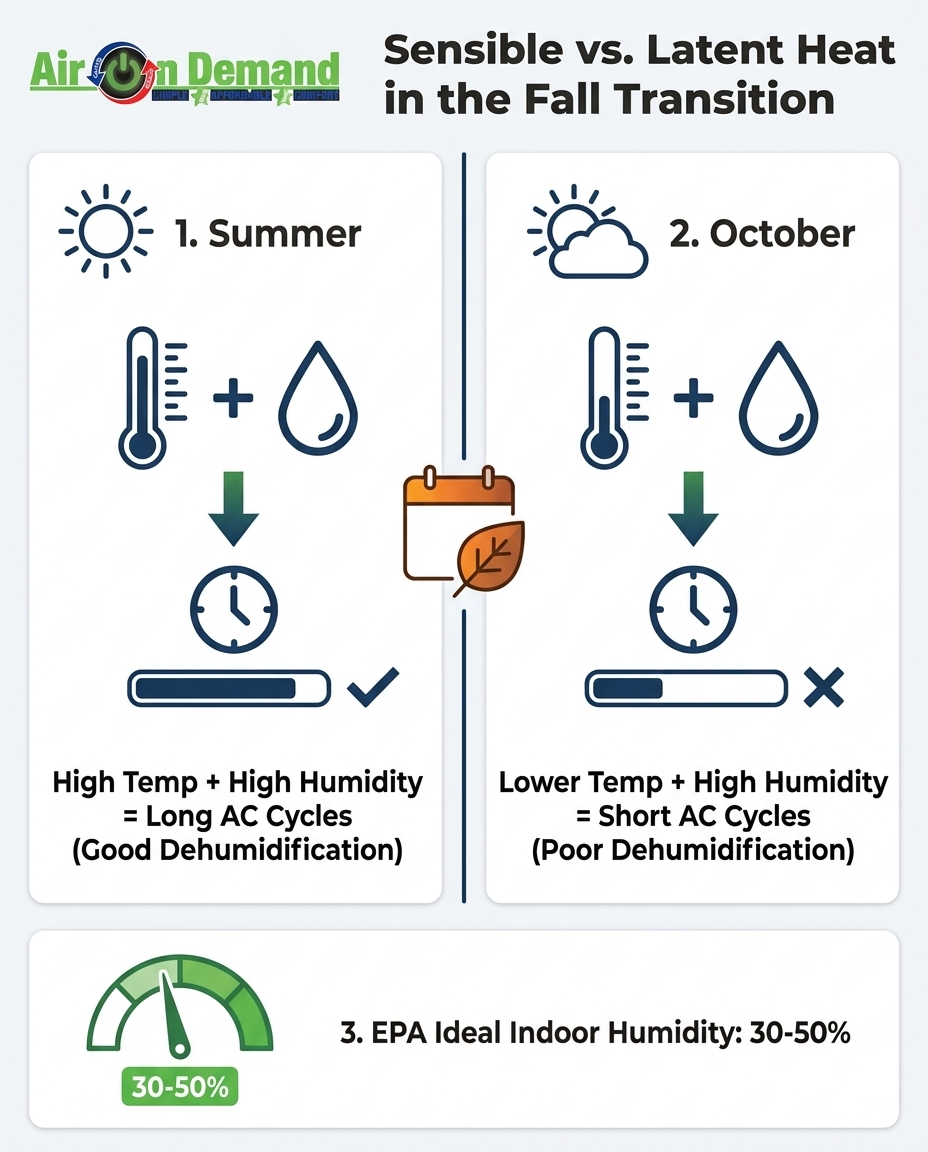
In our experience servicing Miami HVAC systems, the physics of a clammy condo almost always come down to runtime. During the peak of summer, your system runs for 45 minutes at a time, providing plenty of opportunity to extract humidity. During the October fall transition, the system might only run for 10 minutes to hit 74 degrees. That brief window simply isn't long enough to perform adequate latent cooling, leaving the heavy moisture behind. The problem is the cause; the solution requires finding ways to extend that runtime or remove the moisture independently. If you are struggling to find this balance, professional AC maintenance in Miami can help calibrate your system for better fall performance.
When an air conditioner turns on and off in rapid, brief bursts, it is known as short-cycling. While short-cycling can be caused by mechanical failures or an oversized unit, our technicians note that it happens naturally to perfectly healthy systems during cooler fall weather.
These brief cooling cycles leave heavy coastal air trapped indoors. The evaporator coil barely gets cold enough to start forming condensation before the thermostat signals that the room is cool enough. The system shuts down, the blower stops, and the moisture that was just starting to collect on the coil evaporates right back into your condo's ductwork.
Single-family homes breathe differently than multi-family buildings. When you live in a coastal property, the architectural realities of your building actively work against your indoor air quality during the fall. Wind-driven marine moisture and salt air constantly push against the building envelope of beachfront properties. Even with modern weatherstripping, this heavy, damp air infiltrates through balcony doors, window frames, and ventilation intakes.
Miami Beach mid-rise condos feature unique structural elements that exacerbate this indoor humidity:
• Shared concrete walls: Concrete acts as a thermal mass, holding onto ambient temperatures and limiting natural heat transfer, which changes how your unit cools down.
• Stacked layouts: With units above, below, and beside you, your condo has very few exterior walls to release heat, meaning your AC runs even less often than a freestanding house in the same weather.
• Limited cross-ventilation: Most condos only have windows on one or two sides, making it nearly impossible to flush out stale, damp air naturally.
The Environmental Protection Agency (EPA) strongly recommends that ideal indoor relative humidity should remain between 30% and 50%. Staying within this range is critical not just for your physical comfort, but to prevent mold growth and protect your interior finishes, cabinetry, and drywall from warping.
Because our team at Air On Demand specializes in servicing coastal properties, a pattern we see often is how these complex buildings dictate HVAC performance. Upgrading or repairing HVAC systems in these environments requires navigating shared plumbing chases, strict HOA guidelines, and complex drainage networks. For instance, managing condensation overflows in Miami high-rise condos is a unique challenge because a clogged drain line in your unit can quickly affect the neighbors below you. Managing moisture here isn't just about comfort; it is about protecting your property investment.
When performing fall maintenance and pre-winter inspections, our team routinely finds that most builder-grade HVAC systems installed in condos are single-stage units. A single-stage air conditioner has exactly one speed: 100% capacity. Whenever the thermostat calls for cooling, the compressor kicks on at full blast, pumps out maximum cold air, and then shuts off completely when the target temperature is reached.
We consistently see this "all-or-nothing" operation as the primary reason standard units struggle so much during the October fall transition. When the outdoor temperature is only 82 degrees, blasting the condo with 100% cooling capacity drops the indoor temperature incredibly fast. The thermostat is satisfied in a matter of minutes. As we established earlier, a few minutes of runtime is nowhere near enough time to pull thick coastal humidity out of the air.
Furthermore, this mechanical limitation is often made worse by restricted airflow. When a system is already struggling to dehumidify, pushing air through a clogged or neglected filter severely reduces the volume of air passing over the evaporator coil. If the air doesn't touch the cold coil, the moisture stays in the room. Ensuring you have the right air conditioner filters in Miami—and changing them regularly—is a baseline requirement for giving your single-stage unit a fighting chance against fall humidity.
If you are currently sitting in a clammy condo and need immediate relief, you might have a built-in tool on your thermostat that you haven't used yet. Many modern thermostats and ductless mini-split systems feature a setting called "Dry Mode" (often indicated by a water drop icon).
Dry Mode changes the sequence of operations in your HVAC system to prioritize latent cooling (moisture removal) over sensible cooling (temperature drops). Here is how you can utilize this setting effectively during the fall transition:
1. Activate the setting: Switch your thermostat from "Cool" to "Dry" (or select the water drop icon on your remote).
2. Understand the fan shift: The system will automatically lower the fan speed. Moving air slower over the evaporator coil gives the moisture more time to condense and drip away into the drain pan.
3. Keep windows closed: Do not open your balcony doors while Dry Mode is running, as you will just pull more wind-driven marine moisture into the unit.
4. Monitor the temperature: The air coming out of the vents won't feel as aggressively cold, but as the humidity drops, the condo will naturally feel more comfortable.
We always remind our clients about the limitations of Dry Mode. It is a temporary mitigation strategy, not a permanent cure for severe or chronic coastal moisture intrusion. Because it still relies on the cooling cycle to remove moisture, it will eventually shut off. If your Miami Beach mid-rise condo suffers from chronic humidity issues, you will eventually need a dedicated mechanical solution.
When temporary thermostat adjustments aren't enough to keep your coastal property comfortable, it is time to look at professional, long-term upgrades. When designing AC installations for our clients, we look to specific technologies designed exactly for the high-humidity, low-heat scenarios that plague Florida condos in the autumn.
We highly recommend replacing a single-stage unit with a variable-speed compressor. Instead of running at 100% capacity and shutting off, a variable-speed system can ramp down and run continuously at lower capacities—sometimes as low as 30%. This allows the system to run all day, constantly wringing moisture out of the air, without turning your condo into a refrigerator.
Another powerful option our team installs is a whole-condo supplemental dehumidifier. These dedicated units tie directly into your existing ductwork but operate entirely independently of the cooling cycle. If the condo is 74 degrees but the humidity is 65%, the dehumidifier turns on without the AC compressor, pulling moisture out of the air without lowering the temperature at all. Because condo buildings have strict rules regarding shared plumbing infrastructure, noise, and electrical loads, it is vital to rely on our professional installation services to ensure complete HOA compliance.
Variable-speed technology is uniquely suited for beachfront living. By utilizing longer, slower cycles, these systems perfectly counter the high-humidity, low-heat conditions of autumn. They maintain a consistent temperature while dramatically improving indoor air quality.
Beyond comfort, these longer, slower cycles also reduce the massive power surges associated with a single-stage compressor constantly turning on and off. This results in notable energy efficiency gains over the lifespan of the equipment. Homeowners upgrading to high-efficiency variable-speed heat pumps or AC units should also check with their utility providers, as federal tax credits and local energy rebates frequently apply to qualifying installations.
Your condo is humid in the fall because the outdoor temperature drops, causing your air conditioner to run less frequently. An AC unit only removes moisture while it is actively cooling. When the system shuts off after just a few minutes of running, the heavy coastal moisture remains trapped inside your living space.
You can lower humidity immediately by utilizing your AC's "Dry Mode," ensuring your air filters are clean, and keeping balcony doors closed. For a permanent fix, running standalone dehumidifiers or upgrading to a variable-speed HVAC system will provide consistent moisture removal without making the apartment freezing cold.
Yes, Dry Mode is specifically designed to combat high humidity without overcooling the space. It works by slowing down the indoor blower fan, which allows the air to spend more time passing over the cold evaporator coil, extracting significantly more moisture before returning to the room.
A cold and clammy feeling happens when the air temperature is low but the relative humidity is high. During the October fall transition, your AC easily cools the air to your target temperature, but because it doesn't run long enough to dehumidify, the lingering moisture settles on your skin and surfaces.
Yes, whole-condo dehumidifiers can be integrated into most ducted HVAC systems, even in mid-rise buildings. However, they must be professionally installed to ensure the unit's drainage ties correctly into the building's shared plumbing chases and meets all local HOA noise and electrical regulations.
Living in a Miami Beach mid-rise condo shouldn't mean accepting a damp, uncomfortable environment for months out of the year. A clammy condo is a mechanical issue caused by the fall weather shift, not a permanent reality you have to live with. By understanding the difference between sensible and latent heat, you can take the right steps to control your indoor environment.
Proper latent cooling solutions—whether that means utilizing Dry Mode, installing a supplemental dehumidifier, or upgrading to a variable-speed system—can fully restore your indoor comfort. Don't let the heavy autumn air dictate your comfort. Reach out to the team at Air On Demand to schedule a professional pre-winter assessment and secure proper AC maintenance in Miami to find the exact moisture management strategy your specific unit needs.