Why October is the Ideal Time for a Full Evaporator Coil Chemical Wash
October 12, 2026
Now that the calendar has finally turned, bringing a slight reprieve from the brutal heat and humidity, many homeowners are discovering exactly why October is the ideal time for a full evaporator coil chemical wash. After running virtually nonstop from May through September, your air conditioning system's internal components are likely caked with a thick layer of biological growth and condensation debris. At Air On Demand, a pattern we see often is homeowners facing a tough dilemma in late summer: shutting the AC down for a multi-hour deep clean in August leaves your home dangerously sweltering within minutes.
However, scheduling this critical AC maintenance in October takes advantage of the temperature dip. In our experience serving Miami, this strategic timing allows for the necessary system downtime to perform a comprehensive cleaning without sacrificing your indoor comfort. Now is the time to address the buildup left behind by the relentless summer cooling season before it causes permanent damage to your equipment.
The problem: By the time autumn arrives, your air handler has been operating as a dark, damp cavern for five straight months. The extreme summer humidity specific to Miami forces your system to extract gallons of moisture from your indoor air every single day. Our technicians frequently open air handlers in early fall to find that this continuous, heavy condensation on the evaporator coils has created the perfect breeding ground for organic buildup.
The cause: The South Florida high-humidity coastal climate means your coils are constantly wet during the cooling season. As your system pulls air from your home, microscopic airborne debris, pet dander, and biological particulates bypass standard air filters and stick directly to the wet aluminum fins. Over several months, this mixture bakes into a thick, restrictive sludge. Because the environment inside the air handler is devoid of sunlight and constantly damp, microbial growth accelerates rapidly, embedding itself deep within the coil structure.
The solution: This level of severe biological buildup cannot simply be wiped away with a rag or a standard soft-bristle brush. To fully restore the system, you need a professional AC coil cleaning in Miami that utilizes industrial-grade foaming agents to break down the hardened grime from the inside out.
Most homeowners don't realize that not all coil cleanings are created equal. If you are comparing a deep chemical coil cleaning vs standard service, it helps to understand the mechanics of how your system is actually serviced by our team.
Standard brushing involves a technician using a specialized comb or soft brush to gently sweep away loose, surface-level dust and pet hair from the outer face of the evaporator coil. While our Air On Demand technicians find this to be a helpful step during a light routine tune-up, it does absolutely nothing to remove the hardened biological sludge packed tightly between the microscopic aluminum fins.
A deep chemical wash, on the other hand, uses specialized, expanding foaming agents designed to penetrate the entire depth of the coil block. As the chemical reacts, it expands and pushes embedded grime, microbial growth, and hardened debris out from the center of the coil to the surface, where it can be safely rinsed away. Because handling highly corrosive HVAC chemicals and navigating the razor-thin aluminum fins requires specific safety protocols, we always remind our customers that this is strictly a job for licensed professionals, never a DIY weekend project.
• Primary Target — Standard Brushing: Loose dust, pet hair, surface debris — Deep Chemical Wash: Hardened sludge, biological growth, deep grime
• Method — Standard Brushing: Manual sweeping with a soft-bristle brush — Deep Chemical Wash: Expanding foaming agents and thorough rinsing
• Penetration Depth — Standard Brushing: Surface level only — Deep Chemical Wash: Full depth of the aluminum fin block
• Best Used For — Standard Brushing: Light routine tune-ups — Deep Chemical Wash: Post-summer recovery in high-humidity climates
Understanding the exact logistics of the service call highlights exactly why fall timing is so strategic. A proper deep clean is a methodical process that our team simply cannot rush. During the October post-summer cooling season in Miami, average temperatures drop from the upper 90s to the much more bearable mid-80s, making the following multi-hour shutdown entirely comfortable for your household.
Here is the timeline of how a professional chemical wash is executed by our licensed technicians:
1. System Shutdown and Isolation: The technician completely powers down the air handler and isolates the electrical components to prevent water damage during the wash.
2. Access and Inspection: The plenum and coil casing are opened, and the technician inspects the severity of the biological buildup to select the appropriate chemical strength.
3. Chemical Application: The foaming agent is sprayed evenly across the entire surface area of the coil, ensuring it penetrates deeply between the fins.
4. The Dwell Period: The system must sit idle while the chemical reacts, expands, and breaks down the hardened biological matter.
5. Thorough Rinsing and Reassembly: The coils are carefully rinsed with water, the drain pan is flushed, and the system is reassembled and tested.
This entire process requires the air conditioning to remain off for several hours. Enduring a multi-hour shutdown in the peak heat of August is miserable, often driving indoor temperatures into the upper 80s. By scheduling this service in October, your indoor climate remains comfortable while our technicians complete their work.
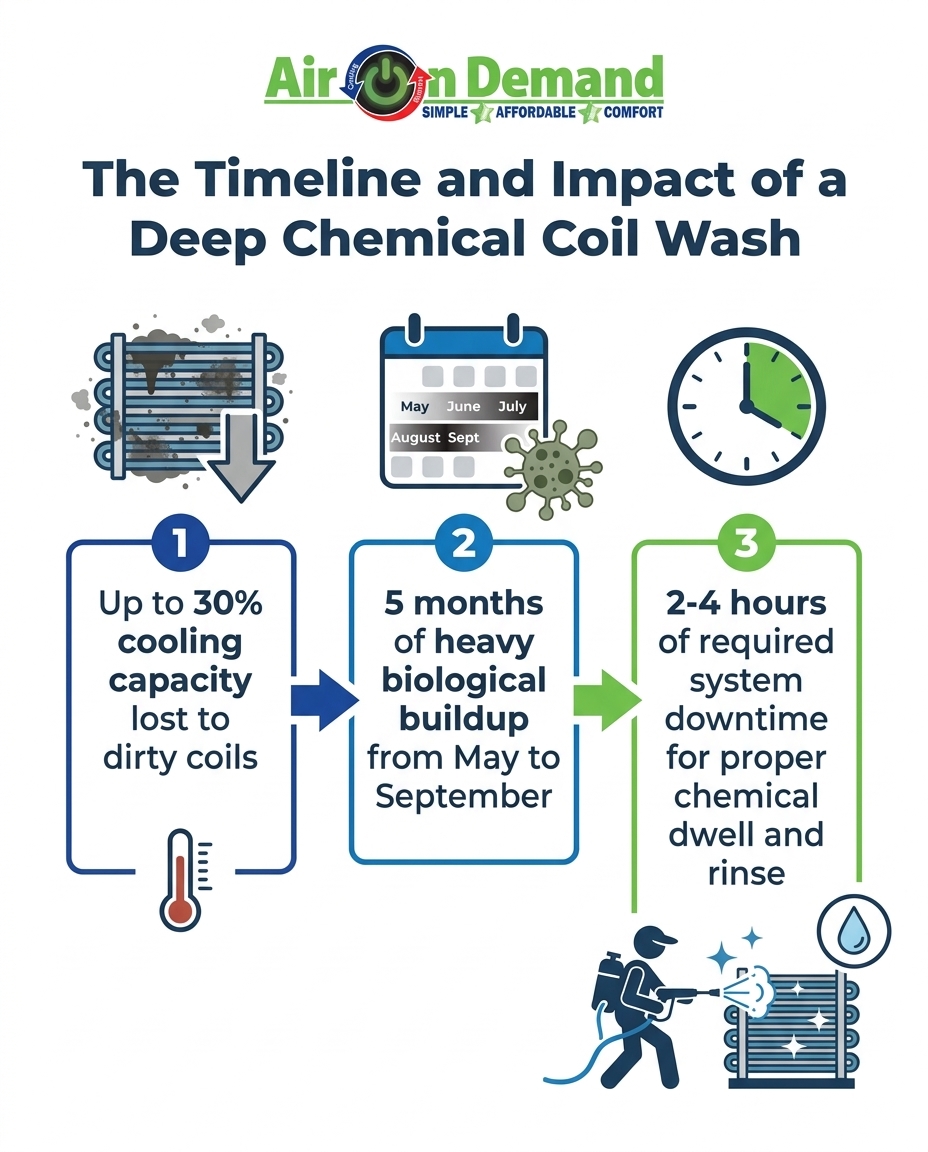
We frequently remind our Miami customers that the benefits of a deep chemical wash go far beyond basic cleanliness; it is a direct investment in your system's performance. According to U.S. Department of Energy data, a dirty evaporator coil can reduce a system's cooling capacity by up to 30%. When you consider how hard your system works during a South Florida summer, that efficiency loss translates to significant energy waste.
Your air conditioner cools your home by absorbing heat from the indoor air. The cold refrigerant flows through the evaporator coil, and as warm air blows across the aluminum fins, the heat is transferred into the refrigerant. However, when those fins are caked with biological debris, that grime acts as a thick blanket of insulation.
This insulation prevents the refrigerant from absorbing heat effectively. As a result, we often see a cascading effect of mechanical strain:
• Longer cooling cycles: The system has to run significantly longer to reach the temperature set on your thermostat.
• Increased energy consumption: Longer run times mean the compressor and blower motor are drawing maximum power for extended periods.
• Excessive wear and tear: The constant strain forces components to work harder than their engineered design, leading to premature breakdowns.
A deep chemical clean strips away this insulating layer of sludge, restoring the critical heat transfer process to factory-like efficiency and ensuring your system doesn't overwork itself during the upcoming seasons, including when you occasionally switch to heating mode during brief winter cold snaps.
The problem: One of the most common complaints our Air On Demand dispatchers hear as the weather begins to shift in the fall is a sudden, foul odor coming from the vents. Often described as smelling like a high school locker room, "Dirty Sock Syndrome" is the musty scent emitted when the AC turns on after a period of inactivity or during slight temperature fluctuations.
The cause: The root cause of this odor is the biological toll we discussed earlier. The EPA Indoor Air Quality guidelines note that microbial growth thrives in dark, damp HVAC environments. During the heavy summer use, bacteria and mold spores multiply rapidly on the wet evaporator coil. When the system cycles on, the blower fan pushes air directly across this thriving biological colony, carrying the musty spores straight into your living areas.
The solution: Standard brushing leaves the microscopic bacteria behind, meaning the smell will return almost immediately. We recommend a chemical wash to neutralize the biological growth directly at the source. The foaming agents eradicate the odor-causing bacteria lodged deep inside the fins, drastically improving your indoor air quality and ensuring your home smells fresh.
The chemistry behind a successful coil wash relies entirely on patience. The foaming chemicals require a specific "dwell time" to effectively break down hardened biological matter. If the chemical is rinsed away too quickly, the deep-set grime remains trapped in the center of the coil.
During peak summer emergencies, when technicians are rushing from house to house restoring failed systems, there is immense pressure to get the AC back on quickly. A rushed technician might cut the chemical dwell time short to minimize the homeowner's discomfort in a sweltering house.
This is exactly why scheduling in October is so beneficial. Working with our expert local technicians at Air On Demand who understand South Florida's unique humidity challenges means we can dedicate the exact time needed for safe, effective chemical washes. Because the milder fall weather keeps your home comfortable while the system is off, our technicians can allow the full dwell time required to thoroughly melt away the summer sludge. Thorough, unhurried maintenance now is the best way to prevent the need for major AC repair services down the road.
A full chemical coil wash typically takes 2 to 4 hours to complete. This timeline depends heavily on the level of biological buildup and how accessible your indoor air handler is. The process includes safely shutting down the system, applying the chemical, waiting for the necessary dwell time, and performing a thorough rinse.
That musty odor is usually caused by biological growth that thrives on the damp evaporator coil during heavy summer use. As the weather shifts and the system cycles differently, the air blowing across these microbial colonies carries the "dirty sock" smell into your home. A deep chemical wash neutralizes this growth at the source.
Neglecting your evaporator coils leads to a severe drop in system performance. You will experience reduced cooling capacity, significantly higher energy bills, and poor indoor air quality. Over time, the restricted airflow can cause the coils to freeze over, eventually leading to premature compressor failure.
No, handling corrosive HVAC chemicals and safely navigating the delicate aluminum fins requires a licensed professional. Applying the wrong chemical or failing to properly isolate the electrical components can permanently damage the coil, void your warranty, or cause dangerous chemical fumes to circulate through your home.
In high-humidity coastal climates, our team typically recommends a deep chemical wash annually or bi-annually based on your household's usage. Homes with multiple pets, heavy airborne dust, or systems that run continuously from May to September usually require a thorough chemical cleaning every fall to maintain efficiency.
October's milder weather provides the perfect strategic window for a deep chemical clean. By acting now, you can effectively clear out the heavy biological buildup from the grueling summer without forcing your family to endure a sweltering house during the multi-hour service call.
Booking your service with Air On Demand today restores the efficiency your system lost over the past five months and eradicates the source of musty indoor odors. Talk to our local experts to schedule your comprehensive coil cleaning before the calendar fills up, and discover exactly why October is the ideal time for a full evaporator coil chemical wash.