Permitting Delays for AC Installations in Miami-Dade County This Fall
October 8, 2026
At Air On Demand, our team typically sees a wave of frustrated homeowners hit an administrative wall when trying to schedule a system upgrade. Navigating permitting delays for AC installations in Miami-Dade County this fall is a frustrating reality for many whose systems barely survived the summer heat. You finally decide to pull the trigger on a new unit, only to learn that the county building department is backed up, leaving you waiting for official paperwork to clear before the real work can begin. While the calendar says it is mid-fall and you might be thinking about pre-winter inspections, the local municipal inspection pipeline is still heavily congested from processing the peak-season rush.
If you are ready to explore your options for AC installation and replacement, scheduling your Miami AC installation services early is the best way to get ahead of the paperwork queue.
Setting realistic expectations is the first step toward a successful project. When you plan a full system upgrade during the October post-summer period, you have to account for both the physical labor and the administrative timeline. In our years of serving South Florida, we have found that understanding why these bottlenecks happen, and what goes into resolving them, will help you manage your timeline and keep your household comfortable while you wait for the green light from the county.
Most homeowners assume that once September ends and they start scheduling fall maintenance, HVAC companies and local building departments immediately slow down. In reality, our team consistently sees Miami-Dade County experience a compounding administrative backlog by early fall. The surge of emergency replacements that occurred during the hottest months creates a massive wave of paperwork that takes weeks, or even months, to fully process and close out.
This backlog affects every licensed contractor operating in the region. The delays are driven by several overlapping factors that strain municipal resources:
1. The sheer volume of applications: The peak cooling season pushes thousands of aging systems to failure, resulting in a flood of permit applications hitting the county offices simultaneously.
2. Late-season weather events: Fall is still active hurricane season. When tropical storms threaten the area, municipal offices often shift their priorities to emergency preparations and post-storm assessments, pausing routine permit processing.
3. Inspector availability: Field inspectors are stretched incredibly thin trying to finalize inspections for jobs that were completed earlier in the year, leaving fewer resources to review new applications.
The emergency installations from July and August are still making waves in the fall. Even as our customers shift their focus toward indoor air quality (IAQ) improvements and heating-startup checks, county inspectors are busy clearing out the massive summer queue. Because of this, new permit applications submitted in the fall often end up sitting in a longer line than they would during the spring.
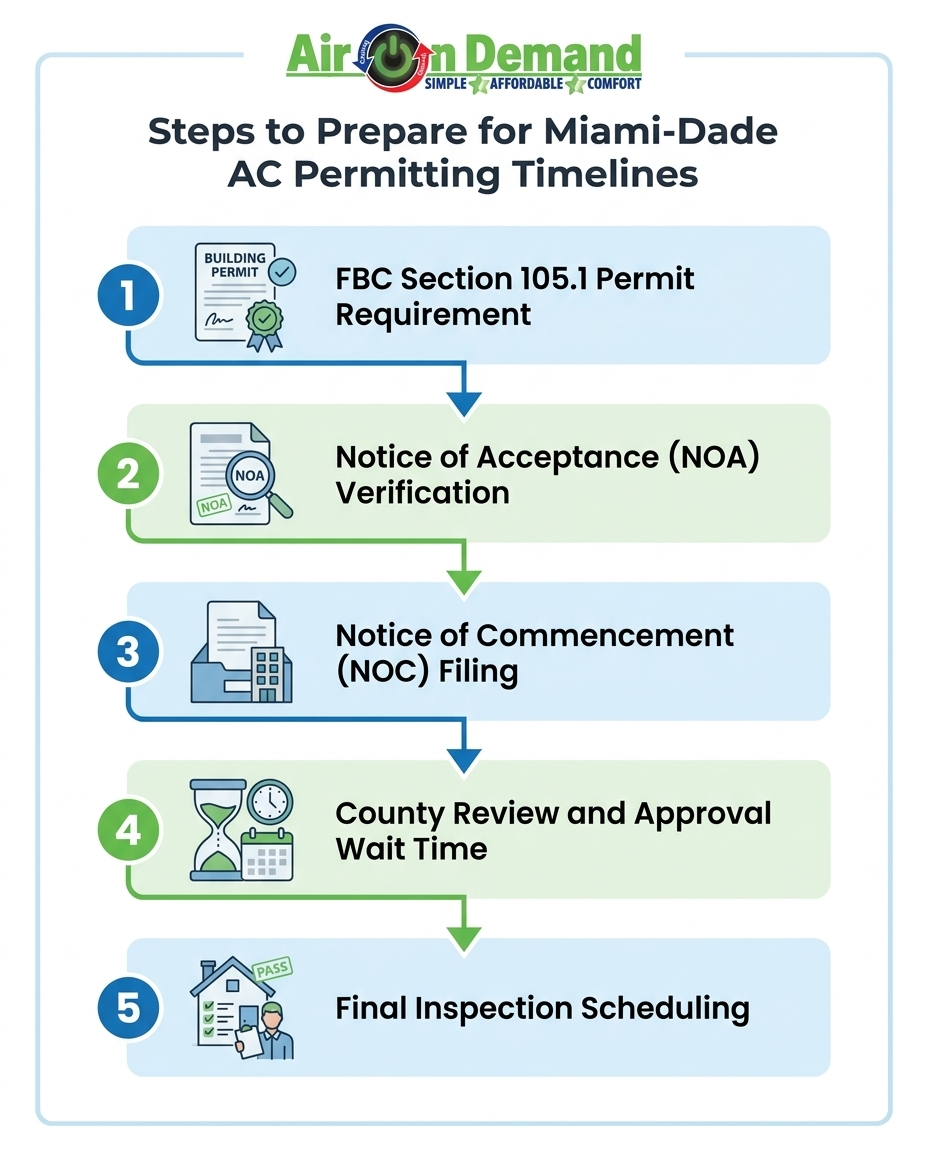
Replacing an air conditioner in South Florida is not as simple as swapping out a box and plugging it in. As a local contractor, we know firsthand that the region is subject to some of the strictest building codes in the country to ensure structures and equipment can withstand extreme weather. Florida Building Code (FBC) Section 105.1 explicitly mandates that a permit must be pulled for all HVAC system replacements. In Miami-Dade County, these regulations are even tighter.
The county operates within a High Velocity Hurricane Zone (HVHZ). This designation means every piece of equipment installed outside your home must meet rigorous wind-load engineering requirements. The paperwork required to prove compliance is extensive, and any missing detail will cause the application to be rejected by the reviewer.
Before any inspections can be scheduled, a Notice of Commencement (NOC) must be filed and recorded with the county clerk. This legal document protects you from certain liabilities, but recording it adds another administrative step to the timeline.
One of the most critical documents in the Miami-Dade County permitting process is the Notice of Acceptance (NOA). The NOA is an official product approval document proving that your specific AC unit or heat pump, along with its tie-downs and the stand it rests on, has been tested and certified to withstand hurricane-force winds.
The county strictly enforces NOA requirements for all outdoor units. If the application does not include the correct, up-to-date NOA for the exact model being installed, or if the engineering details for the concrete pad and tie-down straps are incomplete, the permit will face immediate rejection. We always stress to our clients that this level of scrutiny is necessary for public safety, but it requires absolute precision during the application process.
When facing an October replacement, it helps to understand the difference between unavoidable municipal backlogs and avoidable administrative errors. The speed at which the county processes a flawlessly submitted application is entirely out of your hands. However, the accuracy of that initial submission is completely within the control of the company you hire.
A pattern we see often with inexperienced contractors is critical paperwork mistakes that derail the entire timeline. Common errors include missing energy calculations, attaching the wrong NOA for the equipment combination, or failing to secure notarized signatures on the Notice of Commencement. When a permit application is rejected for these errors, the contractor must correct the paperwork and re-submit it. Unfortunately, a re-submission pushes your application straight to the back of the line, turning a standard wait into a prolonged, multi-week ordeal.
• Unavoidable County Delays — Common Causes: High application volume, inspector shortages, hurricane preparations. — Impact on Timeline: Standard processing wait time; predictable based on current municipal backlog.
• Avoidable Contractor Errors — Common Causes: Missing energy calcs, incorrect NOA documents, unsigned NOC forms. — Impact on Timeline: Application rejected; pushed to the back of the line upon re-submission, doubling the wait.
This is where partnering with an established professional makes a massive difference. Working with our team at Air On Demand means you benefit from our deep local roots and established mastery of the county's permitting processes. We ensure that every piece of paperwork, from energy calculations to tie-down engineering, is filed flawlessly the first time to prevent unnecessary administrative delays.
Waiting for a permit to clear is heavily taxing when your indoor environment is uncomfortable. While the calendar might say it is fall, October in this region remains hot and highly humid, making any delay in an AC replacement an urgent comfort issue. If your current system is failing or completely offline, you need strategies to keep your home livable.
Temporary cooling strategies are essential during this waiting period. Utilizing portable air conditioning units in primary living spaces or bedrooms can provide a safe, localized retreat from the heat. Running ceiling fans counterclockwise creates a wind-chill effect that makes the room feel cooler, while standalone dehumidifiers pull excess moisture from the air, making the high temperatures much more tolerable.
Protecting indoor air quality (IAQ) is just as vital when your central system is down. Our technicians highly recommend keeping windows closed during the most humid parts of the day to prevent moisture buildup, which can quickly lead to musty odors and biological growth in a South Florida home.
Most importantly, do not let the discomfort push you into skipping the permit process out of desperation. Allowing unpermitted work carries severe legal and financial penalties, including massive fines, the potential forced removal of the new equipment, and complications if you ever try to sell your home.
While your permit application works its way through the Miami-Dade County system, you can use the waiting period to prepare your property. Taking a few proactive steps now ensures that once the county gives the green light, our physical installation crews can work rapidly and without unexpected roadblocks.
• Clear the indoor workspace: Ensure there is a clear, wide path from your front door to the indoor air handler. Remove furniture, rugs, and fragile items from the immediate area so technicians have plenty of room to maneuver heavy equipment.
• Prep the outdoor condenser pad: Trim back any overgrown bushes, branches, or tall grass around the outdoor unit. Technicians need at least two to three feet of clearance on all sides to safely remove the old unit and secure the new one to the pad.
• Secure pets and plan for noise: AC replacement is a heavy construction process. Plan a safe, quiet space for your pets away from the work zones, and be prepared for several hours of drilling and heavy lifting.
The administrative waiting period is also the perfect time to finalize the financial logistics of the upgrade. You can review your options for financing options for new AC systems without feeling rushed. Take the time to understand how much AC replacement services cost over the long term, factoring in the energy efficiency of the new unit versus the operating costs of your old system. Additionally, generally applicable federal tax credits may apply to qualifying heat pump installations, so use this time to verify current programs with your utility or a tax professional. If you live in a community with a Homeowners Association (HOA), ensure all neighborhood architectural approvals are secured alongside your municipal permits.
A properly permitted and inspected installation does more than just keep you compliant with local laws; it is often a strict requirement to keep your manufacturer warranties valid. Major HVAC manufacturers design their systems to perform under specific conditions, and they require proof that the equipment was installed according to local building codes by a licensed professional.
If a system is installed without a permit in Miami-Dade County, and a major component fails a year later, the manufacturer can—and likely will—void the warranty, leaving you responsible for the entire repair bill. Going through the proper channels protects your investment.
It is also important to understand the difference between standard parts warranties and comprehensive unit replacement guarantees. A standard warranty might cover a broken compressor, but you will still pay for the labor. A more robust coverage plan, like a Daikin unit replacement guarantee, offers a higher level of protection if a major component fails within a specified timeframe. Knowing your system is fully compliant with county codes gives you the peace of mind that your warranties will stand strong when you need them.
Understanding current municipal timelines helps set realistic expectations for a fall AC installation. While the post-summer backlog at the building department is an unavoidable reality of living in South Florida, the timeline does not have to be dragged down by sloppy paperwork or administrative errors.
Flawless administrative execution is the key to minimizing wait times. By working with a dedicated local team like Air On Demand that understands the nuances of HVHZ requirements and NOA documentation, you ensure your application moves through the system as efficiently as possible.
Do not wait until your system completely fails to start the process. Schedule a consultation today to evaluate your current equipment, secure your place in line, and get the paperwork started before the municipal backlog grows any larger.
Do I need a permit to replace my AC in Miami-Dade County?
Yes, a permit is legally required for all AC replacements in the county. The Florida Building Code mandates that any modification or replacement of an HVAC system must be reviewed and inspected by local authorities. This ensures the new equipment meets safety standards and strict wind-load requirements.
How long does it take to get a building permit in Miami-Dade?
The timeline fluctuates based on the season, but wait times often stretch longer in the fall. Following the busy summer season, the county processes a backlog of applications and inspections. Submitting flawless paperwork on the first attempt is the best way to prevent additional weeks of delay.
What happens if I replace my AC without a permit in Florida?
Replacing an AC without a permit carries severe consequences, including heavy fines and potential legal action from the county. Homeowners may be forced to tear out the unpermitted equipment and start over. Furthermore, unpermitted work generally voids manufacturer warranties and can block the future sale of your home.
Why are Miami-Dade permits taking so long this fall?
The fall backlog is primarily driven by the massive volume of emergency replacements that occurred during the summer. Inspectors are busy finalizing those mid-summer jobs, leaving fewer resources to process new applications. Late-season tropical weather preparations also frequently divert municipal resources.
Can a contractor start my AC installation before the permit is approved?
No, physical installation should not begin until the permit is officially approved and issued. Starting work prematurely violates local building codes and can result in immediate stop-work orders. A reputable contractor will always wait for official county clearance before removing your old equipment.
What is a Notice of Acceptance (NOA) for an AC unit?
A Notice of Acceptance is an official document certifying that a specific product meets the county's High Velocity Hurricane Zone standards. For air conditioners and heat pumps, the NOA proves that the outdoor unit, its stand, and its tie-down straps can withstand hurricane-force winds. Missing or incorrect NOAs are a leading cause of permit rejections.