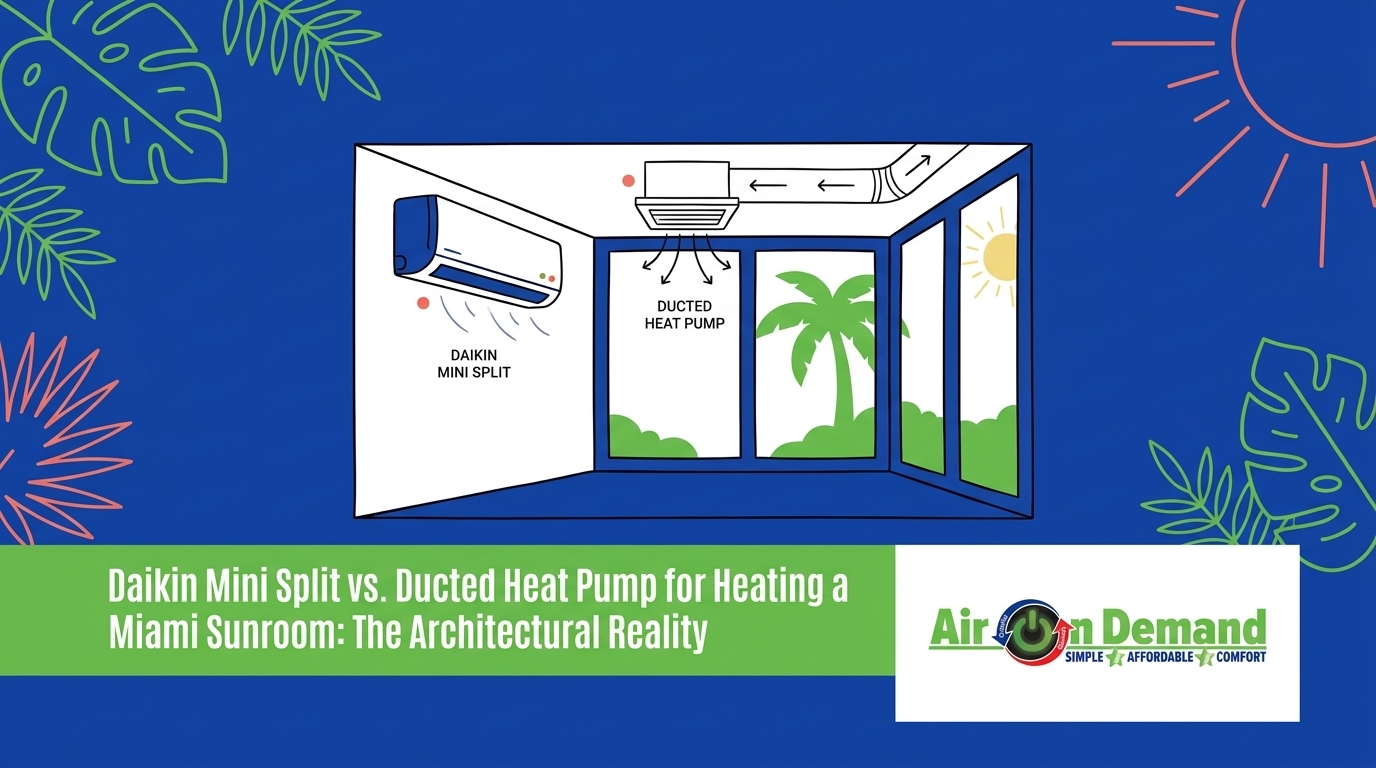
Daikin Mini Split vs. Ducted Heat Pump for Heating a Miami Sunroom
October 5, 2026
Tying a sunroom into your home's existing central air seems like the most logical, straightforward way to get comfortable. But the truth is, extending ductwork into an uninsulated space is one of the fastest ways to compromise your entire home's heating and cooling system. When weighing a Daikin Mini Split vs. Ducted Heat Pump for Heating a Miami Sunroom, you are fundamentally evaluating the aesthetic and functional viability of conditioning a poorly insulated space without ruining the efficiency of your main house.
As the intense summer heat begins to break and we start looking toward cooler October fall evenings, many homeowners realize their Florida room is entirely unequipped for temperature drops. The space becomes too chilly at night and remains too sticky during the day. This creates a critical decision point: do you attempt to force your existing central system to cover this extra square footage, or do you install a dedicated solution?
To make the right choice for your home, it helps to understand the underlying mechanics of Ductless Mini Split Systems and why treating a sunroom like a standard bedroom almost always leads to systemic HVAC failure.
Florida rooms require highly specialized mechanical solutions because they were rarely designed with modern climate control in mind. While the rest of your home operates within a sealed, insulated envelope, your sunroom plays by an entirely different set of physical rules.
Here is why your sunroom creates a unique microclimate inside your home:
1. Post-construction additions: Most Florida rooms were enclosed long after the original construction of the primary residence. They often began as screened-in porches or covered patios before being upgraded with glass windows or acrylic panels.
2. A severe lack of R-value insulation: Standard interior walls and ceilings feature thick insulation to trap conditioned air. Sunrooms, by contrast, are essentially glass boxes. They suffer from rapid heat gain during sunny afternoons and rapid heat loss during cooler October fall evenings.
3. Exclusion from original ductwork design: Because these spaces were originally built as outdoor or transitional areas, they were never factored into the home's original central HVAC ductwork blueprint. The main system was simply not sized to push air into that zone.
4. Intense regional climate factors: Miami's intense heat and high humidity make poorly insulated sunrooms notoriously difficult to manage. The space acts like a greenhouse, trapping moisture and heat that standard central air systems struggle to dehumidify without freezing out the rest of the house.
This architectural reality sets the stage for severe mechanical failures if you attempt to apply standard central air conditioning and heating principles to a space that defies them.
When you hire a contractor to simply punch a hole in your existing duct trunk and run a flex duct out to your sunroom, you are altering the fundamental physics of your home's airflow. Our deep local expertise in Miami's unique residential architecture has shown us time and again that these well-intentioned extensions almost always result in costly central air mistakes.
While a traditional AC and ductwork installation is perfect for the main body of a house, forcing it to service a high-heat-loss sunroom creates a cascade of mechanical problems.
Your central ductwork operates much like your home's plumbing system; it relies on carefully balanced static pressure to deliver air evenly to every room. The blower motor is calibrated to push a specific volume of air against a specific amount of resistance.
When you tap into the existing supply trunk to feed a sunroom, you suddenly reduce the air pressure available to the rest of the house. It is exactly like turning on every faucet in your home at once—the water pressure drops everywhere. By forcing air into a new, uninsulated space, you inadvertently starve your master bedroom, living room, and kitchen of the airflow they need to stay comfortable.
HVAC systems are sized based on an ACCA Manual J load calculation, which factors in square footage, window placement, and insulation quality. Adding an uninsulated room throws off the entire home's math.
Because Florida rooms require a disproportionate amount of energy compared to their actual square footage, your central thermostat will read the temperature in the main hallway and shut the system off long before the sunroom reaches a comfortable temperature. Alternatively, if you place the thermostat in the sunroom, your primary system will run endlessly, overworking the compressor, reducing overall HVAC efficiency, and drastically shortening the equipment's lifespan. This is why transitioning to an independent Daikin wall cassette is often the only mechanically sound choice.
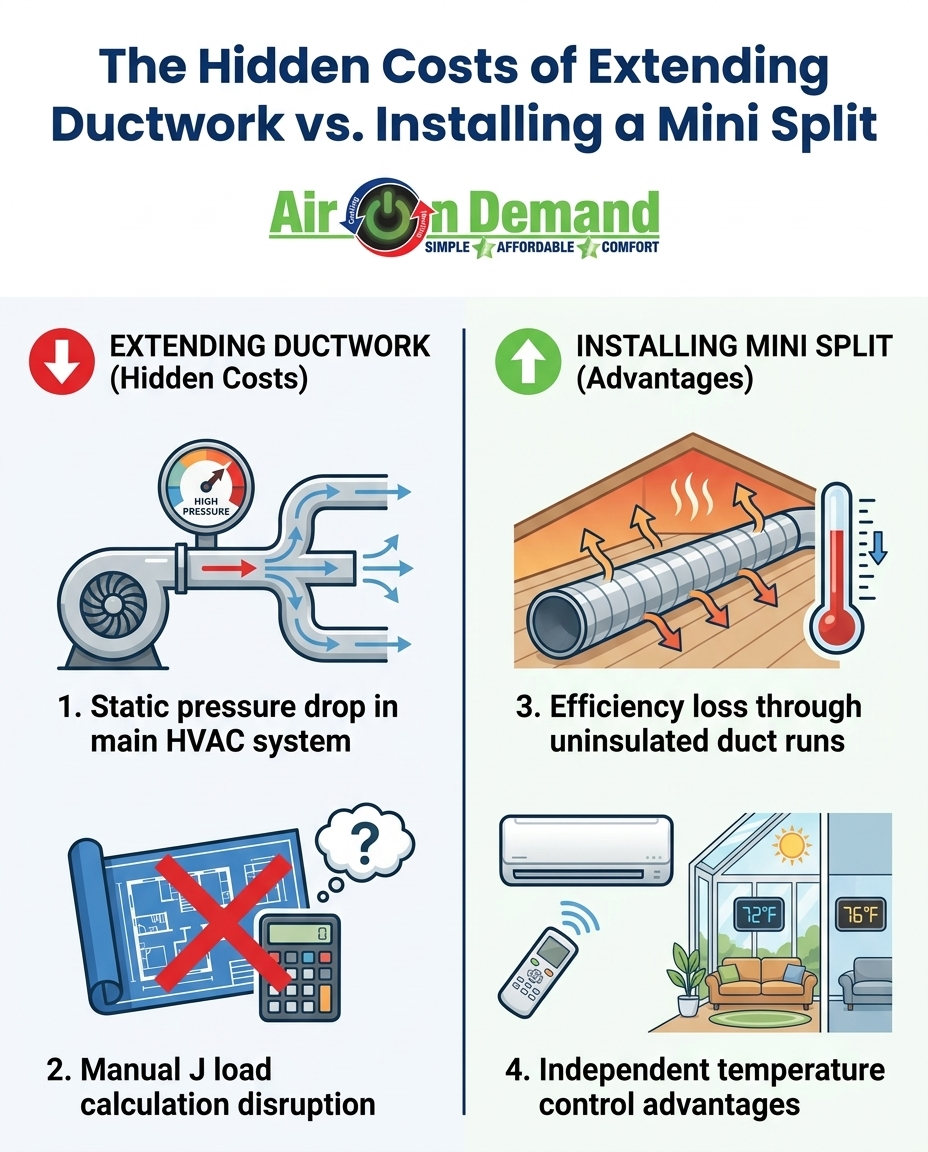
The most effective way to solve the load calculation problem is to decouple the sunroom from the main house entirely. By utilizing independent temperature control, you allow the primary central system to do exactly what it was originally designed to do, while a dedicated unit handles the heavy lifting in the Florida room.
This is where ductless air conditioners excel. A standalone Daikin system provides superior humidity control in Miami, treating the specific moisture load of the sunroom without overcooling the rest of the house. Because there are no uninsulated duct runs losing conditioned air into attics or crawlspaces, 100% of the energy consumed goes directly into cooling or heating your living space.
The secret to a Daikin wall cassette's efficiency lies in its inverter technology. Traditional single-stage central heat pumps operate on a basic "on or off" principle. When they turn on, they blast air at 100% capacity until the thermostat is satisfied, then shut down completely.
How an inverter compressor changes the game:
• Variable speed operation: Instead of turning on and off, an inverter compressor modulates its speed seamlessly. It operates much like the accelerator pedal in a car, gently adjusting power to maintain a constant speed rather than slamming on the gas and then the brakes.
• Precise temperature maintenance: This technology allows the unit to match the exact thermal load of a sunroom at any given moment, preventing the rapid temperature swings common in high-glass rooms.
• Seamless seasonal transitions: As October weather fluctuates between hot afternoons and chilly nights, an inverter system smoothly transitions between cooling and heating without missing a beat.
Even when homeowners understand the mechanical superiority of a ductless system, there is often one major hurdle left: the visual impact. It is completely natural to worry that a wall unit will disrupt your sunroom's carefully curated decor and sightlines.
Historically, ductless units were bulky, utilitarian boxes that dominated the room. However, modern engineering has transformed these systems. Today's Daikin wall cassette features a sleek, low-profile design that blends quietly into the background. When you weigh the slight visual change against the massive architectural and comfort benefits—no more sweating in the summer, no more freezing in the winter, and no more astronomical energy bills—the trade-off becomes highly favorable.
Functionality does not have to ruin aesthetics. Working with the existing architectural features of your Florida room allows for discreet installation.
Common strategic placements include:
• High on the wall: Mounting the unit just below the ceiling line keeps it out of direct eye-level sightlines while maximizing the natural downward flow of conditioned air.
• Above entryways: Placing the cassette over the door leading back into the main house often hides it from view when you are sitting and enjoying the room.
• Corner installations: Utilizing dead corner space can make the unit feel like a natural structural element rather than an add-on.
Proper clearance requirements for optimal airflow must always be maintained, but a skilled technician can almost always find a location that balances mechanical efficiency with interior design.
When evaluating how to condition your sunroom, the initial installation price is only a fraction of the total cost of ownership. Extending existing ducts often seems cheaper upfront, but the operational costs, energy waste, and potential repairs to your overtaxed central system make it a notoriously poor long-term investment.
Furthermore, general energy rebates or federal tax credits may apply to qualifying high-efficiency heat pump installations, helping to offset the initial investment (always verify current programs and eligibility with a qualified tax professional). Beyond energy savings, you also gain the peace of mind that comes with robust manufacturer protections.
• Impact on Main HVAC — Extending Central Ducted Heat Pump: High risk of static pressure drops and premature compressor failure. — Dedicated Daikin Wall Cassette: Zero impact. Operates completely independently.
• Energy Efficiency — Extending Central Ducted Heat Pump: Poor. Loses energy through ductwork; struggles with sunroom load. — Dedicated Daikin Wall Cassette: Excellent. Inverter technology eliminates duct loss and minimizes power draw.
• Temperature Control — Extending Central Ducted Heat Pump: Tied to the main house thermostat; often results in hot/cold spots. — Dedicated Daikin Wall Cassette: Precise, room-specific zoning for exact comfort control.
• Warranty Value — Extending Central Ducted Heat Pump: May void existing central system warranties if improperly modified. — Dedicated Daikin Wall Cassette: Backed by comprehensive coverage, like the Daikin Unit Replacement Guarantee vs. Standard Compressor Warranties.
Extending ductwork to a sunroom disrupts the static air pressure of your entire central HVAC system. Because the blower motor was only sized for the original footprint of the house, forcing air into a new, uninsulated space starves your other rooms of airflow. Additionally, the lack of insulation in the sunroom will cause your main system to run continuously, driving up energy bills and wearing out the equipment prematurely.
Daikin mini splits perform exceptionally well in Florida rooms because they operate independently from the main house. Their inverter technology allows the compressor to modulate its speed, matching the exact heating or cooling load required by the sunroom's unique microclimate. This provides precise humidity control and consistent temperatures without wasting energy.
While it is physically possible to cut into your existing duct trunk and run a line to a sunroom, it is highly discouraged by HVAC professionals. Doing so throws off the Manual J load calculation of your home. The resulting imbalance usually leads to poor airflow, hot and cold spots throughout the main house, and a significantly shortened lifespan for your central AC unit.
The best way to heat and cool a Florida room is by installing a dedicated, ductless mini-split system. This approach decouples the poorly insulated sunroom from your main home's tightly sealed thermal envelope. A dedicated system provides targeted comfort, handles the high moisture load efficiently, and protects your primary central air system from being overworked.
Yes, adding a mini split transforms a seasonal sunroom into a fully functional, year-round living space, which adds significant usable square footage to your home. By providing reliable temperature control during both sweltering summer afternoons and cooler October fall evenings, the space becomes far more appealing and functional for daily use.
Modern Daikin wall cassettes are designed with sleek, low-profile aesthetics specifically to minimize visual disruption. By working with a professional installer, the unit can be strategically placed high on a wall, above an entryway, or tucked into a corner. The slight visual addition is vastly outweighed by the ability to actually enjoy the room in total comfort.
Trying to force a central ducted heat pump to manage the extreme thermal loads of a sunroom is a battle you will ultimately lose on your energy bills. A dedicated Daikin system efficiently handles the unique architectural challenges of a Florida room without ruining your interior aesthetics or compromising your main home's efficiency.
As we transition into cooler October fall evenings, now is the ideal time to finalize your home's heating preparations before winter weather arrives. You don't have to abandon your sunroom just because the temperature drops. If you are ready to evaluate your space and explore how a dedicated system can transform your comfort, consulting with a local expert for a Miami mini split installation is the safest, most reliable way to protect your home and enjoy your sunroom year-round.