Daikin Unit Replacement Guarantee vs. Standard Compressor Warranties
September 23, 2026
Your air conditioning system abruptly stops blowing cold air right in the middle of a brutal August late-summer heat wave, leaving you sweating in your own living room. Here at Air On Demand, our technicians see a surge of these exact breakdowns as Miami families transition into the back-to-school season. Navigating the differences between a Daikin Unit Replacement Guarantee vs. Standard Compressor Warranties is the last thing you want to do when your house feels like an oven, but it is the most important decision you will make regarding your home's comfort. When the outdoor unit falls silent and the indoor temperature starts climbing by the hour, you are suddenly faced with a massive mechanical failure that requires immediate action.
To learn more about premium system options that offer superior protection, explore our full lineup of Daikin equipment.
The compressor is the heart of your air conditioning system. It is the heavy-duty motor responsible for pumping refrigerant between the indoor and outdoor coils, making the entire heat-transfer process possible. When a compressor fails, your system is essentially reduced to a giant fan blowing warm air through your ductwork. This is not a minor repair like a blown capacitor or a clogged drain line; a dead compressor is a catastrophic system event.
At this critical juncture, homeowners must navigate their warranty coverage to restore system functionality. Most people assume that if their system is "under warranty," a major breakdown will be fully covered and quickly resolved. However, not all manufacturer warranties offer the same level of protection for major component failures. The industry standard approach heavily favors providing a replacement part, while premium coverage tiers offer a completely new outdoor unit. Understanding the mechanical and financial differences between receiving just a replacement part versus a factory-fresh outdoor condensing unit is the key to making a smart, long-term investment in your home cooling system.
To understand the value of premium coverage, you first have to understand the limitations of traditional HVAC warranties. When a contractor tells you that your failed compressor is covered under a standard manufacturer warranty, it sounds like excellent news. But in our years of performing AC repair across Miami, we've found that the mechanical reality of how that warranty is fulfilled often catches homeowners off guard.
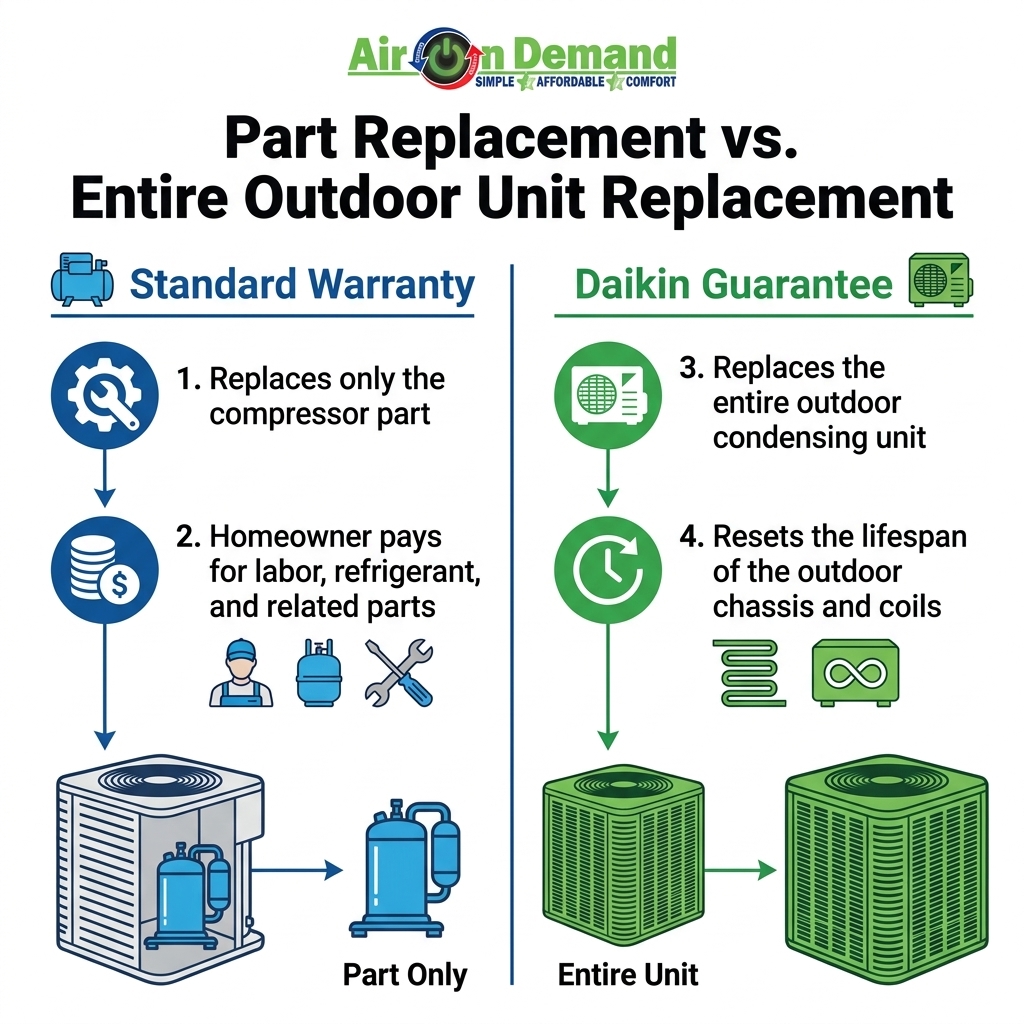
A standard compressor warranty is a "parts-only" agreement. It legally covers the physical, uninstalled compressor unit sitting in a supply house—and absolutely nothing else. The manufacturer provides the metal box containing the motor, but the homeowner is entirely responsible for the complex labor required to install it. Replacing a compressor is one of the most labor-intensive jobs in the HVAC industry. A professional technician must recover the existing refrigerant, use a torch to cut out the dead compressor, weld the new compressor into place, replace the liquid line filter drier, pull a deep vacuum on the entire system to remove moisture, and then weigh in fresh refrigerant. You are responsible for the labor hours, the brazing materials, the recovery process, and the costly new refrigerant required to get the system running again.
Beyond the immediate labor expenses, there is a severe mechanical downside to this approach. When you install a brand-new compressor under a standard warranty, you are putting a pristine, high-performance motor into an aging, degraded chassis. In Miami coastal and high-humidity zones, the surrounding components—such as the condenser coil, the fan motor, the contactor, and the aluminum fins—are likely already suffering from environmental wear and tear by the time the original compressor fails. The new compressor is forced to push refrigerant through a coil that may be partially corroded or inefficient, which immediately puts excess strain on the new part.
This parts-only approach leaves the rest of the outdoor unit highly vulnerable to subsequent failures. You might successfully replace the compressor this season, only to have the condenser fan motor burn out or the outdoor coil spring a massive refrigerant leak next season. A standard warranty fixes the immediate symptom but ignores the overall health of the aging outdoor unit, forcing you into a cycle of ongoing repairs.
Daikin recognized the mechanical flaws of putting new parts into old, degrading outdoor units. To provide a higher level of protection for homeowners investing in high-efficiency systems, they introduced a premium warranty tier that fundamentally changes how major failures are handled.
The Daikin Unit Replacement Guarantee is available on select high-efficiency models and operates on a simple but powerful premise: if the compressor fails within the specified guarantee period, the manufacturer does not just send a replacement part. Instead, the homeowner receives a completely new outdoor condensing unit. This completely bypasses the mechanical mismatch of pairing a new motor with an old coil.
Here is how the process typically works when a failure occurs during an August late-summer heat wave:
1. Professional Diagnosis: A certified HVAC technician inspects the system, performs electrical and mechanical tests, and officially condemns the compressor.
2. Warranty Verification: The technician verifies the system's serial numbers to confirm the Unit Replacement Guarantee is active and valid.
3. Equipment Order: Instead of ordering a bare compressor, the local dealer orders a factory-fresh outdoor unit that perfectly matches your indoor air handler.
4. Clean Installation: The technicians remove the entire old outdoor chassis and install the new one. This is a much cleaner, faster process than field-welding a new compressor into an old box.
The long-term value of this guarantee is immense. By replacing the entire outdoor unit, you are effectively resetting the lifespan of the outdoor system. You get a new coil, a new fan motor, new electrical contactors, and a pristine chassis. To ensure you have comprehensive coverage for the installation process itself, it is highly recommended to explore Daikin extended labor warranties, which can cover the technician's time during the unit swap.
It is important to note that this premium coverage requires action on the homeowner's part. To activate the Unit Replacement Guarantee, the equipment must typically be registered with the manufacturer within 60 days of the original installation. Failing to register the equipment often causes the warranty to revert to a standard parts-only policy.
When faced with a major system failure in Miami coastal and high-humidity zones, seeing the direct mechanical comparison makes the decision much clearer. Here is exactly how a standard compressor warranty compares to a Unit Replacement Guarantee.
• Physical Outcome — Standard Compressor Warranty (Part Only): A brand-new compressor installed inside an old, degrading metal chassis with aging coils. — Daikin Unit Replacement Guarantee: A factory-fresh outdoor unit, including a new cabinet, coils, fan motor, and compressor.
• Labor Intensity — Standard Compressor Warranty (Part Only): Extremely high. Requires cutting, brazing, vacuuming, and extensive field labor. — Daikin Unit Replacement Guarantee: Moderate. Involves disconnecting the old unit and setting a new, factory-sealed unit in place.
• System Reliability — Standard Compressor Warranty (Part Only): Low to Moderate. The new compressor is bottlenecked by the wear and tear on the old condenser coil. — Daikin Unit Replacement Guarantee: Maximum. Factory reliability is completely restored with matched, brand-new components.
• Adjacent Part Risk — Standard Compressor Warranty (Part Only): High. The fan motor, contactor, or coils could fail weeks or months later. — Daikin Unit Replacement Guarantee: Eliminated. All outdoor components are brand new and reset to day-one condition.
• Long-Term Value — Standard Compressor Warranty (Part Only): A temporary fix that extends the life of a declining system. — Daikin Unit Replacement Guarantee: A permanent resolution that resets the lifespan of the outdoor equipment.
Understanding the difference between these two warranty types is especially critical when you factor in regional climate extremes. In our extensive experience handling AC installation and maintenance across Miami, we've seen firsthand how our continuous high-heat and humid coastal environment subjects your air conditioning system to workloads that systems in milder climates never experience. This relentless environment dictates whether repairing vs. replacing your AC is a viable mechanical choice.
Continuous High-Heat Workloads: During the peak of summer, your compressor runs almost continuously to remove heat and humidity from your home. This does not just wear out the compressor motor; it wears out everything simultaneously. The contactor that sends voltage to the compressor arcs and pits with every cycle. The condenser fan motor bearings slowly dry out from the intense heat radiating off the coils. By the time the compressor finally gives out, the surrounding parts are usually on their last legs as well.
Salt Air Corrosion: Miami coastal and high-humidity zones present a unique threat: salt air. Airborne salt is highly corrosive to the aluminum fins and copper tubing that make up your outdoor condenser coil. Over several years, this galvanic corrosion literally eats away the thin metal fins, significantly reducing the coil's ability to reject heat into the outside air. The metal chassis itself may begin to rust and degrade.
The Inefficiency of Mismatched Parts: If you use a standard warranty to put a pristine new compressor into a salt-corroded coil system, you are setting the new part up for failure. A degraded coil cannot dissipate heat efficiently, which forces the new compressor to operate at higher pressures and temperatures than it was designed for. This drastically reduces the efficiency of the new part and shortens its lifespan. Because regional climate extremes accelerate wear on the entire outdoor unit simultaneously, the Unit Replacement Guarantee becomes exceptionally valuable. It allows you to discard the corroded, inefficient coil and start fresh, ensuring your new compressor operates in an optimal, factory-clean environment.
When a compressor fails during August late-summer heat, many homeowners wonder if they can simply buy a new outdoor condenser unit while keeping their older indoor air handler to save on costs. While this sounds like a logical workaround, it introduces severe mechanical and warranty complications.
Air conditioning systems are engineered to operate as matched pairs. The outdoor condenser and the indoor evaporator coil are designed to move a specific volume of refrigerant at specific pressures to achieve their rated SEER (Seasonal Energy Efficiency Ratio). If you attempt to connect a modern, high-efficiency outdoor unit to an older, less efficient indoor coil, the system will not perform correctly. The indoor coil will likely be too small to handle the refrigerant flow of the new outdoor unit, leading to poor humidity removal, frozen coils, and premature compressor failure.
The HVAC industry has undergone significant regulatory changes regarding refrigerants. Older systems utilized R-22, which has been completely phased out, while most current systems use R-410A (and the industry is currently transitioning to newer A2L refrigerants). You absolutely cannot connect an outdoor unit designed for one type of refrigerant to an indoor coil designed for another. The oils are incompatible, and the operating pressures are vastly different. Doing so will destroy the new compressor almost immediately.
Manufacturer warranty policies, including Daikin's, are very strict about matched systems. To qualify for premium coverage tiers like the Unit Replacement Guarantee, the outdoor unit and the indoor unit must be an AHRI-certified matched system. If you attempt to replace just the AC condenser and pair it with an incompatible or third-party indoor coil, the manufacturer will likely void the warranty entirely. If you are dealing with a failed system and want the flexibility of zoned cooling without extensive ductwork matching, exploring ductless mini split systems is often a smarter route than trying to cobble together mismatched traditional components.
Premium warranty coverage is only as reliable as the technicians who install the equipment. It is a common misconception that manufacturer warranties are unconditional. In reality, warranties—including the Daikin Unit Replacement Guarantee—can be easily voided by improper installation or neglect.
Strict Manufacturer Specifications: HVAC manufacturers engineer their equipment to operate under specific parameters. If an installer cuts corners, the warranty is at risk. Proper installation requires exact refrigerant charging; if a system is overcharged or undercharged, the compressor will suffer liquid slugging or overheating, and the manufacturer will deny the warranty claim. Adequate airflow is equally critical. If the ductwork is undersized or the indoor blower speed is set incorrectly, the system will suffocate, leading to premature failure that is not covered by the factory.
The Necessity of Routine Maintenance: Beyond the initial installation, homeowners must uphold their end of the warranty agreement through documented routine maintenance. Manufacturers require proof that the system has been regularly serviced by a licensed professional. Skipping annual tune-ups allows dirt to clog the coils and electrical components to weaken, causing preventable breakdowns that void coverage.
The Value of Local Expertise: This is why working with certified local technicians is non-negotiable. Our team at Air On Demand has spent years mastering Daikin equipment, ensuring that every AC installation meets strict manufacturer standards so your warranties remain fully valid. We understand the specific demands of Miami coastal and high-humidity zones, and we meticulously size, install, and commission every system to protect your investment. A premium warranty is a powerful shield against unexpected costs, but only if the equipment is installed by professionals who respect the manufacturer's engineering standards.
When the August late-summer heat is pushing your air conditioner to its absolute limits, you need to know that your system is backed by coverage that actually protects your home. Investing in equipment backed by a Unit Replacement Guarantee offers vastly superior protection against major failures compared to standard industry warranties.
The mechanical advantage is clear: receiving a completely new outdoor unit eliminates the risks of putting a new compressor into a degraded, salt-corroded chassis. It restores factory reliability, ensures optimal efficiency, and prevents a domino effect of adjacent part failures. A standard parts-only warranty may sound reassuring, but it often leaves homeowners burdened with significant labor expenses and an aging system that will inevitably break down again.
Before peak temperatures arrive and put maximum strain on your cooling equipment, take the time to evaluate your current system's age, performance, and warranty status. If your system is aging out of its coverage window, now is the time to explore high-efficiency replacements that offer total peace of mind. Secure your long-term comfort today by exploring our premium Daikin Fit systems and experience the difference that true manufacturer backing can make.
The Daikin Unit Replacement Guarantee is a premium warranty tier available on select high-efficiency models. If the compressor fails within the specified guarantee period, Daikin provides a completely new outdoor condensing unit rather than just a replacement compressor part. This ensures the new compressor operates in a factory-fresh chassis with brand-new coils and electrical components.
No, standard manufacturer warranties across the HVAC industry typically only cover the cost of the uninstalled replacement part. The homeowner is responsible for all labor costs associated with diagnosing the failure, removing the old part, installing the new component, and recharging the system with refrigerant. Extended labor warranties must usually be purchased separately through the installing dealer.
Daikin ductless mini split systems often come with up to a 12-year parts limited warranty when properly registered. This extensive coverage protects the major internal components of both the indoor air handlers and the outdoor condenser. Unregistered equipment typically defaults to a much shorter 5-year parts warranty.
Yes, registration is strictly required to activate maximum warranty benefits. Homeowners must register their new Daikin equipment online within 60 days of the installation date. If the equipment is not registered within this window, the warranty coverage usually reverts to a standard 5-year base policy.
Manufacturer warranties can be voided by improper installation, lack of documented annual maintenance, or the use of unapproved third-party replacement parts. Additionally, pairing a new outdoor unit with an incompatible or uncertified indoor coil will typically void the warranty immediately, as the system must operate as an AHRI-matched pair to meet engineering standards.