Identifying the Source of a Burning Smell When Turning on the Heater in Miami
October 11, 2026
Late October or November arrives, and with it comes the first real chill of the season, prompting you to finally switch your thermostat over to "heat." But within minutes, a strong, alarming odor fills the house. Identifying the source of a burning smell when turning on the heater in Miami is a critical step for any homeowner experiencing that sudden moment of panic. You are immediately faced with a crucial decision: is this just a harmless seasonal burn-off, or are you dealing with a dangerous electrical fire? When the temperature drops and the heater kicks on for the first time in nearly a year, that pungent scent is enough to make anyone rush to the thermostat in fear.
Before you assume the worst, it helps to understand exactly what happens inside your system during that October/November first heater startup. The sudden transition from cooling to heating awakens components that have been sitting completely dormant. However, safety must always come first. If you determine the situation is unsafe, you can always rely on professional HVAC repair and emergency AC and heating repair in Miami to resolve the issue safely and swiftly.
The panic you feel is entirely justified. We are conditioned to associate burning smells with immediate danger, especially inside our homes. When you smell something burning near an appliance, your instincts tell you that something is actively catching fire. In South Florida, this anxiety is compounded by the fact that heating systems are rarely used, making the sudden odor feel highly abnormal. However, knowing the mechanics behind this seasonal phenomenon is the key to differentiating between a normal maintenance quirk and a genuine hazard that requires immediate professional intervention.
Most homes in South Florida do not rely on traditional gas furnaces, which are far more common in northern, colder climates. Instead, Miami homeowners typically use heat pumps equipped with electric heat strips, or straight cool air conditioners paired with electric heating elements. These heat strips function very much like the glowing coils inside a toaster. When activated, electricity flows through the metal elements, generating intense heat that the blower motor then pushes through your ductwork and into your living spaces.
Because our winters are so mild, these heating elements sit entirely dormant for the vast majority of the year. During those 10+ months of idle dust accumulation on heat strips, a thick layer of airborne particulates settles directly onto the metal components. Every time your air conditioner runs during the long summer, tiny particles of dust, pet dander, dead skin cells, and microscopic debris bypass the filter and find a resting place on the inactive heating coils.
Miami's unique climate makes this dust accumulation significantly worse than in other parts of the country. With our high average humidity—often hovering at 70% or higher for months on end—the airborne dust does not just settle lightly. The moisture in the air causes the particulates to clump together and stick stubbornly to the idle heat strips. It forms a dense, caked-on layer rather than a light dusting.
When you finally turn the heat on, those metal strips rapidly heat up to hundreds of degrees. The caked-on layer of clumped dust is instantly incinerated. This rapid incineration is exactly what creates that harsh, burning smell. Because the dust layer is so thick from the humidity, the resulting odor is much stronger and more pungent than what homeowners in dry climates experience. This is why testing your heat strips before a cold snap is such a valuable practice; it allows you to manage this inevitable burn-off safely and on your own terms, rather than being caught off guard on the first truly cold night.
When you are trying to determine if your system is safe, time is your best diagnostic tool. The HVAC industry has a standard baseline for how long this normal dust burn-off should last. When you initiate that October/November first heater startup, the harmless burning dust odor typically dissipates within a very specific window.
1. The initial blast (0 to 5 minutes): This is when the smell will be at its absolute strongest. The heat strips have just reached their maximum temperature, and the thickest layers of accumulated dust are burning away all at once. The odor will quickly spread through the vents into every room.
2. The fading phase (5 to 15 minutes): As the primary layer of dust is incinerated, the smell should noticeably begin to weaken. You will still smell it in the air, but the intensity coming directly from the vents should drop significantly.
3. The clear-out (15 to 20 minutes): By the twenty-minute mark, the heat strips should be completely clean. The odor coming from the vents should be gone, though a faint, lingering scent may remain in the ambient air of your home for a short while longer.
The quick fix: If the smell is strong but clearly resembles dusty, stale air or singed lint, simply open a few windows slightly to ventilate the home. Monitor the system closely during this initial 20-minute startup period. Do not leave the house or go to sleep while the heater is running for the first time. As long as the smell steadily decreases in intensity and vanishes within that 20-minute window, your system is functioning exactly as it should after a long summer.
While burning dust is harmless, an electrical short is a severe hazard that requires immediate action. To keep your home safe, you must learn to contrast the normal dust smell with dangerous electrical odors. Unlike the temporary odor of 10+ months of idle dust accumulation on heat strips burning away, an electrical malfunction has a very distinct, chemical scent that will not fade over time.
An electrical short, melting wire insulation, or a failing blower motor produces an acrid, sharp odor. It often smells like melting plastic, burning rubber, pungent sulfur, or a distinct "fishy" ozone scent. Furthermore, this smell will not dissipate after 20 minutes; in fact, as the electrical component continues to overheat or melt, the smell will grow progressively stronger and more toxic.
An electrical emergency rarely happens in silence. In addition to the chemical odor, you should listen and watch for secondary warning signs. Unusual sounds, such as loud buzzing, aggressive humming, or sudden popping noises coming from the air handler, strongly indicate electrical arcing or a seized motor. You may also notice your interior lights flickering when the system attempts to run, or you might find that the HVAC system is repeatedly tripping your circuit breaker. High-humidity corrosion over the summer can easily degrade wiring connections, leading to these exact types of electrical failures when the system is suddenly forced to draw heavy power for heating.
• Smell Profile — Harmless Dust Burn-Off: Singed lint, stale air, dusty — Dangerous Electrical Emergency: Melting plastic, ozone, sulfur, acrid
• Duration — Harmless Dust Burn-Off: Fades steadily within 10 to 20 minutes — Dangerous Electrical Emergency: Persists indefinitely and grows stronger
• Associated Sounds — Harmless Dust Burn-Off: Normal, smooth blower fan operation — Dangerous Electrical Emergency: Unusual buzzing, humming, or popping
• Electrical Impact — Harmless Dust Burn-Off: System runs normally without interruption — Dangerous Electrical Emergency: May cause tripping breakers or flickering lights
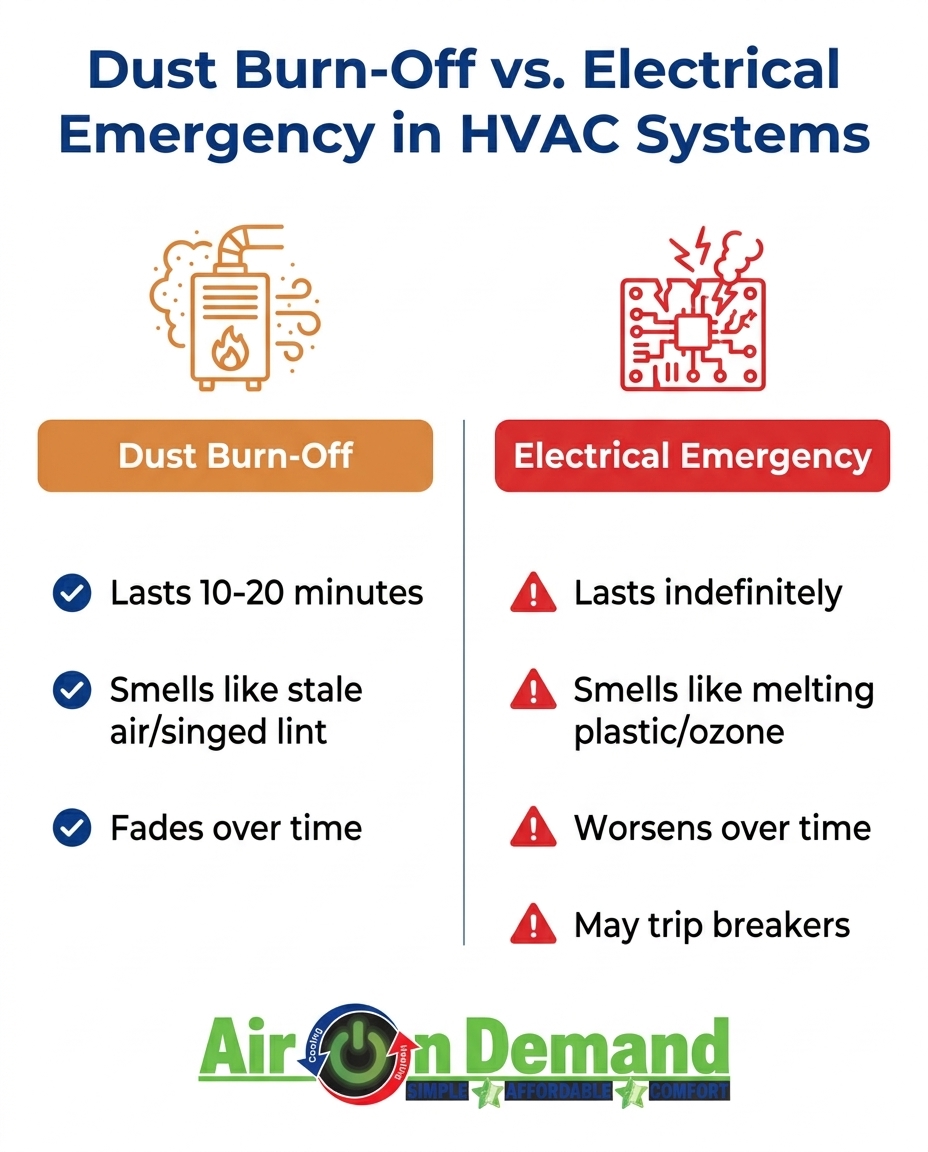
If the odor during your October/November first heater startup crosses that 20-minute threshold, or if it immediately smells like melting plastic and ozone rather than dusty lint, you must treat the situation as an active electrical hazard. Taking swift, decisive action can prevent a minor wiring short from escalating into a devastating house fire.
1. Turn off the thermostat immediately: Do not wait to see if the smell goes away. Walk straight to your thermostat and switch the system from "Heat" to the "Off" position. This stops the thermostat from calling for more heating power.
2. Shut off the breaker to the HVAC system: To completely cut power and eliminate the fire risk, locate your home's main electrical panel. Find the breaker clearly labeled for the HVAC system, air handler, or heat pump, and flip it to the "Off" position. This ensures no residual electricity is flowing to a potentially melting wire.
3. Do not attempt DIY electrical diagnostics: Never open the air handler cabinet to investigate the wiring yourself. High-voltage electrical components can retain a lethal charge even after the breaker is flipped. There are no safe DIY repairs for an active electrical short in an HVAC system.
4. Call a professional for immediate inspection: Reach out to local experts right away. Working with Air On Demand means you benefit from fast emergency response and a deep knowledge of South Florida HVAC systems. Local technicians understand exactly how our coastal humidity degrades wiring and can safely resolve electrical hazards, restoring your peace of mind.
By following these steps, you remove the fuel—electricity—from the potential fire, keeping your home and family completely safe while you wait for a qualified technician to arrive and assess the damage.
The best way to handle the panic of a burning smell is to prevent it from happening in the first place. You do not have to accept the harsh odor of 10+ months of idle dust accumulation on heat strips as an inevitable part of winter. By shifting your focus from emergency response to proactive prevention, you can ensure your heater starts up cleanly and safely every single year.
Routine maintenance removes the fuel for the burning smell before the heat strips are ever turned on. During a thorough tune-up, a technician will open the air handler and physically clean the heating elements, the blower motor, and the surrounding cabinet. By carefully wiping away the thick, clumped layers of humidity-caked dust, they eliminate the material that causes the harsh burn-off odor. When you finally turn the heat on, the clean metal elements heat up without incinerating any debris, resulting in warm, odorless air.
• Change your air filters early: Before the first cold snap arrives, replace your HVAC filter. A fresh, clean filter improves airflow and drastically reduces the amount of dust circulating through the home and settling on the heating components.
• Schedule proactive service: By scheduling routine HVAC maintenance before the late fall temperature drop, you ensure your system is prepped and ready for the sudden change in weather.
• Catch electrical vulnerabilities: Professional inspections do more than just clean away dust. Technicians will test electrical connections, measure voltage, and look for signs of summer corrosion. This allows them to catch frayed wires and failing capacitors before they become active fire hazards during a cold night.
A heater should only smell like burning for 10 to 20 minutes during its initial use. This brief window allows the accumulated dust on the heat strips to safely incinerate and clear out of the system. If the smell persists beyond 20 minutes, it is no longer a normal burn-off and requires immediate attention. Always monitor the system closely during this initial timeframe.
An electrical fire typically smells like melting plastic, pungent sulfur, burning rubber, or a sharp, chemical ozone scent. Unlike the smell of burning dust, which resembles stale air or singed lint, an electrical odor is harsh and highly toxic. Furthermore, an electrical smell will grow stronger the longer the system runs, rather than fading away.
Yes, it is perfectly normal for a brief period during your October/November first heater startup. Because the heat strips sit idle for most of the year, they collect a thick layer of dust that must burn off when activated. As long as the odor dissipates within 20 minutes and does not smell like melting plastic, it is a standard part of seasonal HVAC operation.
A burning plastic odor usually indicates a serious electrical malfunction, such as melting wire insulation, a failing capacitor, or an overheating blower motor. This is never a normal smell and should be treated as an immediate fire hazard. Shut off your thermostat and the circuit breaker to the HVAC system right away, and contact a professional technician.
Yes, high humidity causes airborne dust to clump together and stick much more stubbornly to idle heating components. In coastal climates like Miami, this creates a thicker, denser layer of debris on the heat strips compared to dry regions. When this thick layer finally burns off, the resulting odor is noticeably stronger and more pungent.
Opening windows is a great way to ventilate the harmless dust odor during the initial startup. Cracking a few windows allows the singed, dusty air to escape the house quickly, minimizing discomfort. Once the 20-minute burn-off window has passed and the smell is gone, you can close the windows and enjoy the clean, warm air.
Navigating the sudden drop in temperature shouldn't come with a side of panic. By understanding the clear guidelines for your system's operation, you can stay comfortable without fear. Remember the golden rule: the harmless smell of 10+ months of idle dust accumulation on heat strips will steadily fade within 10 to 20 minutes. Conversely, any scent of melting plastic, sulfur, or an odor that persists indefinitely is a clear signal to shut the system down immediately at the breaker.
Knowing the difference between these two scenarios keeps your family safe and prevents unnecessary panic during a chilly evening. You do not have to guess whether your system is functioning properly. Identifying the source of a burning smell when turning on the heater in Miami is much easier when you know exactly what to look and listen for. If you ever remain unsure about your system's safety, or if you want to skip the dusty burn-off entirely with a pre-season cleaning, reach out to local experts to explore your service options and ensure a worry-free winter.