Upgrading to a Daikin Inverter System vs. Replacing Your Single-Stage Condenser
October 10, 2026
If you are debating the choice of upgrading to a Daikin Inverter System vs. replacing your single-stage condenser, you might believe the common myth that simply swapping out that noisy metal box in your yard will automatically cure a sticky, uncomfortable home. Many homeowners assume that a new outside unit equals better cooling. While a fresh condenser will certainly blow cold air, raw temperature control is only half the battle when you live in a coastal climate. The real challenge is managing the heavy moisture lingering in your indoor air.
For comprehensive guidance on navigating these choices, exploring professional AC installation and replacement is the best first step.
The frustration usually peaks during Miami's muggy fall / October timeframe. The intense heat of summer begins to back off slightly, but the oppressive moisture in the air does not. You might notice that your thermostat reads a perfectly reasonable 74 degrees, yet your skin feels clammy, the floors feel slightly slick, and the air feels heavy. This specific discomfort happens because your cooling system is failing to extract moisture. When making your replacement decision, understanding how different technologies handle this exact problem is critical. Choosing between a standard single-stage unit and an advanced inverter-driven system comes down to how well they manage water, not just how well they manage heat.
To understand why your house feels like a refrigerator but still feels stuffy, you have to look at the two distinct jobs your air conditioner performs: sensible cooling and latent cooling. Sensible cooling is the process of lowering the actual temperature of the air—the number you see dropping on your thermostat. Latent cooling, on the other hand, is the process of extracting humidity from that air. A truly comfortable home requires a precise balance of both.
Human beings perceive comfort through a combination of temperature and humidity. Our bodies cool themselves by sweating; when the indoor humidity is too high, that sweat cannot evaporate. As a result, a room sitting at 74 degrees with 70% humidity will feel significantly warmer and vastly more uncomfortable than a room sitting at 76 degrees with 45% humidity.
This balance becomes extremely difficult to maintain during seasonal shifts. In Miami FL, average relative humidity often stays above 70% deep into the fall. Because the outdoor temperature has dropped slightly from the summer peak, your air conditioner does not need to run very long to satisfy the thermostat's temperature setting. It blasts cold air, hits 74 degrees quickly, and shuts off. However, the latent heat load—the humidity—remains aggressively high.
When your system fails to provide adequate latent cooling, the consequences go beyond just physical discomfort. Poor moisture removal severely diminishes your indoor air quality. High indoor humidity creates an ideal breeding ground for dust mites, encourages mold and mildew growth inside your ductwork, and can cause wood floors and cabinetry to swell. Mastering latent cooling is essential for protecting both your comfort and your property.
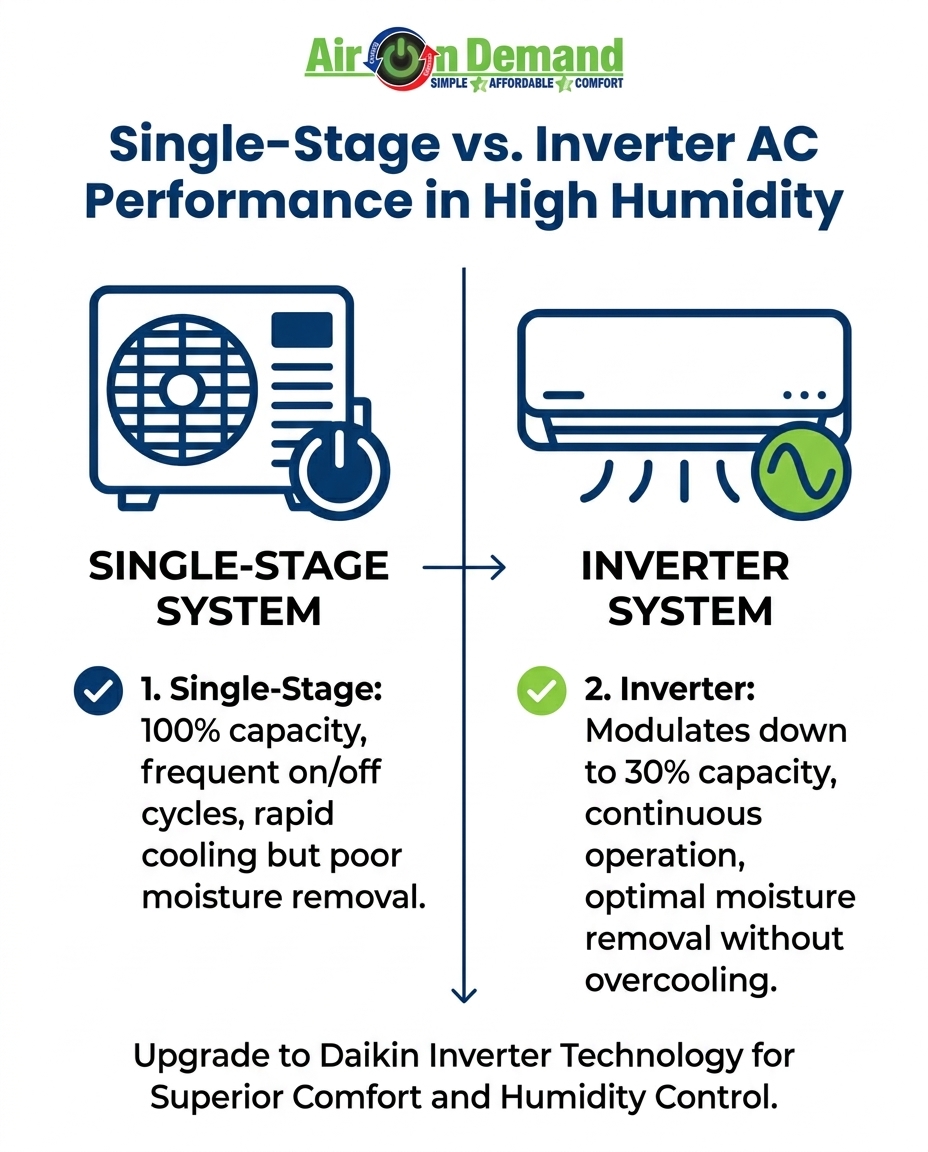
The root cause of poor humidity control usually traces back to the mechanical limitations of traditional cooling equipment. Standard single-stage compressors operate at exactly 100% capacity whenever they are turned on. There is no middle ground, no low gear, and no cruising speed. They are either running at full blast or completely completely shut off.
This all-or-nothing operation leads directly to a phenomenon known as "short-cycling" during milder weather. Because the system pushes out its maximum cooling capacity, it rapidly drops the indoor temperature to match the thermostat setting. The unit then abruptly powers down. In the middle of summer, this isn't always a problem because the intense heat forces the system to run for long stretches anyway. But in milder, highly humid conditions, the system runs in short bursts.
Many homeowners ask if they can solve their comfort issues by just swapping out the broken outdoor unit while keeping the indoor equipment. If you are exploring AC replacement services, it is vital to know that a basic single-stage condenser swap won't change this fundamental operational flaw. A new single-stage unit will still operate at 100% capacity, and it will still short-cycle when the weather is mild but muggy. Furthermore, this constant starting and stopping puts immense mechanical wear and tear on electrical components like contactors and capacitors, shortening the lifespan of the equipment.
The physics of dehumidification require time. Inside your home, warm air blows over the cold evaporator coil. For moisture to be removed from the air, the coil must get extremely cold, and the air must pass over it long enough for condensation to form—much like water droplets forming on the outside of a cold glass of iced tea on a summer afternoon. Those droplets then fall into a drain pan and are channeled out of your house.
The time factor: It typically takes a standard air conditioner about 10 to 15 minutes of continuous running just for the indoor coil to get cold enough to start wringing meaningful amounts of water out of the air.
The short-cycle failure: If your single-stage system blasts the house with cold air and satisfies the thermostat in just 8 minutes, it shuts down before the dehumidification process ever really gets going. The result is cold, stagnant, humid air circulating endlessly through your living spaces.
The solution to the short-cycling trap lies in variable-speed modulation. Unlike a single-stage system that operates like a light switch (only on or off), an inverter-driven compressor operates more like the gas pedal in your car. It constantly adjusts its speed and cooling output to exactly match the real-time demands of your home.
When the system first turns on, it may ramp up to full capacity to quickly bring the temperature down. But once it nears the target temperature, the inverter technology allows the compressor to seamlessly ramp down to 30% capacity or even lower. Instead of shutting off entirely, it continues to run at a very low, ultra-efficient speed.
This "continuous run" capability is the ultimate weapon against indoor humidity. Because the system is running constantly at a low speed, indoor air is continuously circulating over the cold evaporator coil. This maximizes moisture extraction without overcooling the room. The system wrings out the humidity hour after hour, creating a perfectly balanced, dry, and comfortable environment.
As specialized local experts, Air On Demand leverages the Daikin Inverter System to solve the specific climate challenges of South Florida. We understand that aggressive latent cooling is non-negotiable here. By utilizing inverter technology, we help homeowners eliminate the temperature swings and sticky air that traditional systems leave behind. If you want to dive deeper into the mechanics of these advanced units, learning about inverter-driven compressors vs. two-stage systems can clarify exactly how this modulation works to protect your indoor air quality.
While mastering humidity is the primary reason to upgrade, premium inverter systems offer several secondary benefits that dramatically improve your day-to-day experience at home. When you move away from the aggressive on/off cycles of standard equipment, you gain advantages in acoustics, footprint, and longevity.
• Whisper-quiet operation: Standard condensers are notorious for the loud "clunk" they make when the compressor kicks on at 100% capacity. Because inverter systems gradually ramp up their speed and spend most of their time operating at a low hum, they generate significantly lower decibel levels. You can easily hold a conversation on your patio right next to the running unit.
• Space-saving side-discharge designs: Many inverter models feature a slim, side-discharge cabinet rather than the traditional bulky cube that blows air upward. This narrow footprint is ideal for zero-lot-line homes, tight side yards, or placement under low overhangs where standard units simply won't fit or breathe properly.
• Reduced mechanical stress: The hardest part of an air conditioner's job is starting up. Pulling the massive amount of electricity required to jump-start a single-stage compressor from zero to 100% generates heat and wear. Continuous, low-speed operation eliminates these harsh electrical surges, reducing stress on the internal components over the lifespan of the unit.
To help clarify the core differences, here is a direct comparison of how these two approaches handle the realities of high latent heat conditions.
• Humidity Control — Standard Single-Stage Condenser: Poor during mild weather; frequent short cycles fail to extract moisture. — Advanced Inverter Upgrade: Excellent; continuous modulation wrings out moisture without overcooling.
• Run Times — Standard Single-Stage Condenser: Frequent, abrupt on/off cycles (100% or 0%). — Advanced Inverter Upgrade: Long, steady, continuous operation at low speeds (down to 30%).
• Noise Levels — Standard Single-Stage Condenser: Noticeable start-up "clunk" and loud operation. — Advanced Inverter Upgrade: Whisper-quiet, gradual ramping up and down.
• Efficiency — Standard Single-Stage Condenser: Standard SEER ratings; high energy spikes at every start-up. — Advanced Inverter Upgrade: High-efficiency operation; sips electricity by avoiding constant restarts.
Making the right choice for your home involves looking past the initial installation day. It is true that upgrading to a fully modulating inverter system requires a higher initial investment than simply swapping a standard condenser for another basic model. However, evaluating the return on that investment requires looking at the total impact on your home environment and your monthly utility usage.
The value of an inverter system is realized every single day through the complete elimination of humidity issues and superior daily comfort. Furthermore, because inverter compressors sip electricity at lower speeds rather than demanding massive power surges to start up repeatedly, they offer significantly lower month-to-month energy consumption. When you are repairing vs replacing your AC, factoring in these long-term operational savings is crucial.
Additionally, high-efficiency inverter systems frequently qualify for general energy efficiency rebates or federal tax credits designed to incentivize energy conservation. While you should always verify current local utility programs and consult a tax professional for the latest guidelines, these incentives can help offset the initial upgrade costs. Ultimately, for homes struggling with latent heat and sticky air, the premium technology pays immense dividends in quality of life, superior indoor air quality, and extended system longevity.
While it is physically possible to just swap the outside box, it is rarely recommended and won't solve underlying humidity problems. An air conditioning system is designed as a matched set; pairing a new outdoor condenser with an old indoor air handler severely impacts efficiency, compromises moisture removal, and can significantly shorten the lifespan of the new equipment.
Yes, an inverter AC provides vastly superior dehumidification. Because it can modulate its capacity and run continuously at lower speeds, it gives the indoor evaporator coil much more time to pull moisture from the air, preventing the cold and clammy feeling associated with traditional units.
This happens when your AC cools the air too quickly (sensible cooling) but shuts off before extracting the humidity (latent cooling). The system satisfies the thermostat's temperature setting but leaves high levels of moisture trapped in your indoor air.
A single-stage AC runs at 100% capacity or 0%, meaning it is either fully on or fully off. An inverter AC modulates its compressor speed—much like a car's gas pedal—allowing it to run continuously at lower capacities to maintain exact temperatures and remove humidity.
For regions with high humidity and long cooling seasons, the dramatic improvement in daily comfort, indoor air quality, and energy efficiency makes it a highly valuable upgrade. It eliminates the sticky, clammy feeling that basic systems leave behind during milder weather.
True indoor comfort requires mastering both the temperature and the humidity inside your living spaces. Settling for a basic condenser replacement often means settling for the exact same sticky, clammy environment you are trying to escape. By choosing an advanced solution like the Daikin Inverter System, you ensure that your home remains perfectly dry, quiet, and consistently cool, regardless of how muggy it gets outside.
You don't have to live with a home that feels like a damp cave. Take the time to explore advanced solutions tailored to the specific profile of your house. To review your options and see how upgrading to a Daikin Inverter System vs. replacing your single-stage condenser can transform your daily comfort, schedule a consultation with our team to learn more about Daikin Fit systems in Miami today.