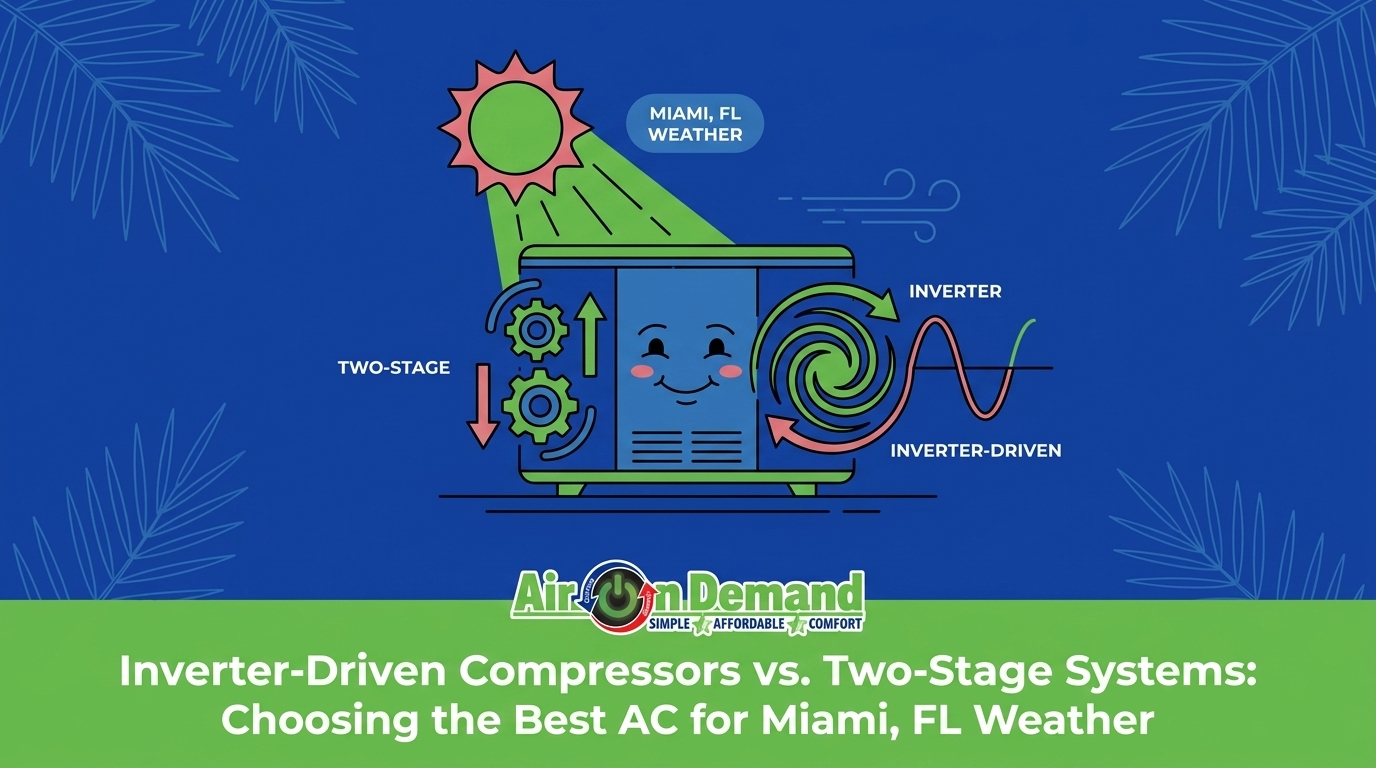
Inverter-Driven Compressors vs. Two-Stage Systems for Miami Weather
September 23, 2026
Have you ever walked into your living room on a muggy early fall afternoon, checked the thermostat to confirm it reads a cool 73 degrees, but still felt a sticky, clammy chill in the air? When evaluating Inverter-Driven Compressors vs. Two-Stage Systems for Miami Weather, the choice often comes down to solving that exact discomfort. During the early fall, South Florida enters a very specific weather pattern where the intense, blistering heat of summer backs off, but the heavy moisture in the air remains.
If you are exploring new AC units, comparing standard models against advanced Daikin Fit inverter systems is the best place to start. Making the right choice now ensures your home stays comfortable regardless of what the forecast throws your way.
To understand why your home feels this way, we have to look at the September transition (high humidity, lower sensible heat load). At Air On Demand, when our technicians evaluate Miami homes during this transition, we measure two types of heat: sensible heat and latent heat. Sensible heat is the actual temperature you read on a thermometer. Latent heat is the moisture suspended in the air—the humidity that makes a 75-degree day feel suffocating.
During peak summer, both sensible and latent heat are extremely high. Your air conditioner runs constantly to battle the high temperatures, and because it runs for long periods, it naturally pulls a massive amount of moisture out of the air. However, as we move into September, the sensible heat drops. It might only be 78 degrees outside, but the humidity is still hovering around 80 percent.
Because Miami's subtropical climate means homes require significantly longer AC run cycles to dehumidify without freezing out the occupants, this seasonal shift exposes the limitations of older cooling technology. Your system doesn't need to run very long to cool the house down to your set temperature, but it shuts off long before it has a chance to extract the heavy moisture. You are left deciding between a fully variable inverter vs. a two-stage compressor to solve this specific, deeply uncomfortable climate challenge.
The situation described above is what HVAC professionals call a "part-load" condition. A full-load condition happens on the hottest day of the year when your system needs every ounce of its cooling capacity just to keep up. A part-load condition occurs when your home only requires a fraction of that cooling power to lower the indoor temperature, yet still desperately needs the system to run in order to extract moisture.
Our AC repair and installation teams at Air On Demand see these conditions frequently across Miami coastal and inland residential zones. In fact, for a large portion of the year outside of the peak summer months, your air conditioner is operating under part-load demands. Overcast days, rainy afternoons, and early mornings all present scenarios where the temperature is relatively mild, but the air is thick with humidity.
The mechanics of moisture removal: Your air conditioner does not act like a sponge. Instead, it removes humidity by passing warm, moist indoor air over a freezing cold set of indoor coils (the evaporator coil). As the warm air hits the cold metal, condensation forms—just like water droplets forming on the outside of a cold glass of iced tea. That condensation drips into a pan and drains outside. However, this process takes time. The air has to pass over the coils continuously for the system to wring out enough moisture to make a difference.
When standard systems face part-load conditions, they fall into the over-cooling trap. Because they only know how to blast cold air at maximum speed, they drop the indoor temperature incredibly fast. The thermostat senses that the target temperature has been reached and shuts the system down.
The result? The house is cold, but the moisture was never removed. To combat this clammy feeling, many homeowners turn the thermostat down even lower, forcing the system to run longer. This leads to a house that is uncomfortably frigid, wasting energy while failing to address the root cause. This is why reviewing humidity control tips for South Florida homeowners always brings the conversation back to how your compressor technology dictates your indoor climate.
For decades, the standard air conditioner only had one speed: full blast. Whenever it turned on, it ran at 100 percent capacity, regardless of whether it was 95 degrees outside or 75 degrees outside. Upgrading to a two-stage compressor was a massive leap forward in home comfort technology.
A two-stage compressor is designed to operate at two distinct speeds, providing a step-down approach to cooling your home. Here is how it generally functions:
1. High Stage (100% Capacity): On blistering summer afternoons, the system runs at full capacity to quickly remove intense heat and keep the home comfortable.
2. Low Stage (65% to 70% Capacity): On milder days, or once the initial heat has been removed, the system drops down to a lower gear. It uses less electricity and blows a gentler stream of cool air.
This stepped-down capacity is a vast improvement over older single-stage systems. By running at 65 percent capacity, the system runs longer than a single-stage unit would, allowing more air to pass over the cold evaporator coils, which in turn removes more humidity.
While a two-stage system is excellent for general cooling, it still has limitations when facing the extreme moisture of South Florida. When comparing a fully variable inverter vs. two-stage compressor during the September transition, that 65 percent capacity can still be too much cooling power.
If it is raining and 76 degrees outside, even running at 65 percent capacity will cool your living room down too quickly. The system will still short-cycle—meaning it turns on, blasts a moderate amount of cold air, reaches the thermostat setting, and shuts off before adequately removing indoor humidity. Homeowners looking into AC replacement services in Miami often upgrade from a single-stage to a two-stage without realizing an even better option exists for our specific coastal humidity.
If a single-stage system is an on/off switch, and a two-stage system is a switch with a "high" and "low" setting, an inverter-driven compressor is like a dimmer switch. This fully variable technology represents the absolute pinnacle of residential climate control.
The best way to understand inverter technology is to think about how you drive a car. You don't drive by stomping the gas pedal to the floor, reaching the speed limit, taking your foot completely off the gas until you slow down, and then stomping it to the floor again. You press the accelerator just enough to maintain a steady, consistent speed.
An inverter compressor does exactly this for your home's temperature. It can modulate its speed in tiny increments, adjusting its output precisely to match the exact cooling load of the house at any given moment.
The true magic of a fully variable inverter vs. two-stage compressor becomes obvious during part-load conditions. Instead of dropping to 65 percent capacity, an inverter system can drop to capacities as low as 20 to 30 percent.
Continuous Dehumidification: By running at such a low speed, the system almost never shuts off. It continuously circulates air over the cold evaporator coils. Because the cooling output is so low, it doesn't drastically drop the temperature in the room. Instead, it gently sips power while constantly wringing moisture out of the air like a sponge.
Set-Point Precision: This continuous operation eliminates temperature swings entirely. If you set your thermostat to 74 degrees, an inverter system will hold the house at exactly 74 degrees, rather than fluctuating between 72 and 76 degrees like older systems do. The non-monetary value of eliminating these temperature swings and achieving precise climate control completely transforms how your home feels.
When you are preparing for an early fall AC upgrade, seeing the differences laid out clearly can help clarify which technology makes the most sense for your daily life. Both systems are massive upgrades over outdated single-stage units, but they behave very differently when battling the September transition (high humidity, lower sensible heat load).
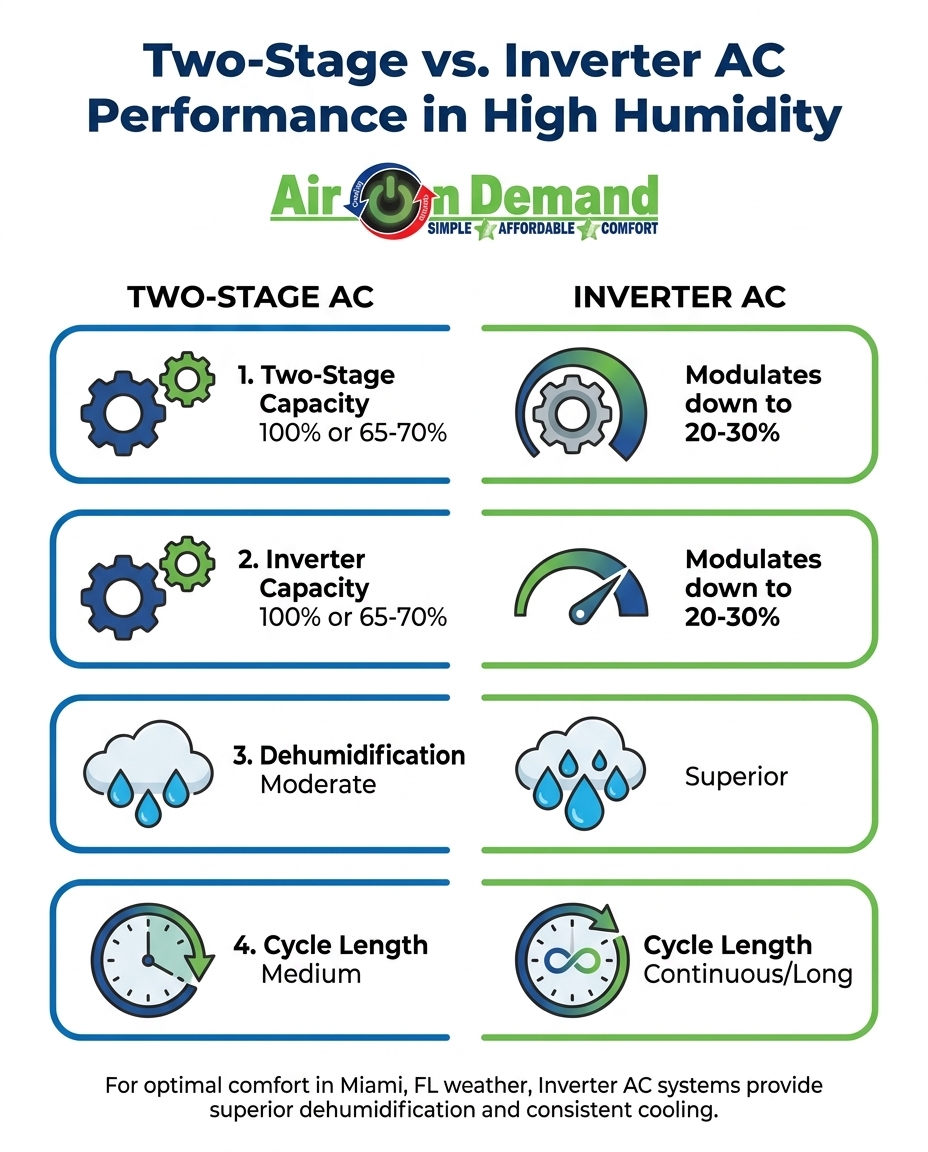
The table below outlines how these two advanced technologies handle the most critical aspects of indoor comfort.
• Dehumidification — Two-Stage Compressor: Moderate (Good for average climates) — Inverter-Driven Compressor: Superior (Continuous moisture extraction)
• Cycle Length — Two-Stage Compressor: Medium (Steps down to 65% capacity) — Inverter-Driven Compressor: Long/Continuous (Modulates down to 20-30% capacity)
• Temperature Consistency — Two-Stage Compressor: Minor Swings (Usually within 2-3 degrees) — Inverter-Driven Compressor: Exact Precision (Maintains exact set-point)
• Acoustic Comfort — Two-Stage Compressor: Quiet on low stage, noticeable on high — Inverter-Driven Compressor: Ultra-quiet, barely noticeable operation
• Part-Load Handling — Two-Stage Compressor: Can still over-cool during mild, humid days — Inverter-Driven Compressor: Perfectly matches mild, humid conditions
It is also worth noting that qualifying high-efficiency heat pumps and ACs of both types may be eligible for generic federal tax credits or utility rebates. We always advise readers to verify current programs locally with their utility provider or a tax professional to see what incentives apply to their upgrade.
Understanding the technology is one thing, but finding the right equipment to deliver those results is another. When homeowners in Miami coastal and inland residential zones ask the Air On Demand team how to permanently solve their humidity issues, we consistently point them toward inverter technology based on our years of local HVAC experience.
The Daikin Fit is a premier example of inverter technology specifically designed for challenging climates. As a dedicated Daikin dealer, our installation experts have seen firsthand how this fully variable compressor addresses the latent heat challenges unique to our area. It doesn't just cool the air; it actively manages the indoor climate profile, ensuring that even on a rainy, 75-degree day, your home feels crisp and dry.
Beyond the compressor technology, the Daikin Fit offers several unique advantages for South Florida homeowners:
• Compact Footprint: It features a unique side-discharge design. Instead of a massive, bulky cube sitting in your yard blowing air upward, it is a slim profile unit that blows air outward.
• Space-Saving: This slim design is ideal for the zero-lot-line homes common in South Florida, fitting easily into tight side yards or narrow clearances where traditional units struggle to breathe.
• Acoustic Profile: Because the inverter compressor rarely runs at 100 percent speed, the outdoor unit is incredibly quiet, meaning you won't hear a loud mechanical roar every time the system cycles on.
However, choosing the right equipment is only half the battle. A fully variable system must be paired with precise ductwork evaluation and accurate load calculations. Proper sizing and professional AC installation are absolutely critical to realizing these benefits. If an inverter system is oversized, it will still short-cycle, completely negating the technology you invested in.
Living in South Florida means dealing with high moisture levels year-round. True Miami comfort relies heavily on effective part-load humidity removal, especially during the September transition (high humidity, lower sensible heat load). If your system cannot handle the moisture without freezing you out of your living room, you aren't getting the comfort you deserve.
While two-stage systems are undeniably good and offer a solid step up from basic builder-grade units, inverter-driven systems provide the ultimate non-monetary value in comfort, consistency, and quiet operation. The ability to run continuously at a low speed transforms how a house feels, turning a clammy, sticky environment into a crisp, consistently comfortable sanctuary.
The Air On Demand team encourages homeowners to weigh these operational benefits carefully when planning their early fall AC upgrade. The initial investment in your home's infrastructure dictates your daily comfort for the next decade or more. Consult with our local experts who understand the specific cooling load of your neighborhood to evaluate which system best fits your home's unique layout and your family's comfort needs.
What is the difference between a 2-stage and an inverter AC?
The primary difference lies in how they adjust their cooling capacity. A 2-stage AC operates at either 100 percent full blast or steps down to roughly 65 percent capacity. An inverter AC uses a fully variable compressor that can modulate its speed in tiny increments, often running as low as 20 to 30 percent to match your home's exact cooling needs continuously.
Does a variable speed AC dehumidify better?
Yes, a variable speed (inverter) AC provides vastly superior dehumidification. Because it can run at very low speeds for long, continuous cycles, it constantly pulls indoor air across the cold evaporator coils. This extended run time wrings out significantly more moisture from the air without causing the indoor temperature to drop uncomfortably low.
Is an inverter AC worth it for high humidity?
An inverter AC is widely considered the best solution for high-humidity environments. Standard systems often "short cycle" on humid days, shutting off before they can extract enough moisture. By running continuously at a low capacity, an inverter system eliminates the clammy feeling in your home, making the operational benefits highly worthwhile for coastal residents.
Which AC is best for Florida weather?
For Florida weather, a fully variable inverter-driven AC is generally the best choice. Florida experiences high latent heat (humidity) for most of the year, even when the actual temperature is mild. Inverter systems are uniquely capable of handling these "part-load" conditions, ensuring your home stays dry and comfortable without over-cooling.
How do part-load conditions affect my AC's performance in September?
In September, part-load conditions occur because the outdoor temperature drops, but the humidity remains extremely high. A standard AC will quickly cool the house to your set temperature and shut off, leaving the heavy moisture behind. This results in a cold but sticky indoor environment, which is why advanced systems that run longer cycles are necessary during this transition.