Why Is My AC Blowing Warm Air? The Hidden Link Between High Humidity and Float Switches
August 17, 2026
You walk inside expecting relief from the heat, but instead, you realize the vents are blowing warm air, and your house is getting hotter by the minute. When you start searching for home maintenance tips and troubleshooting, our technicians at Air On Demand suggest the first step is figuring out if this unexpected shutdown is a minor hiccup or a major mechanical breakdown. The immediate discomfort is frustrating, but the underlying cause might not be as catastrophic as a failed compressor.
During peak summer humidity, air conditioning systems are pushed to their absolute limits. Most homeowners immediately assume their unit is out of refrigerant or that the motor has died. However, we consistently find that the true culprit is often a built-in safety mechanism reacting to a clogged drain line. Understanding this critical decision point—distinguishing between a simple water backup and a complex system failure—can save you time, money, and unnecessary stress.
If you need immediate help diagnosing the issue, professional AC repair can quickly identify the root cause and restore your home's comfort. For those who want to understand exactly what is happening behind the walls, the answer lies in how your cooling system manages moisture.
To understand why your air conditioner is blowing warm air, you first have to understand what it actually does. Air conditioners do much more than just pump cold air into a room; they actively extract heat and moisture from your indoor environment. This dehumidification process is what makes your home feel crisp and comfortable rather than damp and sticky.
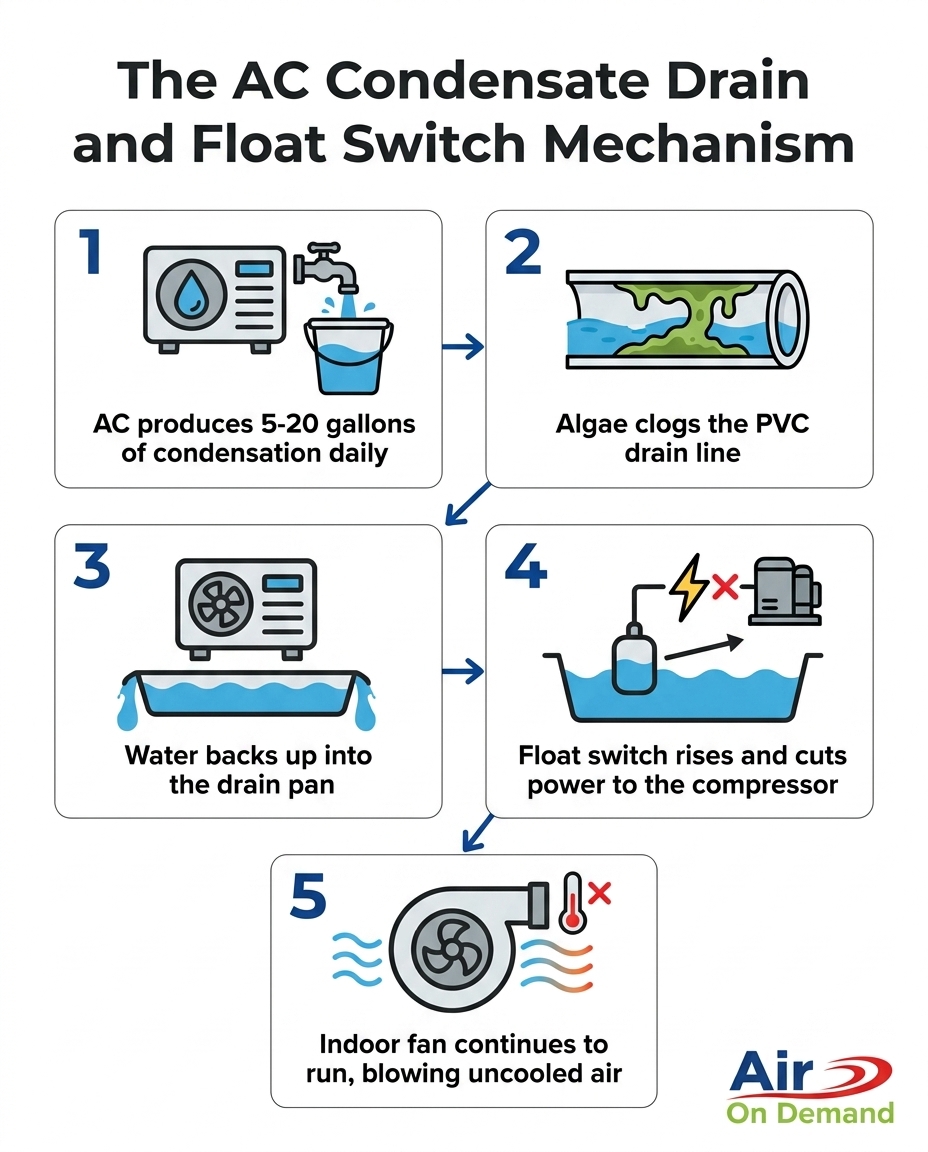
According to Department of Energy data, a standard residential air conditioning system can produce between 5 to 20 gallons of condensation per day, depending on the indoor humidity levels and the size of the unit. That is a massive volume of water that your system must safely channel out of your home every single day. As warm indoor air passes over the freezing cold evaporator coils, the moisture in the air condenses into water droplets, much like a cold glass of water sweating on a hot afternoon.
In our years of servicing Miami, we have seen firsthand how our extreme peak-summer heat and high relative humidity force AC units to extract significantly more moisture than in drier climates. This constant, heavy moisture removal heavily taxes the condensate drainage system. Managing this continuous flow of water is just as critical to the system's ability to cool your home as the refrigerant itself. When the system is running non-stop during peak summer humidity, the drain line is working at maximum capacity, creating the perfect storm for blockages.
When an air conditioner fails due to a drainage issue, it is rarely a sudden event. It is the result of a predictable biological and mechanical process. The condensate drain line is typically a narrow PVC pipe that carries water from the indoor unit to the outside of your home. Because this pipe is constantly wet, dark, and enclosed, it creates the ideal breeding ground for biological growth.
As the air conditioner pulls moisture from the air, it also pulls in microscopic airborne dust, dirt, and biological particulates. Even with a high-quality air filter, some of these particles make it to the wet evaporator coil and wash down into the drain pan. When this organic debris mixes with constant moisture during peak summer humidity, algae begins to thrive inside the PVC pipe.
Over time, this combination of algae and dirt forms a thick, gelatinous sludge. The sludge clings to the inner walls of the drain line, slowly narrowing the pathway for the water to escape. You might not notice any issues while the line is only partially blocked. The system continues to drain, just at a slower rate. However, as the sludge accumulates, it eventually creates a complete bottleneck, stopping the flow of water entirely.
Our team regularly sees this progression from a slow-draining line to a complete blockage in high-moisture environments. It does not necessarily mean your air conditioner is broken or failing. It simply means the drainage system requires professional intervention to clear the biological buildup. Regular attention through routine AC maintenance is the most effective way to prevent this sludge from forming in the first place.
When the condensate drain line becomes completely blocked, the 5 to 20 gallons of water your system produces daily has nowhere to go. It begins to back up into the indoor condensate drain pan. Without a failsafe, this water would quickly overflow, causing catastrophic water damage to your ceilings, floors, and drywall. This is where the float switch comes into play.
A float switch is a small, standard HVAC safety device located inside or attached to the side of the condensate drain pan. Its primary purpose is to monitor the water level. The mechanical trigger is simple but highly effective: as water backs up from the clogged drain, the rising water level lifts a small buoyant float. Once the float reaches a certain height, it breaks the low-voltage electrical circuit that powers the system.
If you are wondering what to do when your HVAC breaks down unexpectedly, our team's first piece of advice is to realize that a tripped float switch means your safety system is actually working exactly as designed. It is sacrificing your immediate comfort to protect your home from severe water damage.
The most confusing part of a tripped float switch for many homeowners is that the system doesn't always shut down completely. To understand why the vents are blowing warm air, you have to look at how the switch is wired.
In most residential setups, the float switch is wired specifically to shut down the outdoor compressor—the part of the system responsible for cooling the refrigerant. However, it often leaves the indoor blower fan running. Because the compressor is off, no heat is being removed from the refrigerant. The indoor fan continues to circulate air over a warm coil, pulling unconditioned, humid air from your home and pushing it right back out through the vents. This exact mechanical relationship is why a water clog directly results in warm air blowing from your registers.
Navigating the decision point between a tripped safety switch and a major system failure requires knowing what symptoms to look for. While both issues result in a lack of cold air, the secondary signs are very different.
We advise homeowners to perform a basic visual inspection to help narrow down the cause. By carefully looking at the indoor unit (usually located in a closet, garage, or attic), you can check the drain pan. If the pan is full of standing water, a tripped float switch is the most likely culprit. However, we must stress the importance of never bypassing the float switch or attempting complex DIY electrical diagnostics. Bypassing a safety switch removes the only barrier protecting your home from a flood, and handling HVAC electrical components requires a licensed professional.
• Onset of Problem — Tripped Float Switch (Drain Clog): Sudden shift from cold to warm air — Refrigerant Leak / Compressor Failure: Gradual loss of cooling capacity over days
• Indoor Drain Pan — Tripped Float Switch (Drain Clog): Full of standing water or overflowing — Refrigerant Leak / Compressor Failure: Dry, or containing normal moisture levels
• Unusual Sounds — Tripped Float Switch (Drain Clog): Gurgling noises near the indoor unit — Refrigerant Leak / Compressor Failure: Hissing, bubbling, or loud grinding noises
• Evaporator Coils — Tripped Float Switch (Drain Clog): Normal appearance, wet but not frozen — Refrigerant Leak / Compressor Failure: Encased in solid ice or thick frost
If you find that your system is constantly struggling to manage moisture, or if mechanical failures become a continuous pattern despite regular drain clearings, it may indicate that the system is undersized for your home's latent heat load or nearing the end of its lifespan. In these cases, exploring AC replacement services can provide a more permanent, efficient solution.
When a drain line clogs and trips the float switch, the instinct is often to find a quick fix. However, simply vacuuming out the end of a drain line temporarily doesn't solve the recurring algae growth. The biological sludge will quickly return, especially during peak summer humidity, leading to another shutdown just days or weeks later.
This is why professional intervention is essential. The professional diagnostic and repair process goes far beyond a wet-dry vacuum. A licensed technician will use specialized equipment to apply pressurized clearing to the entire length of the line, ensuring the bottleneck is completely removed. Following the clearing, they will treat the line with specialized algaecides to inhibit future biological growth. Finally, they will test the electrical continuity of the float switch to ensure it resets properly and hasn't been damaged by the water exposure.
Ignoring a tripped switch or attempting to reset it without fixing the underlying clog can lead to severe water damage or put immense strain on the compressor as it short-cycles. At Air On Demand, our expert team provides fast, reliable diagnostics to accurately pinpoint whether the issue is a simple drain clog or an emergency repair, giving you peace of mind. Objective, technical diagnostics prevent unnecessary part replacements and ensure your system operates safely and efficiently for years to come.
Finding warm air blowing from your vents is stressful, but it is often a symptom of a clogged drain triggering a vital safety shutoff rather than a catastrophic failure. Understanding this mechanical failsafe helps homeowners make informed, calm decisions when their comfort is interrupted. By recognizing the signs of a tripped float switch and respecting the massive amount of condensation your system processes daily, you can protect your home from water damage.
When the safety switch does its job and stops the compressor, the next step is safely clearing the blockage. Our team at Air On Demand encourages you to seek professional assistance to thoroughly clean the condensate line, treat the algae growth, and restore your home's cooling safely and effectively. For fast, professional help, schedule emergency AC repair in Miami to get your system back online.
Why did my AC suddenly start blowing warm air?
A sudden shift to warm air often means a safety device has shut off your outdoor compressor. When the compressor loses power but the indoor fan keeps running, the system circulates uncooled air through your vents. This is frequently caused by a clogged condensate drain line tripping the float switch.
What happens when an AC float switch trips?
When the float switch trips, it breaks the low-voltage electrical circuit that powers your cooling system. The rising water in the drain pan lifts the float, triggering the shutoff to prevent the pan from overflowing. This immediately stops the cooling process to protect your home from severe water damage.
How does humidity affect my AC drain line?
High humidity forces your air conditioner to extract massive amounts of moisture from the indoor air. This constant flow of water keeps the drain line permanently wet, creating an ideal environment for algae and biological sludge to grow. Over time, this sludge builds up and chokes the narrow PVC pipe.
Can a clogged drain cause AC to blow warm air?
Yes, a clogged drain is one of the most common reasons an AC blows warm air. The clog causes water to back up, which triggers the float switch to shut down the compressor. Because the indoor blower fan often continues to run, it pushes unconditioned, warm air into your rooms.
Why is my AC running but blowing warm air?
If you hear the indoor unit running but feel warm air, it usually means the indoor blower fan is operating while the outdoor compressor is not. This mismatch can be caused by a tripped float switch, a blown capacitor on the outdoor unit, or a severe loss of refrigerant.
How do professionals safely unclog an AC condensate drain?
Professionals use specialized equipment to safely flush and clear the entire length of the condensate drain line. After removing the physical blockage, they treat the line with specific algaecides to prevent rapid regrowth. They also test the float switch and drain pan to ensure the safety mechanisms are functioning correctly.