Transitioning from Automotive AC Repair to Residential HVAC
September 23, 2026
You know exactly how to diagnose a struggling compressor under a cramped hood, but transitioning from automotive AC repair to residential HVAC brings a completely different set of technical roadblocks. At Air On Demand, our team frequently trains experienced auto mechanics who already possess a deep, practical understanding of how refrigeration cycles work. You know how to track down leaks, read gauges, and understand the relationship between pressure and temperature. The primary barrier to entry is not learning how air conditioning functions—it is translating that knowledge to a completely new physical and electrical environment.
The concrete problem we see most mechanics face is moving away from engine-driven compressors and low-voltage systems to handle high-voltage residential equipment safely. Navigating the jump between 240V AC and 24V control circuits vs 12V DC power requires targeted retraining, not starting from scratch. You do not need a beginner's course in thermodynamics; you need a specific roadmap that bridges your existing mechanical aptitude with residential building codes, high-voltage safety protocols, and home ductwork dynamics.
Making this career pivot is highly rewarding, offering excellent job security and consistent year-round work. To get started, you must identify the exact certifications and electrical retraining required to safely navigate HVAC careers.
One of the biggest misconceptions we hear from applicants moving into the home heating and cooling industry is that you have to start at the absolute bottom. In our experience hiring and training technicians across Miami, automotive technicians enter the field with a massive head start. The mechanical and thermodynamic principles that cool a sedan are identical to the principles that cool a four-bedroom house.
The foundational components are the same:
• The Compressor: While driven by an electric motor rather than an engine belt, it still pumps refrigerant vapor and raises its pressure.
• The Condenser: It still rejects heat to the outside air, turning high-pressure vapor back into a high-pressure liquid.
• The Expansion Valve (TXV): It still meters the flow of liquid refrigerant into the indoor coil, dropping its pressure and temperature.
• The Evaporator: It still absorbs heat from the indoor air, boiling the liquid refrigerant back into a vapor to return to the compressor.
Because these fundamental steps remain identical across both fields, your diagnostic mindset is immediately valuable. Troubleshooting a pressure imbalance, identifying a restricted metering device, or tracking down a microscopic refrigerant leak requires the exact same logical deduction you use in the auto shop.
Mechanics already understand phase changes and heat transfer. You are familiar with identifying superheat and subcooling concepts to determine if a system is properly charged or if a component is failing. When our technicians encounter a residential system with low airflow across the evaporator coil, it will freeze up—just like a car's AC system will freeze up if the cabin blower motor fails.
Furthermore, many of your existing tools and procedures transfer directly. The shared use of manifold gauges, vacuum pumps, and refrigerant recovery machines means you already know how to pull a deep vacuum and why removing non-condensables from a system is critical. While you will need different hose adapters for residential refrigerants, the physical process of recovering, evacuating, and charging a system utilizes the exact same muscle memory. The true transition begins when you step away from the sealed mechanical loop and look at how the equipment is powered.
The most significant technical gap we see mechanics face when transitioning to residential HVAC revolves entirely around electricity. In an automotive setting, you are dealing with a chassis-grounded 12V DC electrical system. In a home, you are dealing with alternating current, requiring a completely different approach to diagnostics, safety, and component testing. A successful HVAC service technician must master this electrical divide before ever touching a live wire.
Residential air conditioners and heat pumps operate on a dual-voltage system. The major, heavy-lifting components—like the outdoor compressor and the indoor blower motor—typically require high-voltage 240V AC power. However, the thermostat on the living room wall does not operate on 240 volts. Instead, a transformer steps that high voltage down to a safe, low-voltage 24V AC control circuit.
This separation of high-voltage power and low-voltage control circuits is the primary focus of the electrical diagnostic retraining we provide. When a homeowner sets their thermostat to cool, the thermostat sends a 24V signal out to the outdoor unit. That low-voltage signal energizes the magnetic coil of a contactor. When the contactor pulls in, it closes a heavy-duty switch, allowing the 240V AC power to flow into the compressor and condenser fan motor.
Comparing the electrical environments:
• Primary Power Source — Automotive AC Diagnostics: 12V DC (Battery / Alternator) — Residential HVAC Diagnostics: 240V AC and 24V control circuits vs 12V DC
• Compressor Drive — Automotive AC Diagnostics: Mechanical (Engine Belt) — Residential HVAC Diagnostics: Electrical (Internal 240V Motor)
• Control Logic — Automotive AC Diagnostics: Vehicle ECU / BCM — Residential HVAC Diagnostics: 24V Thermostat & Defrost Boards
• Safety Risk Level — Automotive AC Diagnostics: Low voltage shock risk, high heat — Residential HVAC Diagnostics: Lethal high-voltage shock risk (240V)
• Diagnostic Tooling — Automotive AC Diagnostics: 12V Test Light, OBD2 Scanner — Residential HVAC Diagnostics: True RMS Multimeter, Amp Clamp
Because of these differences, heat pump control boards and residential defrost controls require specific electrical troubleshooting retraining. You can no longer rely on an OBD2 scanner to tell you which sensor is out of range. You must use a multimeter to trace 24V control voltage through a series of safety switches, pressure limits, and relays to find exactly where the circuit is broken. Emphasizing the critical safety protocols required when handling high-voltage equipment is why our formal apprenticeships at Air On Demand are heavily focused on electrical theory rather than refrigeration basics.
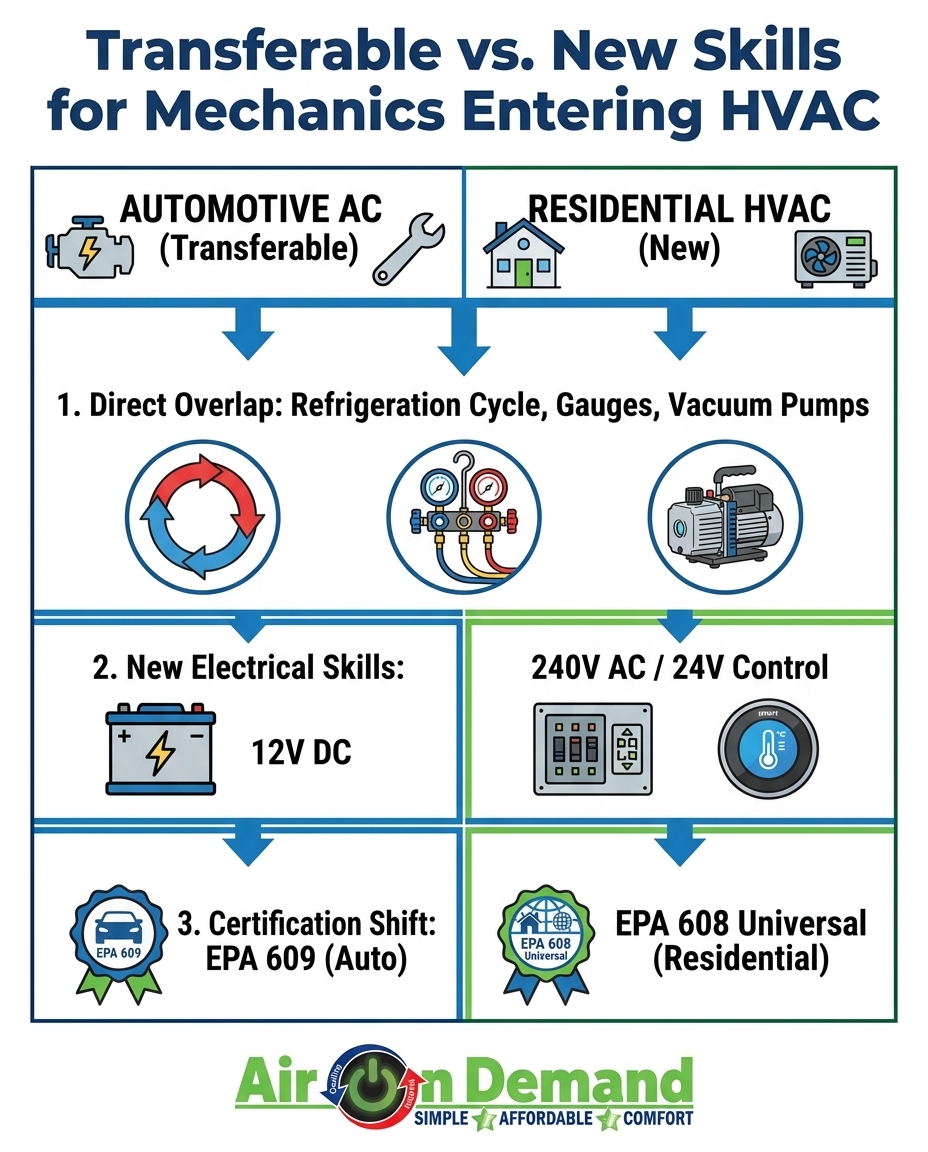
Beyond the electrical learning curve, there are strict legal and regulatory requirements for handling residential refrigerants. If you have been servicing car air conditioners, you likely hold an EPA Section 609 certification. Our service managers always clarify to new applicants that an existing automotive EPA 609 certification does not legally cover residential HVAC work. The Environmental Protection Agency strictly separates motor vehicle air conditioning (MVAC) from stationary residential and commercial equipment.
To legally attach gauges to a home air conditioner, recover refrigerant, or purchase cylinders of residential refrigerants like R-410A or the newer mildly flammable R-32, you must obtain an EPA Section 608 Universal Certification. The transition from automotive refrigerants (like R-134a or R-1234yf) to residential refrigerants also means dealing with significantly higher operating pressures, which requires updated safety knowledge.
The educational steps required to study for and pass the EPA 608 exam include:
1. Passing the Core Section: This covers general safety, ozone depletion theory, the Clean Air Act, and proper recovery techniques. You must pass this section to earn any level of 608 certification.
2. Passing Type I (Small Appliances): This covers equipment containing five pounds of refrigerant or less, such as window units and domestic refrigerators.
3. Passing Type II (High-Pressure Appliances): This is the most critical section for residential HVAC technicians. It covers high-pressure refrigerants used in split-system air conditioners and heat pumps.
4. Passing Type III (Low-Pressure Appliances): This covers low-pressure systems, typically large commercial chillers.
5. Achieving Universal Status: By passing the Core and all three Types, you earn your EPA Section 608 Universal Certification, allowing you to legally work on any stationary HVAC system regardless of size or refrigerant type.
The technical skills are only half of the transition; the physical work environment represents the other half. Working under a hood or standing beneath a hydraulic lift provides a relatively controlled, stationary shop environment. You have immediate access to your tool chest, compressed air, and a parts room just steps away. Residential HVAC service introduces a completely different physical reality.
Instead of pulling a car into your bay, you are navigating tight residential attics, muddy crawlspaces, and sun-baked rooftops. The physical demands of carrying heavy equipment, vacuum pumps, and recovery cylinders up extension ladders cannot be overstated. You are transitioning from a stationary shop environment to a highly mobile service role, which means your service van becomes your rolling shop, and you will be interacting directly with homeowners on their property.
Furthermore, the environment itself becomes part of the diagnostic process. In an automobile, the cabin is a small, factory-sealed box with engineered airflow. In a home, airflow and ductwork dynamics introduce a massive new layer of environmental diagnostics. You must learn how to measure static pressure, identify leaky return ducts pulling in hot attic air, and calculate whether the blower motor is moving enough cubic feet per minute (CFM) across the coil.
This environmental shift is especially notable in South Florida. At Air On Demand, we know firsthand that Miami's year-round extreme heat and high humidity makes attic work physically demanding, but it also guarantees exceptional job security and consistent year-round work compared to seasonal auto repair lulls. When you combine your mechanical skills with the stability of residential HVAC apprenticeships in Miami, you secure a career that is virtually immune to economic downturns.
If you are considering making the jump from auto mechanics to home cooling, timing your transition strategically can make a massive difference in your training experience. We always advise that September and the early fall season represent a strategic window for beginning an apprenticeship in the HVAC industry.
During the peak of summer, service companies are running non-stop emergency calls. Technicians are moving as fast as possible to restore cooling to sweltering homes, which leaves less time for patient, step-by-step instruction. Transitioning out of peak summer cooling demand allows for more structured, hands-on training. In the fall, the pace becomes slightly more manageable, giving our senior technicians the time to properly explain the nuances of 240V AC and 24V control circuits vs 12V DC power without the pressure of a dozen backed-up emergency calls waiting on the board.
This timing prepares transitioning mechanics to be fully up to speed, properly certified, and comfortable with high-voltage diagnostics before the next high-demand cooling season hits. Framing the transition as an investment in long-term career stability means choosing an employer who understands your background. Air On Demand actively seeks out crossover talent for our Miami apprenticeships, offering targeted hands-on training that respects a mechanic's existing knowledge while safely and thoroughly bridging the high-voltage electrical gap.
Yes, because the core understanding of the refrigeration cycle is identical across both fields. An experienced mechanic already knows how compressors, condensers, and evaporators manipulate refrigerant to remove heat. The main learning curve is mastering high-voltage electrical diagnostics and understanding residential ductwork dynamics, which is why targeted retraining is necessary.
It is not necessarily harder, but it requires different safety protocols due to 240V AC power and involves different physical environments like attics and rooftops. Automotive AC work often involves tighter spaces under a dashboard or hood, while residential HVAC requires carrying tools up ladders and working in confined, unconditioned spaces. Both require a high level of critical thinking and mechanical aptitude.
Yes, you absolutely do. EPA 609 only covers motor vehicle air conditioning and does not legally permit you to work on stationary residential or commercial equipment. You must obtain an EPA Section 608 Universal Certification to legally purchase, recover, and handle residential refrigerants like R-410A.
Basic hand tools, wrenches, ratchets, and cordless drills transfer immediately. Multimeters can transfer if they are rated for high voltage (Category III or IV) and have an amp clamp. Manifold gauge sets and vacuum pumps often transfer, though you will need HVAC-specific hose adapters for residential refrigerants, and eventually, you will need specialized tools like digital psychrometers and duct calculators.
While you will start as an apprentice to learn residential codes and electrical safety, your existing mechanical aptitude often allows for much faster progression than a true beginner. You do not have to relearn how a compressor works; you simply have to learn how it is powered and controlled in a home setting. Employers highly value this crossover knowledge.
A mechanic's existing refrigeration knowledge is a massive advantage in the home service industry. The ability to read gauges, understand superheat, and troubleshoot mechanical failures puts you years ahead of someone entering the trades for the very first time. The key to a successful transition is acknowledging the specific areas where you need retraining—namely, the jump between 240V AC and 24V control circuits vs 12V DC power, and the acquisition of your EPA 608 certification.
At Air On Demand, we encourage transitioning mechanics to seek out employers who value these crossover skills and provide the structured electrical retraining necessary to keep you safe and successful in the field. If you are ready to trade flat-rate auto shop frustrations for the stability of residential home services, explore local opportunities and apply to become an HVAC apprentice with our team today. You will find that a realistic, respectful map of transferable skills and new electrical requirements is exactly what you need to make the jump successfully.