The Difference Between Commercial and Residential HVAC Apprenticeships in Miami
September 23, 2026
Your boots are laced up, your tool bag is packed, but you are staring down a career crossroads that will dictate your daily physical reality for years to come. At Air On Demand, we have guided countless new technicians through this exact transition, and we know that the difference between commercial and residential HVAC apprenticeships in Miami is not just about the size of the equipment—it is about choosing which extreme environment you will face every single day. Stepping into the trade means committing to a grueling physical routine, especially when the late-summer August peak cooling season hits and systems are running at maximum capacity.
Choosing an apprenticeship track is the foundational decision of your career. It dictates the technical training you receive, the soft skills you develop, and the type of physical endurance you need to build. Both paths demand resilience, but they challenge you in completely different ways. If you are ready to start your journey, explore HVAC careers in Miami to find the right fit for your future.
Working in South Florida means dealing with intense late-summer heat and extreme humidity, but how you experience that weather depends entirely on your chosen career path. Our veteran technicians at Air On Demand often tell new recruits that the physical environments of residential and commercial HVAC work could not be more different, and apprentices must be prepared for the unvarnished reality of both.
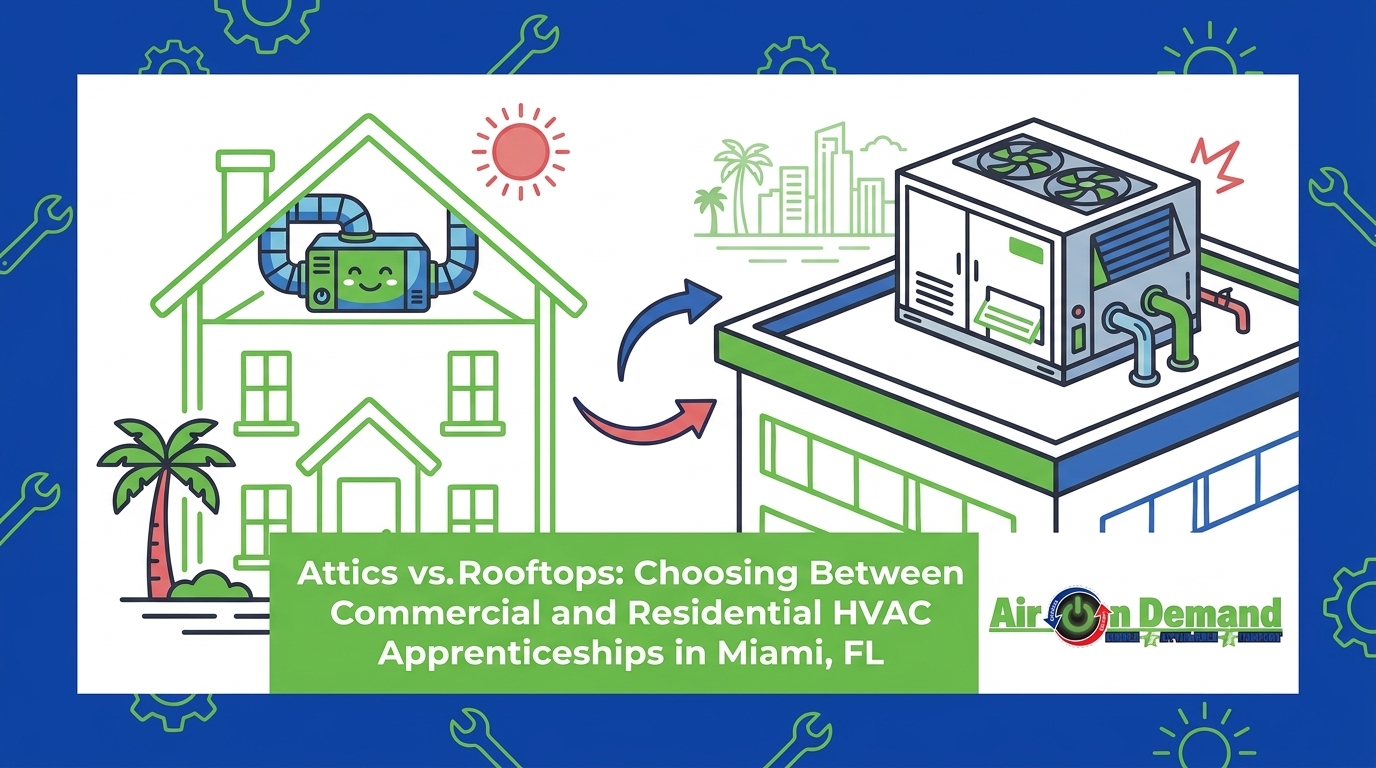
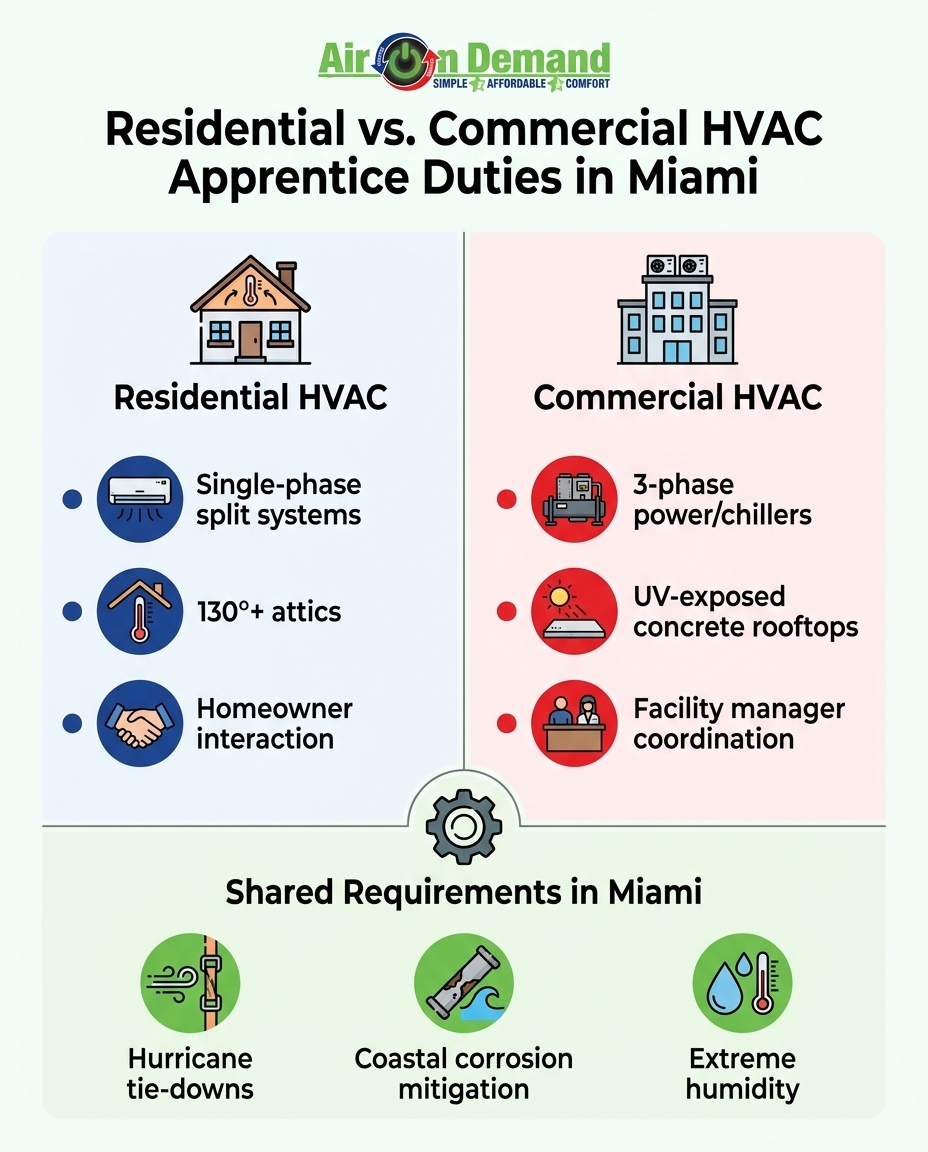
If you choose the residential track, your daily battlefield is often the attic. In our years of providing AC repair and installation across Miami suburban residential neighborhoods, we have seen enclosed attics easily exceed 130 degrees by midday. You are not just dealing with the heat; you are navigating tight spaces, balancing on wooden joists to avoid stepping through a customer's ceiling, and working around fiberglass insulation that sticks to sweating skin. The year-round high humidity makes these enclosed spaces particularly dangerous if you do not manage your hydration and take necessary breaks. Our residential apprentices must develop incredible core strength and agility to maneuver heavy components, like evaporator coils and vacuum pumps, through narrow drop-down stairs and into cramped corners.
Commercial apprentices face a completely different physical test. Instead of cramped attics, you are working on massive flat concrete roofs. While you have room to move, there is absolutely nowhere to hide from the sun. The brutal UV exposure and solar radiation reflecting off high-rise rooftops can drain your energy rapidly. Commercial work also involves significantly heavier lifting. You are dealing with massive compressors, heavy-gauge steel panels, and thick copper piping. Moving this equipment often requires coordinating cranes, utilizing heavy-duty hoists, and working as a synchronized team. The physical stamina required to survive a full shift on a sun-baked roof is immense.
Regardless of the path, heat stress is the primary enemy of any Florida HVAC technician. For our crews, OSHA-recommended safety protocols are a daily requirement, not just a suggestion. Apprentices on both tracks must learn to recognize the early signs of heat exhaustion, maintain strict hydration schedules, and understand when to step back from a task to cool down. The stamina required to survive the back-to-school late-summer cooling demand is built slowly, day by day, under the guidance of experienced lead technicians.
The scale and complexity of the equipment you service will define your technical education. While the fundamental principles of refrigeration remain the same across the industry, our team notes that the application of those principles varies wildly between residential and commercial environments.
Standard residential equipment focuses heavily on single-phase electrical power. At Air On Demand, our apprentices spend their days mastering split systems, traditional air handlers, heat pumps, and increasingly popular ductless mini-splits. The troubleshooting process is highly localized. If a system goes down, the issue is usually contained within a single unit serving a single family. You learn to diagnose airflow restrictions, trace low-voltage control issues at the thermostat, and perform precise refrigerant charge adjustments.
Commercial equipment operates on an entirely different scale. Apprentices working on Downtown Miami high-rises must understand 3-phase electrical power, which is inherently more dangerous and complex. You will be introduced to massive cooling towers, centrifugal chillers, commercial boilers, and variable refrigerant flow (VRF) systems. Troubleshooting is rarely localized. A commercial apprentice must learn to navigate complex building automation systems (BAS) that control the climate for hundreds of occupants across dozens of floors. Diagnosing a problem might involve tracing a chilled water loop through an entire facility before finding a faulty actuator valve.
• Power Supply — Residential Apprenticeship: Single-phase (120V / 240V) — Commercial Apprenticeship: 3-phase (208V, 277V, 480V)
• Primary Systems — Residential Apprenticeship: Split systems, heat pumps, mini-splits — Commercial Apprenticeship: Chillers, cooling towers, packaged RTUs
• Troubleshooting Scope — Residential Apprenticeship: Localized to one home or unit — Commercial Apprenticeship: Facility-wide diagnostics and automation
• Component Size — Residential Apprenticeship: Manageable by 1-2 technicians — Commercial Apprenticeship: Often requires cranes or hoists
• Controls — Residential Apprenticeship: Standard thermostats and smart home hubs — Commercial Apprenticeship: Complex Building Automation Systems (BAS)
Technical skills are only half the job. The environment you work in dictates who you interact with and how your daily schedule is structured. The soft skills required to thrive as an HVAC service technician vary greatly depending on your customer base.
In the residential sector, your primary contact is the homeowner. When our Air On Demand crews arrive at a house in the Miami suburban residential neighborhoods, we are often greeting people who are stressed, uncomfortable, and worried about unexpected AC repair needs. A successful residential apprentice learns how to communicate complex technical problems in everyday language. You must be empathetic, patient, and highly respectful of private property. Laying down drop cloths, wearing shoe covers, and maintaining a pristine workspace are non-negotiable habits for our team. The schedule often involves on-call emergency rotations, meaning you might be dispatched to a sweltering house at 8:00 PM on a Saturday.
Commercial apprentices interact primarily with facility managers, maintenance directors, and corporate stakeholders. The conversation shifts from personal comfort to operational budgets, system uptime, and liability. You must learn to adhere to strict corporate protocols, sign in at security desks, and coordinate shutdowns that affect entire businesses. While commercial work also has emergency calls, much of the heavy maintenance is scheduled during off-hours or weekends to avoid disrupting business operations. The soft skills here revolve around professional documentation, clear reporting, and strict adherence to commercial safety standards.
Training in South Florida means adapting to some of the strictest building codes in the country. A generic HVAC education is not enough; we emphasize to all our trainees that you must master the specific regional regulations that keep systems secure during extreme weather.
Miami-Dade County enforces rigorous building codes designed to withstand catastrophic wind events. Whether you are working as an AC installation and duct mechanic on a suburban home or assisting on a commercial roof, mastering hurricane tie-downs is mandatory. Apprentices must learn how to properly anchor condensing units to concrete pads using approved tapcons, heavy-duty straps, and specific mounting hardware. On Downtown Miami high-rises, the requirements are even more stringent, involving engineered stands and vibration isolators designed to handle intense wind shear at elevation. Understanding the Notice of Acceptance (NOA) for different equipment stands is a critical part of the learning curve we teach daily.
The salty ocean air is highly corrosive to standard HVAC equipment. Our apprentices quickly learn that untreated aluminum fins and copper coils will degrade rapidly in this climate. Training involves applying coastal corrosion mitigation techniques, such as proper coil coating applications, installing specialized marine-grade heat pumps, and recognizing the early signs of galvanic corrosion. A strong grasp of these local regulations and environmental challenges is a non-negotiable part of any local apprenticeship. If you do not build systems to survive the salt and the wind, they will fail long before their expected lifespan.
Choosing to enter the trade is the first step, but choosing the right employer to train you is what determines your long-term success. Generic textbook training falls short when faced with South Florida's unique demands. You need hands-on mentorship that bridges the gap between classroom theory and field reality.
When the late-summer August peak cooling season hits, a textbook cannot prepare you for the physical toll of the job. Working alongside experienced journeymen is how apprentices learn to pace themselves, handle tools efficiently in tight spaces, and diagnose complex electrical faults when the pressure is on. Mentorship protects apprentices from heat-related illnesses and costly technical errors. A good training program provides a structured pathway from carrying tools and fetching parts to independently troubleshooting advanced systems. If you want to understand the timeline, learning about becoming a lead service technician in Miami shows the value of a clear, structured career ladder.
Working with a company dedicated to rigorous local training means you are equipped for South Florida's unique climate from day one. At Air On Demand, our commitment to developing top-tier HVAC professionals involves hands-on guidance that respects the extreme local architecture and weather. We teach our apprentices not just how to fix a machine, but how to survive and thrive in the environment, ensuring they build a sustainable, long-term career rather than burning out in their first summer.
The primary difference lies in the equipment scale and the work environment. At Air On Demand, our residential focus is on single-phase split systems and heat pumps installed in private homes. Commercial involves massive 3-phase power systems, chillers, and large-scale facility equipment. Residential requires strong homeowner communication skills, while commercial focuses on coordinating with facility managers and navigating complex building automation.
Both paths are incredibly demanding, but they stress the body in different ways. We find that residential work often requires navigating extreme heat in enclosed, unventilated attics, demanding flexibility and heat tolerance. Commercial work involves heavy lifting, moving massive components, and enduring direct, relentless sun exposure on flat concrete roofs.
Commercial systems are generally larger and technically more complex, involving advanced automation, pneumatic controls, and 3-phase electrical systems. However, our team knows that residential HVAC requires a broader range of customer service skills, the ability to adapt to wildly different home layouts, and the patience to troubleshoot localized airflow issues. Both require intense study and hands-on practice.
A residential apprentice assists lead technicians with installing split systems, running copper linesets, and pulling vacuums. They navigate attics and crawlspaces to repair or replace damaged ductwork. A major part of their daily routine also involves learning to communicate effectively with homeowners, explaining repairs, and keeping the job site spotless.
Local codes completely dictate installation practices in South Florida. Apprentices must learn specific, highly regulated hurricane tie-down procedures to ensure equipment survives high-wind events. Training also heavily emphasizes applying coastal corrosion mitigation techniques to protect sensitive coils and electrical components from the salty ocean air.
Whether you choose to navigate the tight, sweltering spaces of residential attics or tackle the heavy, sun-baked machinery on commercial rooftops, a realistic understanding of the environment is your best tool for success. The August peak cooling season will test your resolve, but it will also forge you into a highly skilled, resilient technician. The key is finding an employer who understands these unique local challenges and is committed to your safety and education.
Robust, locally adapted training makes all the difference between a frustrating job and a rewarding lifelong career. If you are prepared to put in the work and learn the trade the right way alongside our team, it is time to explore your options. Take the next step and look into a residential HVAC apprenticeship to begin building your future in the South Florida climate.