
How Interviewing for HVAC Jobs in Miami Differs from Other Trades
November 20, 2026
You might have the mechanical aptitude to turn a wrench and troubleshoot complex machinery, but understanding how interviewing for HVAC jobs in Miami differs from other trades is the first critical step toward actually landing the position. In our years of serving the Miami area at Air On Demand, we've seen that while traditional trades focus almost entirely on your ability to perform physical labor and follow building codes, residential cooling and heating in South Florida is a completely different landscape. The combination of intense regional weather, direct homeowner interaction, and strict technical requirements means that an interview with us tests your interpersonal skills just as rigorously as your mechanical knowledge.
To start your journey and explore HVAC careers, you need to know exactly what local hiring managers are looking for. Transitioning into the heating, ventilation, and air conditioning field in this specific market presents unique challenges. We want to see that you hold the baseline technical credentials, such as an active EPA Certification, while also possessing the emotional intelligence to handle high-stress, direct-to-consumer interactions inside occupied homes.
Balancing these technical requirements with strong communication skills is the key to standing out in a highly competitive applicant pool. Candidates must clearly present their interpersonal strengths alongside their foundational credentials to secure a position. To understand the contrast, look at how the expectations differ:
• Work Environment — Traditional Mechanical Trades: Often new construction or unoccupied job sites. — Miami Residential HVAC: Occupied residential homes, finished living spaces, and tight attics.
• Customer Interaction — Traditional Mechanical Trades: Minimal; primarily communicating with site foremen or general contractors. — Miami Residential HVAC: Constant; explaining complex technical issues directly to stressed homeowners.
• Climate Resilience — Traditional Mechanical Trades: Standard outdoor or indoor conditions with seasonal breaks. — Miami Residential HVAC: Extreme, year-round heat and humidity requiring high physical stamina.
• Technical Baseline — Traditional Mechanical Trades: General mechanical aptitude and basic hand tool proficiency. — Miami Residential HVAC: Strict federal standards, including mandatory EPA Certification for refrigerants.
When you sit down for an interview with our team at Air On Demand, the conversation will inevitably turn to the weather. The local climate heavily impacts the day-to-day reality of this job, and we actively screen for climate resilience and stress management. With summer temperatures regularly exceeding 90°F and year-round high humidity, HVAC systems in the region run almost constantly. This makes cooling an essential, high-pressure trade where technicians must handle high-stress, high-temperature work environments safely.
During the interview, we will ask behavioral questions specifically designed to gauge your ability to maintain your composure in these physically demanding environments. We want to know that you can keep a clear head, follow safety protocols, and deliver excellent service even when you are physically exhausted.
Unlike northern markets that experience distinct seasonal lulls during the spring and fall, our team typically sees near year-round cooling demand in Miami. This leads to sustained, high-volume service calls month after month. There is rarely an "off-season" to recover. Even during the cooler months, our technicians are busy with heating maintenance and extensive November holiday-season home prep, ensuring systems are ready for visiting guests and unpredictable temperature dips.
Because the demand is so consistent, we look for candidates who demonstrate long-term stamina. We will ask how you manage your energy levels and stay organized during back-to-back calls. You must show that you understand the pacing required to thrive in a market where the equipment works just as hard as the technicians.
Working in extreme attic temperatures requires strict adherence to safety protocols and personal stamina. A Miami attic in the middle of August can easily reach 130°F. As hiring managers, we need to know that you recognize the physical dangers of these environments, such as heat exhaustion and dehydration, and that you know when to take a step back to stay safe.
Candidates should prepare examples of how they handle physical stress while maintaining high-quality workmanship. Discussing your hydration strategies, your approach to pacing yourself in confined spaces, and your commitment to workplace safety will show us that you are prepared for the reality of your first month as an HVAC apprentice in Miami.
The Problem: At Air On Demand, our HVAC technicians frequently interact with homeowners who are experiencing significant discomfort, financial anxiety, and stress due to unexpected system failures.
The Cause: Unlike trades that primarily work on new construction sites, residential HVAC requires entering occupied living spaces during vulnerable moments. If a family's air conditioning fails during a humid weekend, or their heating system refuses to turn on during a cold snap right in the middle of their November holiday-season home prep, tensions run high. The home is uncomfortable, the routine is disrupted, and the homeowner is worried about the impending repair bill.
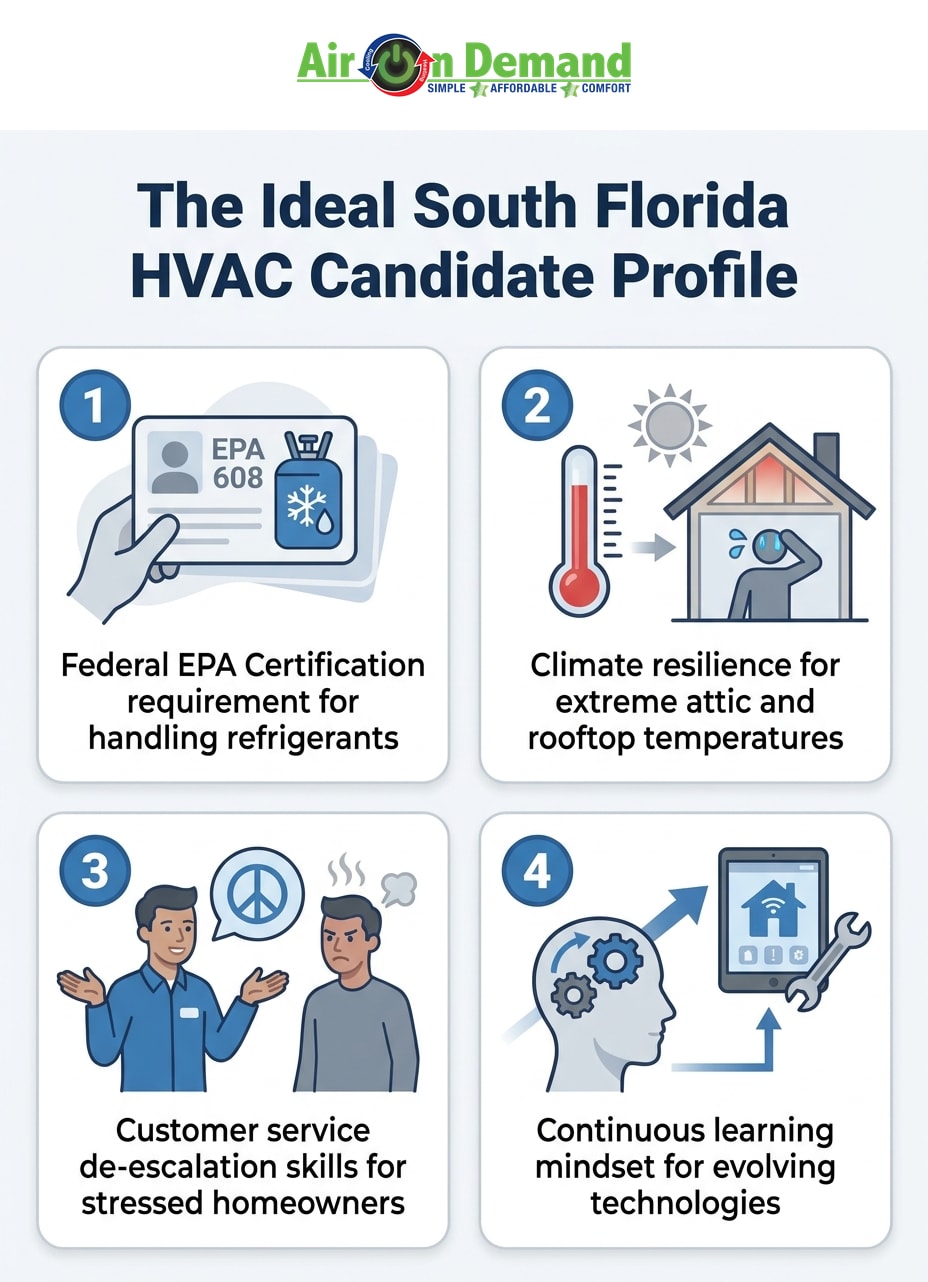
The Solution: We prioritize candidates who can de-escalate these frustrated homeowners and explain technical issues in plain, reassuring language. Demonstrating empathy and clear communication is just as critical as diagnosing a mechanical fault correctly.
Address the emotional aspect of losing air conditioning in South Florida. When a homeowner is sweating in their own living room, they are not just looking for a mechanic; they are looking for a professional who can restore their comfort and peace of mind. During your interview, share specific examples of how you have handled angry or panicked customers in the past. Explain your process for actively listening to their concerns, validating their frustration, and outlining a clear, step-by-step plan to resolve the issue.
Translating complex HVAC jargon into understandable advice builds immediate trust. If you tell a homeowner that their "TXV is restricting refrigerant flow and causing the evaporator coil to freeze," you will likely meet blank stares. If you explain that "a small valve is stuck, which is acting like a kink in a garden hose and stopping the system from cooling," they will understand the problem and feel comfortable approving the repair.
Discuss how clear communication prevents callbacks and improves overall customer satisfaction. A technician who communicates well makes the job easier for our entire team, especially the customer service representative back at the office who handles the follow-up calls.
While exceptional soft skills and a calm demeanor will ultimately win you the job, specific technical credentials are non-negotiable prerequisites for employment. We use the initial stages of an interview to verify your foundational knowledge of basic tools, equipment, and industry safety standards. You must prove that you have the baseline competency to operate safely in the field before the conversation shifts to customer service.
Candidates transitioning from other trades must demonstrate a strong willingness to learn HVAC-specific mechanical troubleshooting. Even if you are an expert in automotive repair or electrical wiring, residential cooling systems require a distinct set of diagnostic skills and legal certifications.
The most critical technical requirement in this industry is the proper handling of chemical refrigerants. Federal regulations require strict adherence to refrigerant handling protocols to protect the environment and ensure personal safety. You cannot legally attach a set of gauges to an air conditioning system without holding an active EPA Certification (specifically Section 608).
Explain your understanding of this legal necessity during the interview. Discuss how you stay updated on the phase-outs of older refrigerants and the introduction of newer, more environmentally friendly alternatives. We will verify this knowledge during the technical screening to ensure you will not create liability issues for the company.
Highlight the importance of safety protocols in both residential and commercial settings. Working with high-voltage electricity, pressurized gases, and heavy equipment carries inherent risks. Detail how a safety-first mindset is your top priority. Mention your familiarity with lockout/tagout procedures, proper ladder usage, and the use of personal protective equipment (PPE). If you are interviewing for a role as an HVAC apprentice, showing a healthy respect for these hazards proves that you are a responsible investment for our team.
Because the technical aspects of the job can often be taught, behavioral interviews in this field focus heavily on your past experiences with difficult customers and high-pressure deadlines. We want to see how you react when things do not go according to plan. To answer these questions effectively, candidates should use the STAR method (Situation, Task, Action, Result) to structure their responses.
Expect scenario-based questions that test both your ethical decision-making and your technical troubleshooting under time constraints. For example, we might ask how you handled a situation where a repair took twice as long as expected during a busy day of November holiday-season home prep. Here is how to break down your answer:
1. Analyze the Situation: Briefly describe the context without placing blame. Explain that you were on a routine maintenance call that unexpectedly turned into a complex electrical diagnostic, putting you behind schedule.
2. Define the Task at Hand: Outline what needed to be accomplished. You needed to fix the homeowner's system correctly while also managing the expectations of your next two appointments.
3. Detail Your Action Plan: Focus on your communication and problem-solving. Explain how you informed the current homeowner of the delay, called your dispatcher to adjust the schedule, and then methodically repaired the electrical fault without rushing the safety checks.
4. Highlight the Result: End with a positive outcome. The system was restored safely, the homeowner was grateful for your transparency, and the dispatcher was able to reroute another technician to cover your delayed calls.
Highlighting adaptability and a calm demeanor during unexpected challenges will strongly resonate with us. It proves that you view obstacles as problems to be solved, rather than reasons to panic.
The cooling and heating industry is rapidly evolving. Today's technicians work with high-efficiency variable-speed systems, smart home integrations, and advanced diagnostic software. We seek candidates who view their role as a long-term career requiring ongoing education, rather than just a daily job where they punch a clock. While holding an EPA Certification gets you in the door, your willingness to keep learning keeps you moving upward.
At Air On Demand, our standard for excellence means we look for continuous learners who value customer service and soft skills just as much as technical credentials. Being a true team player who supports dispatchers, customer service representatives, and fellow technicians is highly valued. We invest heavily in training our staff, and we expect candidates to show genuine enthusiasm for professional development.
• Embrace new technology: Show that you are excited to learn about the latest inverter-driven heat pumps and digital manifolds.
• Support your peers: Discuss how you are willing to run a part out to a colleague or stay late to help a junior technician finish a complex installation.
• Protect the brand: Understand that every time you pull into a driveway in a wrapped company truck, you are representing the entire team's reputation.
In our experience at Air On Demand, we look for a solid balance of mechanical aptitude, safety awareness, and exceptional customer service skills. We want technicians who can accurately diagnose complex mechanical failures without taking shortcuts. Additionally, because technicians work directly inside homes, we prioritize candidates who communicate clearly, maintain a professional appearance, and can de-escalate stressful situations.
Interviewing for this field places a much heavier emphasis on direct consumer interaction and specific environmental resilience. While a rough-in plumber or framer might primarily interact with a general contractor on a dusty job site, an air conditioning technician must speak directly with homeowners in finished living spaces. You must prove you can translate technical jargon into plain English and maintain a clean workspace.
Active listening, empathy, and clear communication are the most critical soft skills you can possess. When a system breaks down, homeowners are often anxious about their comfort and the potential cost. Being able to listen to their concerns, validate their frustration, and clearly explain the repair options builds trust and prevents misunderstandings.
You should wear clean, professional, and practical attire that shows you take the opportunity seriously. A tucked-in polo shirt or button-down shirt paired with clean work pants (like khakis or neat canvas pants) and sturdy, closed-toe shoes is ideal. Avoid wearing dirty work boots, torn jeans, or overly casual t-shirts, as this suggests a lack of professionalism.
Prepare by reviewing the foundational basics of the refrigeration cycle, electrical safety, and common hand tools. Be ready to discuss why you are passionate about entering the trade and how you handle learning new, complex concepts. Most importantly, highlight your reliability, your punctuality, and your eagerness to assist senior technicians without complaint.
Understanding exactly what South Florida hiring managers prioritize allows you to effectively tailor your resume and your interview answers. By recognizing that the local market demands more than just turning wrenches, you position yourself as a well-rounded professional. Highlighting a careful balance of customer service soft skills, climate resilience, and technical readiness—starting with your foundational EPA Certification—is the best path to success in this competitive field.
Take the time to practice your behavioral answers, review your safety knowledge, and approach your interview with confidence. If you are ready to take the next step toward a rewarding, fast-paced trade profession, review our available career opportunities and apply to become an HVAC service technician with Air On Demand today.