What to Expect During Your First Month as an HVAC Apprentice in Miami
October 2, 2026
Figuring out exactly what to expect during your first month as an HVAC apprentice in Miami is often a harsh wake-up call for new technicians stepping out of trade school. You know the refrigeration cycle backward and forward, and you can read a schematic perfectly in an air-conditioned classroom. But staring down a failing compressor on a sweltering rooftop or squeezing into a cramped mechanical closet changes the equation entirely. The transition from textbook theory to the grueling logistics of real-world service calls is the first major hurdle every new technician faces.
If you are ready to take the leap into the trades, building a strong foundation starts with the right team. You can explore local opportunities by visiting our HVAC careers page.
The shock of this transition is completely normal. Most green technicians quickly reach a decision point where they must assess whether they are physically and mentally prepared for the unglamorous realities of the trade. The local environment presents unique challenges that standard national training programs rarely prepare you for. For example, a routine October fall maintenance check in other parts of the country might mean a crisp, cool afternoon. Here in South Florida, that same maintenance call often involves sweating through your uniform before noon while navigating tight spaces.
The real test of your first 30 days:
• Translating theory to practice: Learning how textbook concepts apply to older, heavily modified coastal systems.
• Physical endurance: Adapting your body to long hours of manual labor in high heat.
• Mental resilience: Accepting that you will make mistakes, get dirty, and spend more time fetching tools than diagnosing complex electrical faults in the beginning.
Entering the field requires you to unlearn the perfect scenarios presented in class and embrace the messy, unpredictable nature of residential and commercial service work.
The most immediate shock to the system for any new technician is the sheer physical toll of the local climate. Heat hazards do not magically end when summer officially closes. October in Miami still brings mid-80s heat paired with suffocating humidity, making fall maintenance physically intense, especially when you are working in poorly ventilated attics or stagnant mechanical rooms.
Acclimatization is a critical process during your early weeks. The Occupational Safety and Health Administration (OSHA) provides strict guidelines for heat illness prevention, emphasizing that new workers need time to build a tolerance to extreme environments. A typical pattern we see is an eager new apprentice trying to keep up with a veteran technician, only to experience heat exhaustion by 2:00 PM. Your body needs a gradual introduction to the heat stress required for an October fall maintenance schedule.
To survive and thrive, you must master several physical management strategies:
• Aggressive hydration: Drinking water is not enough. You must replenish electrolytes constantly throughout the shift, starting before you even arrive at the first job site.
• Strategic pacing: Working safely is more important than working fast. Rushing through a heavy equipment lift in an overheated space leads to mistakes and injuries.
• Recognizing physical limits: You must learn the early warning signs of heat stress—dizziness, excessive sweating, or sudden chills—and communicate with your lead technician immediately.
Finding an employer who understands these physical demands is critical. You want to learn the ropes through a structured HVAC apprentice program that prioritizes worker safety over rushing through a schedule. The heat is an inescapable part of the job, but learning to manage it properly ensures you can sustain a long, healthy career in the trades.
Beyond the weather, the physical landscape of South Florida introduces a massive logistical learning curve. Servicing sprawling suburban homes is one thing; navigating Miami high-rise condos is an entirely different beast. The logistical nightmares and physical toll of working in densely populated, multi-story residential buildings will test your organizational skills every single day.
The physical strain is significant. You are no longer just walking a few feet from the service van to a backyard condenser. You will frequently find yourself hauling heavy tool bags, nitrogen tanks, and 50-pound recovery cylinders up multiple flights of stairs when elevators are down or restricted.
Here is a breakdown of the common high-rise challenges and how a successful apprentice handles them:
• Severe Parking Restrictions — The Root Cause: Loading zones are often full, requiring the van to be parked blocks away in expensive or tight garages. — The Apprentice Solution: Mastering the use of collapsible utility carts and organizing the van so heavy items are easily accessible for long hauls.
• Service Elevator Delays — The Root Cause: Strict building management schedules mean waiting 20-30 minutes just to get access to a padded service elevator. — The Apprentice Solution: Extreme mental organization. You must ensure every single tool, part, and gauge is brought up on the very first trip.
• Restricted Roof Access — The Root Cause: Condenser farms on condo roofs often require navigating narrow catwalks or climbing secondary roof hatches. — The Apprentice Solution: Developing spatial awareness, practicing safe lifting techniques in confined spaces, and securing tools to prevent drops.
The most valuable trait you can develop in your first month is mental organization. Forgetting a specific pipe wrench or a specialized meter in the van costs your lead technician an hour of lost time navigating back down through a high-rise building. Anticipating the needs of the job before the elevator doors close is what separates a struggling helper from a rising professional.
Trade schools do an excellent job teaching the fundamentals of thermodynamics, airflow, and electrical theory. However, they often gloss over the highly specific local building regulations that govern how equipment must be legally and safely installed. In South Florida, these codes are not just bureaucratic red tape; they are critical safety measures designed to protect property and lives during severe weather.
As a new apprentice, your first month will involve a crash course in strict permitting and structural codes enforced by local jurisdictions. You will learn that a perfect refrigeration charge means nothing if the condenser is not properly secured against severe wind loads. You will be trained to spot compliance issues on existing coastal units, such as rusted hurricane tie-downs or improper electrical disconnect placements on Miami high-rise condos.
One of the most important regulatory frameworks you will encounter is the Notice of Acceptance (NOA) standard. Issued by Miami-Dade County, an NOA certifies that a specific product or installation method has been rigorously tested to withstand extreme wind pressures and flying debris.
• What it means for daily installations: Every piece of equipment, from the condenser stand to the exact type of Tapcon screws used to secure it to the concrete pad, must match the approved NOA engineering specifications. You cannot improvise with hardware store alternatives.
• Your role as an apprentice: Your job is to ensure the mounting hardware, tie-downs, and vibration pads being loaded onto the truck exactly match the approved permitting documents for that specific job site. Learning to read and verify these requirements early on makes you an invaluable asset to your lead installer.
To succeed early on, you need to set realistic expectations for your daily tasks. You will not be diagnosing complex variable-speed communication errors on day two. Instead, your primary job is to facilitate the workflow of your lead technician and absorb as much information as possible.
If you are curious about how these daily tasks translate into a long-term career path, reviewing the various HVAC service technician roles can give you a clear picture of where this foundational work leads. Here is what your actual daily routine will look like:
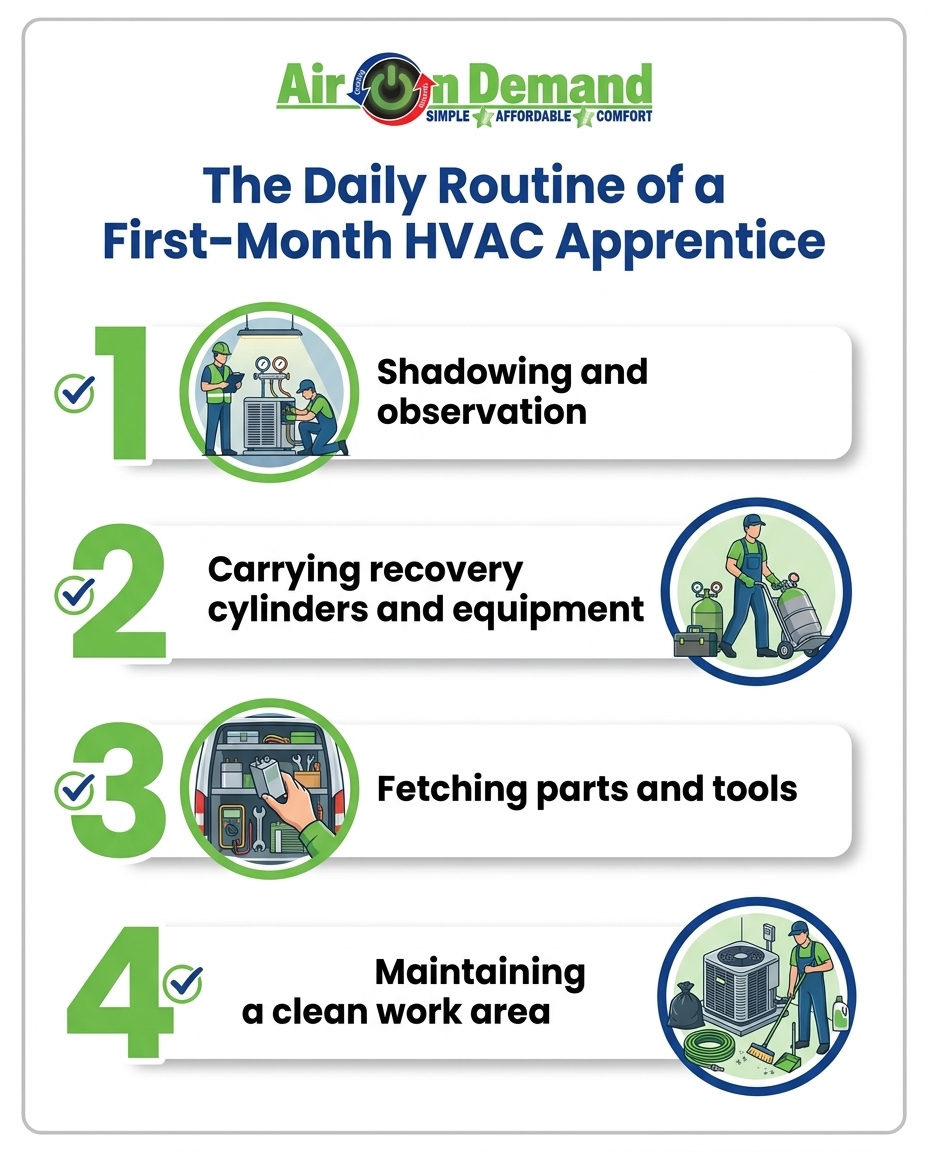
1. Shadowing and Observation: You will spend hours simply watching. You will observe how senior technicians approach a diagnostic process, how they trace electrical shorts, and importantly, how they communicate with frustrated customers whose AC has failed. Take mental notes on their troubleshooting sequence.
2. Managing Tool Requirements: You are responsible for your basic hand tools and the overall organization of the work area. Knowing the essential tools for first-year HVAC apprentices is critical, but keeping them clean, organized, and ready to hand to your lead tech is even more important.
3. Heavy Lifting and Logistics: You will fetch parts, carry recovery cylinders, haul ladders, and handle the physical grunt work. Whether you are working on a suburban split system or navigating the stairs of Miami high-rise condos, your physical effort directly speeds up the job.
4. Anticipating the Next Move: A great apprentice does not wait to be told what to do next. If the lead tech is brazing a line set, you should already have the nitrogen purge ready and a wet rag in hand. Anticipation proves you are paying attention to the process.
5. Prioritizing Punctuality and Work Ethic: Technical perfection will come with time. In your first 30 days, your lead technician is judging your reliability. Showing up 15 minutes early, maintaining a positive attitude in a 110-degree attic, and staying off your phone are the metrics of early success.
The HVAC industry is notorious for high turnover rates among first-year helpers. Often, this is not because the work is too hard, but because the training environment is deeply flawed. A "trial-by-fire" approach—where green technicians are handed a tool bag and left to figure things out on their own—is a recipe for mistakes, injuries, and rapid burnout.
The mentor-apprentice dynamic is critical for safely navigating complex coastal systems. You need a lead technician who takes the time to explain why a specific superheat reading indicates a restriction, rather than just telling you to add refrigerant. Companies that invest in structured career growth understand that an apprentice's questions are not annoyances; they are the building blocks of a future master technician.
At Air On Demand, our commitment to thorough, hands-on training positions our company as a supportive environment that prioritizes apprentice safety and long-term development. We believe that proper guidance prevents burnout. When you are sweating through a grueling October fall maintenance schedule, knowing that your team has your back and is actively invested in your education makes all the difference. To see the kind of professionals you could be learning from, take a moment to meet our HVAC team.
Is being an HVAC apprentice hard in South Florida?
Yes, it is physically and mentally demanding. The combination of persistent heat, high humidity, and the physical labor of hauling equipment makes the early days exhausting. However, once your body acclimatizes and you learn efficient work practices, the difficulty becomes manageable and the skill set you build is highly rewarding.
What does an HVAC apprentice do on a daily basis?
An apprentice primarily supports the lead technician to ensure the job runs smoothly. This includes organizing the service van, carrying heavy tools and recovery cylinders, fetching parts, and maintaining a clean work area. Over time, daily tasks expand to include taking basic gauge readings, cleaning coils during an October fall maintenance visit, and assisting with complex installations.
What should I expect in my first year of HVAC training?
You should expect a steep learning curve focused heavily on safety, logistics, and basic mechanical skills. Your first year is less about mastering advanced diagnostics and more about understanding airflow, proper tool usage, and local building codes. Expect to make mistakes, ask a lot of questions, and gradually earn the trust to perform tasks independently.
Do I need to know local building codes before I start?
You do not need to have the codebook memorized on day one, but you must be ready to learn them quickly. Your mentors will teach you the specifics of Miami-Dade NOA standards, hurricane tie-downs, and wind load requirements. Understanding these codes is essential for ensuring every installation meets strict regional safety guidelines.
How do HVAC apprentices handle the extreme heat and humidity?
Handling the climate requires strict adherence to hydration and acclimatization protocols. Apprentices must drink water and electrolytes constantly, learn to pace their physical exertion, and take necessary breaks when working in confined, unventilated spaces. Recognizing your physical limits early on prevents dangerous heat exhaustion.
The reality of your first month in the trade is that it will test your resolve. The physical tax of hauling equipment up the stairs of Miami high-rise condos, the relentless heat, and the sheer volume of new information can feel overwhelming. But mastering the trade in this unique, demanding market builds an unparalleled level of expertise. If you can succeed here, you can succeed anywhere in the industry.
We encourage aspiring technicians to seek out programs that value their safety, prioritize continuous education, and offer genuine mentorship. If you are ready to put in the hard work and build a career that offers lifelong stability and growth, now is the time to take that first step. Explore local training programs, ask questions, and prepare to learn a trade that keeps our community running.