Essential Tools Every First-Year HVAC Apprentice in Miami Needs
September 22, 2026
Here's the thing: your standard carbon-steel pliers are already showing rust spots, and your budget diagnostic gear is acting up after just one week on the job. Gathering the essential tools every first-year HVAC apprentice in Miami needs means confronting a harsh reality—the local climate will actively destroy cheap equipment. Standard, unsealed tools corrode, short out, or seize up rapidly when exposed to South Florida's relentless humidity and coastal salt air. A typical pattern we see is new technicians buying basic hardware store kits, only to watch them fail during the September peak humidity and late-summer heat.
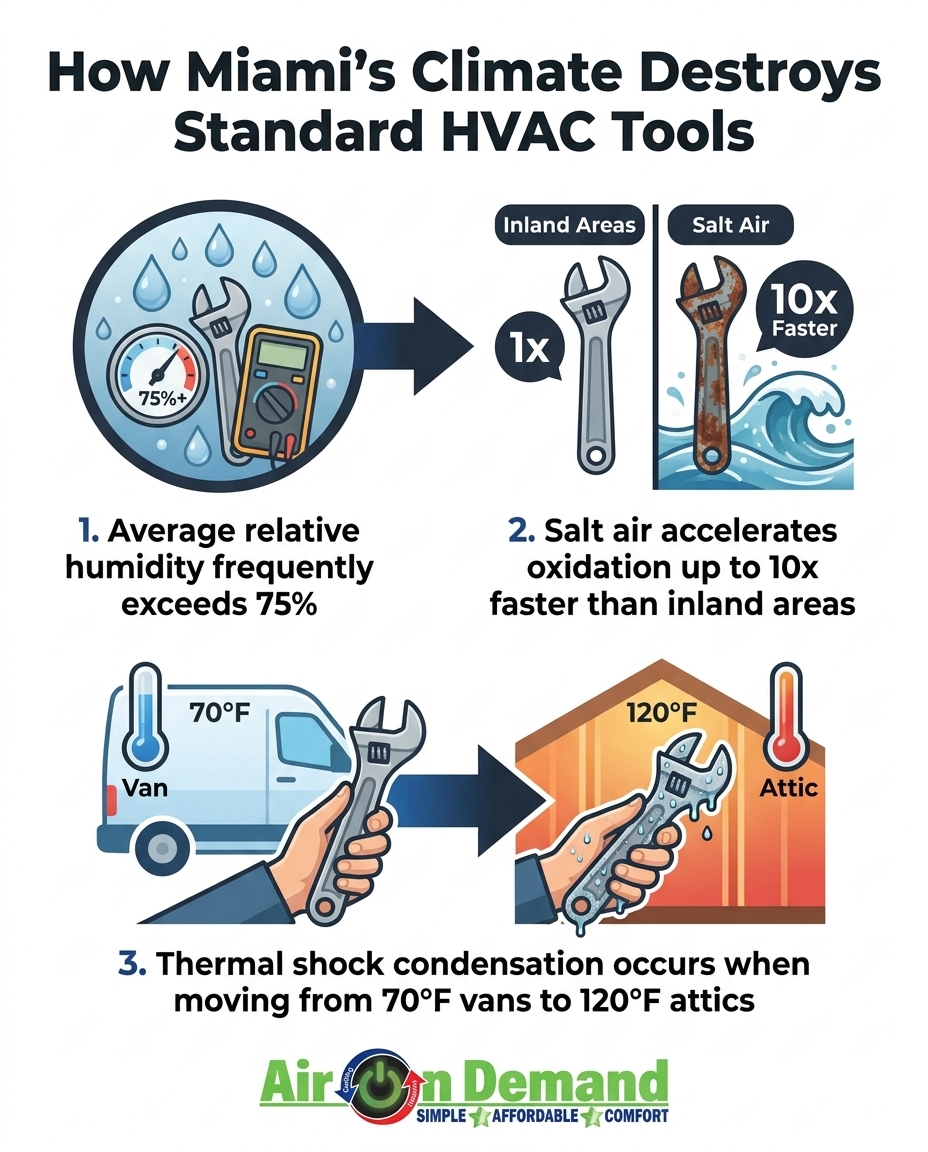
The core decision point for any new technician is figuring out which items require a heavier upfront investment for durability, and where it is safe to be more cost-effective. Surviving the trade in this region means equipping yourself specifically for the local environment. Moving from an air-conditioned service van at 70 degrees into the oppressive 120-degree outdoor heat creates instant, heavy condensation on cold metal and circuit boards. If your gear isn't built to handle that thermal shock and moisture, you will be replacing it before your first year is up.
If you are starting your journey as an HVAC apprentice or looking to advance to a full-fledged HVAC service technician, equipping yourself for the environment is step one.
The problem: Standard DIY hand tools and entry-level electronics are designed for dry, temperate environments. They lack the specialized coatings and internal seals necessary to survive a demanding industrial setting.
The cause: Miami's average relative humidity frequently exceeds 75%, creating an atmospheric soup that wreaks havoc on unprotected gear. When you factor in the coastal salt air, the oxidation process on unprotected iron and steel accelerates by up to 10 times compared to inland areas. Furthermore, the physical toll of extreme heat means your tools must withstand heavy sweat, constant moisture, and abrasive conditions daily. Depending on the difference between commercial and residential HVAC apprenticeships, you might find yourself navigating salt-sprayed commercial rooftops or stifling, unventilated residential attics—both of which test the limits of your equipment.
The solution: Understanding the science of condensation and oxidation allows you to select tools engineered with specific marine-grade or industrial-grade protections. You have to anticipate the September peak humidity and late-summer heat by choosing alloys and electronic casings that reject moisture rather than absorbing it.
The most immediate threat to your tool bag isn't just the ambient heat; it is thermal shock. When you pull a cold tool out of a highly air-conditioned service van and carry it into a sweltering attic, the tool's temperature is well below the dew point of the surrounding air. Moisture immediately condenses on every exposed surface. On poorly sealed equipment, this water vapor instantly coats internal circuit boards, copper wiring, and unlubricated joints, leading to micro-corrosion that degrades performance over time.
Standard steel tools rust quickly in Miami because the airborne salt particles act as an electrolyte, rapidly speeding up the electrochemical process of corrosion. A standard chrome-plated wrench that might last a decade in Arizona can begin pitting and flaking within months in South Florida. This is why specific anti-corrosion coatings, such as black oxide finishes or high-grade chrome vanadium alloys, are non-negotiable for technicians working along the coast.
The multimeter is the absolute lifeline of an HVAC technician. It is the tool that tells you if a circuit is live, if a capacitor is failing, or if a compressor motor is grounded. Relying on cheap, unsealed versions is incredibly dangerous in high-condensation environments. A single drop of sweat or a layer of condensation inside a cheap multimeter can bridge a circuit board, ruining the tool or, worse, causing a catastrophic arc flash. This is one area where professional-grade investment is mandatory to ensure both accuracy and personal safety.
1. Verify the safety rating first: Always check the meter for proper CAT III or CAT IV ratings before purchasing.
2. Check for environmental sealing: Look for meters specifically advertised as moisture-sealed or possessing an IP67 rating to block dust and water vapor.
3. Assess the test leads: Ensure the test leads feature heavy-duty, temperature-resistant silicone insulation rather than cheap PVC that cracks in the heat.
4. Test the continuity speed: A professional meter will provide an instant audible beep for continuity, which is critical when working in awkward, sweaty positions where you can't easily see the screen.
In the HVAC industry, CAT (Category) ratings dictate the level of transient overvoltage a meter can safely handle without blowing up in your hands. A CAT III rating is the minimum standard for residential and commercial HVAC work, designed to handle the load of hard-wired equipment and main breaker panels. CAT IV offers even higher protection for utility-level outdoor connections. These ratings are non-negotiable; using a CAT II meter designed for basic indoor electronics puts you at severe risk of electrical injury.
Humidity actively interferes with electrical resistance and continuity testing. When moisture bridges the gap between test probes or infiltrates the meter's dial, it can create parallel resistance paths. This leads to false readings, causing you to misdiagnose a perfectly good component as faulty, or vice versa. Investing in moisture-sealed multimeters and corrosion-resistant gauges ensures that the numbers on your screen are accurate, preventing callbacks and frustrated customers.
Manifold gauge sets are your window into the refrigeration cycle. They allow you to diagnose airflow issues, check superheat and subcooling, and verify that a system is operating at peak efficiency. However, standard brass fittings or cheap metal manifolds are notorious for failing in Miami's coastal air. The threads seize up, the valves stick, and the internal springs rust, rendering the tool useless.
To survive the local environment, you need gauges constructed from high-grade forged aluminum alloys or specially treated brass. The dials or digital screens must be weather-resistant to prevent internal fogging. If you are handling AC repair in Miami, accurate diagnostics are the foundation of a successful fix. A sticking valve on a cheap manifold can lead to overcharging a system, causing liquid slugging and catastrophic compressor failure. Investing in moisture-sealed multimeters and corrosion-resistant gauges is the only way to guarantee precision.
The debate between analog and digital manifolds often comes down to personal preference, but in a highly humid climate, specific factors must be considered. Extreme humidity can affect the calibration of cheap analog gauges over time, rusting the delicate Bourdon tubes inside the dials. Digital manifolds offer incredible accuracy and automatic calculations, but they introduce electronic components to a wet environment.
• Moisture Vulnerability — Analog Manifold Gauges: Prone to dial fogging and internal tube rust if unsealed. — Digital Manifold Gauges: Screen failure or sensor shorting if IP rating is low.
• Durability in Heat — Analog Manifold Gauges: Highly durable, unaffected by screen glare or battery drain. — Digital Manifold Gauges: Requires temperature-compensated sensors; batteries drain faster.
• Calibration Needs — Analog Manifold Gauges: Requires frequent manual zeroing after temperature swings. — Digital Manifold Gauges: Auto-calibrates, but sensors can be damaged by moisture ingress.
• Ideal Miami Spec — Analog Manifold Gauges: Glycerin-filled dials to prevent fogging and flutter. — Digital Manifold Gauges: IP54 or IP67 rated casing with heavy-duty rubber overmolding.
Beyond diagnostics, your daily hand tools take the brunt of the physical abuse. Working in unventilated spaces during peak summer heat means your hands will be covered in sweat, grease, and grime. Basic DIY tools feature slick plastic handles and untreated carbon steel that will slip from your grip and rust almost immediately. Professional-grade HVAC gear uses specialized metal alloys and textured grips designed specifically for these harsh conditions.
To prepare for the September peak humidity and late-summer heat, your basic tool pouch should include:
• Multi-bit screwdrivers: Look for models with heavy-duty, moisture-resistant internal storage and black oxide-coated bits to prevent rusting inside the shaft.
• Nut drivers (1/4" and 5/16"): These are the most frequently used tools in your bag. Choose hollow-shaft models with chrome plating to resist oxidation from salty fingerprints.
• Wire strippers and crimpers: Avoid cheap stamped steel. Opt for forged steel with a protective clear coat or specialized anti-corrosion finish to keep the cutting edges sharp.
• Adjustable wrenches: A sticking worm gear is incredibly frustrating. Invest in wrenches with tight tolerances and apply a light coat of oil weekly.
• Slip-resistant grips: Ensure all hand tools feature rubberized, textured grips (often called cushion grips) that channel sweat away and provide torque even when wet.
• Service valve wrenches: Essential for opening and closing system valves; choose forged, ratcheting models that resist seizing.
Buying professional-grade tools is only half the battle; maintaining them is crucial in South Florida. Even the best moisture-sealed multimeters and corrosion-resistant gauges will degrade if they are tossed into a damp bag and left in a hot van overnight. Creating a rigorous daily maintenance routine extends the lifespan of your equipment and ensures you are always ready for the next call.
The danger of leaving wet tools in a sealed bag overnight in a humid garage or van cannot be overstated. The trapped moisture creates a micro-climate that accelerates rust faster than leaving them outside. Proper organization and daily care are just as important as the tools themselves.
1. Look for molded, waterproof bases: A hard plastic or rubberized bottom keeps your tools elevated and dry when you have to set the bag down on wet grass, flooded AC pads, or damp attic insulation.
2. Prioritize breathable materials: Choose heavy-duty ballistic nylon that allows for some airflow, rather than completely sealed PVC bags that trap sweat and condensation inside.
3. Use vertical tool pockets: Storing hand tools vertically allows moisture to drain down and evaporate, rather than pooling inside the joints of your pliers and wrenches.
1. The end-of-day wipe down: Keep a dedicated microfiber cloth in your van. Take 60 seconds at the end of your shift to wipe the sweat, dirt, and skin oils off every hand tool you used that day.
2. Apply moisture-displacing sprays: Once a week, lightly spray the hinges of your pliers, wire strippers, and adjustable wrenches with a water-displacing lubricant (like WD-40 or a specialized tool oil). Wipe off the excess so they don't attract dirt.
3. Store electronics separately: Keep your multimeters and digital gauges in padded, zippered pouches equipped with silica gel packets to absorb ambient moisture overnight.
4. Ventilate your bag: If your tools got soaked in a sudden Miami downpour, leave your tool bag open in an air-conditioned room overnight to dry completely before your next shift.
Showing up to a job site with climate-appropriate, professional-grade tools demonstrates a deep commitment to the trade and a readiness to learn. It separates those who view HVAC as a temporary job from those building a lifelong career. At Air On Demand, we believe that high industry standards protect both the technician and the homeowner. Working with a team that values mentorship means you get guidance on how to properly prepare for the realities of the field, rather than learning the hard way through broken equipment and false diagnostics.
The tools you carry reflect the quality of the work you intend to perform. When you are equipped to handle the September peak humidity and late-summer heat without your gear failing, you can focus entirely on solving the customer's problem. Exploring HVAC careers in Miami requires this level of preparation. By investing in the right equipment from day one, you signal to your mentors, your peers, and your customers that you take your responsibilities seriously.
The short answer is: A first-year apprentice needs basic hand tools, a high-quality multimeter, and a reliable manifold gauge set. Specifically, you should focus on items like 1/4" and 5/16" nut drivers, wire strippers, adjustable wrenches, and a multi-bit screwdriver. Because of the local climate, ensuring you have moisture-sealed multimeters and corrosion-resistant gauges is far more important than buying a massive, 100-piece introductory kit.
The quick fix: Wipe them down daily and use a water-displacing lubricant weekly. Sweat and coastal salt air accelerate rust rapidly, so removing those corrosive elements at the end of every shift is vital. Store your gear in a bag with a waterproof base, and keep silica gel packets in the compartments where you store sensitive electronic testing equipment.
Safety and accuracy are paramount: A good HVAC multimeter must have a CAT III or CAT IV safety rating to handle high-voltage spikes safely. It should also measure capacitance, microamps (for flame sensors), and temperature. In high-humidity areas, environmental sealing is essential to prevent internal moisture from causing false continuity readings or dangerous short circuits.
It comes down to the atmosphere: Standard hand tools are often made of untreated carbon steel that rusts rapidly when exposed to high airborne moisture and salt air. Furthermore, the extreme heat causes technicians to sweat heavily, leaving corrosive oils and salts on the handles and joints. Professional HVAC tools use specialized alloys and coatings like black oxide to resist this rapid degradation.
Most professionals build their kits over time: You do not need to purchase every highly specialized tool on your first day. Start by investing heavily in the essentials—specifically a safe, moisture-sealed multimeter and durable basic hand tools. As you gain experience and encounter different types of service calls, you can gradually add specialized, heavy-duty equipment to your bag.
Investing in moisture-sealed multimeters and corrosion-resistant gauges is much more than a preliminary checklist; it is an investment in a successful, long-term South Florida HVAC career. The local climate is unforgiving, and the right gear prevents unnecessary frustration, ensures your safety around high-voltage equipment, and allows you to diagnose complex issues accurately. By building a tool bag designed specifically to withstand high humidity, coastal salt air, and extreme heat, you set a foundation for professional excellence. If you are ready to put those tools to work, take the next step in your career by seeking out mentorship and opportunities that value high standards and continuous learning.