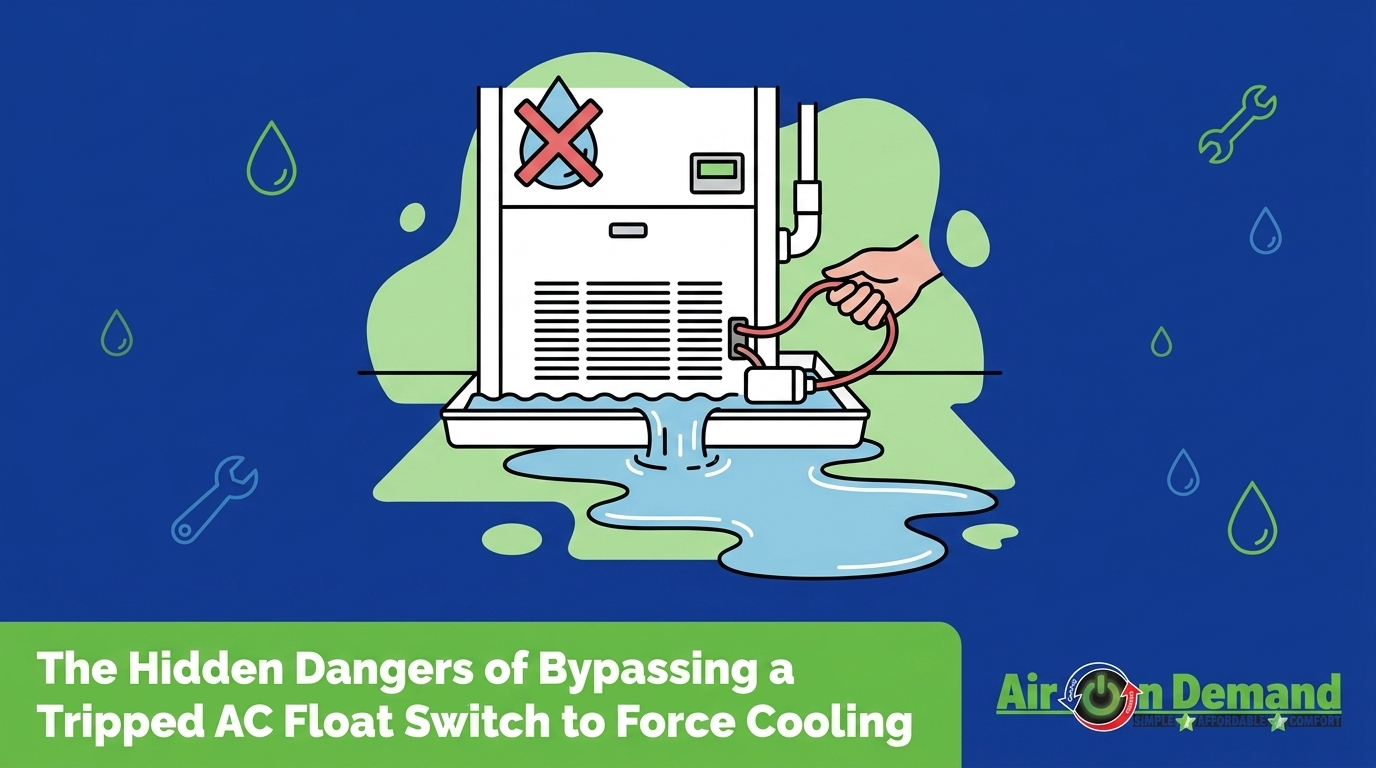
The Danger of Bypassing a Tripped Float Switch to Force Your AC to Run
August 17, 2026
The house is heating up rapidly on a hot August weekend, your thermostat is blank or unresponsive, and you suddenly realize the air conditioning has stopped completely. Understanding the danger of bypassing a tripped float switch to force your AC to run is the most critical thing you can do in this exact moment, because that overwhelming temptation to rig the system for temporary relief usually leads to massive property damage. When our Air On Demand technicians respond to these late-summer emergency calls, we almost always find a drain pan full to the brim with water and a small mechanical switch that has deliberately shut your entire system down.
The immediate frustration is completely understandable. The late-summer heat is oppressive, your family is uncomfortable, and the thought of waiting for a technician feels unbearable. Many homeowners look at that small, simple switch and think about just wiring around it to get the cold air flowing again. However, temporarily bypassing this switch disables a critical fail-safe mechanism. Instead of risking severe property damage with a DIY workaround, reaching out for professional AC repair services or emergency AC repair in Miami is the only responsible way to restore your comfort safely.
To understand why bypassing this component is so hazardous, you first have to understand what it does. A condensate float switch is a small, specialized safety device typically installed in the primary or secondary drain pan of your indoor air handlers. Its sole purpose is to monitor the water level inside that pan. Under normal operating conditions, the water extracted from your home's air drains safely outside. But if that water stops draining and begins to pool, the switch activates.
The mechanics are simple but highly effective. Inside the switch is a small float—much like the one inside a toilet tank, but on a miniature scale. As the water level rises in the drain pan, the float lifts. Once it reaches a predetermined height, it breaks the low-voltage electrical circuit that communicates with your thermostat and compressor. The moment that circuit is broken, the air conditioning system shuts down instantly.
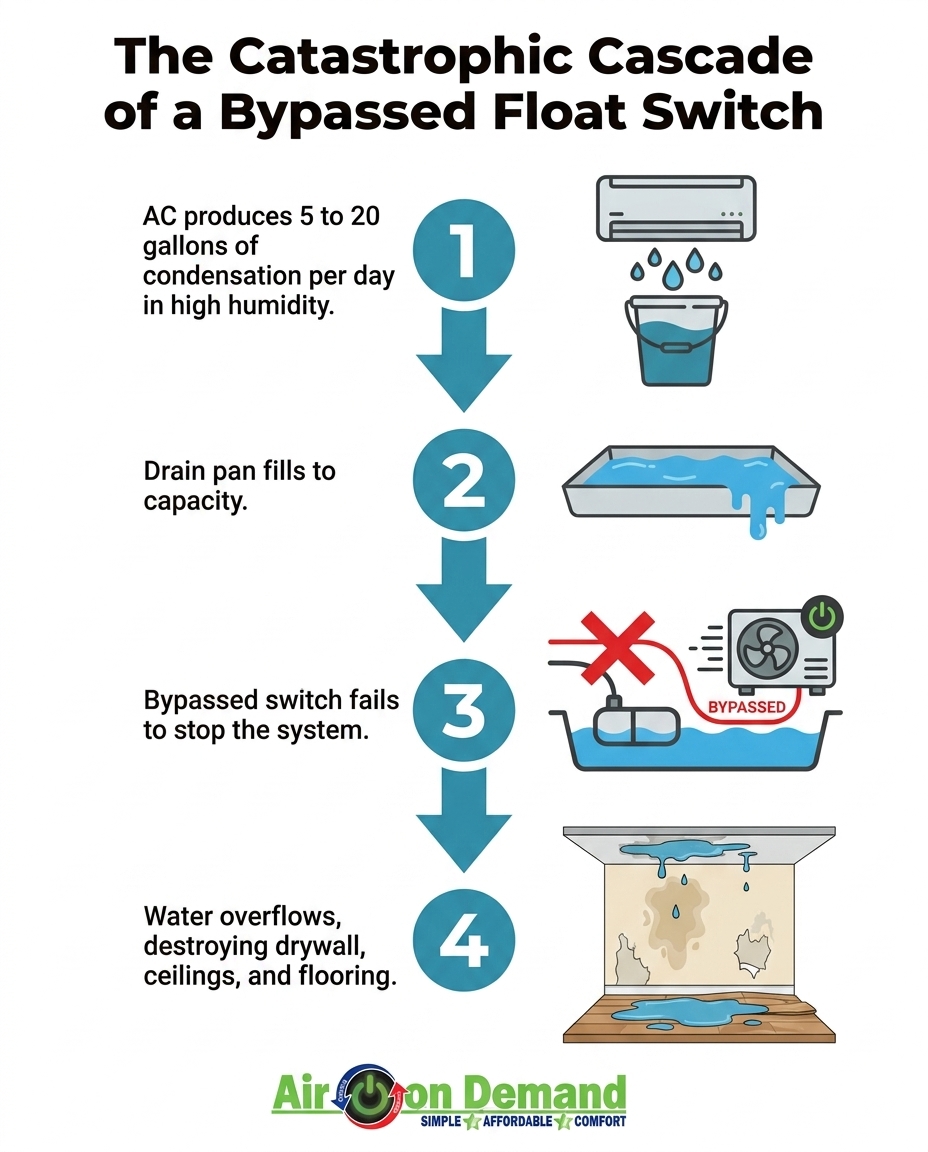
The sheer volume of water: We find that most homeowners do not realize just how much water a central air conditioner produces. In highly humid environments like our Miami FL service area, an air conditioner does not just cool the air; it dehumidifies it. During a typical summer day, a residential AC unit can extract anywhere from 5 to 20 gallons of condensation. That is the equivalent of leaving a garden hose trickling inside your attic or utility closet.
When you view it through this lens, a tripped float switch is not an annoyance. It is a highly successful intervention. That small plastic device just saved your home from tens of gallons of water pouring through your ceilings or across your floors.
Float switches are simple, reliable devices that rarely fail on their own. If your switch has tripped, it is almost certainly because the water in your drain pan literally has nowhere else to go. Bypassing the switch does not fix the underlying problem; it simply ignores an active, worsening plumbing issue inside your HVAC system.
In our years of servicing Miami HVAC systems, we've found that the most common culprit behind a tripped float switch is a clogged condensate drain line. This line is usually a white PVC pipe that carries the extracted water from your indoor unit to the exterior of your home. Over time, this pipe becomes the perfect breeding ground for biological growth. Continuous late-summer operation accelerates this process, pushing constant moisture through a dark, warm environment.
Ignoring this root cause by forcing the system to run guarantees that the water will overflow the pan. The system will continue pulling moisture from the hot August weekend air, and without a clear exit path, that moisture will spill directly into your home. The only way to permanently resolve the issue is through routine AC maintenance and professional drain clearing.
Our team sees the same patterns every August. Understanding how clogs form helps illustrate why they are so stubborn. The blockage is rarely a single object; rather, it is a slow accumulation of several factors:
• Airborne particulates: Even with a good air filter, microscopic dust, pet dander, and dirt bypass the filter and stick to the wet evaporator coil. This debris washes down into the drain pan.
• Biological sludge: When dust mixes with standing water in a warm environment, it creates a thick, jelly-like sludge. Algae, mold, and mildew thrive in these dark, damp PVC pipes.
• Calcification and scale: Over time, minerals from the condensation can build up along the walls of the pipe, narrowing the passage and making it easier for sludge to form a complete blockage.
If you choose to bypass the float switch, the timeline to disaster is shockingly rapid. Because an air conditioner running continuously in high humidity extracts gallons of water a day, an already-full drain pan will begin overflowing within hours—sometimes even minutes—of the system being forced back on.
The cascading damage affects almost every layer of your home's construction. If your air handler is located in the attic, the overflowing water first saturates the attic insulation, rendering it useless. From there, the water pools on the top side of your ceiling drywall. Drywall acts like a giant sponge, absorbing the moisture until it loses its structural integrity. Eventually, the saturated ceiling will collapse under the weight of the water, destroying everything in the room below.
If your unit is located in an interior closet, we have witnessed firsthand how the overflow immediately attacks your flooring. Hardwood floors will warp, cup, and buckle as the wood fibers absorb the moisture. Carpets and their underlying padding will become soaked, creating an instant breeding ground for mold. Water damage from plumbing and HVAC failures is consistently one of the leading causes of severe home insurance claims, and the disruption of remediating this damage far outweighs the temporary discomfort of a warm house.
The visible damage is often just the beginning. The hidden structural risks of an HVAC overflow event can haunt a home for years if not properly mitigated:
• Trapped moisture inside walls: Water travels along the path of least resistance, often running down the inside of wall cavities where it cannot be seen or easily dried.
• Rapid mold growth: In the warm climate of Miami FL, mold can begin colonizing soaked building materials in as little as 24 to 48 hours.
• Compromised indoor air quality: Once mold establishes itself inside ductwork or wall cavities, the HVAC system can inadvertently circulate those spores throughout the entire house.
Beyond the severe risk of water damage, bypassing a float switch introduces significant electrical hazards. The float switch is wired directly into the system's low-voltage control circuit. Altering these wires is not a simple plug-and-play operation; it requires modifying the electrical pathways that govern the entire HVAC system.
Improper wire splicing or jumping circuits can easily cause electrical shorts. If the low-voltage wires are crossed incorrectly or left exposed, they can send a surge of electricity back to the control board or the thermostat, instantly frying those delicate electronic components. Our repair crews frequently have to replace fried circuit boards precisely because a homeowner attempted a quick wiring fix.
Furthermore, introducing unapproved electrical modifications near a known water source—an overflowing drain pan—is a severe fire and safety hazard. Water and exposed wiring are a disastrous combination. Finally, it is important to note that unauthorized modifications to safety mechanisms will instantly void your manufacturer warranties. If the manufacturer or your insurance company discovers that a safety switch was deliberately bypassed, you will likely be held entirely responsible for all resulting damage and equipment failures.
We understand that the psychological temptation to perform a DIY bypass is strong, especially as kids head back to school and the late-summer heat makes the house sweltering. The thought process is usually: "I just need it to run until Monday when I can call someone without paying weekend rates." However, logically dismantling this idea reveals why it is a terrible choice.
You are trading a perceived short-term benefit against a guaranteed catastrophic outcome. The financial burden of replacing ruined ceilings, ripping up warped hardwood floors, and paying for professional mold remediation is entirely preventable. Leaving the system off is the only responsible action until our technicians can clear the drain line.
• Provides a few hours of immediate cooling relief. — The Responsible Action (Leave Off): House remains warm temporarily while awaiting a professional.
• Guarantees the drain pan will overflow into the home. — The Responsible Action (Leave Off): Keeps all condensation contained safely within the pan.
• Creates major electrical short and fire hazards. — The Responsible Action (Leave Off): Protects the system's control board and thermostat.
• Results in massive remediation bills for floors and ceilings. — The Responsible Action (Leave Off): Results only in the standard cost of clearing a drain line.
• Voids manufacturer equipment warranties instantly. — The Responsible Action (Leave Off): Maintains full warranty coverage and compliance.
Instead of modifying your system's wiring, there are safe, actionable steps we recommend taking to assess the situation while waiting for our professionals to arrive. If you are wondering why your AC is blowing warm air or has shut down completely, follow these safe diagnostic steps:
1. Turn the thermostat to OFF: Do this immediately. This prevents the system from attempting to cycle on and off, which can cause further strain on the electrical components and prevent any additional condensation from forming.
2. Inspect the outdoor drain line exit: Walk outside to where your AC condenser is located and find the white PVC pipe that drips water. Look for any obvious, accessible blockages right at the exit point, such as mud, overgrown grass, or insect nests.
3. Use a wet/dry vacuum on the exterior pipe: If you have a shop vacuum, you can safely attempt to pull the clog out from the outside. Place the vacuum hose over the end of the PVC pipe (you can use your hands or a rag to create a tighter seal) and run the vacuum for a few minutes. This can sometimes dislodge the algae sludge safely without touching the indoor wiring.
4. Call a licensed professional: If the vacuum trick does not work, the pan remains full, or the system will not reset, do not attempt to open the indoor air handler or modify the switch. Call our emergency technicians to clear the line with specialized equipment and verify the system is safe to operate.
No, you should never temporarily bypass your AC float switch under any circumstances. Bypassing this switch removes the only safety mechanism preventing your air conditioner from overflowing. Because a running AC produces gallons of water a day, a bypassed switch will almost certainly result in severe water damage to your ceilings, walls, or floors within hours.
If an AC float switch fails mechanically and does not trip when the water level rises, the system will continue to run and produce condensation. The water will eventually crest the edges of the drain pan and spill directly into your home. This is why routine maintenance includes testing the float switch to ensure it is fully operational.
You can usually tell a float switch is bad if the drain pan is completely overflowing with water, yet the air conditioner is still running. Conversely, a bad switch might also get stuck in the "up" position, keeping your AC turned off even when the drain pan is completely bone dry. A licensed technician can test the continuity of the switch to confirm if it has failed.
If your AC float switch keeps tripping, it means the water is not draining out of your system fast enough. The most common reason for this is a persistent clog in the condensate drain line caused by algae, mold, or mineral buildup. Until the physical blockage in the pipe is thoroughly cleared, the switch will continue doing its job by shutting the system down.
Yes, deliberately bypassing a safety switch or altering the factory low-voltage wiring will void your manufacturer's warranty. Manufacturers explicitly state that safety mechanisms must remain intact. If an unauthorized modification leads to a fried control board or a flooded home, you will bear the full financial responsibility for the repairs.
In hot, highly humid climates like Miami FL, a central air conditioning system can easily produce between 5 and 20 gallons of condensation in a single day. The system acts as a massive dehumidifier, pulling moisture out of the indoor air. This massive volume of water is exactly why a functioning float switch and a clear drain line are so critical.
Ultimately, a tripped float switch is a clear sign that your HVAC system is actively working to protect your home. While losing air conditioning on a hot August weekend is incredibly frustrating, the switch is preventing a much larger disaster. Ignoring these warning signs and forcing the system to run against its own safety protocols is a guaranteed recipe for flooded floors, collapsed ceilings, and dangerous electrical shorts.
When you are facing a full drain pan and a sweltering house, do not take matters into your own hands. Rely on Air On Demand's licensed emergency technicians to safely resolve AC drainage issues rather than risking severe property damage or electrical hazards with a DIY bypass. Professional intervention ensures the clog is completely removed, the switch is functioning correctly, and your home remains cool, dry, and secure.