Late Summer Humidity Surges: Adjusting Your AC Dehumidification Settings
August 17, 2026
Here at Air On Demand, our technicians know the reality of late summer humidity surges: adjusting your AC dehumidification settings is often the only way to stop your house from feeling like a swamp. After countless AC installations and repairs across Miami, we can tell you that late August in South Florida brings a very specific, oppressive kind of heat. The ambient temperature might begin to dip ever so slightly as the season progresses, but the moisture in the air remains heavy, stagnant, and completely overwhelming. You walk into your living room, hear the air conditioner running constantly, yet your skin still feels clammy and the air feels thick enough to cut with a knife.
Most homeowners react to this sticky discomfort with a single, frantic reflex: they walk over to the thermostat and drop the temperature down another three or four degrees. While this seems logical, it rarely solves the underlying problem of indoor moisture. Instead of forcing your equipment to work harder at cooling, the actual solution lies in utilizing specific dehumidification settings and making smart fan adjustments to pull that dense water vapor out of your living space.
Whether you are researching ways to upgrade your air conditioning systems or you need to schedule professional AC maintenance in Miami, mastering your thermostat is the first critical step to achieving true indoor comfort.
The problem: You feel hot and sticky, so you lower the thermostat to 68 degrees. The system blasts freezing air into the room, but within twenty minutes, the house feels like a cold, damp cave instead of a comfortable sanctuary.
The cause: Air conditioners in tropical monsoon climates face a unique challenge. In places like Miami FL, latent heat removal (extracting moisture) is often far more critical than sensible heat removal (dropping the temperature). When you lower the thermostat drastically, you force the system to rapidly hit that temperature goal and shut off before it has time to wring the moisture out of the air.
The solution: Stop focusing on the number on the screen and start focusing on the duration of your cooling cycles. Allowing the system to run longer, slower cycles is the only way to effectively combat severe moisture loads.
Short-cycling occurs when an air conditioner turns on, runs for a brief period, and shuts down rapidly, only to turn back on a few minutes later. This often happens because the unit is oversized for the home, or because the homeowner has set the temperature artificially low in a panic. When the system short-cycles, it successfully cools the air (sensible heat), but it completely fails to dehumidify it. The direct correlation between short run times and high indoor humidity cannot be overstated. Dehumidification is a slow, methodical process. If your system blasts cold air and shuts off in ten minutes, that heavy moisture remains suspended in your living room, leading to a clammy environment and massive amounts of wasted energy from the constant starting and stopping.
To understand why dropping the temperature fails, you have to understand the difference between sensible heat and latent heat. Sensible heat is the temperature you can feel and measure with a standard thermometer. Latent heat is the energy absorbed or released during a change in state—in this case, the heavy moisture suspended in the air. The thermometer reading on your wall does not account for latent heat, which is why a 75-degree room at 40% humidity feels perfectly comfortable, while a 75-degree room at 80% humidity feels miserable. The physics of moisture removal require extended operational cycles. Your system must run long enough to pull that latent heat out of the air, converting it from a vapor back into a liquid that can be drained away.
Your air conditioner does not actually "create" cold air. Instead, it removes heat and moisture from the existing air inside your home. This mechanical process is entirely dependent on the physical interaction between warm indoor air and the freezing cold components hidden inside your air handler. During late August in South Florida, understanding this process is the key to finally getting your indoor climate under control.
The primary defense against indoor stickiness is a component called the evaporator coil. Here is the step-by-step process of how it extracts moisture:
1. Air intake: The blower motor pulls warm, humid air from your hallways and living spaces through the return vents.
2. Heat absorption: This sticky air is forced over the evaporator coil, which is filled with highly pressurized, freezing-cold liquid refrigerant.
3. Condensation: Because the coil is drastically colder than the surrounding air, the moisture in the air condenses upon contact. Think of a glass of ice water sitting on a patio table in the middle of summer—water beads form on the outside of the glass. The exact same scientific process happens on your evaporator coil.
4. Drainage: The extracted water drips off the coil into a condensate drain pan, where it is safely funneled outside your home through a dedicated PVC drain line.
5. Redistribution: The newly cooled, dried air is pushed back through your ductwork and out of your supply vents.
For the condensation process to work effectively, the humid air must spend an adequate amount of time touching the cold evaporator coil. This is known as air contact time. If the blower fan pushes the air across the coil too quickly, the system will cool the air down, but the water vapor will not have enough time to condense into liquid. Rushing the cooling process leaves the air damp. By slowing down the airflow and extending the cooling cycle, you maximize the volume of moisture extracted. Continuous, uninterrupted cycles are absolutely essential to winning the battle against heavy coastal humidity surges.
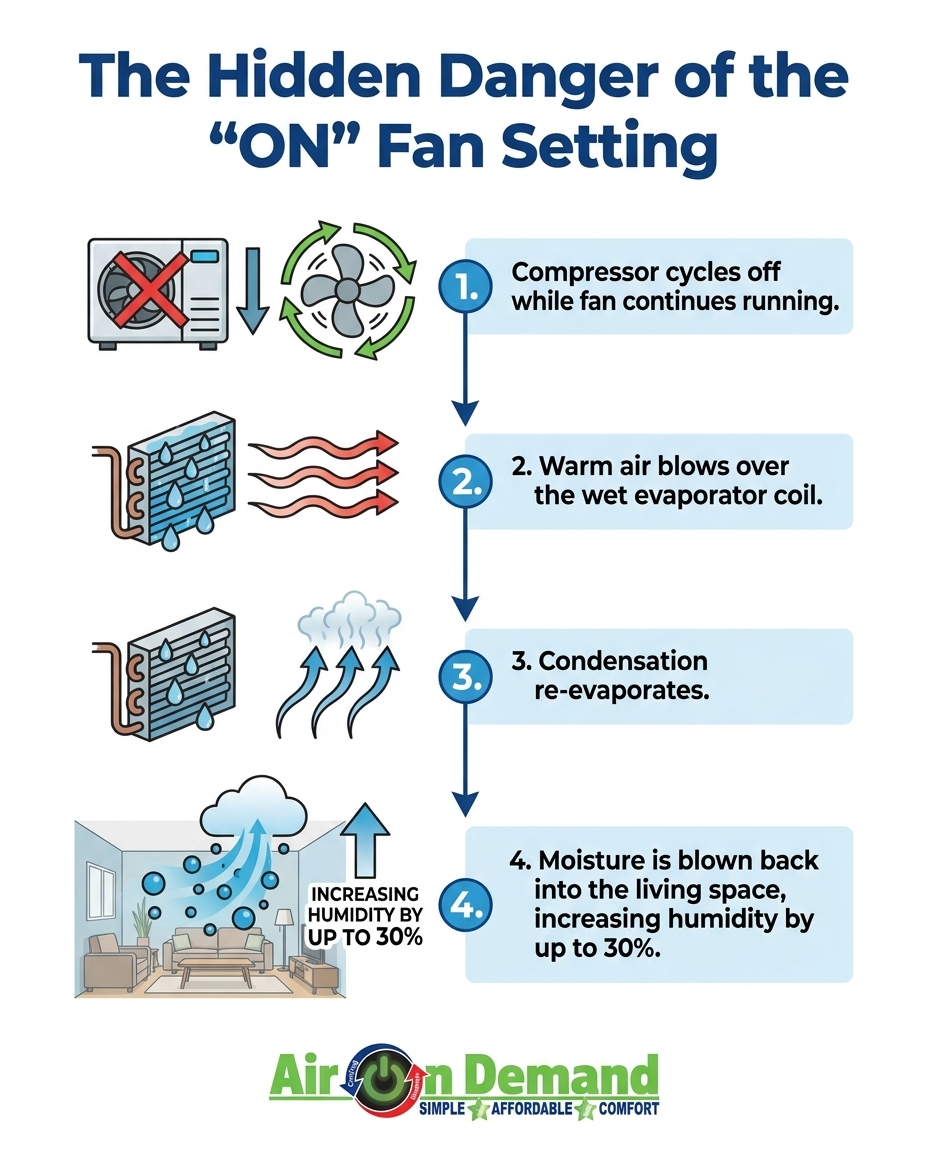
In our years of providing AC maintenance across Miami, one pattern our Air On Demand team sees often is homeowners unintentionally sabotaging their own comfort by using the wrong fan setting on their thermostat. Generic national advice sometimes suggests running your fan constantly to filter the air, but in our extreme coastal environment, this is a recipe for disaster. We always tell our customers that the difference between the "ON" setting and the "AUTO" setting is the difference between a dry home and a damp one.
• ON — How It Operates: The blower fan runs 24/7, continuously circulating air even when the outdoor compressor is off. — Impact on Indoor Humidity: Severe increase in humidity. Re-evaporates moisture off the wet coil and blows it back inside.
• AUTO — How It Operates: The blower fan only runs when the compressor is actively cooling the home. — Impact on Indoor Humidity: Maximum dehumidification. Allows moisture to drain outside while the fan rests between cycles.
When you set your thermostat fan to "ON," the indoor blower motor runs continuously, regardless of whether the outdoor unit is actually cooling. During a cooling cycle, the evaporator coil gets dripping wet with condensed moisture. When the cooling cycle ends and the compressor shuts off, that coil needs time to drain into the pan. If the fan keeps blowing air over that wet, warming coil, it acts like a giant humidifier. This phenomenon is called moisture blow-back. The running fan literally re-evaporates the water sitting on the coil and blows it right back into your living space. A single incorrect setting can undo hours of hard-fought dehumidification in a matter of minutes.
During high-humidity periods in Miami FL, you must always keep your thermostat fan set to "AUTO." This setting synchronizes the indoor blower fan with the outdoor compressor cycle. When the compressor shuts off to end a cooling cycle, the indoor fan shuts off immediately alongside it. This critical pause allows the condensed moisture to safely drip off the coil, into the pan, and down the drain line without being disturbed by moving air. By simply switching your fan to "AUTO," you prevent gallons of water from re-entering your living space each week.
If you have a modern thermostat, you might have noticed a setting indicated by a small water drop icon. This is dry mode, and it is arguably the most powerful tool at your disposal for combating extreme seasonal moisture. While standard cooling mode focuses entirely on dropping the ambient temperature, dry mode shifts the system's priority toward latent heat removal.
When you activate dry mode, the thermostat communicates with your HVAC system to change how it operates. First, it significantly lowers the indoor fan speed. As we discussed earlier, slowing down the airflow maximizes the time the air spends touching the freezing evaporator coil. Second, it runs the compressor in shorter, highly specific bursts designed to keep the coil as cold as possible without unnecessarily dropping the room temperature. By focusing the system's energy on condensation rather than temperature drops, dry mode effectively wrings out the air like a wet sponge.
Dry mode is not meant to be a permanent, year-round setting. It is the perfect antidote to late-summer days when the ambient heat drops slightly, but the dew point remains aggressively high. The best times to utilize this feature are during rainy, muggy afternoons or those transitional end-of-season weeks in late August in South Florida when standard cooling would overchill the house. If the temperature outside is a mild 78 degrees but it is pouring rain, standard cooling mode won't run long enough to remove the moisture. Switching to dry mode solves this problem by pulling the humidity out without freezing you out of your living room.
While basic thermostat adjustments can make a massive difference, extreme coastal climates sometimes require a more robust approach to system control. Upgrading the technology that commands your HVAC equipment allows for precise humidity tracking alongside standard temperature management.
The days of constantly walking back and forth to manually adjust your settings are over. Upgrading to a modern smart thermostat allows you to automate your comfort completely. These advanced controls feature built-in indoor humidity sensors that constantly monitor the moisture levels in your home. You can program the system to automatically toggle into dry mode or adjust fan speeds the moment indoor humidity creeps past 50%. You can also set specific schedules that align with peak coastal moisture hours, ensuring your system is proactively fighting the humidity before you even feel it.
Proper airflow is required for any dehumidification setting to work effectively. If the air cannot reach the evaporator coil, the moisture cannot be extracted. This is where the physical cleanliness of your system becomes paramount.
1. Check your filters: Clogged, dirty air filters severely restrict airflow. This mimics the exact symptoms of poor dehumidification, causing the coil to freeze and the home to feel sticky.
2. Protect the coil: Integrating whole-home air filtration systems protects the delicate evaporator coil from dust buildup. Even a thin layer of dust acts as insulation, preventing the humid air from touching the cold metal and halting the condensation process.
3. Keep hands off the mechanics: While adjusting your thermostat settings and changing filters are safe homeowner tasks, you should never attempt internal mechanical adjustments. Do not open the air handler or attempt to modify blower motor speeds manually.
There comes a point where pressing buttons on a screen simply won't fix the problem. If you have set your fan to AUTO, activated dry mode, and changed your filters, but your home still feels like a tropical rainforest during late August in South Florida, you are likely dealing with a systemic mechanical failure. Recognizing the signs of a larger issue can save your equipment from a catastrophic breakdown.
The dehumidification process relies entirely on the evaporator coil remaining freezing cold. If your system is low on refrigerant due to a leak, the coil cannot reach the proper temperature to cause condensation. In severe cases, low refrigerant causes the coil to literally freeze solid into a block of ice, halting the dehumidification process entirely. Look out for these warning signs:
• Persistent stickiness: The AC runs all day, but the humidity never drops.
• Strange noises: Hissing or bubbling sounds coming from the indoor unit.
• Visible ice: Frost or ice buildup on the copper refrigerant lines or the indoor coil.
• Extended run times: The system operates for hours with zero impact on your indoor comfort.
One of the most frustrating realities our team uncovers during routine HVAC inspections in humid climates is discovering that a homeowner's AC unit is simply too large for their home. Bigger is not better when it comes to HVAC systems. An oversized unit will blast the home with massive amounts of cold air, dropping the temperature in minutes. However, because it reaches the target temperature so quickly, it inevitably short-cycles. It will never run long enough to pull the latent heat out of the air. Proper load calculations—something we prioritize on every AC installation—are an absolute necessity for latent heat removal. If your system is grossly oversized, no amount of thermostat tweaking will permanently solve the problem, and you may need to consult a professional for a long-term strategy. For more regional insights, check out our Humidity Control Tips for South Florida Homeowners.
The AUTO setting is the only choice for reducing indoor humidity. When you set the fan to AUTO, it shuts off alongside the compressor, allowing the condensed moisture on the coil to drain away safely. The ON setting keeps the fan blowing constantly, which re-evaporates the water on the coil and blows it right back into your living space, making your home significantly more humid.
Dry mode is a specialized thermostat setting designed specifically to prioritize moisture removal over rapid cooling. It typically lowers the blower fan speed and runs the compressor in highly controlled cycles to maximize the amount of time humid air spends touching the cold evaporator coil. This effectively wrings the moisture out of the air without turning your living room into an icebox.
If your AC is running but the house remains humid, your system is likely short-cycling or suffering from restricted airflow. When a unit is oversized, has a clogged filter, or is set to a drastically low temperature, it cools the air too quickly and shuts off before it can extract the latent heat. It can also indicate a refrigerant leak preventing the coil from getting cold enough to cause condensation.
The best setting for high humidity is utilizing "dry mode" (if your thermostat has it) and ensuring your fan is strictly set to "AUTO." If you do not have dry mode, keep the fan on AUTO and set the temperature to a moderate, comfortable level (like 74-76 degrees) rather than dropping it drastically, which encourages longer, steadier cycles that pull more moisture from the air.
Yes, modern smart thermostats are equipped with advanced indoor humidity sensors that monitor moisture levels in real-time. You can program these devices to automatically activate dehumidification protocols, adjust fan speeds, or alert you when indoor humidity exceeds your preferred threshold, taking the guesswork out of climate control.
Short-cycling destroys your system's ability to remove moisture. Because dehumidification is a slow process that requires sustained air contact with the cold coil, a system that turns on and off every ten minutes never gets the chance to wring the water out of the air. This leaves the heavy moisture suspended in your rooms, leading to a cold, clammy environment.
True indoor comfort comes from mastering both sensible temperature control and latent moisture removal. By switching your fan to AUTO, utilizing dry mode, and resisting the urge to drastically drop the temperature, you can force your system to extract that heavy, stagnant air. However, if you have made these thermostat adjustments and your home still feels unbearably sticky, professional diagnostics are the next logical step. Our team at Air On Demand has helped countless families achieve true climate control. Do not suffer through a damp, uncomfortable house as the kids head back to school; schedule an inspection for your AC maintenance in Miami today to ensure your system is operating at peak efficiency and effectively removing humidity before the season ends.