Why Is My AC Unit Fan Not Spinning? Causes and Safe Next Steps
August 17, 2026
When your air conditioning system suddenly stops working properly in the middle of a hot afternoon, getting common homeowner questions answered quickly becomes your top priority. You walk outside expecting to hear the familiar hum of your cooling system, only to find the outside unit buzzing loudly while the fan blades sit completely still. Your house is getting warmer by the minute, and the sudden silence from your condenser fan is alarming. This specific malfunction is one of the most frequent issues our team at our business sees when homeowners call us for emergency AC repair in the local area.
Here is the thing: a stationary condenser fan is a serious mechanical issue, not just a minor glitch. The primary decision point you face right now is determining if this is a simple external obstruction you can safely clear, or a complex electrical failure requiring professional intervention. Continuing to run your air conditioner in this state is highly destructive. Your immediate priority is to stop the system from causing further damage to itself while you figure out the next steps.
In this guide, we will walk through exactly what is happening inside your unit, what components typically fail, and how to safely troubleshoot the problem without putting yourself at risk. By understanding the mechanics behind the failure, you can make an informed decision about when to call in a professional.
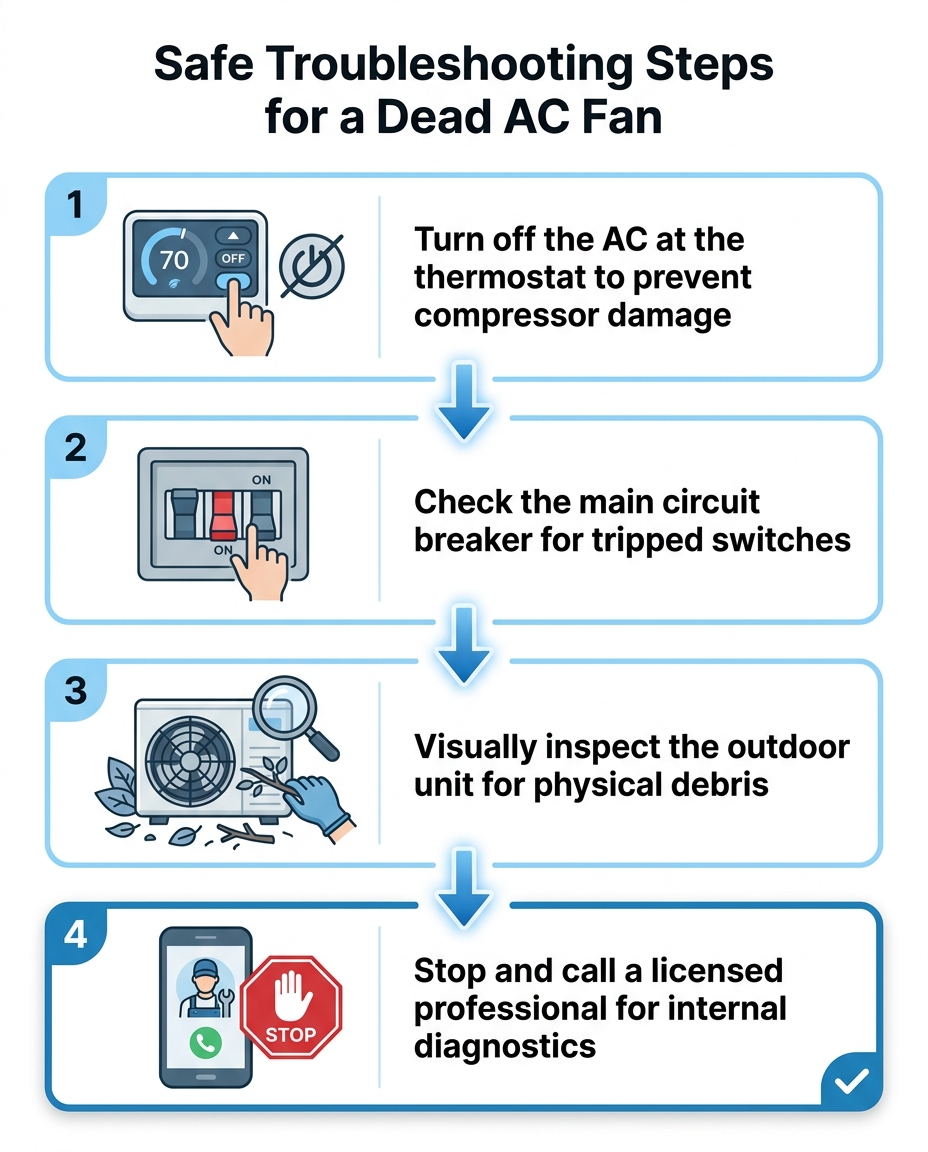
If you notice your AC fan is not spinning, the very first thing you must do is turn your thermostat to the "Off" position. When helping clients get common homeowner questions answered, our technicians constantly remind homeowners that ignoring a dead fan leads to catastrophic mechanical damage.
Your air conditioner does not actually create cold air; it removes heat from inside your home and pumps it outside. The outdoor fan is responsible for blowing that absorbed heat into the outdoor air. When the fan stops spinning, the heat has nowhere to go. This leads to a dangerous condition known as thermal overload. Without the fan expelling the heat, the compressor—the expensive "heart" of your air conditioning system—rapidly overheats.
During intense summer heatwaves, running an AC with a dead fan can permanently destroy the compressor within a matter of hours. The internal temperature of the unit spikes, and while modern compressors have thermal safety switches designed to shut them down when they get too hot, these switches can fail or wear out from repeated tripping.
Additionally, a dead outdoor fan stalls the entire refrigeration cycle. Because the heat is not being released outside, the cold refrigerant returning to your indoor unit drops below freezing. This causes the moisture in your indoor air to freeze directly onto your evaporator coil. With high relative humidity in areas like Miami, this process accelerates rapidly. The intense moisture in the air creates thick blocks of ice on the indoor coil. When that ice eventually thaws, it often overwhelms the drain pan, leading to severe water damage inside your home.
To understand why a stationary fan is such a critical emergency, it helps to know exactly what this component is designed to do. When getting common homeowner questions answered about heat pumps or AC units, we always start with the basic mechanics of heat transfer.
Your outdoor unit, known as the condenser, houses three main components: the compressor, the condenser coils, and the condenser fan. The compressor pressurizes warm refrigerant gas, sending it through the coils. The condenser fan pulls outdoor air through these coils to cool the refrigerant down, turning it back into a liquid so it can return indoors to absorb more heat.
According to Department of Energy (DOE) HVAC maintenance guidelines and ASHRAE standards for residential cooling systems, proper airflow is mandatory for this heat exchange process. Most residential HVAC fan motors operate between 850 and 1600 Revolutions Per Minute (RPM) to maintain the necessary heat dissipation.
• Indoor Blower Fan — Location: Inside (Attic/Closet) — Primary Function: Circulates conditioned air through the home's vents. — What Happens if it Fails?: Coils freeze, no air comes out of the vents.
• Outdoor Condenser Fan — Location: Outside Unit — Primary Function: Expels absorbed heat into the outdoor air. — What Happens if it Fails?: Compressor overheats, system trips on high pressure.
• Compressor — Location: Outside Unit — Primary Function: Pumps refrigerant through the entire system. — What Happens if it Fails?: Total system failure; no cooling occurs at all.
When the outdoor fan stops turning, the refrigerant stays hot. It travels back indoors as a warm gas instead of a cool liquid. The entire refrigeration cycle stalls objectively and completely. The system will continue to consume massive amounts of electricity while providing zero cooling to your home.
When getting common homeowner questions answered regarding a dead fan, we find the root cause usually boils down to a few specific electrical or mechanical failures. In our years of providing AC repair in the local area, we have seen that properly diagnosing condenser failures requires technical knowledge of these specific electrical pathways.
1. The Dual Run Capacitor has Failed: This is the most frequent issue.
2. The Fan Motor has Burned Out: A mechanical failure of the motor itself.
3. The Contactor is Faulty: The electrical bridge is broken.
The dual run capacitor acts like a large battery that provides the initial electrical jolt needed to jump-start the fan motor and the compressor. Because fan motors require significantly more energy to start spinning than they do to keep spinning, they rely heavily on this stored charge.
• Heat sensitivity: Capacitors are highly susceptible to heat damage and power surges.
• Visible symptoms: A bad capacitor often bulges at the top, resembling a swollen soda can, or leaks an oily fluid.
• Audible symptoms: This is the most common cause of an outdoor unit that hums loudly while the fan remains stationary. The motor is trying to start, but it lacks the necessary torque.
If the capacitor is functioning properly, the fan motor itself may have reached the end of its lifespan. This occurs when the internal motor windings short out or the bearings seize up from a lack of lubrication.
• Warning signs: Motor failure is often preceded by grinding noises, squealing, or excessive heat radiating from the top of the outdoor unit.
• Overworking: Motors frequently burn out when they are forced to run continuously during extreme heatwaves, or when they have to fight against thick dirt and debris blocking the unit.
The contactor is an electronic switch controlled by your indoor thermostat. When the thermostat calls for cooling, it sends a low-voltage signal to the contactor, pulling a mechanical switch closed to deliver high-voltage power to the fan and compressor. Over time, the metal plates on the contactor can become pitted, burned, or covered in bugs and debris, failing to close the electrical circuit. If power cannot pass through the contactor, the fan will not spin.
Not every fan failure is caused by a broken internal component. Sometimes, the issue is environmental. When helping customers get common homeowner questions answered, our team often finds that simple external factors are to blame.
Physical Debris and Blockages:
Your outdoor unit is exposed to the elements 24/7. Severe storms, heavy winds, or basic landscaping tasks can introduce physical debris into the system. Tree branches, large accumulations of wet leaves, or even thick vines can physically jam the fan blade, preventing it from turning freely. If the motor tries to spin against a physical blockage, it will quickly overheat and burn out.
Tripped Circuit Breakers:
Your air conditioner requires a significant amount of electricity, and it is protected by dedicated circuit breakers in your main electrical panel. If there is a power surge or an electrical anomaly, the breaker will trip to cut power to the unit and prevent a fire.
While a tripped breaker is a simple reset, it is important to understand the "why" behind the trip. If you reset the breaker and the system turns on normally, it may have been a fluke power surge. However, if the breaker immediately trips again, or trips repeatedly over a few days, you have a serious underlying electrical short. Never force a breaker to stay on, as this removes the safety mechanism protecting your home.
You can safely perform a visual inspection of your outdoor unit to check for these issues without ever opening an electrical panel or touching a wire.
There is a distinct line between being a proactive homeowner and attempting dangerous electrical work. When we help get common homeowner questions answered, we clearly delineate safe basic troubleshooting from illegal or unsafe DIY repairs.
Safe Troubleshooting Steps You Can Take:
• Verify thermostat settings: Ensure the thermostat is set to "Cool" and the temperature is set several degrees below the current room temperature.
• Check the main breaker panel: Look for a tripped breaker labeled "AC" or "Condenser" and firmly reset it once.
• Visually inspect for debris: Look down into the top grille of the outdoor unit to see if sticks, leaves, or debris are physically blocking the fan blade.
• Listen to the unit: Note if the unit is completely silent, clicking, or humming loudly. This information is highly valuable to your technician.
Strict Professional Boundaries (What NOT to do):
• Never attempt DIY electrical repairs: The dual run capacitor stores a lethal amount of high-voltage electricity, even when the main power to the unit is completely shut off. Handling a capacitor without safely discharging it can cause severe injury or electrocution.
• Do not bypass safety switches: Never attempt to wire around a faulty contactor or pressure switch to force the system to run.
• Do not spin the blade with a stick: While some older guides suggest "jump-starting" a humming fan by pushing the blade with a stick, this is incredibly dangerous. If the motor starts, the stick can shatter and cause injury. Furthermore, forcing a bad motor to run will quickly destroy the compressor.
Professional diagnostics are ultimately safer and far more cost-effective than risking electrocution, causing severe mechanical damage, or voiding your manufacturer warranties. Replacing internal components requires specialized tools, multimeters, and a licensed professional.
When homeowners experience a cooling emergency, they need fast, factual information. Here are the most frequent inquiries we address when getting common homeowner questions answered for our local area customers.
The most likely cause is a failed dual run capacitor, which prevents the fan motor from getting the electrical boost it needs to start. It could also indicate a burnt-out fan motor, a faulty contactor, or physical debris jamming the fan blade. While the compressor may still be running (which is the noise you hear), the system cannot properly cool your home without the fan operating.
No, you should never run your air conditioner if the outside fan is not spinning. Doing so traps the heat inside the outdoor unit, causing the compressor to rapidly overheat and potentially fail completely. Turn the system off at the thermostat immediately to prevent catastrophic mechanical damage and expensive replacement costs.
Testing an AC fan motor requires a digital multimeter to check for proper voltage, continuity, and resistance across the motor windings. Because this involves interacting with high-voltage electrical components and potentially dangerous capacitors, testing should only be performed by a licensed HVAC professional. Attempting this without proper training is highly unsafe.
Yes, a broken AC fan is considered an HVAC emergency, especially during hot summer weather. Without the fan, your system cannot cool your home, and leaving the system running will destroy the compressor. You should shut the system down and request emergency diagnostic services to restore your cooling safely.
A loud humming noise usually indicates that the electrical components are trying to start the motor, but the motor lacks the power to turn. This is a classic symptom of a failed run capacitor or a seized fan motor bearing. The hum is the sound of electrical current meeting heavy mechanical resistance.
Fan motors burn out due to excessive strain, old age, or poor maintenance. If the outdoor unit is choked with dirt and debris, the motor has to work much harder to pull air through the coils, leading to overheating. A failing capacitor can also cause the motor to draw too much amperage, eventually melting the internal wire windings.
Dealing with a stationary air conditioner fan is stressful, but understanding the underlying mechanics helps you make informed, logical decisions. As we have covered in this guide to getting common homeowner questions answered, a dead fan is a serious issue that stalls the entire heat transfer process. While checking your breaker and looking for physical debris are great first steps, our repair experts at our business know that the vast majority of fan failures stem from high-voltage electrical components like capacitors, contactors, or the motor itself.
The most important action you can take is to keep the system turned off at the thermostat to protect your compressor from permanent thermal damage. Once the system is safely powered down, the next logical step is to reach out for a professional evaluation. Relying on fast, reliable emergency diagnostic services ensures that the exact electrical fault is identified and resolved safely. By bringing in a licensed expert for your AC repair, you can restore your home's comfort quickly and ensure your cooling system operates efficiently for the rest of the season.