Why Is Your AC Unit Fan Not Spinning? Symptoms, Causes, and Safe Next Steps
August 17, 2026
Is your indoor air handler blowing air, but the outdoor unit sits completely still? When you need local service expertise and area tips to handle a sudden breakdown, the very first step is understanding exactly what you are dealing with. In our years of providing dependable AC repair to the local area, our team has found that discovering your outdoor condenser fan is not spinning while the indoor system continues to run is an urgent situation. The outdoor fan plays a critical role in releasing the heat your system absorbs from inside your house. Without it, the entire cooling cycle collapses.
You are now at a critical decision point: deciding whether this specific symptom requires immediate professional intervention or if it falls under routine homeowner troubleshooting. Making the right call prevents you from paying unnecessary emergency fees while protecting your expensive equipment from catastrophic damage. Taking a neutral, step-by-step diagnostic approach empowers you with the objective information needed to assess the situation safely. When researching local service repair vs replace troubleshooting, you will quickly find that staying informed is your best defense against system failure.
Consistent AC and HVAC maintenance is the most effective way to prevent these sudden component failures. However, when the unexpected happens, knowing the basics helps you understand exactly when it is time to schedule air conditioning repair with a licensed professional.
When the outdoor fan stops spinning, the clock starts ticking on your compressor's lifespan. The compressor is the heart of your cooling system, responsible for pumping refrigerant through the lines. The fan's job is to blow outside air over the condenser coils, carrying away the intense heat generated by the compression process. Without airflow, that heat has nowhere to go. The temperature and pressure inside the unit will skyrocket, leading to severe thermal overload and potential catastrophic failure of the compressor.
To protect your system and avoid massive replacement costs, take these immediate actions:
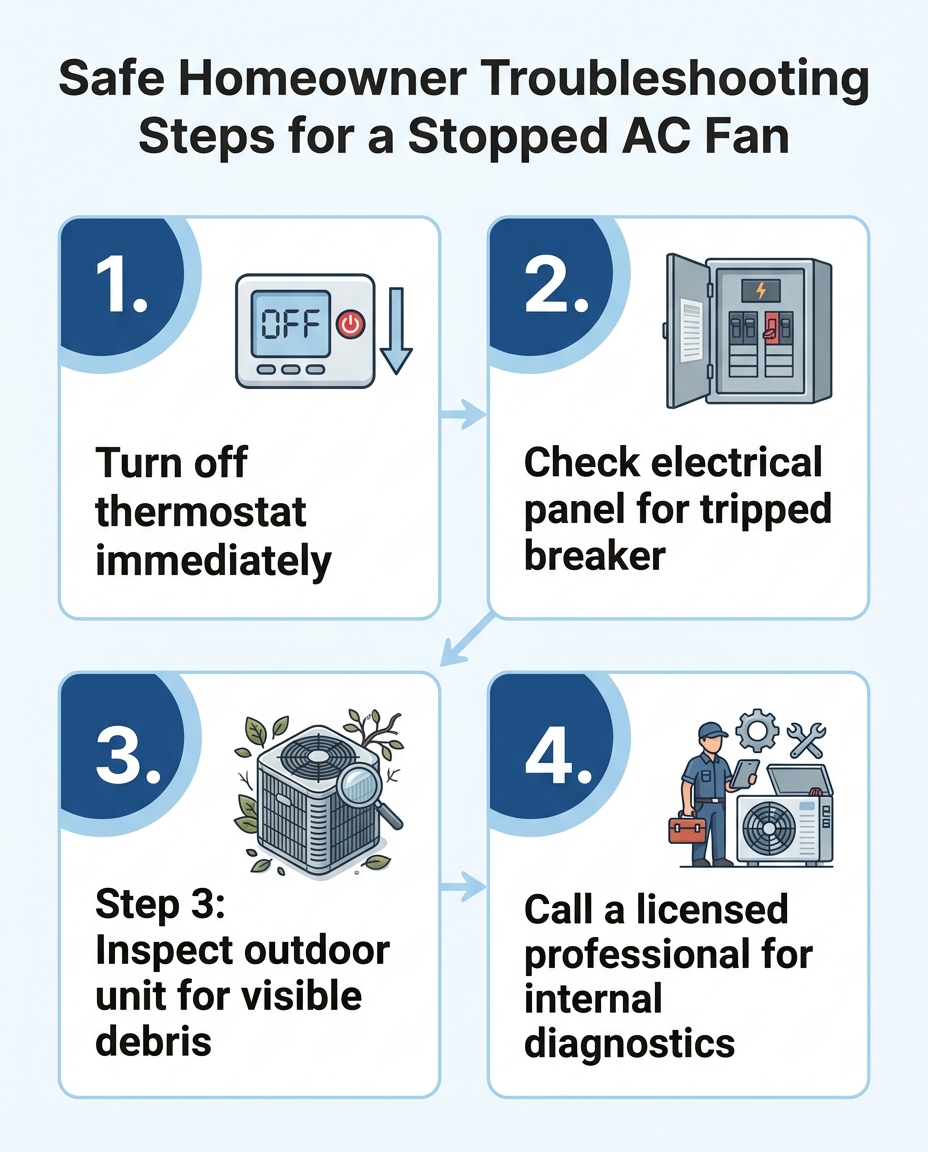
1. Turn off the AC at the thermostat immediately: Do not wait to see if the fan starts spinning on its own. Switch your thermostat from "Cool" to "Off." This stops the system from calling for cooling and cuts the signal to the outdoor unit, preventing the compressor from running without heat dissipation.
2. Check the main electrical panel: Locate your home's primary electrical breaker box. Look for the dedicated double-pole breaker labeled for the air conditioner or condenser. If it has tripped to the middle or "Off" position, firmly push it all the way off, then back to the "On" position. A tripped breaker is a common safety mechanism that cuts power during an electrical surge or overload.
3. Perform a visual inspection: Walk outside to the condenser unit. Without touching the equipment or opening any casings, look closely at the fan blades through the top grille. Look for obvious physical obstructions like fallen branches, heavy debris, or encroaching vegetation that might be physically wedging the blades in place.
4. Do not attempt to force the fan: If you see an obstruction, do not reach through the grille while the system has power. If the fan is simply stuck, attempting to spin it by hand can result in severe injury if the motor suddenly engages.
Establishing clear boundaries between safe homeowner maintenance and dangerous professional diagnostics is vital for your physical safety and the longevity of your equipment. Once you have turned off the thermostat to protect the compressor, there are a few additional visual checks you can perform to gather information.
Begin by examining the immediate perimeter of the outdoor condenser. Over time, high winds and heavy storms can blow significant debris into the unit. Look for accumulations of wet leaves, pine needles, or small sticks that may have slipped through the protective grilles. Heavy vegetation, such as overgrown bushes or climbing vines, can also creep into the housing and bind the fan motor shaft. If you spot exterior debris that is easily accessible without tools, you can carefully clear it away—but only after confirming the power is completely disconnected.
Every outdoor air conditioning unit is required to have a dedicated electrical disconnect switch mounted on the exterior wall of the house, usually within a few feet of the condenser. This box contains either a pull-out block or a physical switch that cuts high-voltage power to the unit. Ensure the switch is in the "ON" position, or that the pull-out block is properly seated. Sometimes, landscapers or utility workers may accidentally bump this switch or pull the block and forget to replace it.
In our years of performing AC installations and repairs, we have seen too many homeowners risk injury by pushing past safe boundaries. Any step that requires the removal of metal access panels, the handling of internal wiring, or the use of electrical testing meters is strictly off-limits for homeowners. Opening the electrical cabinet exposes you to raw, high-voltage electricity. If you have verified the breakers, checked the disconnect box, and ensured the fan is free of physical debris, your safe troubleshooting journey is complete. We always advise our customers that understanding exactly when your HVAC breaks down unexpectedly ensures you hand the diagnosis over to a professional before causing accidental harm.
If the power is on and the fan path is clear, the most frequent cause of a stopped condenser fan is a failed dual run capacitor. Understanding how this component works helps demystify the repair process and explains why your system suddenly stopped cooling.
Think of the dual run capacitor as a massive, high-powered battery that stores energy. Your AC fan motor and compressor require a massive jolt of electricity to overcome inertia and start spinning—often much more power than your home's standard electrical wiring can deliver instantly. The capacitor stores this energy and releases it in a fraction of a second to jumpstart the motors. Once the motors are running, the capacitor provides a continuous, steady supply of voltage to keep them spinning smoothly.
Capacitors are highly susceptible to heat. Our team typically sees a huge surge in these issues during the hottest months. The local area's extreme heat and continuous heavy strain on AC units make dual run capacitor failures the leading cause of sudden condenser fan stoppage. When the outdoor temperature soars, your air conditioner is forced into much longer cooling cycles. This relentless operation heats up the dielectric fluid inside the capacitor. Over time, this fluid begins to break down, expand, and lose its ability to hold an electrical charge. When the capacitor drops below its required microfarad rating, it can no longer start the fan motor.
Safety Warning: HVAC capacitors store lethal high-voltage electrical charges—often 240 volts or more. This charge remains actively stored in the component even after the main power is disconnected at the breaker and the disconnect box is pulled. Touching the terminals of a charged capacitor can result in severe electrical shock, burns, or death. This is why replacing a capacitor is never a DIY project.
When one of our technicians inspects the system, they look for specific visual signs of capacitor failure. A degraded capacitor will often bulge at the top, resembling a swollen soda can, or leak a viscous fluid from its casing. However, many capacitors fail internally while looking completely normal on the outside, which is why we must test them with specialized multimeters.
When the capacitor is functioning properly but the fan still refuses to spin, the diagnosis usually moves to mechanical wear and tear or environmental degradation. Two primary components are typically at fault: the contactor and the fan motor itself.
The contactor is a heavy-duty magnetic switch located inside the outdoor unit's electrical panel. When your indoor thermostat calls for cooling, it sends a low-voltage signal (usually 24 volts) to the contactor. This signal energizes a magnetic coil, which violently pulls down a set of metal contacts. When these contacts touch, they bridge the gap and allow high-voltage electricity (240 volts) to flow from your home's electrical panel into the compressor and fan motor.
Because the contactor relies on physical metal pads touching each other, it is highly vulnerable to the elements. As local HVAC experts, we frequently see how the local area's humidity and coastal elements can accelerate corrosion on outdoor unit electrical contacts, leading to abrupt fan failures. Furthermore, the constant arcing of electricity every time the switch engages causes tiny pits and carbon buildup on the metal pads. Eventually, this pitting becomes so severe that electricity can no longer pass through the switch, leaving the fan motor completely without power. Insects, such as ants and earwigs, are also notorious for crawling into the contactor and being crushed between the plates, creating an insulating barrier that blocks the electrical flow.
If the contactor is sending power and the capacitor is providing the jumpstart, the fan motor itself may have failed. This often happens when a failing capacitor forces the motor to work harder than it was designed to, drawing excessive amperage and overheating the internal copper windings. Alternatively, the internal bearings of the motor can lose their lubrication over years of use, causing the shaft to seize up completely. When the motor burns out, you will often hear specific noises you don't want to hear from your AC, such as a loud, aggressive buzzing or a grinding sound as the system struggles to force a seized bearing to turn.
Listening to your outdoor unit can provide vital clues about the state of your system. Identifying auditory symptoms helps you frame the component failures objectively and allows you to provide accurate information to our dispatchers over the phone. A neutral diagnostic approach prevents miscommunication and ensures our technician brings the right tools and replacement parts to the job.
• Loud Humming or Buzzing — What It Means: The system is receiving electrical power, but a component is physically unable to move. — Likely Component Failure: Failed dual run capacitor, seized motor bearings, or a physically blocked fan blade.
• Clicking Sound, Then Silence — What It Means: The contactor is engaging, but the high-voltage power is immediately cutting out or failing to reach the motor. — Likely Component Failure: Tripped breaker, severely pitted contactor pads, or a completely burnt-out motor winding.
• Complete Silence — What It Means: No power is reaching the outdoor unit, or the low-voltage signal from the thermostat is broken. — Likely Component Failure: Blown fuse in the disconnect box, failed thermostat wire, or a dead contactor coil.
• Grinding or Screeching — What It Means: Metal-on-metal friction inside the motor housing. — Likely Component Failure: Failing fan motor bearings that require immediate motor replacement.
If you hear a loud humming noise while the fan remains stationary, it typically points to a locked rotor scenario. The motor is trying to turn, drawing massive amounts of electricity, but cannot overcome the resistance. This is an urgent situation that will quickly destroy the motor if the power is not cut. Complete silence, on the other hand, often indicates a total loss of power or a communication failure between the indoor and outdoor units.
Once you have exhausted the safe, visual checks, the next steps require specialized tools, deep electrical knowledge, and safety certifications. Rely on our licensed, professional HVAC experts for safe and accurate diagnostics rather than attempting risky DIY electrical repairs. Internet tutorials often downplay the lethal risks associated with high-voltage HVAC components.
Testing capacitance and motor windings requires a professional-grade multimeter. When our technicians arrive at your home, they will safely discharge the capacitor using a heavy-duty resistor before testing its microfarad rating. They will also test the fan motor by measuring the electrical resistance (ohms) between the internal copper windings and the metal casing of the motor. If the meter detects continuity between the windings and the ground, it means the internal insulation has melted away, and the motor is completely shorted out.
Our team provides an objective assessment of the motor's lifespan and the system's overall health. If the issue is simply a failed capacitor or a pitted contactor, these are relatively standard, cost-effective repairs that can be completed in a single visit. However, if the fan motor has burnt out, the conversation shifts.
You must weigh the costs of replacing a major component against the age and efficiency of the entire system. If your air conditioner is over ten years old and uses outdated refrigerant, investing heavily in a new fan motor might not make financial sense. Guiding you through the repair vs replace your HVAC decision requires looking at the total cost of ownership, the warranty status of the equipment, and the likelihood of other components, like the compressor, failing in the near future.
This usually means the compressor is still receiving power, but the fan motor has failed or the capacitor providing its startup energy has died. The indoor blower will continue to circulate air, but because the outdoor fan cannot remove the heat, the air coming from your vents will quickly turn warm. Turning the system off immediately is required to prevent the compressor from overheating.
No. Running the system without the condenser fan prevents heat from escaping, which will quickly overheat and destroy the compressor. The compressor relies on the fan to cool the refrigerant coils. Without this airflow, the internal pressure spikes rapidly, leading to a catastrophic and expensive system failure.
Check for tripped breakers and clear exterior debris first. If the breaker is on and the area is clear, a licensed professional must test and replace the internal electrical components. Because the internal parts involve high voltage, attempting to fix the fan yourself without proper training is incredibly dangerous.
Overwork due to a failing capacitor, lack of maintenance, physical blockages, or age-related wear and tear on the internal bearings are the primary causes. When a motor is forced to push past heavy resistance or run without the proper electrical support from the capacitor, the internal copper windings overheat and melt, destroying the motor.
Yes. Capacitors store high-voltage charges that can cause severe injury or death even when the main power to the unit is turned off. Our professional technicians use specific tools to safely discharge the stored electricity before removing the component, ensuring the repair is handled without risk of electrocution.
Understanding the exact symptoms and potential causes of a stopped condenser fan empowers you to make informed, logical decisions about your home comfort system. By recognizing the difference between a simple tripped breaker and a complex electrical failure, you protect your equipment from further harm and avoid the trap of unnecessary panic.
Always remember that a clear sequence of actions—turning off the unit at the thermostat immediately, checking the basic electrical panel, and calling a professional—prevents minor component failures from cascading into major compressor damage. Do not let a silent outdoor unit ruin your comfort or compromise your safety. Schedule an inspection with our local experts to resolve the issue safely, efficiently, and effectively, ensuring you get a clear, structured explainer of exactly what went wrong and how to fix it.