Why Is My AC Unit Fan Not Spinning? Professional Diagnostics Explained
August 17, 2026
Your air conditioner is running, and you can hear the familiar, heavy hum of the compressor, but the house is getting warmer by the minute. When you are looking for home maintenance tips and troubleshooting advice, discovering that your outdoor AC fan is completely still while the system runs is one of the most alarming situations you can face. The panic sets in quickly as you realize something is mechanically wrong, but the concrete problem for most homeowners is identifying the correct service approach without prior technical knowledge.
The immediate decision point you face is crucial: you must decide on the appropriate service intervention based on standard industry diagnostic steps rather than guessing at the cause. In regions like South Florida, where severe heat and high humidity push air conditioning systems to their absolute limits, a stalled fan is a critical comfort and safety issue. The extreme temperatures accelerate potential damage to the system, turning a minor component failure into a major system breakdown in a matter of hours.
The most critical immediate action: Turn your thermostat off right now. Allowing the compressor to run while the fan is stalled traps immense heat inside the unit, which can lead to irreversible compressor damage. Once the system is safely powered down, you can begin to understand the mechanics behind the failure and why professional diagnostics are the safest path forward.
To understand why a stalled fan is an emergency, you have to understand the basic mechanics of the refrigeration cycle. Your air conditioning system does not actually create cold air; it removes heat from inside your home and transfers it outside. The outdoor unit, known as the condenser, is where that heat is finally released into the outdoor air.
The condenser fan is responsible for pulling cooler outside air through the hot condenser coils. As the air passes over the coils, it exhausts the heat absorbed from your home. Without this critical airflow, the refrigerant cannot cool down and condense back into a liquid state. Consequently, the heat stays trapped inside the system, causing the compressor to rapidly overheat.
Modern HVAC systems are equipped with internal safety mechanisms to prevent catastrophic failure. The most common is a thermal overload switch located on the compressor. When the compressor gets too hot due to a lack of airflow, this switch trips, shutting the system down. However, as the compressor cools, the switch resets, and the system tries to start again. This repeated cycle of overheating and shutting down causes permanent, cumulative damage to the compressor's internal windings.
• Normal Operation — Airflow Status: Steady airflow across coils — Compressor Temperature: Stable, within manufacturer limits — Long-Term Outcome: Efficient cooling and standard lifespan
• Stalled Fan (System Running) — Airflow Status: Zero airflow across coils — Compressor Temperature: Rapidly increasing, extreme heat — Long-Term Outcome: Thermal overload, potential compressor death
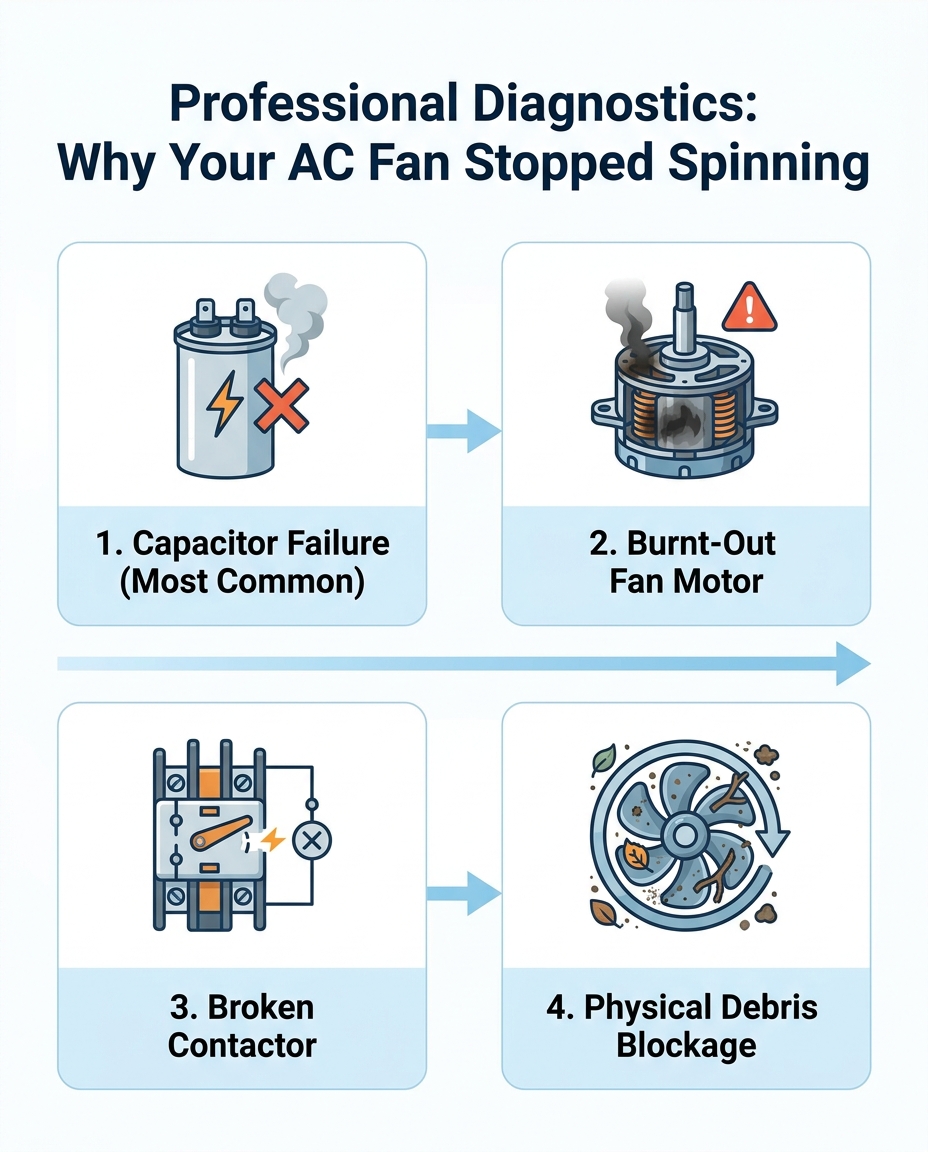
When an outdoor fan stops spinning, the most common reason is a failed run capacitor. The run capacitor is a cylindrical component that stores electrical energy, acting much like a powerful battery. It provides the initial jolt of electricity needed to start the fan motor and supplies a continuous, regulated electrical current to keep the motor spinning at the correct speed.
Capacitors are highly sensitive to heat and electrical stress, meaning they naturally degrade over time. In climates like South Florida, the high humidity forces air conditioners to run extended cooling cycles just to dehumidify the air. This places continuous thermal stress on the capacitors, forcing them to work harder and longer than they would in milder climates. Over years of heavy use, the internal chemical components of the capacitor begin to break down.
Professionals look for specific visual signs of capacitor degradation during an inspection. A failing capacitor will often bulge at the top, resembling a swollen soda can. In severe cases, the casing may split, leaking an oily dielectric fluid, or develop heavy rust around the electrical terminals. If you want to understand more about why your AC fan motor stops working, the capacitor is almost always the first component a technician will test.
If the capacitor is functioning correctly, the next logical step in standard industry diagnostics is evaluating the fan motor itself and the electrical pathways feeding it. Fan motors endure immense wear and tear, spinning thousands of hours every cooling season while exposed to rain, heat, and dirt.
Over time, the sealed bearings inside the fan motor can lose their lubrication and seize up. When the bearings fail, the motor physically cannot turn, even if it is receiving the correct electrical voltage. Alternatively, the electrical windings inside the motor can short out or burn through entirely due to age or a lack of routine maintenance. When a motor burns out, it must be completely replaced.
Another frequent electrical fault lies in the contactor. The contactor is a heavy-duty mechanical switch controlled by your thermostat. When your home needs cooling, the thermostat sends a low-voltage signal to the contactor, which electromagnetically pulls a set of metal contacts closed. This allows high-voltage electricity to flow from your home's electrical panel to the compressor and the fan motor.
• Pitting and Arcing: Every time the contactor closes, a small electrical arc occurs. Over time, this arcing burns and pits the metal contacts, creating a blackened, uneven surface that blocks electricity from passing through.
• Physical Blockages: Because the contactor is located in the outdoor unit, insects or small debris can crawl between the contacts. When the switch closes, the bug is crushed, creating an insulated barrier that prevents the fan motor from receiving power.
Finally, a tripped circuit breaker can stop the fan. However, it is crucial to understand that a tripped breaker is a protective response, not the root problem. If a fan motor is overheating or a compressor is struggling, it will draw excessive electrical current, tripping the breaker to prevent an electrical fire.
Not all fan failures are electrical; some are entirely mechanical. The outdoor condenser unit sits exposed to the elements, making it vulnerable to physical blockages. Sticks, heavy leaves, pine needles, or yard debris thrown by a lawnmower can easily fall through the top condenser grate and jam the fan blades.
When a blade is physically blocked, the motor still receives electricity and attempts to turn. This creates a state known as "locked rotor." The motor will draw a massive amount of electrical current, generating a loud, distinct humming or buzzing noise. If the system is left running in a locked rotor state, the intense heat generated will quickly burn out the motor windings, turning a simple debris removal job into an expensive motor replacement.
Warning: Never attempt to reach into the unit or poke objects through the grate to clear debris while the power is connected. The fan could start suddenly, causing severe injury, or you could strike high-voltage electrical components.
To prevent physical obstructions, follow these preventative checks while the system is completely powered off at the breaker:
1. Inspect the perimeter: Keep bushes, shrubs, and tall grass trimmed at least two feet away from all sides of the condenser unit.
2. Look through the top grate: Use a flashlight to visually inspect the bottom of the unit for accumulated leaves or large sticks.
3. Listen for abnormal humming: If you hear a loud buzz but see no movement, shut the system off immediately.
4. Schedule seasonal clearing: Have a professional open the unit and clean the interior cabinet during your annual maintenance visit.
If you search for advice online, you will likely encounter a dangerous DIY workaround commonly referred to as the "stick trick." The premise suggests that if your fan is stalled, you can take a long stick, push it through the top grate, and manually spin the fan blades to jumpstart the motor.
The short answer is that you should never do this. Pushing the fan blades manually exposes you to severe safety risks, including electrical shock if the stick damages a wire, or physical injury if the heavy metal blades suddenly catch and spin at full speed. More importantly, this trick carries massive mechanical risks for your HVAC system.
Here is the mechanical reality: if a fan requires a manual push to start, it usually means the start capacitor has failed, but the run windings in the motor are still receiving power. By forcing the motor to spin, you are forcing it to run without its proper electrical phase shift. The motor will run excessively hot, drawing incorrect amperage. This immense strain can cause the motor to burn out entirely, and the resulting heat buildup can trigger a catastrophic compressor failure. Bypassing a failing component simply forces the rest of your system to carry a dangerous burden.
A typical pattern we see in general educational service inquiries is homeowners asking exactly what a technician does to determine the cause of a stalled fan. Professionals follow a strict, logical, step-by-step breakdown to isolate the failure point safely. Relying on prompt, reliable local expertise to diagnose and resolve these specific failures safely ensures the problem is fixed before your home becomes uncomfortably hot.
Here is the standard industry procedure for diagnosing a stalled condenser fan:
1. Safety Disconnect: The technician begins by pulling the disconnect block near the outdoor unit and verifying with a voltage meter that all high-voltage power is entirely disconnected from the system.
2. Visual Inspection: They inspect the fan blades for physical damage, check the cabinet for debris, and examine the capacitor for obvious signs of bulging or leaking.
3. Electrical Testing: Using specialized diagnostic tools, they measure the precise electrical values of the internal components to find the exact point of failure.
4. Thermostat Communication Check: They verify that the low-voltage signal from the indoor thermostat is successfully reaching the outdoor contactor.
Even with the main power disconnected, the run capacitor retains a high-voltage electrical charge that can cause severe injury. Technicians safely discharge this stored energy using a heavy-duty resistor. Once discharged, they use a multimeter set to measure capacitance (microfarads). If a capacitor is rated for 5.0 microfarads but reads 2.1 on the meter, it has fallen out of its acceptable tolerance range and must be replaced. This step is strictly for licensed technicians due to the retained voltage risks.
If the capacitor tests within normal limits, the technician evaluates the motor. They will manually spin the fan blades (with power verified off) to feel for resistance, which indicates seized bearings. Next, they use a multimeter to measure the electrical resistance (ohms) across the motor's internal wire windings. If the meter reads "OL" (open line), it means the internal wires have burned through and snapped, dictating that a full motor replacement is necessary rather than a simple capacitor swap.
An AC fan that is not spinning is a clear, urgent signal to power down your system immediately. Leaving the system running without airflow traps extreme heat inside the condenser, putting your expensive compressor at immediate risk of permanent failure.
Understanding these standard diagnostic steps empowers you to make informed decisions about your home's maintenance. You now know that a stalled fan is rarely a simple glitch; it is usually a specific mechanical or electrical failure involving the capacitor, motor, or contactor. Instead of attempting dangerous workarounds, rely on professional diagnostics to protect your HVAC investment. A logical, step-by-step breakdown of how the service works and the standard criteria used to determine the best solution ensures your system is repaired safely, correctly, and efficiently.
Can I run my AC if the fan is not spinning?
No, you should never run your air conditioner if the outdoor fan is not spinning. The fan is required to remove heat from the system, and without it, the compressor will rapidly overheat. Continuing to run the system in this state can cause irreversible damage to the compressor, leading to a complete system replacement.
Why is my AC fan not spinning but making a humming noise?
If your fan is making a humming noise but not moving, it is likely experiencing a locked rotor state or a capacitor failure. The humming indicates that the motor is receiving electrical power and trying to start, but either a physical obstruction or a lack of starting torque is holding it back. Turn the system off immediately to prevent the motor from burning out.
Is it bad if the AC fan doesn't spin?
Yes, it is extremely bad for the health of your cooling system. The condenser fan is a critical component of the refrigeration cycle, responsible for exhausting absorbed heat into the outdoor air. If the fan fails, the heat remains trapped in the refrigerant, causing internal pressures and temperatures to spike to dangerous levels.
How do professionals fix an AC fan that won't spin?
Professionals fix a stalled fan by first disconnecting all high-voltage power and safely discharging the electrical components. They then use specialized multimeters to test the run capacitor, the fan motor windings, and the contactor to isolate the exact point of failure. Once the faulty component is identified, they replace it with an OEM-approved part to restore proper operation.
What happens to the compressor if the condenser fan stops working?
If the condenser fan stops working, the compressor will overheat and trigger its internal thermal overload switch, shutting the system down. As the compressor cools, it will try to start again, creating a continuous cycle of overheating. Over time, this intense thermal stress breaks down the electrical insulation inside the compressor, eventually causing it to seize permanently.