
Why the Florida Coast is a Death Trap for Your Air Conditioner
August 17, 2026
What shortens your AC lifespan in heat humidity and salt air comes down to three environmental forces working together against your system around the clock. Here is a quick summary:
• Salt air deposits microscopic sodium chloride particles on metal surfaces, triggering corrosion that can eat through condenser coils, cabinet panels, and electrical terminals years ahead of schedule.
• High humidity keeps those salt particles wet 24/7, acting as a nonstop chemical accelerant that never gives metal surfaces a chance to dry out.
• Extreme heat forces your system to run far longer cycles — Miami-area units can log 2,500 to 3,500 operating hours per year, compared to just 1,000 to 1,500 hours in northern states.
• Combined exposure means coastal AC units near the Florida shore often fail in 7 to 10 years, while a well-maintained inland unit can last 12 to 15 years or more.
The national average lifespan for a central air conditioning system is 15 to 20 years. In coastal South Florida, that number drops to 10 to 15 years — and for homes within a mile or two of the water, sometimes as few as 8 to 12 years.
Most homeowners do not realize the damage is already happening long before anything looks wrong. By the time you see rust on the cabinet or notice a decrease in efficiency, the corrosion has usually been spreading quietly for months. Understanding exactly what is wearing your system down — and why it happens so fast here — is the first step toward protecting one of the most vital pieces of equipment in your home.
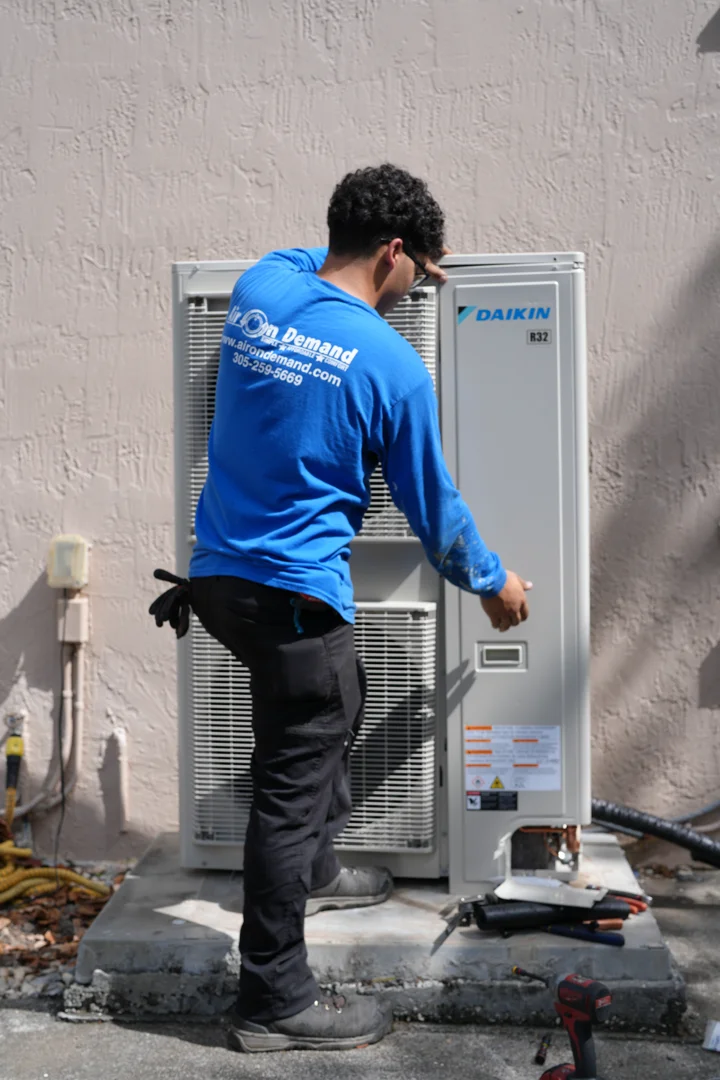
If you live in a place like Coral Gables or Palmetto Bay, you know that the sea breeze is one of the best parts of living here. However, your air conditioner views that breeze as a delivery system for a microscopic army of destroyers.
The primary culprit is sodium chloride—salt. When these salt particles travel on the wind, they settle on the metal surfaces of your outdoor unit. But salt alone isn't the problem; it’s the chemistry that follows. Salt is hygroscopic, meaning it attracts and holds onto moisture. In our 70% to 85% relative humidity, those salt particles stay perpetually damp, creating an electrolytic film.
This film triggers two main types of chemical destruction:
1. Galvanic Corrosion: This occurs because AC coils are often made of two different metals—copper tubing and aluminum fins. When the salty moisture connects these two metals, it creates a tiny electrical circuit. The aluminum acts as an "anode" and literally sacrifices itself, dissolving to protect the copper.
2. Pitting: This is where the salt eats small, deep holes into the metal. On aluminum fins, this often looks like "white rust"—a powdery, chalky substance that signals the metal is breaking down.
As these fins deteriorate, the surface area available to release heat vanishes. This is a major factor in how dust and dirt affect your air-conditioner, as the combination of salt crust and grime creates an insulating blanket that traps heat inside your home. To keep things running smoothly, check out our Miami air-conditioning guide-simple ways to improve for more tips on battling these coastal elements.
Living in South Florida in 2026 means our air conditioners never truly get a "day off." In northern states, a system might sit idle for six months. In Pinecrest or Cutler Bay, we might run our cooling systems 10 or 11 months out of the year.
The sheer volume of operating hours is a massive contributor to what shortens your AC lifespan in heat humidity and salt air. When a system logs 3,500 hours a year, the mechanical wear on the compressor, fan motors, and bearings is tripled compared to a unit in a milder climate.
• Condenser Coils — Inland Lifespan (Years): 15+ — Coastal Lifespan (Unprotected): 5–7
• Cabinet Panels — Inland Lifespan (Years): 20 — Coastal Lifespan (Unprotected): 7–10
• Fan Motor Bearings — Inland Lifespan (Years): 12–15 — Coastal Lifespan (Unprotected): 6–8
• Electrical Terminals — Inland Lifespan (Years): 15 — Coastal Lifespan (Unprotected): 5–8
• Overall System — Inland Lifespan (Years): 15–20 — Coastal Lifespan (Unprotected): 8–12
High ambient heat (often exceeding 95°F) reduces the "temperature differential," which is the AC's ability to swap heat from inside to outside. When it’s scorching outside, the compressor has to work significantly harder to move that heat, leading to thermal stress and premature fatigue.
Furthermore, humidity and air-conditioning in miami-fl go hand-in-hand because a huge part of your AC's job is actually dehumidification. If the air is thick with moisture, the system runs longer cycles just to make the air feel comfortable, even if the temperature is technically at the set point. You can read more about how humidity can affect the quality of air-condi to see how this extra workload translates into a shorter life for your equipment.
How do you know if your system is losing the battle against the Miami climate? The signs are often subtle at first but become undeniable over time.
• Brittle or Crumbling Fins: If you touch the thin metal slats on your outdoor unit and they flake off like dry crackers, you have advanced corrosion.
• White "Powder" on Coils: This is the "white rust" we mentioned earlier. It is the oxidation of the aluminum fins.
• Decreased Efficiency: As the coils corrode, they lose their ability to transfer heat. Your system has to run longer to achieve the same cooling, which results in decreased performance.
• Intermittent Electrical Failures: Salt is conductive. If salt residue builds up on electrical terminals or contactors, it can cause "ghost" issues where the system shuts off for an hour and then starts back up.
• Refrigerant Leaks: Specifically, "formicary corrosion" creates microscopic, tunnel-like holes in copper tubing. If you find the system requires frequent refrigerant adjustment every year, your system is likely a victim of the coastal air.
It’s also important to remember that can severe weather in miami disrupt my air-condi through more than just wind; storm surges and salt spray during heavy weather can accelerate these issues overnight. Additionally, how dirty air filters impact ac performance is magnified in humid areas, as damp filters can become breeding grounds for biological growth that further restricts airflow.
If you are replacing a system in a coastal area like Lakes By the Bay, you shouldn't just buy a "standard" unit. You need equipment built for the environment.
We often recommend coastal-rated units that feature:
• All-Aluminum Coils: Since galvanic corrosion happens between two different metals, using all-aluminum (microchannel) coils eliminates the copper-aluminum reaction.
• Phenolic Epoxy Coatings: Often called "Seacoast Coatings," these are factory-applied layers (like Blue Fin or Gold Fin technology) that provide a physical barrier against salt.
• Stainless Steel Fasteners: Standard screws will rust and bleed down the side of your unit within two years. Stainless steel stays structural.
These features help significantly with how your air-conditioner helps to control the hu without the system itself falling apart under the strain.
You wouldn't buy a boat and never wash the salt off it, right? Your AC unit deserves the same respect. While the coastal environment is harsh, you aren't helpless.
The single most effective DIY task is fresh water rinsing. Every 2 to 4 weeks, take a garden hose and gently rinse the outdoor condenser unit. This washes away the salt film before it has a chance to start the corrosion process. Note: Never use a pressure washer! The high pressure will bend the delicate aluminum fins, blocking airflow and causing more harm than good.
Other key strategies include:
• Vegetation Clearance: Maintain at least a 2-foot buffer around your outdoor unit. Plants trap humidity and restrict the airflow the unit needs to "breathe."
• Frequent Filter Changes: In the Miami heat, we recommend changing filters every 30 to 60 days. Because our systems run so much, a "90-day" filter is usually clogged by day 45.
• Clear the Drain Lines: High humidity means your AC is pulling gallons of water out of the air. This can lead to algae growth and clogs.
Properly managing dirty air filters and miami-fl air-conditioning is critical because a clogged filter makes a system that is already struggling with salt and heat work twice as hard. For more on the health benefits of this, see Miami ac tip-why a clean ac helps with indoor ai.
While DIY rinsing is great, there are things only a thorough inspection can see. In coastal Florida, "annual" maintenance isn't enough—we strongly recommend semi-annual (twice a year) maintenance.
A thorough coastal tune-up should include:
1. Chemical Coil Cleaning: Using specialized, non-acidic cleaners that remove salt deposits that a garden hose can't reach.
2. Electrical Terminal Inspection: Checking for "pitting" on contactors and ensuring connections haven't become brittle from salt exposure.
3. Refrigerant Level Checks: Catching a tiny leak early can save the compressor from failing due to low pressure.
4. Thermostat Calibration: Ensuring your Miami air-conditioning tip-thermostat settings are actually resulting in the right indoor climate.
There comes a point where continuing to repair a salt-damaged unit is no longer effective. If your system is approaching the 10-year benchmark in a coastal area, it’s time to evaluate its overall condition.
We generally advise replacement over repair if:
• The Coil is Leaking: Replacing a condenser coil on an old unit is a major undertaking. If the rest of the unit is also corroded, the new coil won't last long anyway.
• Structural Integrity is Gone: If the base pan or the cabinet is so rusted that the fan motor is vibrating or sagging, the unit is a safety hazard.
• Efficiency has Plummeted: If performance is significantly lower than it was three years ago, the impact of keeping the old unit is likely higher than the benefits of a new, efficient system.
When you do decide to upgrade, you know what can withstand a hurricane-your-duc—so make sure your new unit is paired with a duct system that can handle the pressure. And even though we focus on cooling, don't forget special heating considerations in miami for those three days in January when the temperature actually drops!
If you want your next system to break the 10-year "coastal curse," look for these three upgrades:
1. Variable-Speed Compressors: These systems don't just blast on and off. They ramp up and down, which is much better for managing humidity and reduces the mechanical "shock" to the system.
2. Whole-House Dehumidification: By tackling moisture separately, your AC doesn't have to run marathon cycles just to stop the "sticky" feeling.
3. Coastal Protection Packages: Many manufacturers offer specific "Seacoast" versions of their units with extra layers of protection.
You might think being five miles away from the beach in Kendall or Homestead protects you, but salt particles can travel up to 10 miles inland on sea breezes. If you can smell the salt in the air after a storm, your AC is definitely "at risk."
In places like Coconut Grove or Cutler Bay, we recommend a gentle rinse every two weeks. If you live further inland, once a month is usually sufficient. Always make sure the unit is off before you start.
In the North, the AC removes heat. In Miami, the AC has to remove heat and massive amounts of water. This dual workload, combined with the fact that the moisture keeps salt particles in a liquid, corrosive state, creates a "perfect storm" that northern units never have to face.
Living on the Florida coast is a dream, but for an air conditioner, it’s a constant battle for survival. By understanding what shortens your AC lifespan in heat humidity and salt air, you can take the small, proactive steps needed to keep your home cool.
Local specialists understand the unique demands of the Miami climate. Whether in Pinecrest, Palmetto Bay, or Homestead, expertise and robust protection can help give you peace of mind in a harsh environment.
Don't let the salt air win. Schedule your coastal AC maintenance today to help protect your equipment.