Seasonal HVAC Preventative Maintenance: Addressing an AC Unit Fan That Stopped Spinning
August 17, 2026
Summer weather is rapidly approaching, which means it is time to finalize your seasonal home maintenance checklist before the extreme heat arrives. Addressing preventative maintenance and system vulnerabilities prior to major weather shifts is the most effective way to prevent sudden, catastrophic equipment failures. As the outdoor temperatures begin to climb, your household HVAC system shifts from periods of relative dormancy into a heavy, continuous operational cycle. This upcoming seasonal transition places immense stress on aging mechanical and electrical components.
Early identification of system vulnerabilities is critical. When you catch a minor issue—like a slightly degraded electrical component or a dirty condenser coil—you prevent complete breakdowns during peak heat waves when repair schedules are often booked weeks in advance. The core decision point homeowners face during this time is determining which maintenance tasks require a licensed professional and what can be safely deferred or handled independently. Understanding how your system operates, what signs indicate impending failure, and where the safety boundaries lie will help you make informed decisions about your property.
Routine preventative HVAC maintenance is not just about keeping the air cold; it is about optimizing the entire refrigeration cycle. Data from the Department of Energy indicates that proper, routine maintenance can improve system efficiency by up to 15%. When your air conditioner operates efficiently, it draws less electricity, cycles more consistently, and maintains a stable indoor climate.
Positioning your AC maintenance as essential property protection is vital, particularly when dealing with rapid indoor humidity spikes. An air conditioner does not just cool the air; it removes moisture. If the system fails, indoor humidity can skyrocket within hours, potentially leading to warped wood, peeling paint, and poor indoor air quality. Increased cooling loads during seasonal shifts drastically increase the electrical draw on condenser units. In hot, humid tropical climates where AC units run for significantly more hours per year, this continuous operation accelerates wear on electrical components far faster than in temperate zones.
To understand the tangible benefits of seasonal preparation, consider the differences between a maintained and unmaintained system:
• Electrical Draw — Maintained HVAC System: Operates within manufacturer specifications, keeping utility costs stable. — Unmaintained HVAC System: Draws excessive amperage as components struggle, driving up utility bills.
• Humidity Control — Maintained HVAC System: Removes moisture efficiently, maintaining a comfortable 40-50% indoor humidity. — Unmaintained HVAC System: Short-cycles or struggles to cool, leaving indoor air feeling sticky and damp.
• Component Lifespan — Maintained HVAC System: Motors and compressors run cooler, extending the overall life of the equipment. — Unmaintained HVAC System: Overheating degrades wire insulation and internal fluids, leading to premature failure.
• Reliability — Maintained HVAC System: Prepared for the upcoming seasonal transition with minimal risk of sudden failure. — Unmaintained HVAC System: Highly vulnerable to breaking down during the first major heatwave of the year.
Before the heavy heat sets in, evaluating the physical state of your outdoor condenser unit is a safe, top-of-funnel task you can perform without specialized tools. The outdoor unit (the condenser) requires unrestricted airflow to dissipate the heat removed from your home. If this airflow is choked, the system works harder, runs hotter, and risks catastrophic damage.
Follow these safe visual inspection steps to assess your exterior condenser unit:
1. Verify power status: Always ensure the thermostat is set to the "off" position before performing any visual inspection around the outdoor unit. Do not touch electrical panels or wiring.
2. Check the clearance zone: Inspect the perimeter of the heat pump or AC unit. You need a minimum of two feet of clear space on all sides. Overgrown shrubs, tall grass, and low-hanging branches must be trimmed back.
3. Remove physical obstructions: Clear away any accumulated debris, dead leaves, pine needles, or trash that has gathered against the delicate aluminum fins of the unit. These obstructions block airflow and insulate the coils, trapping heat inside.
4. Inspect the aluminum fins: Look closely at the thin metal fins wrapping the outside of the unit. If large sections are flattened, crushed by hail, or caked in thick mud, the system is not ready for heavier seasonal usage and requires professional cleaning and fin-combing.
5. Examine the refrigerant lines: Locate the two copper lines running from the house to the unit. The larger suction line should be wrapped in thick, black foam insulation. If this insulation is missing, severely cracked, or deteriorating, it indicates physical wear that should be addressed to maintain efficiency.
One of the most alarming issues you might encounter during an upcoming seasonal transition is walking outside to find the AC unit fan not spinning while the system is supposedly running. The mechanical function of the AC condenser fan is vital: it pulls outside air through the condenser coils to expel the heat absorbed from inside your home. Without this fan, the refrigeration cycle breaks down completely.
The immediate consequences of a fan that stops spinning are severe. Because the heat cannot be expelled, it remains trapped in the refrigerant. This causes the internal pressure and temperature of the compressor to skyrocket. Rapid system overheating occurs, and if the system's internal thermal overload switches fail to trip in time, the compressor—the most expensive component in the entire system—can suffer irreversible damage. In tropical climates, a broken AC fan is an immediate emergency due to the rapid rise in indoor temperatures and oppressive humidity that follows within minutes of a failure.
Initial signs of fan failure often present before the blade stops entirely. You might hear a loud, electrical buzzing noise coming from the outdoor unit, indicating that power is reaching the motor but it cannot turn. Alternatively, you might see the fan blades struggling to turn, spinning sluggishly, or operating with a severe wobble. When diagnosing condenser failures, recognizing these early symptoms is the difference between a minor part replacement and a major system overhaul.
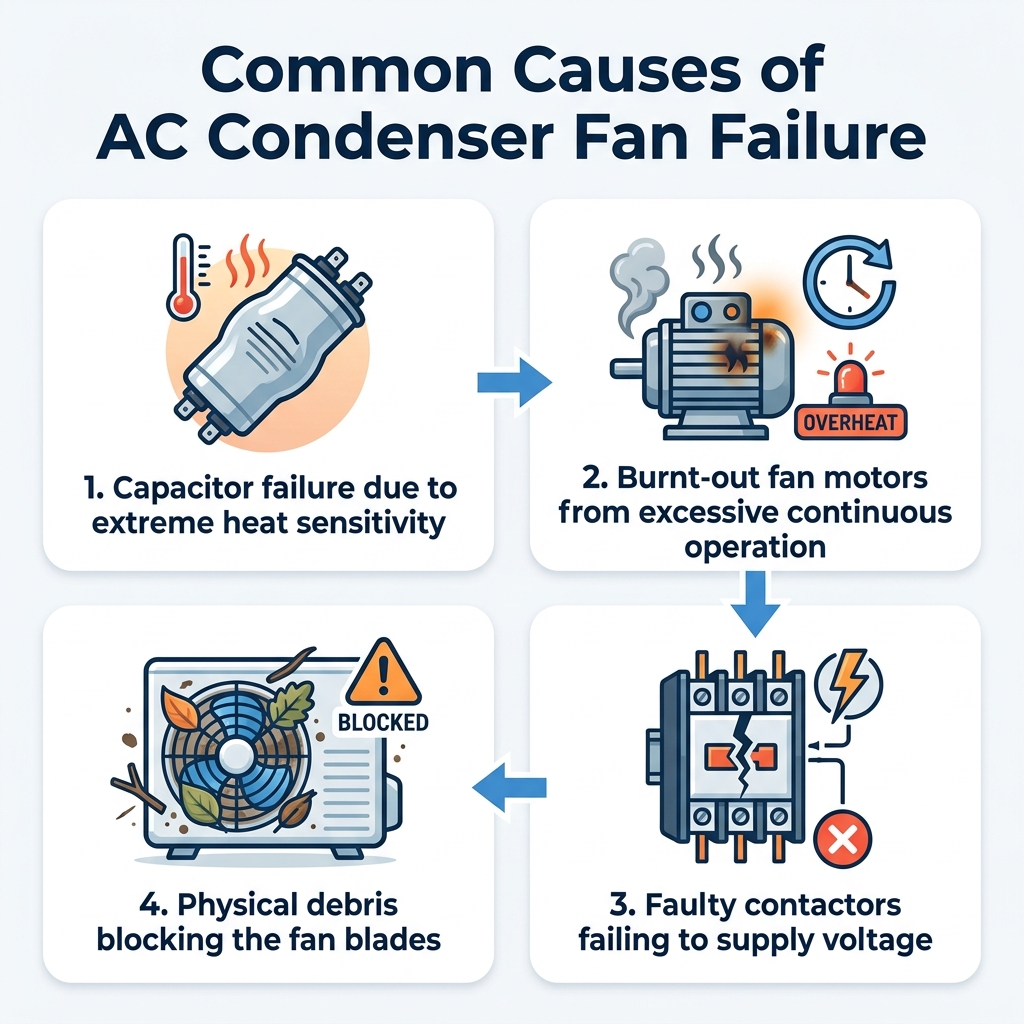
When the fan stops, the root cause is typically mechanical or electrical. On the mechanical side, burnt-out fan motors are a frequent culprit. Excessive continuous operation, especially during extreme heat waves, degrades the motor's internal windings. Over time, the bearings wear out, friction increases, and the motor simply burns itself up.
Another common mechanical issue involves physical debris blockages. Sticks, heavy accumulations of wet leaves, or even small rocks can fall through the top grate of the condenser unit. These obstructions can physically wedge against the fan blades, preventing them from turning. When the motor tries to spin against this locked rotor state, it overheats rapidly and can burn out if the system is not shut down immediately.
Beyond mechanical blockages, the electrical components inside your outdoor unit are highly vulnerable to the extreme heat associated with the upcoming seasonal transition. The two most common points of electrical failure are the run capacitor and the contactor.
Capacitors are highly sensitive to extreme heat and are a leading cause of outdoor fan failure. A capacitor acts as a powerful, short-term battery that stores electricity. It delivers a massive jolt of energy to start the fan motor and the compressor, and then provides a continuous, steady electrical current to keep them running smoothly. Because they are filled with a dielectric fluid, prolonged exposure to high ambient temperatures and heavy operational loads causes that fluid to break down, expand, and eventually cause the capacitor to bulge or pop.
The contactor is equally critical. This component acts as the heavy-duty switch that supplies high-voltage electricity to the condenser unit. When your thermostat calls for cooling, it sends a low-voltage signal to the contactor, pulling a magnetic coil closed to bridge the high-voltage connection. Over time, the electrical arcing that occurs every time this switch closes causes the metal contacts to become pitted, burnt, and covered in carbon. Seasonal temperature spikes push these aging electrical components past their failure points, resulting in a system that either will not turn on or will not shut off.
While clearing leaves and changing indoor air filters are excellent homeowner tasks, there are strict safety boundaries when dealing with the internal components of an HVAC system. We issue clear warnings against DIY diagnostics for high-voltage HVAC electrical components. The outdoor condenser unit operates on 240 volts of electricity, which is more than enough to cause severe, life-threatening injuries if handled improperly.
Furthermore, the symptoms of different component failures often overlap. The risks of misdiagnosing a bad capacitor versus a burnt motor are substantial. If a homeowner assumes the capacitor is bad, replaces it improperly, and turns the power back on while the motor is actually shorted to ground, it can lead to catastrophic compressor damage. The compressor relies on the fan to keep it cool; if you force the system to run with a compromised electrical setup, you risk destroying the entire unit.
This is why specialized tools and extensive training are required to safely test electrical loads. Technicians use professional-grade multimeters to measure microfarads, check for continuity, and read the exact amperage draw of the motor under load. Professional, licensed diagnostics are the only way to ensure the correct component is identified and fixed safely without risking the compressor. A licensed expert knows how to safely discharge a capacitor, test the contactor for voltage drops, and verify that the motor windings are intact before restoring power to the system.
To navigate the upcoming seasonal transition successfully, you need a clear decision-making framework for when to handle maintenance yourself and when to call a professional. Preventative action is always more cost-effective than reactive emergency repairs, especially when dealing with expensive cooling equipment.
Here are the objective criteria to guide your maintenance strategy:
• Safe for homeowner deferment and action: Replacing indoor air filters every 30-90 days, gently washing the exterior condenser cabinet with a standard garden hose (never a pressure washer), and trimming back foliage to maintain the two-foot clearance zone.
• Immediate professional intervention required: Fan not spinning. If you hear the system running but the top fan is stationary, turn the system off immediately at the thermostat and call a licensed technician.
• Immediate professional intervention required: Electrical buzzing. A loud hum or buzz from the outdoor unit without the fan or compressor engaging indicates a locked rotor or failed electrical component.
• Immediate professional intervention required: Rapid cycling. If the system turns on and off every few minutes (short cycling), it is struggling with airflow, refrigerant levels, or electrical faults.
• Immediate professional intervention required: Warm air at the vents. If the system is running constantly but the air blowing inside is room temperature, the refrigeration cycle has failed and requires professional gauges to diagnose.
A comprehensive seasonal checklist should prioritize airflow and electrical safety. It must include replacing indoor air filters, clearing a two-foot perimeter around the outdoor unit, and scheduling a professional inspection of the electrical components. Additionally, checking the thermostat calibration and ensuring all indoor vents are open and unblocked are critical steps. Taking these actions before the heat arrives prevents unexpected breakdowns.
Effective preparation starts with a visual inspection of the outdoor condenser to ensure no debris is blocking the delicate aluminum fins. Next, wash away dirt and pollen using a gentle stream from a garden hose, being careful not to bend the fins. Finally, the most effective step is booking a preventative maintenance tune-up with a licensed professional to test the capacitors, contactors, and refrigerant levels before the system faces heavy cooling loads.
The fan usually stops spinning due to a failed capacitor, a burnt-out fan motor, or physical debris blocking the blades. Yes, this is highly dangerous to the equipment. Without the fan expelling heat, the internal compressor rapidly overheats, which can cause catastrophic, irreversible damage to the most expensive part of your HVAC system if the power is not shut off immediately.
If you skip routine service, the compressor works significantly harder to pump refrigerant through dirty coils and failing electrical parts. This excessive strain causes the compressor to run hotter than its designed thermal limits. Over time, this heat breaks down the internal lubricating oils and wire insulation, leading to a seized compressor and a total system failure.
Any task involving the sealed refrigerant loop or high-voltage electrical components mandates a licensed professional. This includes testing or replacing capacitors, changing contactors, diagnosing motor failures, and checking refrigerant pressures. Homeowners should never attempt DIY diagnostics on these parts due to the severe risk of electrocution and the high probability of causing further damage to the system.
A clear, well-structured technical approach to your seasonal home maintenance checklist prevents sudden, expensive failures when you need your cooling system the most. By understanding the mechanical functions of your equipment and respecting the dangers of high-voltage components, you protect your property from humidity spikes and catastrophic compressor damage. We encourage you to review your property's systems based on the objective criteria outlined above. If you notice any signs of electrical strain, or if your system has not been evaluated for the upcoming seasonal transition, schedule a consultation with a licensed professional to verify your system's readiness today.