
Electronic Polarized Media Filters vs. Traditional Pleated Health Smart Filters
September 23, 2026
Here at Air On Demand, our HVAC technicians find that the debate between Electronic Polarized Media Filters vs. Traditional Pleated Health Smart Filters often starts with a common misconception: that the thickest, most densely woven filter will automatically provide the best results for your home. Most homeowners assume that blocking allergens requires a physical barrier so tight that almost nothing can get through. The reality is that your air conditioning system needs to breathe, and cutting off its air supply to trap dust can create a cascade of mechanical failures.
If you want to explore broader solutions first, reviewing your options for indoor air cleaners and purifiers is a great starting point. However, if you are specifically weighing high-efficiency filtration methods, understanding the mechanical trade-offs is non-negotiable.
Our AC repair crews see this conflict peak during the late summer. The combination of August peak humidity and late-summer AC strain means your system is running nearly 24/7. When you introduce a highly restrictive filter into an air handler that is already working overtime to dehumidify the air, you are essentially asking your blower motor to run a marathon while breathing through a thick wool blanket. The core decision you face is whether to upgrade to an active electronic system that captures particles without restricting air, or to rely on passive, high-MERV disposable pleated filters that prioritize physical trapping over system breathability.
A "health smart" filter generally refers to a passive, disposable pleated media filter designed to trap microscopic allergens, pet dander, and fine dust. These filters rely entirely on physical interception. To capture smaller and smaller particles, the manufacturer must weave the synthetic fibers closer and closer together.
The effectiveness of these passive filters is measured by the Minimum Efficiency Reporting Value (MERV) scale. While standard fiberglass filters sit around MERV 1 to 4, and standard pleated filters sit around MERV 5 to 8, health smart filters typically start at MERV 11 and can go up to MERV 16. Here is the step-by-step reality of how this passive filtration impacts your system:
1. Physical Interception: The HVAC blower motor pulls return air from your home through the return ducts and forces it through the pleated filter media.
2. Particulate Trapping: As air passes through, particles larger than the gaps in the media are physically trapped on the surface of the filter.
3. Airflow Restriction: Because the weave is exceptionally tight (to catch particles as small as 1 to 3 microns), there is significantly less open space for the actual air to pass through.
4. Increased Resistance: The tight weave creates a physical wall. The blower motor must work exponentially harder to pull the same volume of air through this dense barrier.
This physical trade-off is the primary drawback of passive high-efficiency filtration. The high static pressure and airflow restriction from MERV 11+ passive filters can severely alter how your system performs. For a deeper dive into how these filters handle local climate challenges, you might find it helpful to read about evaluating Health Smart filters for South Florida humidity. Ultimately, while passive filters are excellent at stopping contaminants, their dense physical barrier fundamentally limits the volume of return air your system can process efficiently.
To understand why active filtration is different, we have to look at the mechanics of polarization. The problem with passive filters is that increasing capture efficiency always requires increasing the density of the media. Electronic polarized media filters solve this problem by changing how particles behave, rather than just putting a thicker wall in front of them.
The Problem: Airborne particles, such as fine dust, pollen, and smoke, are incredibly small and easily slip through standard, breathable filter media. To catch them passively, you have to restrict the airflow to a dangerous degree.
The Cause: Particles naturally repel each other or remain neutral, floating independently through the air. Because they remain microscopic, they require microscopic physical barriers to stop them.
The Solution: Electronic polarized media filters use an active electrical field to change the physical properties of the contaminants. When the filter is connected to a power supply, it generates a safe, 24-volt polarized electrical field across a relatively porous fiberglass or synthetic media pad. As airborne particles pass through this field, they become polarized—essentially turning into tiny, charged magnets.
Once polarized, these particles undergo a process called agglomeration. They become attracted to each other and stick together, forming much larger clusters. They are also drawn directly to the polarized fibers of the media pad. Because the particles are clumping together and actively seeking out the filter fibers, the media pad itself does not need to be densely woven. It remains highly breathable. This active process delivers the high capture efficiency of a dense pleated filter but completely eliminates the high static pressure and airflow restriction from MERV 11+ passive filters.
The most critical difference between these two technologies is their impact on your HVAC system's static pressure. Think of static pressure as the blood pressure of your air conditioning system. It is the measurement of resistance to airflow within the ductwork and the air handler.
The danger of high static pressure: When you install a dense passive filter, you immediately spike the system's static pressure. The blower motor is designed to move a specific volume of air (measured in cubic feet per minute, or CFM). When a thick filter blocks the return air, modern variable-speed (ECM) blower motors will automatically ramp up their RPMs to try and overcome the resistance. This leads to massive energy consumption, loud operation, and premature motor burnout. Older single-stage motors will simply fail to pull enough air, severely reducing your home's cooling capacity.
The risk of frozen evaporator coils: This lack of airflow becomes incredibly dangerous in our specific regional climate. With summer temperatures regularly exceeding 90°F and extreme moisture in the air, your AC relies on a steady, heavy volume of warm return air passing over the cold indoor evaporator coil to prevent freezing. The August peak humidity and late-summer AC strain create the perfect storm. When our team responds to emergency AC repair calls for frozen coils during the back-to-school transition, a restrictive passive filter choking off that warm airflow is one of the most common culprits we find. The heavy condensation pulled from Miami's humid air rapidly turns to solid ice, completely shutting down your cooling system and potentially damaging the compressor.
The breathability advantage: This is where polarized media excels. Because the media pad is loosely woven, it maintains optimal static pressure. The system breathes easily, the blower motor operates at its intended speed, and the optimal volume of warm air continually washes over the evaporator coil, preventing ice buildup. Upgrading your air conditioner filters in Miami requires balancing this need for maximum airflow with the need for clean air.
When evaluating how well each system removes allergens, dust, and contaminants, it is important to look at how their efficiency changes over time.
Traditional health smart filters are highly effective on day one. A MERV 13 pleated filter will capture up to 90% of particles in the 1.0 to 3.0-micron range, which includes pet dander, mold spores, and fine dust. However, as the filter catches these particles, the tiny gaps in the media become clogged. While this technically increases the filter's capture efficiency (because the holes are getting smaller), it rapidly accelerates the airflow restriction. The filter becomes a solid wall of dirt, suffocating the system long before the recommended replacement date.
Electronic polarized media filters typically provide a capture efficiency equivalent to MERV 13 or higher, but their performance curve is vastly different. Because the electrical field causes particles to agglomerate, the filter actually becomes more efficient as it loads with dirt, without suffering the same drastic drop in airflow. The polarized dust particles attached to the media fibers act as extensions of the electrical field, actively attracting more particles.
For homes with severe allergy or asthma concerns, both filters offer excellent particulate removal. However, the traditional pleated filter will only maintain that performance if you are willing to change it obsessively to prevent system damage. The polarized media filter offers the same high-level capture of microscopic allergens but maintains that performance safely over a longer period, making it the superior choice for continuous indoor air quality management.
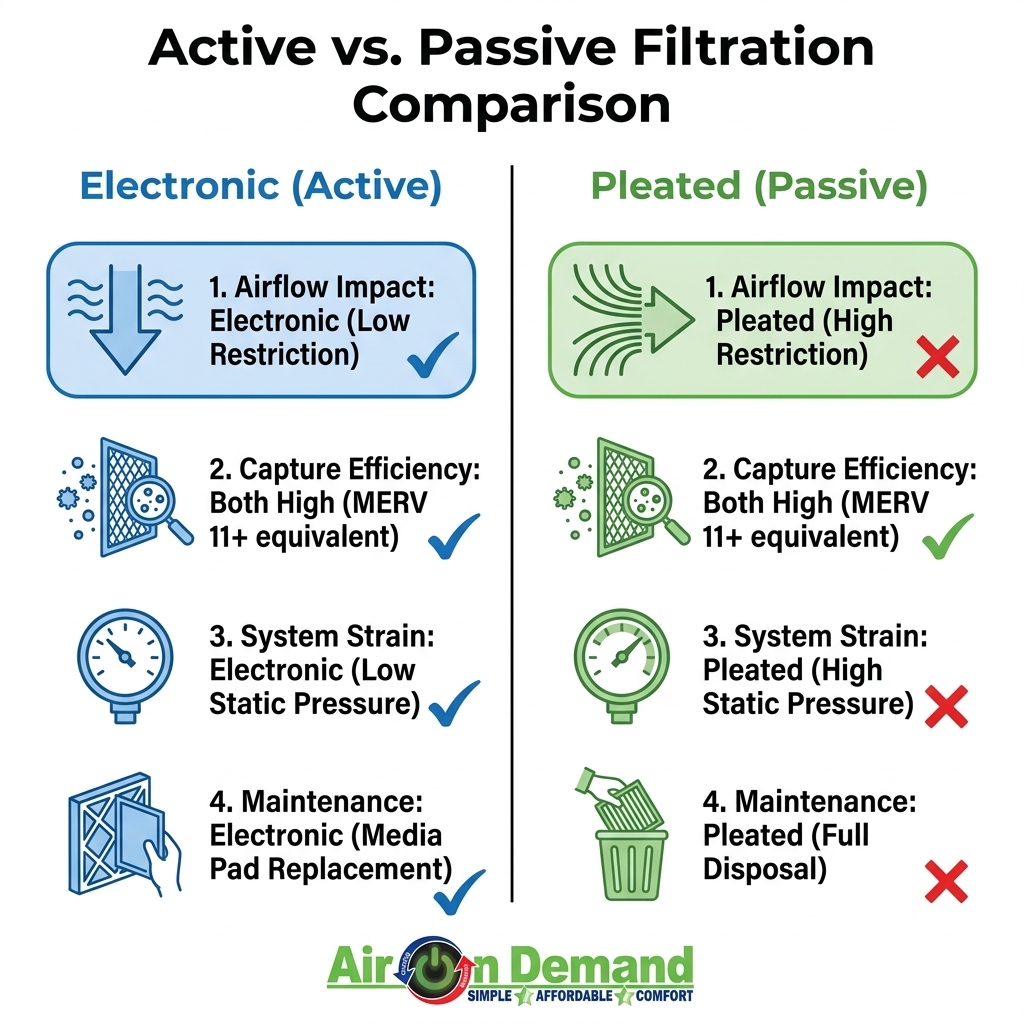
To make the decision easier, here is a breakdown of how these two approaches compare across the most important operational metrics.
• Filtration Method — Electronic Polarized Media Filters: Active (Electrical polarization & agglomeration) — Traditional Pleated Health Smart Filters: Passive (Physical barrier interception)
• Airflow Impact — Electronic Polarized Media Filters: Minimal restriction; highly breathable media — Traditional Pleated Health Smart Filters: High restriction; dense physical barrier
• Capture Efficiency — Electronic Polarized Media Filters: High (MERV 13+ equivalent); improves as it loads — Traditional Pleated Health Smart Filters: High (MERV 11-16); clogs rapidly
• System Strain (Static Pressure) — Electronic Polarized Media Filters: Low static pressure; protects blower motor — Traditional Pleated Health Smart Filters: High static pressure; strains blower motor
• Maintenance Style — Electronic Polarized Media Filters: Replace internal media pad periodically — Traditional Pleated Health Smart Filters: Dispose of and replace the entire filter
Beyond the daily performance, you must consider what it takes to live with these filters year-round. The maintenance routines for these two systems are entirely different.
Traditional pleated filter maintenance: During high-usage months, particularly given the August peak humidity and late-summer AC strain, a high-MERV pleated filter may need to be replaced every 30 to 45 days. Because it traps everything on the surface, leaving it in place for the standard 90 days can lead to severe system suffocation. You are entirely responsible for monitoring the airflow and constantly purchasing thick, disposable replacements.
Polarized media filter maintenance: The maintenance for an active system is slightly different but highly manageable for homeowners. The durable outer frame remains permanently installed in your ductwork and remains plugged into its power source. Every few months, you simply unplug the frame, open it, remove the dirty fiberglass media pad, wipe down the carbon contacts, and slide a fresh, inexpensive media pad inside.
The real long-term value of the polarized system lies in system protection. By maintaining low static pressure, you are actively extending the life of your expensive variable-speed blower motor and reducing your monthly energy consumption. In our years of providing AC installation and repair services across Miami, the Air On Demand team has learned that proper system matching is absolutely critical for any high-efficiency filtration upgrade. We ensure that whichever filtration method you choose, it aligns perfectly with your specific air handler's CFM requirements to prevent airflow restriction in South Florida homes. You can review more about integrating these units by looking into whole-home air filtration systems.
No, they operate with a highly breathable media that allows air to pass through easily. They use an electrical field rather than dense physical material to trap particles. This active polarization means you get excellent air cleaning without choking off the return air your system needs to function.
They offer superior airflow and comparable or better capture efficiency over time. They are generally better for system longevity due to lower static pressure. While pleated filters are great for short-term trapping, polarized filters protect the blower motor from unnecessary strain while keeping the air clean.
It is typically a high-MERV, passive pleated filter designed to trap smaller allergens like pet dander and fine dust. Because it relies on a very tight physical weave, it requires careful monitoring to ensure it doesn't suffocate the HVAC system. If left in too long, the high static pressure and airflow restriction from MERV 11+ passive filters can cause mechanical failures.
The internal media pad usually needs replacing every few months. The exact frequency depends on household factors like the number of pets, indoor dust levels, and continuous fan usage. Unlike traditional filters, the frame stays in place, and you only replace the inner pad.
Yes, restricted airflow prevents warm return air from passing over the cold evaporator coil. Without that heat exchange, the coil's temperature drops below freezing. The heavy condensation pulled from the humid summer air then turns into solid ice, completely blocking the system.
High static pressure forces the motor to work significantly harder to push and pull air through the ductwork. This constant resistance leads to increased energy consumption and overheating. Over time, this strain causes premature motor failure. In our experience, this often turns a simple filter choice into an extensive AC repair.
The short answer is that achieving pristine indoor air quality should never come at the expense of your air conditioner's health. The high static pressure and airflow restriction from MERV 11+ passive filters can turn a well-intentioned upgrade into a mechanical nightmare, especially when fighting the August peak humidity and late-summer AC strain.
Electronic polarized media filters provide an elegant solution, giving you the high-level particulate capture you need while maintaining the breathability your system demands. Protecting your HVAC equipment is just as important as cleaning the air you breathe. If you are unsure which path is right for your specific air handler, consult with our local professionals to evaluate your current system's static pressure and find a balanced, long-term filtration strategy.