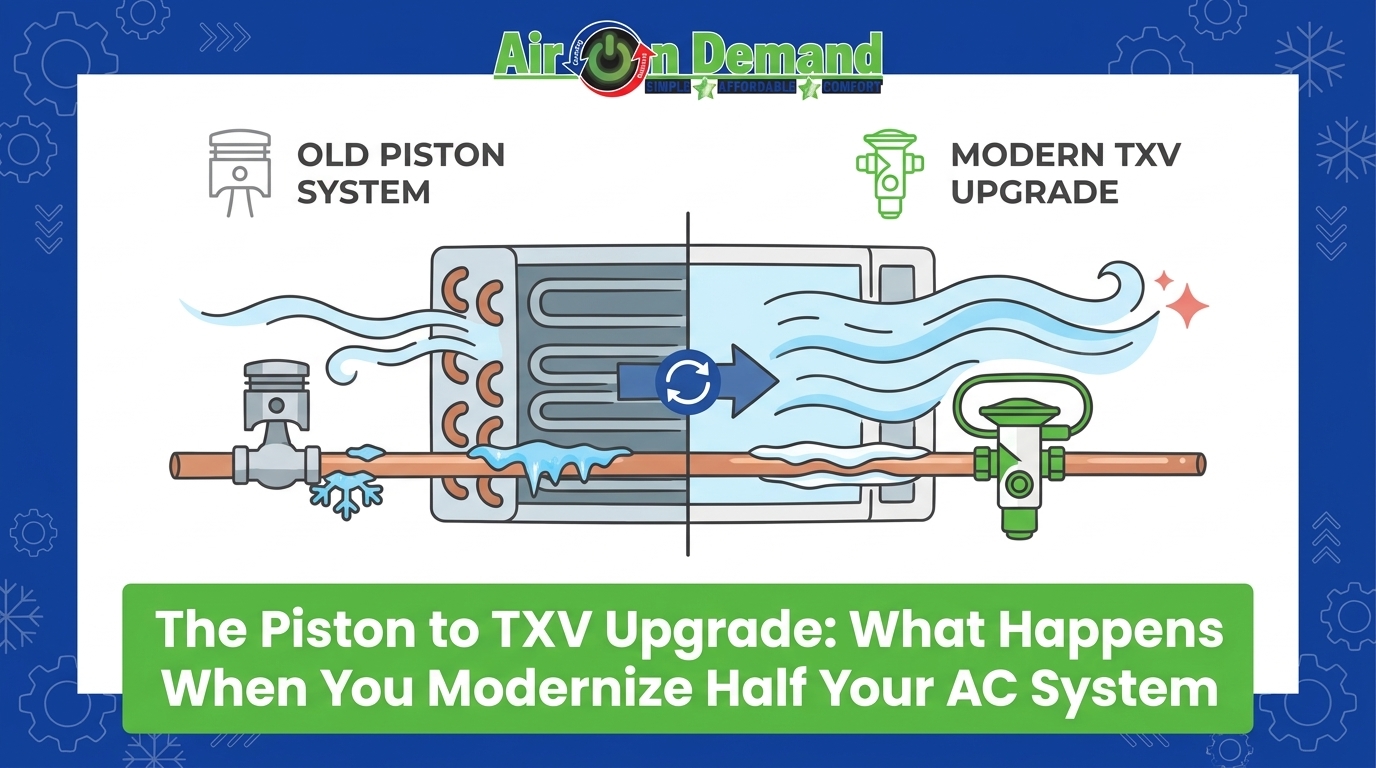
The Piston to TXV Upgrade: What Happens When You Modernize Half Your AC System
September 23, 2026
Your outdoor condenser has just failed in the sweltering heat, and understanding the piston to TXV upgrade: what happens when you modernize half your AC system is the key to making a smart replacement decision. When a catastrophic breakdown hits your home in late August—just as the kids are heading back to school and the end-of-summer humidity is peaking—the immediate priority is getting the cold air flowing again as quickly as possible. The outdoor unit sits dead in the yard, but the indoor air handler in your closet or attic seems perfectly fine. This creates a highly common dilemma we see all the time at Air On Demand: you want to replace the broken outdoor equipment while leaving the indoor unit untouched to save time and resources.
However, an air conditioning system is not a collection of independent parts; it is a carefully balanced, closed-loop network. When you connect a brand-new, high-efficiency outdoor condenser to an older indoor air handler, you are essentially asking modern technology to communicate with outdated hardware. To make this partial modernization work, a critical, often misunderstood modification must take place inside your home. Upgrading the indoor metering device is not an optional upsell tacked onto your AC installation and replacement quote. It is an absolute technical necessity that determines whether your new equipment will survive its first season or fail prematurely under the heavy cooling load.
The short answer is yes, it is physically possible to replace only the outside unit, but doing so comes with strict compatibility rules that must be followed to the letter. In our years of providing HVAC services across Miami FL, our team frequently hears homeowners assume that because the outdoor unit does the heavy lifting of compressing the refrigerant and exhausting the heat, the indoor unit is just a fan blowing air over cold pipes. In reality, the indoor coil and the outdoor compressor are a matched pair that must operate in perfect synchronization.
When you are weighing the options of repairing vs. replacing your AC, you have to consider the "brain" of the refrigerant flow. Inside your indoor air handler sits a small but vital component called the metering device. This part regulates exactly how much liquid refrigerant enters the indoor evaporator coil. If you connect a highly advanced, modern condenser to an older indoor setup without changing this metering device, the system will suffer immediate performance issues.
Here are the critical steps professional technicians take when evaluating partial replacements:
1. Assess the indoor coil condition: Before any partial replacement, we meticulously inspect the indoor coil for leaks, rust, and airflow restrictions. If the coil is failing, replacing only the condenser is a wasted investment.
2. Verify refrigerant type: Older systems use R-22 refrigerant, which is obsolete. Modern systems use R-410A or newer A2L refrigerants. The indoor coil must be rated to handle the pressure of the new refrigerant.
3. Identify the existing metering device: Older air handlers typically use a fixed-orifice piston. Modern condensers require a dynamic valve to manage the flow.
4. Perform the necessary modifications: If the indoor coil is structurally sound and compatible with the new refrigerant pressures, a licensed technician must remove the old piston and braze in a new, responsive valve to ensure the two halves of the system can communicate safely.
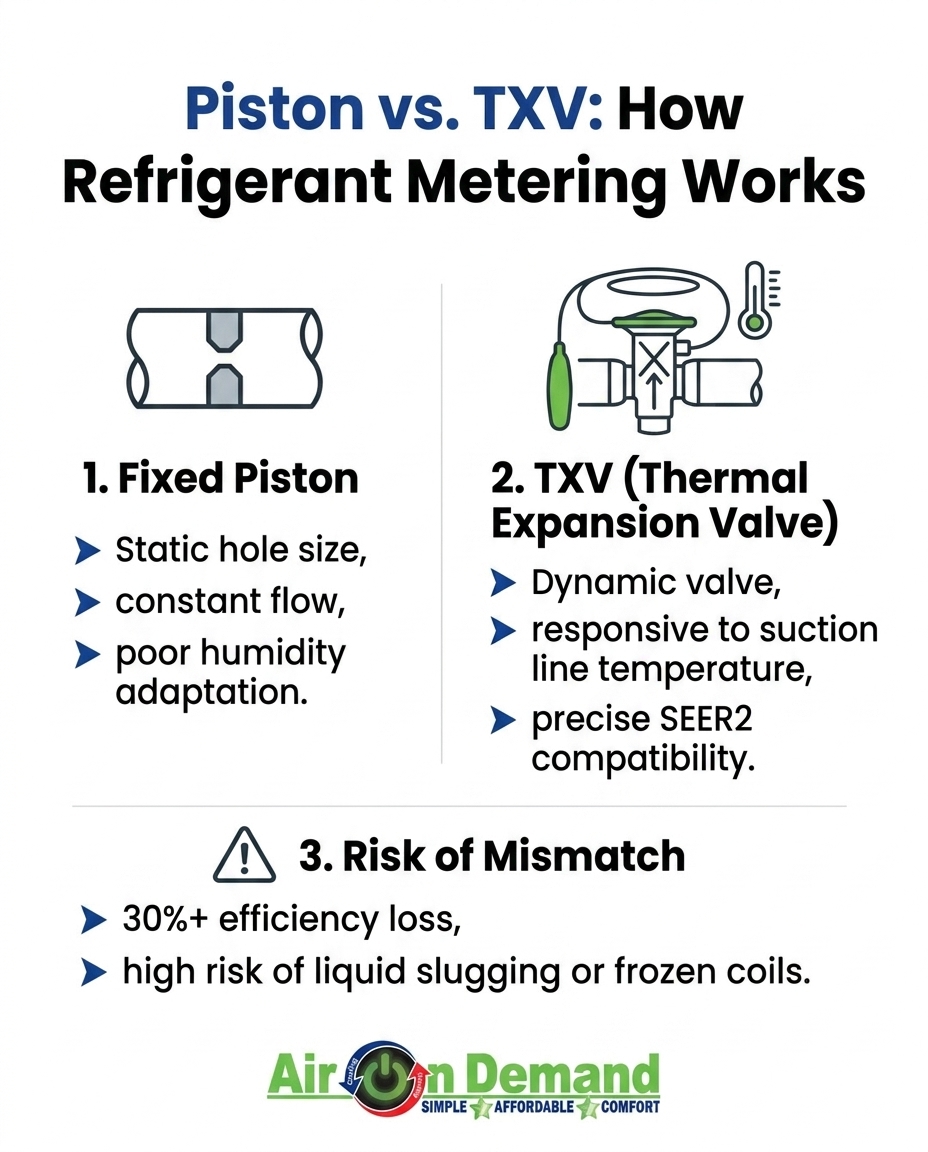
To understand why modernizing half your system requires an upgrade, you need to know the difference between the two primary types of metering devices: the fixed-orifice piston and the Thermal Expansion Valve (TXV). While they both serve the same basic function—restricting the flow of high-pressure liquid refrigerant so it drops in pressure and turns into a cold gas—they go about it in completely different ways.
A fixed-orifice piston is an older, static device. As the name suggests, it features a small, precisely drilled hole (the orifice) that allows a constant, unchanging volume of refrigerant to pass through. Think of it like a standard garden hose nozzle locked into one position. Whether your home is slightly warm on a mild morning or baking in the late August sun, the piston pushes the exact same amount of refrigerant into the indoor coil. It cannot adjust, adapt, or respond to changing conditions.
A Thermal Expansion Valve (TXV), on the other hand, is a dynamic, highly responsive piece of engineering. A TXV features a sensing bulb strapped to the suction line leaving the indoor coil. This bulb constantly measures the temperature of the refrigerant exiting the coil. If the coil is getting too warm, the TXV actively opens wider to feed more refrigerant. If the coil is getting too cold, the valve throttles back to restrict the flow. Returning to the analogy, a TXV is like a smart irrigation system that measures soil moisture and delivers the exact amount of water needed at any given second.
• Refrigerant Flow — Fixed-Orifice Piston: Static and constant, regardless of demand. — Thermal Expansion Valve (TXV): Dynamic and variable, adjusting in real-time.
• Response to Heat/Humidity — Fixed-Orifice Piston: Cannot adapt to sudden spikes in indoor load. — Thermal Expansion Valve (TXV): Actively opens and closes based on coil temperature.
• Efficiency — Fixed-Orifice Piston: Lower; wastes energy during mild cooling loads. — Thermal Expansion Valve (TXV): High; maximizes efficiency by optimizing refrigerant use.
• Best Suited For — Fixed-Orifice Piston: Older, lower-efficiency AC units (Sub-13 SEER). — Thermal Expansion Valve (TXV): Modern, high-efficiency SEER2 condensers.
The HVAC industry has undergone massive regulatory changes in recent years, specifically with the rollout of the updated Department of Energy SEER2 guidelines. SEER2 stands for Seasonal Energy Efficiency Ratio 2, and it represents a stricter, more rigorous testing standard for how air conditioners perform under real-world conditions. To meet these new, mandated efficiency minimums, manufacturers have entirely redesigned the internal components of their outdoor units.
When you look at new AC units today, you are looking at sophisticated machines featuring advanced scroll compressors, enhanced fan blade designs, and highly calibrated internal sensors. These modern outdoor units are built with the assumption that they will receive a precise, highly managed return flow of refrigerant from the indoor unit. They rely on that exact flow not just for cooling your home, but for cooling the compressor motor itself as it operates.
A fixed piston simply cannot meter refrigerant accurately enough for a high-efficiency system to achieve its rated performance. Because a piston delivers a static flow, there are times during the cooling cycle when the modern compressor is starved for refrigerant, causing it to run hotter and pull more electricity. Failing to upgrade the valve during a partial replacement means you are paying for high-efficiency equipment—which may even qualify for generic federal tax credits or local utility incentives—but forcing it to operate with low-efficiency results. The advanced SEER2 condenser will be handcuffed by the outdated piston, effectively erasing the energy savings you expected to see on your monthly utility bills.
Beyond mechanical compatibility, there is a physical reality to how a mismatched system impacts your daily comfort, particularly regarding latent cooling. Sensible cooling is the act of dropping the temperature in a room; latent cooling is the system's ability to remove moisture from the air. In a subtropical climate with extreme late-summer humidity, latent cooling is arguably more important than sensible cooling for keeping your home comfortable.
With end-of-season temperatures and moisture levels surging in Miami FL, a fixed piston struggles to manage the heavy latent load. Because the piston cannot adjust to sudden spikes in indoor humidity, it often leaves the evaporator coil running too warm to extract moisture effectively. Water vapor in the air only condenses into liquid (and drips down your condensate drain) when the indoor coil is kept consistently cold. If the piston is feeding too much refrigerant during a humid afternoon, the coil temperature rises, and the dehumidification process grinds to a halt.
A TXV solves this problem by actively throttling the refrigerant flow to keep the indoor coil at the perfect, consistently cold temperature required to wring maximum humidity out of the air. It continuously adapts to the heat and moisture load inside the house, ensuring the coil stays cold enough to act as a powerful dehumidifier without dropping so low that it freezes.
• Inability to adapt to peak humidity loads: When a heavy rainstorm rolls through and indoor humidity spikes, a piston cannot increase refrigerant flow to compensate.
• Shorter cooling cycles that fail to pull moisture: A mismatched system often cools the air too quickly (sensible cooling) before it has time to remove the moisture (latent cooling), causing the thermostat to shut the system off prematurely.
• Overworking the outdoor unit: Because the home feels sticky and clammy, homeowners naturally push the thermostat lower and lower to compensate, forcing the outdoor unit to run nonstop and accelerating wear and tear.
Refusing a TXV upgrade during a partial replacement isn't just an efficiency issue; it presents severe mechanical risks that can destroy your investment in a matter of weeks. When you force a modern condenser to work with an incompatible fixed piston, you disrupt the delicate balance of pressures and temperatures required to keep the system stable.
One of the most common consequences of this mismatch is starving the indoor coil of refrigerant. If the older piston restricts the flow too much for the new condenser's capacity, the pressure inside the indoor coil drops rapidly. As pressure drops, temperature drops. The coil quickly falls below freezing (32°F), causing the natural condensation on the fins to turn to solid ice. Within hours, the entire indoor coil can become encased in a block of ice, completely blocking airflow and shutting down your cooling right in the middle of late August.
An even more catastrophic risk is the reverse scenario: the piston feeding too much refrigerant into the coil. If the liquid refrigerant does not fully boil off into a gas before leaving the indoor unit, it travels down the suction line and enters the new outdoor compressor as a liquid. Compressors are designed to compress gas, not liquid. When liquid refrigerant hits the compressor valves—a condition known as liquid slugging—the immense hydraulic pressure shatters the internal mechanical components. Our technicians at Air On Demand have seen far too many destroyed compressors that resulted from liquid slugging simply because a previous installer cut corners. These are mechanical realities, not theoretical risks, which is why matching indoor air handlers with new condensers is a critical phase of any installation.
When reviewing an estimate for a partial system replacement, seeing unfamiliar technical terms can be frustrating. However, spotting a "TXV upgrade" or "indoor coil modification" on a quote for an outdoor condenser replacement is actually a sign of a thorough, honest assessment. It means the technician is evaluating the entire system's ecosystem rather than just swapping out a box in your yard and hoping for the best.
The Air-Conditioning, Heating, and Refrigeration Institute (AHRI) sets strict matching standards for HVAC equipment. Manufacturers test specific combinations of outdoor condensers, indoor coils, and metering devices to ensure they operate safely and efficiently together. If a specific Daikin condenser requires a TXV to meet AHRI standards, installing it on an older piston setup is a direct violation of those installation requirements.
Working with a team that has deep technical expertise, like ours at Air On Demand, ensures that these partial replacements meet exact manufacturer specifications. Installing a new condenser on an incompatible metering device will almost certainly void the manufacturer's warranty. If the compressor dies from liquid slugging because a required TXV was omitted, the manufacturer will deny the warranty claim, leaving you responsible for the full cost of a second replacement. We prioritize long-term system survival over a quick, mismatched install, ensuring your new equipment is fully protected.
Yes, you can replace just the outside unit if the indoor air handler is in good condition, but the indoor metering device must be updated to match the new outdoor technology. The indoor coil must also be thoroughly inspected for leaks and rated for the operating pressures of modern refrigerants. A professional assessment is required to confirm that the existing indoor equipment is structurally sound enough to handle the upgrade.
If you are installing a modern, high-efficiency SEER2 condenser on an older piston-style air handler, a TXV upgrade is a mandatory requirement to prevent damage. Modern compressors require highly precise refrigerant management that an older fixed piston simply cannot provide. Skipping this upgrade guarantees poor performance and significantly increases the risk of premature system failure.
The system will suffer from poor dehumidification, reduced efficiency, and severe risks of frozen coils or catastrophic compressor failure. Because the piston cannot adapt to changing temperatures, it will either starve the compressor of refrigerant (causing freezing) or flood the compressor with liquid (causing mechanical destruction). Your home will also likely feel clammy and uncomfortable during peak humidity.
Yes, manufacturers require equipment to be installed according to AHRI matching standards; failing to install the required TXV typically voids the compressor warranty. When a compressor fails due to liquid slugging or improper refrigerant return, factory diagnostics easily reveal the cause. To protect your investment, the installation must adhere exactly to the manufacturer's engineering specifications.
It is a standard procedure that a qualified technician handles seamlessly during the outdoor unit installation, adding minimal time to the overall project. Because the technician must already recover the old refrigerant, cut the lines, and braze in the new outdoor unit, modifying the indoor coil's metering device at the same time is highly efficient. It generally adds less than an hour to a standard partial replacement timeline.
The TXV upgrade is the critical bridge between an old air handler and a new, high-efficiency condenser. While it may seem like a small component tucked away inside your indoor unit, it dictates the performance, efficiency, and lifespan of the expensive new machinery sitting outside. Proper matching prevents premature failure, stops indoor coils from freezing, and ensures your home receives comfortable, consistent dehumidification even on the hottest days in Miami FL.
When facing a major equipment failure, the goal shouldn't just be to get the air running again; the goal is to ensure the repair lasts for years to come. By understanding the mechanics behind your quote, you can make an informed decision that protects your new equipment. If you are considering a partial system upgrade, always consult with professionals who prioritize technical accuracy and warranty protection. Reach out to our team for expert AC replacement services in Miami to ensure your system is matched, optimized, and ready to handle whatever the season brings.