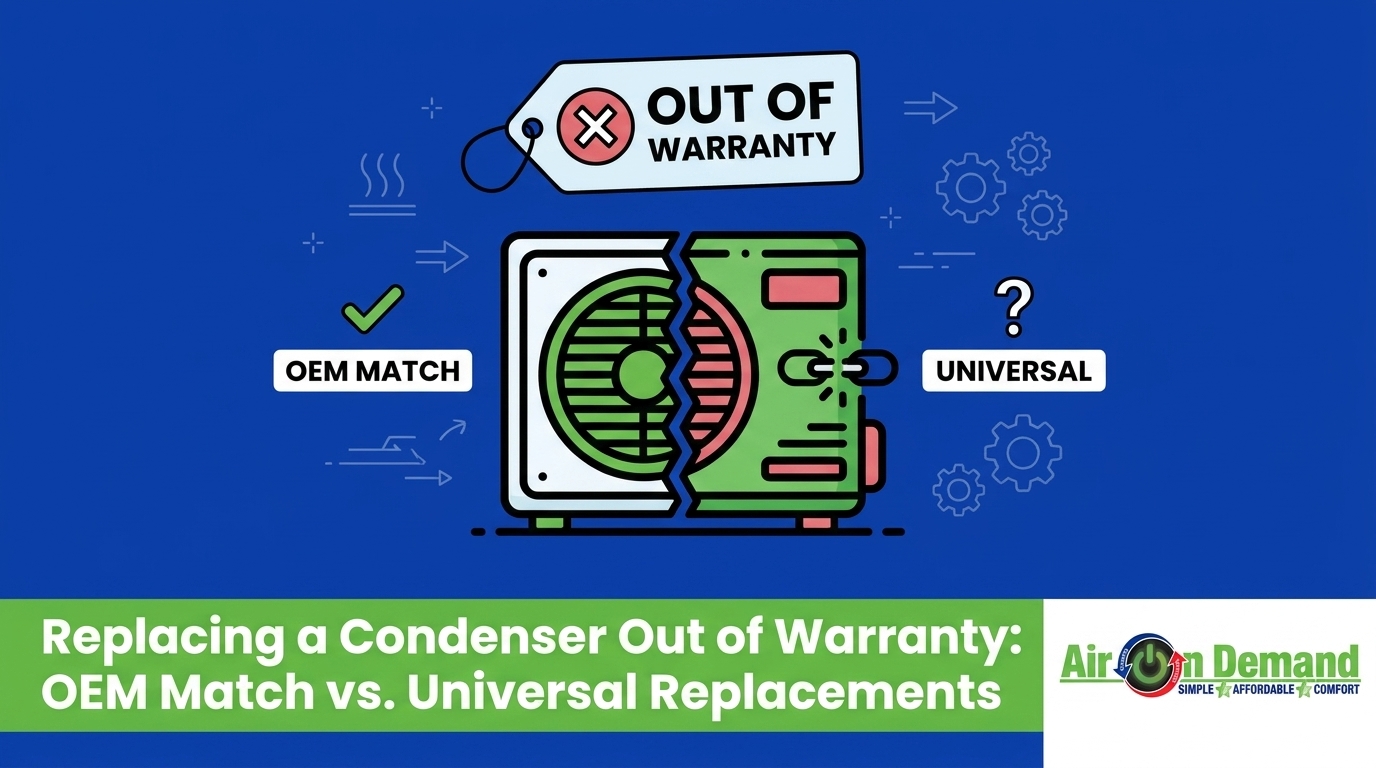
Replacing a Condenser Out of Warranty: OEM Match vs. Universal Replacements
August 17, 2026
Are you staring at a completely unresponsive outdoor AC unit, wondering how your household will survive the rest of the week? When you are suddenly faced with replacing a condenser out of warranty: OEM match vs. universal replacements is one of the most critical decisions you will have to make. A sudden equipment failure forces homeowners into a difficult position, especially when the breakdown occurs right in the middle of brutal August late-summer heat and humidity. Here in Miami, our team at Air On Demand sees this exact panic every back-to-school season. The immediate instinct is to find the fastest possible fix to restore comfort to your living space.
This urgency introduces a major dilemma: do you secure immediate cooling with a readily available third-party unit, or do you wait for an exact Original Equipment Manufacturer (OEM) match? While an off-the-shelf universal unit might seem like the perfect quick fix, this decision impacts far more than just your immediate comfort. It directly affects your long-term energy efficiency, your monthly utility bills, and the overall health of your entire HVAC system. Before committing to a major AC installation and replacement, it is essential to understand how these two distinct paths will perform over the next decade.
The short answer is yes, physically connecting a new outdoor unit to an existing indoor setup is possible, but the technical reality is much more complicated. Homeowners frequently ask our technicians, "Can you replace just the outside AC unit?" without realizing that a central air conditioning system is not a single appliance. It is a split system consisting of two highly interdependent halves: the outdoor condenser (which releases heat) and the indoor evaporator coil (which absorbs heat). When you pair a universal third-party condenser vs. existing OEM indoor coil, you are forcing two distinct pieces of engineering to work together.
A universal replacement refers to an off-brand or generic outdoor unit designed to be broadly compatible with various indoor setups. An OEM match, on the other hand, is an outdoor unit manufactured by the exact same brand, engineered specifically to communicate and cycle perfectly with your indoor equipment. While a technician can weld the copper lines and connect the electrical wiring between mismatched units, the internal components—such as the refrigerants, compressors, and metering devices—must communicate seamlessly to perform efficiently. When they do not, the entire system struggles.
To understand why mixing equipment is risky, you have to look at how these systems are designed. Indoor and outdoor units are engineered at the factory to share the exact same cooling load. The volume of refrigerant pumped by the outdoor compressor must perfectly match the expansion capacity of the indoor coil's metering device.
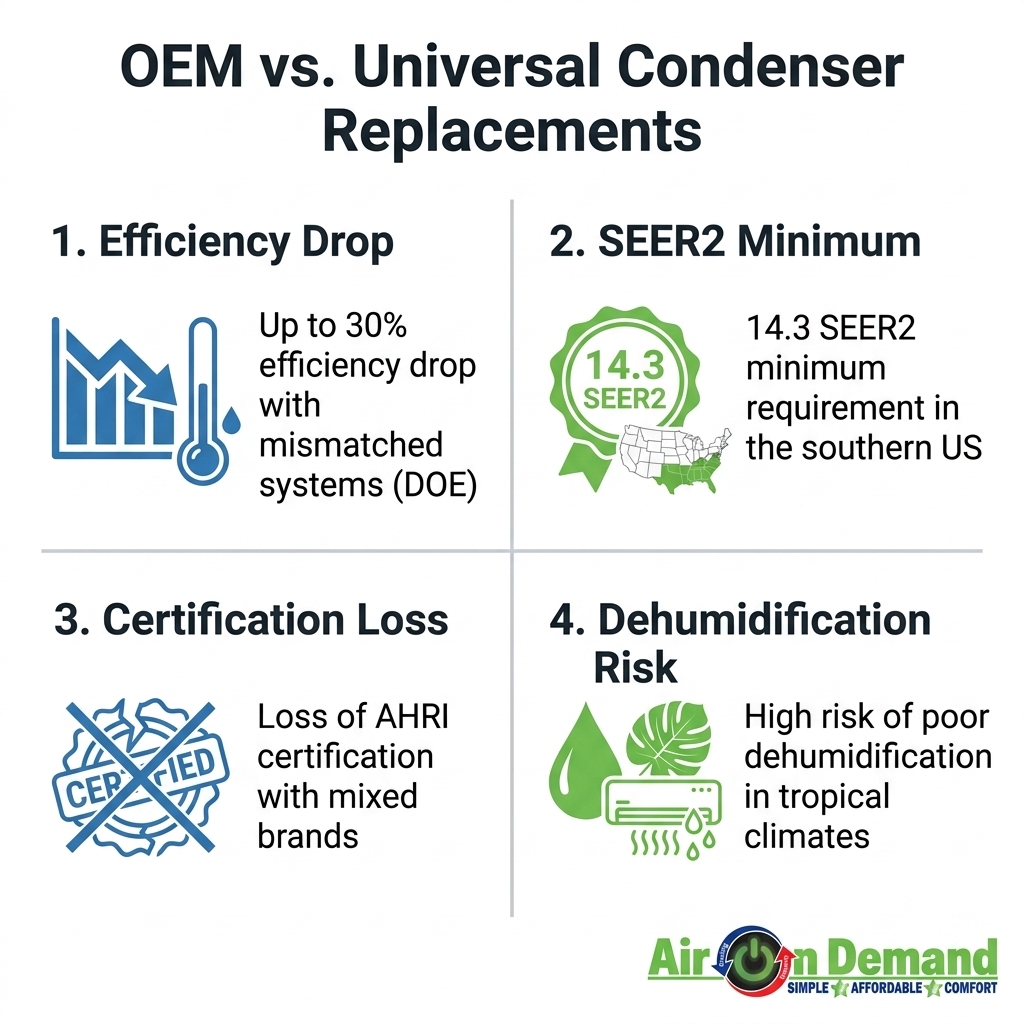
When you pair new, high-efficiency outdoor technology with an older, out-of-warranty indoor coil, the components often operate at different pressures and speeds. In our daily field experience across Miami, we frequently encounter the fallout from these mismatched setups. Furthermore, mismatched systems almost never achieve an AHRI (Air-Conditioning, Heating, and Refrigeration Institute) certification. Without this certification, there is no verified guarantee that the system will deliver the cooling capacity or energy efficiency promised on the box. Before deciding on this route, we highly recommend weighing the long-term impacts of an AC repair vs. replacement strategy that includes the entire system.
There is a reason why universal condensers remain a popular topic of discussion: availability. When an AC unit fails in the middle of a late-summer heatwave, waiting days or weeks for a specific OEM part to ship from a factory is incredibly frustrating. Universal units are often stocked locally in abundance, offering incredibly fast relief when a catastrophic breakdown occurs. However, prioritizing speed over compatibility introduces several significant risks that homeowners in Miami FL must carefully evaluate.
The primary risks of installing a universal third-party condenser include:
• Severe Efficiency Drops: According to data from the Department of Energy, improper component matching can reduce a system's overall efficiency by up to 30 percent. You might pay for a high-efficiency outdoor unit, but you will not reap the benefits.
• The "Lowest Common Denominator" Effect: When you pair a brand-new 15-SEER2 condenser with an older 10-SEER indoor coil, the system does not average the two ratings out. Instead, the system defaults to the lowest efficiency component, forcing your new equipment to underperform.
• Refrigerant Incompatibility: Older indoor coils were often designed to handle specific refrigerants and operating pressures. Forcing a modern condenser to pump newer refrigerants through an outdated, mismatched coil can lead to chronic freezing, poor cooling, or catastrophic compressor failure.
• Communication Failures: Modern HVAC systems use complex digital control boards to optimize cooling cycles. A universal outdoor unit lacks the proprietary software to "talk" to an existing OEM indoor air handler, resulting in basic, inefficient on/off cycling rather than nuanced climate control.
Choosing to install an exact OEM match is an investment in long-term performance, stability, and regulatory compliance. OEM components are engineered with proprietary communication protocols designed to optimize every single cooling cycle. When the outdoor compressor and the indoor air handler speak the same digital language, they can make micro-adjustments to airflow and refrigerant pressure in real time, drastically reducing energy consumption while maximizing comfort.
Regulatory Compliance and SEER2 Standards:
In 2023, the Department of Energy rolled out strict new regulations requiring a minimum efficiency rating of 14.3 SEER2 for any new air conditioning system installed in the southern United States. When you mix a universal third-party condenser vs. existing OEM indoor coil, it is practically impossible to verify that the hybrid system meets this mandatory federal standard. An exact OEM match guarantees that your system is AHRI-certified and fully compliant with regional energy codes.
Advanced Features Require Exact Matching:
Modern cooling technology relies heavily on advanced features like variable-speed compressors and multi-stage blowers. These features cannot function correctly if the outdoor unit is generic. As experts in top-tier cooling solutions, our team at Air On Demand understands that high-performance equipment—such as Daikin Fit systems—requires precise, uncompromising load-matching. By committing to an exact OEM match, you ensure that these premium systems can utilize their proprietary communication technology to deliver the exact efficiency and whisper-quiet operation they were designed for.
One of the most critical, yet frequently overlooked, aspects of HVAC performance is latent heat removal. Sensible cooling refers to simply lowering the temperature of the air (what you read on the thermostat). Latent cooling refers to the removal of moisture from the air (dehumidification). In a climate like ours, managing latent heat is just as important as dropping the temperature.
The Threat of the "Cold but Clammy" Home:
During peak August late-summer heat and humidity, extreme tropical moisture places maximum strain on an HVAC system's latent cooling capacity. When our technicians get called to homes that feel "cold but clammy," a mismatched universal condenser paired with an older indoor coil is often the culprit. The powerful new outdoor unit drops the indoor temperature rapidly, satisfying the thermostat in just a few minutes. Because the cycle shuts off so quickly, the indoor coil never has enough time to extract the heavy moisture from the air.
The Solution is Proper Load-Matching:
The result of a short-cycling mismatched system is a home that feels cold but incredibly clammy. High indoor humidity makes the air feel heavier, forces you to lower the thermostat even further, and creates an environment highly susceptible to indoor air quality issues. Proper OEM load-matching is the only way to ensure the system runs long enough, at the correct variable speeds, to pull that heavy tropical moisture out of your living space effectively.
Beyond daily performance and humidity control, mixing HVAC brands introduces significant secondary risks regarding manufacturer warranties and the overall longevity of your equipment. HVAC systems are significant investments, and protecting that investment should be a top priority for any homeowner in Miami FL.
Voided Existing Warranties:
If your indoor coil or air handler happens to have any remaining warranty coverage, installing a third-party universal condenser will almost certainly void it. We constantly remind our customers that manufacturers stipulate their equipment must be used with approved, matching components. If an older indoor coil fails after a universal outdoor unit is attached, the original manufacturer will likely deny the claim, citing improper installation and unauthorized equipment pairing.
Compromised New Warranties:
Furthermore, the manufacturer of the new universal condenser may not honor a full warranty if they determine the unit was installed with an incompatible or restrictive indoor coil. Mismatched systems inherently work harder to cool the home. The irregular refrigerant pressures and constant short-cycling lead to accelerated wear and tear on the new compressor. This added strain significantly reduces the overall lifespan of the equipment, turning a seemingly cheap, immediate fix into a costly long-term liability.
When synthesizing the core trade-offs, the decision ultimately comes down to short-term convenience versus long-term reliability. A universal unit offers the undeniable benefit of speed and immediate availability, which is highly tempting during a severe heatwave. However, the associated drops in efficiency, the loss of AHRI certification, the severe dehumidification issues, and the warranty complications often outweigh that initial convenience.
If you are evaluating a universal third-party condenser vs. existing OEM indoor coil, we highly advise consulting with our load-matching experts to evaluate the exact condition and specifications of your current setup before making a final call. Professional AC replacement services in Miami can provide an objective assessment of what your home truly needs to stay comfortable and efficient for the next ten to fifteen years.
• Efficiency Retention — Exact OEM Match: Operates at maximum advertised SEER2 rating. — Universal Third-Party Condenser: Defaults to the lowest efficiency of the older component (up to 30% loss).
• Dehumidification Capability — Exact OEM Match: Excellent; properly cycles to remove heavy moisture. — Universal Third-Party Condenser: Poor; prone to short-cycling, leaving the home cold and clammy.
• Warranty Preservation — Exact OEM Match: Fully protects new equipment warranties. — Universal Third-Party Condenser: Often voids remaining indoor warranties and limits new outdoor coverage.
• AHRI Certification Status — Exact OEM Match: Guaranteed certified and compliant with DOE regional standards. — Universal Third-Party Condenser: Cannot be certified; compliance with southern SEER2 minimums is unverified.
Making the right component match is absolutely critical for your long-term comfort, your monthly energy expenses, and the overall health of your HVAC system. While the panic of a sudden breakdown might push you toward the fastest available option, taking the time to ensure proper system compatibility will save you from years of high humidity, excessive energy bills, and premature equipment failure. Do not settle for a universal third-party condenser vs. existing OEM indoor coil without understanding the full scope of the risks involved.
If your outdoor unit has failed and you need objective, professional guidance, our team is here to help you navigate your options. We encourage you to reach out for a comprehensive evaluation of your current setup, including the intricacies of matching indoor air handlers with new Daikin condensers. Schedule an assessment today to ensure your home remains perfectly cooled and dehumidified for years to come.
Can I replace just my AC condenser?
Yes, it is physically possible to replace just the outdoor AC condenser while leaving the indoor coil in place. However, doing so requires absolute certainty that the new outdoor unit is fully compatible with the older indoor components in terms of refrigerant type, operating pressure, and capacity. Without an exact match, the system will suffer from reduced efficiency and potential mechanical failures.
Can you replace just the outside AC unit?
While you can replace just the outside AC unit, HVAC professionals strongly advise against mixing different brands or vastly different generations of equipment. The outside unit and inside coil are designed to work as a unified pair. Replacing only the outside unit often leads to a mismatched system that cannot achieve its advertised energy efficiency and may struggle to properly dehumidify your home.
Do I need to replace my indoor coil when I replace my condenser?
It is highly recommended to replace your indoor coil at the same time you replace your condenser. If your current indoor coil is out of warranty, older, or designed for a phased-out refrigerant, pairing it with a modern, high-efficiency condenser will severely limit the new unit's performance. Replacing both simultaneously guarantees AHRI certification and maximum energy savings.
What happens if you mix AC brands?
Mixing AC brands typically results in a loss of AHRI certification, meaning the system's efficiency and capacity can no longer be officially verified. Additionally, proprietary communication protocols between the thermostat, indoor air handler, and outdoor compressor will fail to sync. This lack of communication forces the system to operate poorly, often voiding manufacturer warranties in the process.
Will a mismatched AC system still cool my house?
A mismatched AC system will likely still blow cold air and lower the temperature in your house, but it will do so inefficiently. Because the components are not optimized to work together, the system will consume significantly more electricity to achieve the desired temperature. Over time, the added strain of this inefficiency will lead to accelerated wear and tear on the compressor.
How does an unmatched AC condenser affect indoor humidity?
An unmatched AC condenser often cools the indoor air much faster than the older indoor coil can process, leading to a phenomenon known as short-cycling. Because the system turns on and off so rapidly, the indoor coil does not have enough time to extract latent heat (moisture) from the air. This leaves the home feeling cold but uncomfortably clammy and humid.