Stop Burning Cash with High Efficiency Cooling
August 17, 2026
Understanding how high efficiency systems reduce summer costs starts with one simple idea: they do the same job as a standard AC — keeping your home cool — while using dramatically less electricity to get there.
Here's a quick snapshot of the core ways high-efficiency systems cut your summer bills:
• Lower energy consumption — High-efficiency units can save 30% or more on monthly cooling costs compared to older, standard systems
• Fewer daily cycles — Variable-speed compressors run 3–8 cycles per day instead of 10–12, reducing costly power spikes
• Lower startup wattage — High-efficiency units ramp up at 2,000–3,000 watts vs. 4,000–6,000 watts for standard units
• Better dehumidification — Superior moisture removal lets you feel comfortable at higher thermostat settings, which directly lowers runtime
• Less wasted air — Modern systems work better with sealed ducts, meaning the cool air you pay for actually reaches your rooms
In South Florida — from Coconut Grove and Coral Gables to Kendall and Palmetto Bay — air conditioning isn't a seasonal luxury. It runs almost every day of the year. And because AC typically accounts for 40% to 70% of a summer electricity bill, even modest efficiency improvements translate into real, recurring savings month after month.
If your system is more than 10–15 years old, there's a good chance it's quietly draining your wallet every time it kicks on. The rest of this guide breaks down exactly how high-efficiency technology works, what the numbers actually look like for a South Florida home, and what you can do right now to stop leaving money on the table.
When we talk about high-efficiency systems, we aren't just talking about "newer" models. Efficiency is a specific engineering standard. In HVAC, this is primarily measured by the Seasonal Energy Efficiency Ratio (SEER), or the updated SEER2.
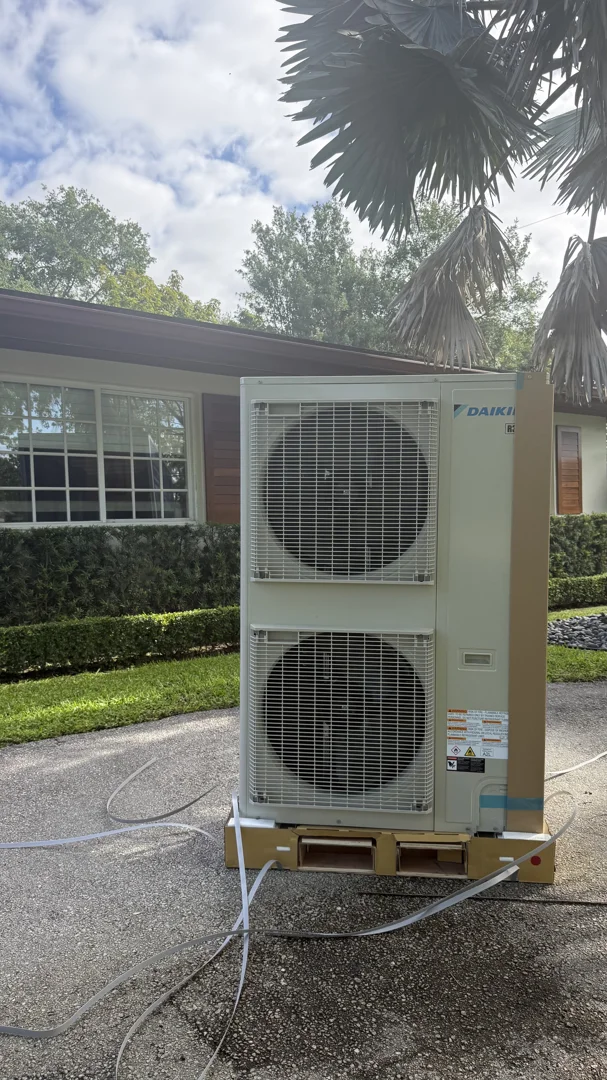
To put it simply, SEER is like the "miles per gallon" for your air conditioner. It measures the cooling output divided by the energy consumed. As of 2026, a unit is generally considered high-efficiency if it has a SEER2 rating of 16 or higher. Some ultra-efficient models, like those using Daikin’s inverter technology, can reach ratings of 20 or even 22.
Key components that define these systems include:
1. Variable-Speed Motors: Unlike older units that are either "100% on" or "100% off," variable-speed motors adjust their output to meet the exact cooling needs of your home in real-time.
2. Advanced Inverter Technology: This allows the system to ramp up slowly rather than hitting the power grid with a massive surge every time it starts.
3. Energy Star Certification: We always look for the blue What the Energy Star Means for Air Conditioning label, which signifies the unit meets strict EPA guidelines for energy savings and performance.
Understanding these AC Installation Tip: Efficiency Ratings is the first step toward reclaiming your summer budget.
Living in places like Country Walk or Homestead, we know the "summer" bill isn't just a July problem; it’s a May-through-October problem. Because our cooling systems work harder and longer than almost anywhere else in the country, the ROI on efficiency is much faster here.
Research shows that high-efficiency AC systems can save a minimum of 30% on your monthly electricity bill. In many cases, especially when jumping from an old SEER 10 or 12 unit to a modern SEER 18+ system, those savings can skyrocket to 44%.
Let’s look at how this impacts a typical 2,000-square-foot home in Kendall or Coral Gables:
• Standard/Older Unit (SEER <14): Monthly summer cooling cost might average $180.
• High-Efficiency Unit (SEER 16+): Monthly summer cooling cost drops to approximately $100.
That is an $80 savings every single month. Over a five-year period, that’s $4,800 back in your pocket — essentially paying for a significant portion of the system itself. This is how high efficiency systems reduce summer costs so effectively; they turn a monthly expense into a long-term investment.
It is also important to recognize How an Older Air Conditioner Tanks Your Energy Efficiency. As parts wear down, motors struggle, and coils get dirty, an old unit can use 15% to 20% more energy than it did the day it was installed. If you’re seeing consistent spikes, there are 4 Things Your Energy Bills Can Tell You about the health of your system and why it might be time for an upgrade.
You might have heard the term "SEER2" recently. This updated testing standard was introduced by the Department of Energy to better reflect real-world conditions, such as the external pressure found in home ductwork.
As of 2025, SEER 16 is the minimum acceptable rating to be considered "energy certified." When we help homeowners in Pinecrest or Palmetto Bay choose a system, we often explain What is SEER2 and Why it Impacts Your Next AC Replacement. Choosing a higher rating isn't just about being "green"; it’s about "staying ahead of the game" as energy costs continue to rise.
If you are wondering Which Air Conditioner is the Most Efficient, the answer usually lies in units with "Inverter" compressors. These units don't just shut off; they slow down to a crawl, maintaining a steady temperature and preventing the expensive "on-off" cycles that eat up electricity.
In South Florida, "it's not the heat, it's the humidity" is a cliché for a reason. High humidity makes 78 degrees feel like 85. Standard AC units often cool the air so quickly that they shut off before they’ve had a chance to remove enough moisture. This leaves you feeling clammy and prompts you to "crank down" the thermostat even further.
High-efficiency systems are specifically Which Air Conditioner is Best for Warm Climates because their variable-speed fans run for longer, slower cycles. This provides superior dehumidification. When the air is dry, you can comfortably set your thermostat to 78°F instead of 72°F. Since each degree you raise the thermostat can save you 6% to 10% on your bill, the humidity control alone is a massive cost-saver.
The "secret sauce" of a high-efficiency unit is how it manages power during startup and operation. Standard units are like a car that can only go 0 or 100 mph. High-efficiency units are like a modern car with a smooth transmission.
One of the biggest energy drains is "startup wattage." It takes a massive surge of electricity to get a heavy compressor motor moving. High-efficiency systems use "soft-start" technology to ramp up slowly.
• Startup Wattage — Standard AC Unit: 4,000 – 6,000 Watts — High-Efficiency AC Unit: 2,000 – 3,000 Watts
• Daily Cycles — Standard AC Unit: 10 – 12 per day — High-Efficiency AC Unit: 3 – 8 per day
• Daily Energy Use — Standard AC Unit: ~72,000 Watts — High-Efficiency AC Unit: ~24,000 Watts
• Blower Motor — Standard AC Unit: Fixed Speed (On/Off) — High-Efficiency AC Unit: Variable Speed (Modulating)
By reducing the number of daily cycles from 12 down to as few as 3, these systems eliminate the most expensive part of AC operation: the startup surge. This is a primary reason why we recommend that homeowners Install a High Efficiency AC System This Time Around.
Furthermore, when you look at What are the Benefits of Trane Air Conditioning or Daikin systems, you see that they are built to last longer. Because they aren't constantly slamming on and off, there is less mechanical wear and tear on the compressor and fan motor, leading to lower repair costs over the life of the unit.
Even the most efficient system in the world will struggle if your home is "leaking" cold air. To truly understand how high efficiency systems reduce summer costs, you have to look at the whole home as an ecosystem.
In many homes in Cutler Bay or Lakes By The Bay, ductwork runs through a scorching hot attic. If those ducts have small leaks or disconnected joints, you could be losing 20% or more of your cooled air before it ever reaches your living room. Sealing your ducts ensures that the high-efficiency air you’re paying for actually stays inside.
A neglected system can use 15% to 20% more energy than a well-maintained one. We always emphasize Miami Air Conditioning Installation Tip: Why SEER matters, but maintenance is what keeps that SEER rating high.
• Clean Coils: Dirty coils force the system to run longer to achieve the same cooling.
• Filter Management: A clogged filter blocks airflow, making the motor work overtime. We recommend checking filters every 30 days during the peak South Florida summer.
• Professional Tune-ups: Our technicians check refrigerant levels and electrical connections to ensure peak performance.
Don't forget the "envelope" of your home. Using weatherstripping around doors in Coral Gables or adding attic insulation in Homestead can reduce the total "load" on your AC. When the house stays cool longer, the AC doesn't have to work as hard, further driving down those summer costs.
If your current AC is between 10 and 15 years old, it is likely a candidate for replacement. In South Florida, the salt air and constant runtime mean systems age faster than in other climates. If you notice your energy bills climbing even with regular maintenance, or if you’re facing a repair that costs more than 50% of a new unit, upgrading to a high-efficiency system is a smart financial move.
Most South Florida homeowners see a minimum reduction of 30%. However, if you are upgrading from a legacy unit (SEER 10 or 12) to a modern SEER 18 or 20 unit, you can cut your cooling costs by up to 44%. For a home that typically spends $250 a month on cooling, that’s a savings of over $100 per month.
No, they require the same annual professional tune-up and regular filter changes as any other unit. However, because they use advanced components like variable-speed motors and sensors, it is even more important that the person servicing them is a trained professional who understands the technology. Keeping the system clean is vital to protecting your investment and maintaining those high-efficiency ratings.
At Air On Demand, we’ve spent years helping our neighbors in Coconut Grove, Palmetto Bay, and across South Florida navigate the heat without breaking the bank. As a Daikin specialist, we take pride in offering some of the most advanced, energy-efficient solutions on the market today.
Whether it’s the peace of mind provided by a 12-year parts warranty or the immediate relief of a lower utility bill, the move to high-efficiency cooling is one of the best upgrades you can make for your home. Don’t let another summer of record-breaking heat drain your savings.
Ready to see how much you could save? Schedule your professional AC maintenance today or contact us to discuss which high-efficiency system is the perfect fit for your South Florida home. From Pinecrest to Country Walk, we are here to keep you cool for less.