
Do Health Smart Filters Restrict Airflow on Variable-Speed Blowers?
August 17, 2026
Do Health Smart filters restrict airflow on variable-speed blowers? Yes, Health Smart and high-MERV filters can restrict airflow, causing variable-speed (ECM) blowers to ramp up their RPMs to compensate. This creates a very common dilemma for homeowners: deciding whether the indoor air quality benefits of upgrading to hospital-grade filtration outweigh the risks of increased noise and potential wear on a modern HVAC system.
When you install a dense, high-efficiency filter in a standard one-inch slot, you are placing a significant roadblock in front of your system's air supply. A Communicating ECM (Electronically Commutated Motor) is incredibly smart. It will sense this restriction and automatically compensate to maintain the required airflow. However, this mechanical effort comes at the cost of increased operational noise, higher energy consumption, and added strain on the motor if the filter isn't properly sized for your ductwork.
For professional guidance on integrating high-efficiency air filtration systems without damaging your equipment, upgrading your air conditioner filters in Miami requires expert air balancing.
To understand why your system gets louder when you use a dense filter, you have to look at how modern blower motors are engineered. A Communicating ECM (Electronically Commutated Motor) is essentially a programmable, intelligent fan. It is designed to deliver a very specific volume of air, measured in Cubic Feet per Minute (CFM), regardless of the conditions inside your ductwork.
When you slide a restrictive filter into the return grille or air handler, the motor immediately detects a drop in airflow. Because its primary directive is to maintain that programmed CFM, the ECM responds by increasing its RPMs (Revolutions Per Minute) and pulling more electrical wattage to force air through the dense media. This mechanical compensation is exactly why homeowners notice a sudden, distinct increase in operational noise—often described as a loud rushing or whistling sound—right after installing a new high-efficiency filter.
Older, standard blower motors—known as Permanent Split Capacitor (PSC) motors—react very differently to restrictive filters. Comparing the two highlights why variable-speed systems require much more careful filter selection.
• Standard PSC Motor — Reaction to Restrictive Filters: Loses power and simply blows less air through the vents. — Noticeable Symptoms: Weak airflow at the registers, longer cooling cycles, uneven room temperatures.
• Communicating ECM — Reaction to Restrictive Filters: Ramps up RPMs and wattage to overcome the restriction. — Noticeable Symptoms: Loud rushing noises, whistling return grilles, higher energy bills.
The bottom line: While older motors just give up and blow weaker air, an ECM will fight the restriction. If you have modern variable-speed air handlers, they will work themselves to the point of exhaustion trying to pull air through a suffocating filter.
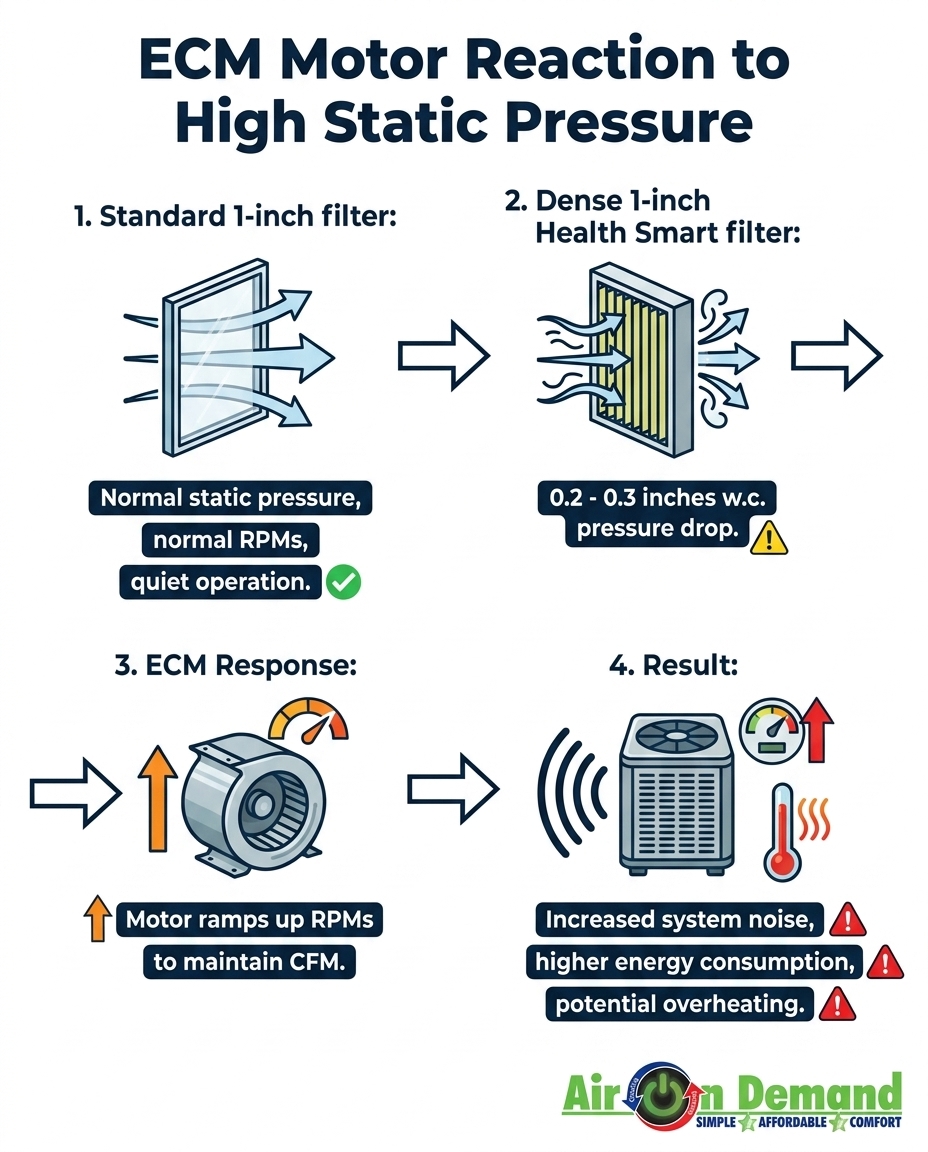
The core issue with high-efficiency filters comes down to a physics concept called static pressure. In simple terms, static pressure is the resistance to airflow within your HVAC system. Think of it like blood pressure for your air conditioner: if the resistance is too high, the heart (the blower motor) has to work dangerously hard to keep things circulating.
Most residential HVAC systems are designed to operate at a Total External Static Pressure (TESP) of about 0.5 inches of water column (w.c.). When you install a dense, 1-inch high-efficiency filter, that single component can create a massive initial pressure drop—often between 0.2 and 0.3 inches w.c. right out of the package. This consumes up to 60% of the system's total allowable resistance before the air even travels through the ductwork, the cooling coil, or the supply registers.
Filters are graded on the Minimum Efficiency Reporting Value (MERV) scale. Standard fiberglass filters are usually MERV 1 to 4, designed only to protect the equipment from large dust bunnies. "Health Smart" or hospital-grade filters typically boast a MERV 13+ rating.
To achieve a MERV 13 rating, the filter media must be woven from incredibly dense fibers packed tightly together to trap microscopic particles like pollen, pet dander, and smoke. The issue isn't the filtration quality itself; the problem is trying to force a massive volume of air through a narrow 1-inch depth of this dense material. When evaluating Health Smart filters for South Florida, it becomes clear that a standard 1-inch slot simply does not provide enough surface area for air to pass through a MERV 13 media without severe restriction.
Signs your filter is causing high static pressure:
• Whistling noises: Air squeezing through tiny gaps around the filter frame.
• Bowed filter frames: The blower is pulling so hard it physically bends the cardboard filter frame inward.
• Excessive heat: The blower motor housing feels unusually hot to the touch due to overexertion.
• Frequent cycling: The system overheats and shuts down prematurely on its internal safety limits.
If you are evaluating Health Smart filters for South Florida, understanding this static pressure drop is the first step to protecting your equipment.
Airflow restriction does more than just strain the blower motor; it directly impacts the air conditioner's ability to cool and dehumidify your home. This is especially critical in regional climates that experience extreme moisture loads. Proper volumetric airflow over the indoor evaporator coil is absolutely essential for the air conditioner to extract moisture from the indoor air.
In Miami's extreme relative humidity, unhindered airflow is mandatory to properly dehumidify the home without freezing the coil. The cooling process works by passing warm, humid indoor air over a freezing-cold evaporator coil. The heat is absorbed by the refrigerant, and the moisture condenses into water droplets that drain away. However, this delicate heat exchange requires a very specific volume of air moving at a very specific speed.
When a restrictive Health Smart filter slows down the airflow, there is not enough warm air passing over the evaporator coil to keep it above freezing. As a result, the temperature of the coil plummets. The condensation that normally drips down the drain pan begins to freeze directly onto the metal fins.
Once a thin layer of ice forms, it creates an insulating barrier that further blocks airflow, causing the ice to grow rapidly until the entire coil is encased in a solid block of ice. A frozen coil completely halts the cooling process. Even worse, because the refrigerant is no longer absorbing heat, it can travel back to the outdoor compressor in a liquid state rather than a gas. This is called "liquid slugging," and it can instantly destroy the compressor—the most expensive component in your entire system.
The stress placed on a variable-speed blower motor by a restrictive filter is not static; it compounds over time. Introducing a high-static-pressure variable into your system is risky at any time, but doing it during periods of extreme weather amplifies the danger significantly.
Consider the cumulative thermal stress on HVAC components after months of heavy operation. By the time August / late-summer peak AC usage arrives, your system has likely been running for hundreds of hours. Electrical components like capacitors, contactors, and the ECM control module have been subjected to constant heat and vibration. The motor is already operating at its maximum thermal capacity just dealing with the ambient heat load of the home.
When an ECM motor is forced to work against a restrictive filter during this late-summer peak AC usage, it is at its highest risk for premature failure. The motor is running longer cycles to combat the extreme heat, and it is ramping up to higher RPMs to fight the filter restriction. This double-duty creates excessive heat within the motor housing, degrading the electrical insulation and shortening the lifespan of the bearings.
Because of this cumulative stress, it is highly unadvisable to upgrade to dense, high-MERV filters during the hottest, most demanding months without a professional assessment. If you are scheduling routine AC maintenance, that is the perfect time to have a technician measure your airflow before changing filter types.
The good news is that homeowners do not have to choose between breathing clean air and maintaining a quiet, healthy HVAC system. You can achieve hospital-grade indoor air quality without suffocating your variable-speed blower, provided the system is modified correctly.
The primary solution is modifying the filter depth. If a 1-inch MERV 13 filter creates too much resistance, the answer is to increase the surface area of the filter media. This is achieved by upgrading to a 4-inch or 5-inch media cabinet installed directly into the ductwork next to the air handler.
• 1-Inch Health Smart (MERV 13) — Surface Area: Very low (tightly packed pleats). — Static Pressure Impact: High restriction; forces ECM to ramp up. — Replacement Frequency: Every 30 to 60 days.
• 4-Inch Media Cabinet (MERV 13) — Surface Area: Very high (deep, wide pleats). — Static Pressure Impact: Low restriction; allows ECM to run quietly. — Replacement Frequency: Every 6 to 12 months.
A 4-inch filter has deep pleats that unfold to reveal massive amounts of surface area. This allows the filter to trap microscopic particles just as effectively as a 1-inch filter, but with plenty of room for the air to flow freely around the captured debris. The static pressure drops significantly, allowing the Communicating ECM (Electronically Commutated Motor) to operate at a lower, quieter RPM.
However, modifying ductwork and installing media cabinets requires precision. Air On Demand's technical expertise with advanced Daikin systems and precise air balancing ensures that any filtration upgrade is perfectly matched to your equipment's capabilities. A licensed professional must measure the Total External Static Pressure (TESP) with a digital manometer before and after any filter changes. This scientific measurement is the only way to guarantee that the ECM motor is operating within safe parameters and that your indoor air quality upgrade won't result in a system breakdown.
Yes, if the filter creates too much static pressure for the ductwork design, it can cause severe wear on the motor. The ECM blower is programmed to maintain a specific airflow, so it will overwork itself to pull air through the dense material. Over time, this constant overexertion leads to overheating, degraded bearings, and premature failure of the motor module.
The ECM blower is ramping up its RPMs to pull air through a more restrictive material. When you install a dense filter, you are effectively choking the system's air supply. Compare it to breathing through a straw—the system has to work much harder, and significantly louder, to get the same amount of air it was getting before.
A filter that balances high particle capture with low static pressure drop is always the best choice. For variable-speed systems, deep-pleated media cabinets (4 to 5 inches thick) are generally best because they offer massive surface area. This allows them to capture fine dust and allergens without suffocating the blower motor.
In a standard 1-inch filter slot, a MERV 13 filter often restricts airflow significantly and pushes the static pressure beyond safe limits. The dense fibers required to achieve that rating leave very little room for air to pass. However, MERV 13 filtration is easily achievable and safe if the filter surface area is expanded via a thicker, multi-inch media cabinet.
Yes, and it is highly recommended if your ductwork can accommodate the modification. A 4-inch filter has exponentially more pleated surface area than a standard 1-inch filter. This structural advantage allows it to trap microscopic particles efficiently without choking the blower, keeping your system quiet and efficient.
Symptoms include increased blower noise, whistling return grilles, hot motor housings, and frozen evaporator coils. While these signs point to an airflow restriction, the only definitive way to know your exact static pressure is by having an HVAC technician measure it. A professional will use a tool called a manometer to test the pressure before and after the filter to ensure safe operation.
Achieving hospital-grade air quality shouldn't come at the expense of a noisy, overworked blower motor. While it is true that dense filters can restrict airflow on variable-speed blowers, the issue is almost always a matter of sizing and surface area rather than the filtration quality itself. Your Communicating ECM (Electronically Commutated Motor) is a highly efficient piece of technology, but it needs room to breathe to operate quietly and reliably.
Before you introduce a high-restriction variable into your HVAC system—especially during the heat of the summer—we highly encourage you to seek a professional static pressure measurement. By upgrading to a properly sized media cabinet, you can enjoy pristine indoor air without putting your equipment at risk. Contact a local indoor air quality expert today to schedule an inspection and find out the safest way to upgrade your home's filtration.